Food for Agile Thought’s issue #142—shared with 17,322 peers—covers corporate innovation failure patterns, dives into flow metrics for Scrum, and asks: does more planning make the team more successful?
We also shed light on systemic issues that may trigger bad behavior in people and try to understand better whether design thinking is indeed “BS.” (Some do not think so, a Danish toy manufacturer, for example, check their case study on running design thinking at scale.)
Lastly, we like to invite you to participate in the Scrum Master Trends Survey 2018 — a joined-venture of Scrum.org and Age of Product.
Food for Agile Thought’s issue #141—shared with 17,129 peers—analyzes why ‘agile’ is the most important social technology since Taylorism. Although, the proxy discussion of ‘outcome vs. output’ raging in many organizations signals that organizational debt is still a wide-spread issue.
We also cover the latest opportunities that innovative technology provides—unless your organization suffers from the not-invented-here syndrome, of course. (We also feature a list of 50 epic corporate innovation failures.)
Lastly, we get into the trenches and ask: why should teams not select themselves?
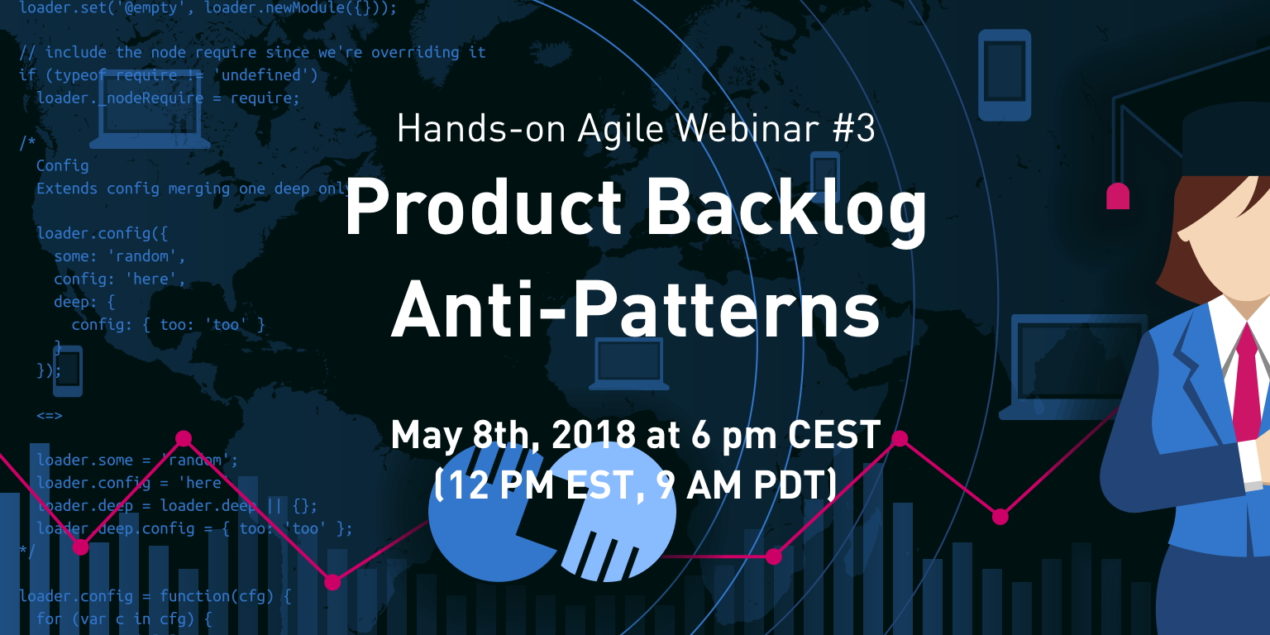
The third Hands-on Agile webinar product backlog anti-patterns covers common problems from out-dated and oversized tickets to the part-time proxy product owner and his or her idea repository. Learn more about the numerous product backlog anti-patterns that can manifest themselves when you try to create value for your customers and your organization.
TL;DR: Webinar Product Discovery Anti-Patterns — April 10th, 2018
Scrum has proven to be a practical product delivery framework for digital products like applications or apps. However, Scrum is equally suited to build the wrong product efficiently as its Achilles heel has always been the product discovery part. What product discovery part, you may think now. And this is precisely the point: The product owner miraculously identifies the best way to proceed as a team by gating and prioritizing the product backlog is. How that is supposed to happen is nowhere described in the Scrum Guide. Consequently, when everyone is for himself, product discovery anti-patterns emerge. I believe it is time to address this issue with the webinar product discovery anti-patterns.
From sunk costs, HIPPO-ism, my-budget-my-features to self-fulfilling prophecies — learn more about the numerous product discovery anti-patterns that can manifest themselves when you try to fill Scrum’s product discovery void.
Food for Agile Thought’s issue #140—shared with 16,912 peers—dives into making smart decisions (under uncertainty) and feels with the agile hero of Greek-style transition tragedy. (To counter this possibly frustrating reading experience, we also feature the thoughts of a CEO how to transition in the right way.)
We also analyze the universe of “minimum viable [add something of your choice here],” and we look beyond the traditional NPS metric to define customer success—there is more out there.
Lastly, we get a better understanding of why so many organizations excel at optimizing one thing incrementally and utterly fail at anything innovative. (Are organizations thus probably damned to keep the problem alive they wanted to fix initially?)
Food for Agile Thought’s issue #139—shared with 16,718 peers—reports on Haier’s organizational principles that encourage self-organization and entrepreneurship lifting the company at one level with Zappos, Patagonia or Semco.
We also analyze how fear prevents psychological safety, we address the metrics fetish and learn why even these fail to avoid sunk costs in product development.
Lastly, we ask: Is the manifesto of agile software development in need of an overhaul?