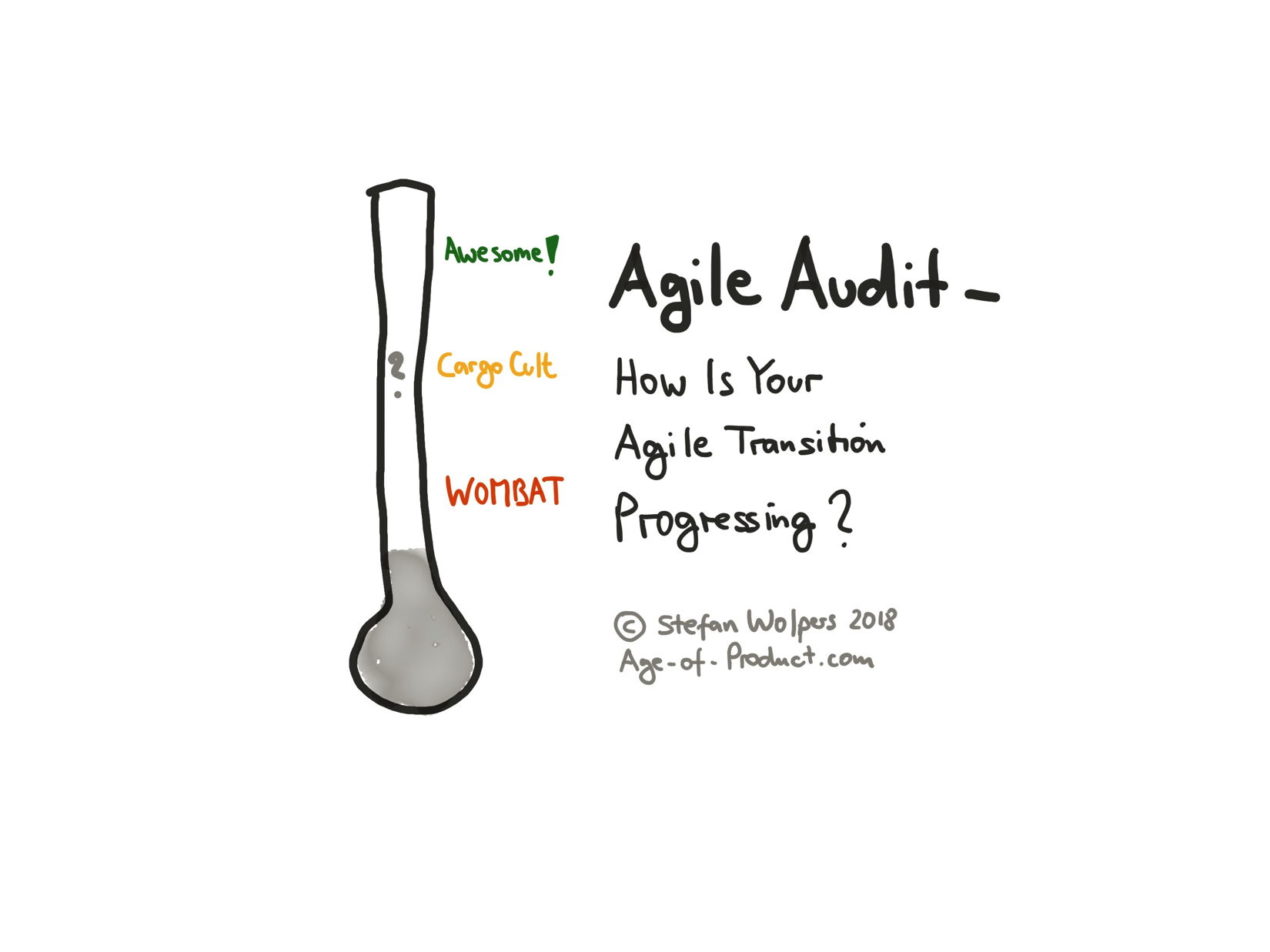
Supposedly, becoming agile is a journey, not a destination. This is a convenient narrative if the viability of your consultancy depends on selling men and materiel. The fuzzier the objective of an agile transition the less likely there will be an agile audit addressing the return on investment question the customer might have.
Moreover, a fuzzy objective such as ‘we want to become an agile organization’ is probably the reason for applying the same methodologies indiscriminately to every organization—a one size fits all approach for agile transitions.
However, what if not every organization embarking on a transition to agile practices is meant to become a teal organization or a holacracy? What if being late to the agile transition party is instead a deliberate choice than a manifestation of hubris, ignorance or leadership failure?
Read more on why feedback loops in the form of an agile audit are beneficial for organizations and teams alike.
Food for Agile Thought’s issue #130—shared with 14,911 peers—covers once more the corporate agile failure at legacy organizations. We like the guide to suitable agile metrics by XSCALE Alliance’s Leon Tranter, and we deal with how to scale and align a growing engineering team.
We then dive deep into the psychology of creating products: from confirmation bias, Kahneman’s systems 1 and 2, the benefits of listening to talking, persuasion techniques, to 25 cognitive biases.
Lastly, we remember the project management nightmare called ‘waterfall.’
Food for Agile Thought’s issue #129—shared with 14,709 peers—covers mental models relevant to your agile journey and shares the download link to an excellent book on team-centric agile software development. (Yub, it is free of charge.)
We then dive into organizational resilience through business agility, what your stakeholders want to know regarding your product roadmap, and why loving your customers’ problems will make your life so much easier.
Lastly, Intercom’s VP of Product created an overview what product people with an agile mindset can expect from the organization. (And the good folks at Intercom are checking a lot of the right boxes!)
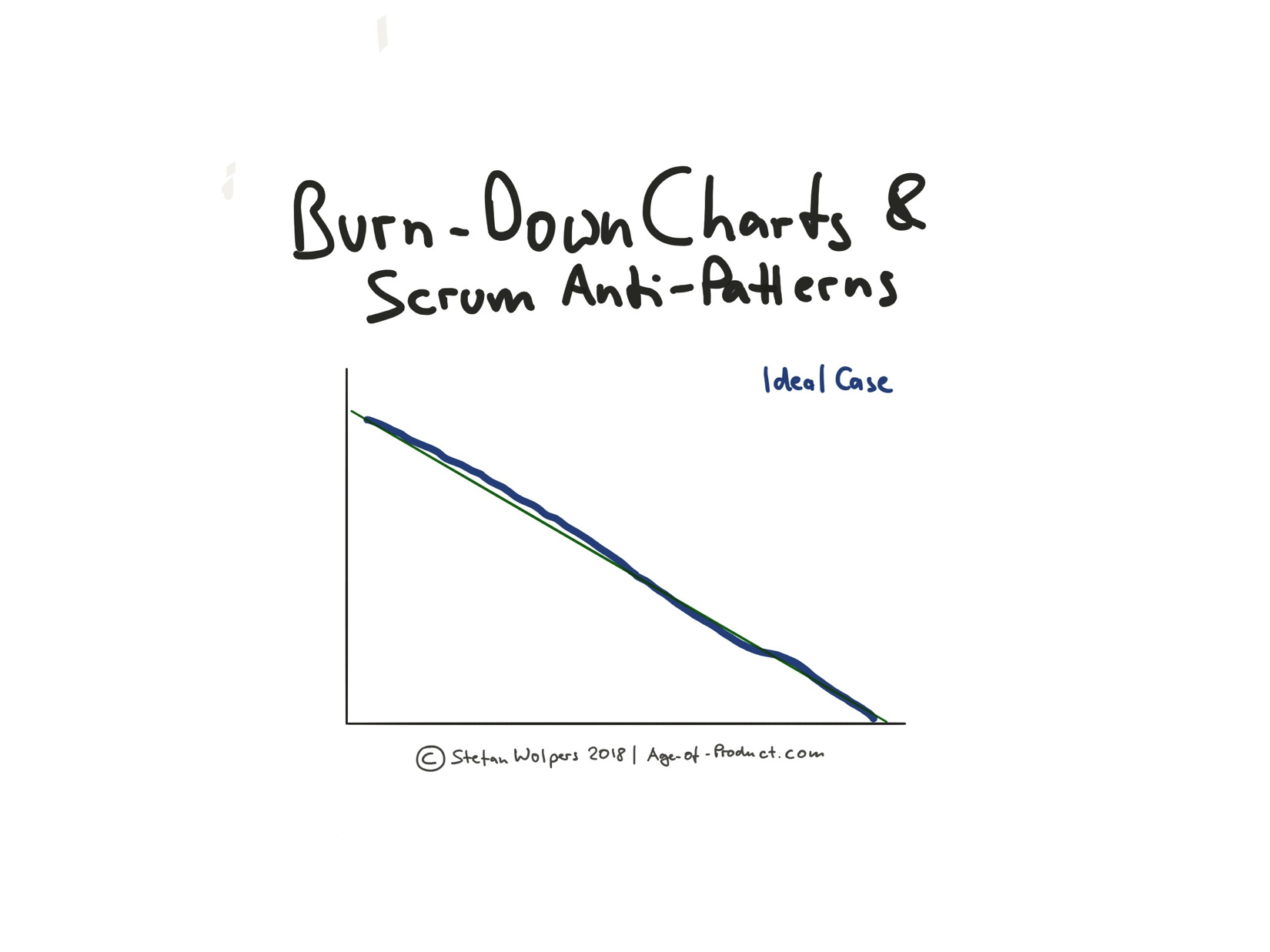
TL;DR: Use Burn-Down Charts to Discover Scrum Anti-Patterns
A burn-down chart tracks the progress of a team toward a goal by visualizing the remaining work in comparison to the available time. So far, so good. More interesting than reporting a status, however, is the fact that burn-down charts also visualize Scrum anti-patterns of a team or its organization.
Learn more about discovering these anti-patterns that can range from systemic issues like queues outside a team’s sphere of influence and other organizational debt to a team’s fluency in agile practices.
Food for Agile Thought’s issue #128—shared with 14,506 peers—covers disrupting companies—seven habits that make any organization highly vulnerable—, Jeff Sutherland’s new framework to scale scrum, and the movements that inspire the future of work.
We then dive into the advantages of autonomous product teams and learn that a bug-free product is not necessarily a sign of a quality mindset.
Lastly, if your stakeholders believe your team is a black box, why not build an information radiator? C. Kyle Jacobsen can help you with that.
Food for Agile Thought’s issue #127—shared with 14,292 peers—covers useless agile metric; we learn common excuses why continuous delivery would not work, and how to organize a big room planning.
We then talk about signs of toxic team culture, how design thinking, agile and lean fit together, and what to do when a team fails to deliver at the end of a sprint.
Lastly, we learn why experiments do not just happen to the best organizations but perhaps create them, and what product thinking has to do with it.