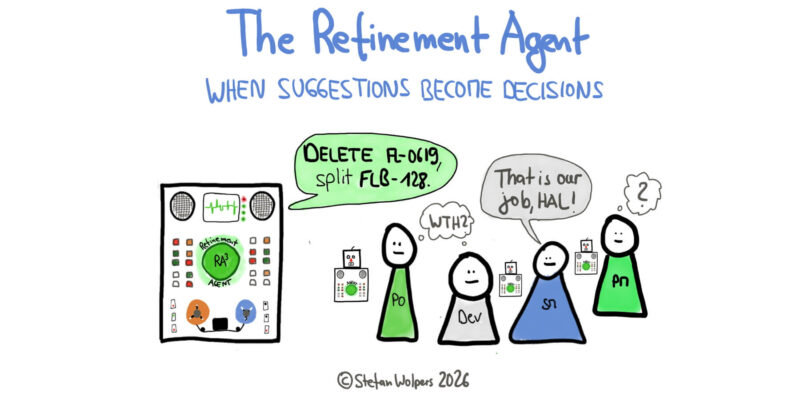
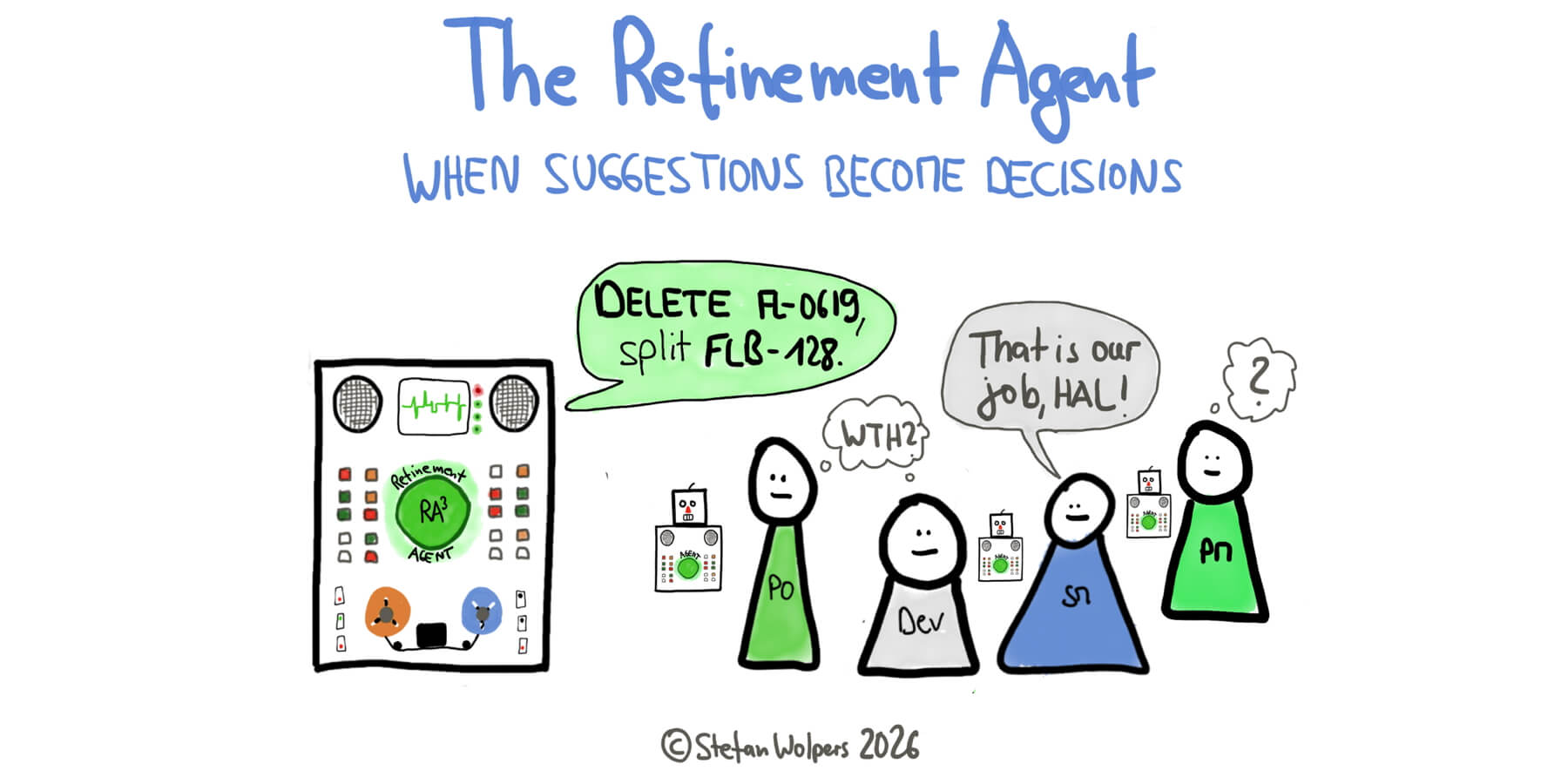
TL; DR: The Product Backlog Refinement Agent and the Risk When a Suggestion Becomes a Decision
Preparing a refinement session is tedious, and AI is good at the tedious part: reading every Product Backlog item, every repeated comment column, and the team’s own records on the afternoon before. The risk sits elsewhere. A refinement agent asked to “help with refinement” can take the conversation away from the team without writing a single acceptance criterion: “suggesting” to the Product Owner or Product Manager which items to close, merge, split, or create is enough, and the questions the team was supposed to work out arrive in the brief already answered.
The remedy is a boundary decided before the first run: the agent marks evidence and asks questions, the Product Owner checks the brief and sets the agenda, and the team refines. Writing that boundary into an A3 Handoff Canvas, together with what the agent reads and who checks its output, turns a good intention into a rule the agent follows and the Product Owner can verify.
Thesis: This article explains how Product Owners and Product Managers can use AI to prepare Product Backlog refinement without pre-empting the team’s conversation: four evidence checks, a four-part test separating suggestions from decisions, written boundaries, and human verification of the agent’s brief.
Disclaimer: I read Charniak/McDermott’s book on “Artificial Intelligence” decades ago; of course, I use AI for research, translations, proofreading, challenging story arcs and article structures, creating artifacts such as graphics, and summarization. It is a production tool, not a substitute for thinking.
🎓 🇬🇧 The AI4Agile Online Course v4 — November 27, 2026, at $149 — Join the Waitlist
Sooner or later, a CFO will ask what your AI use actually returns. “It saves me time” will not survive that meeting.
The first wave of AI adoption rewarded practitioners who learned to prompt. That skill still matters, and this course still teaches it. The second wave rewards something rarer: people who can turn individual AI use into knowledge that survives departures, spend that can be explained and steered, and output that organizations can trust. That work is process design and change management. You have been doing both for years, on harder problems than this.
EXCLUSIVE: The new A3 Delegation Lifecycle System with seven ready-to-use templates, from the AI Workflow Inventory to the AI Definition of Done to the AI Working Agreement, to make sense of delegating work to AI models.
BRAND-NEW: Hands-on exercises to build AI Agents, with your tactical work, covering, for example, Jira-based stakeholder reports, product discovery, AI Impact on metrics, or preparation for backlog refinement. All exercises use realistic data and context to simulate reality as closely as possible in a fail-safe environment.
The AI 4 Agile Online Course v4 is in English. 🇬🇧
What You Will Get:
✅ 20+ hours of self-paced video modules ✅ 4 Live onboarding session ✅ A cohort-hardened, proven course design ✅ New agent-based exercises: Jira report, product discovery, refinement prep, measuring AI impact ✅ Learn to 10x your effectiveness with AI; your stakeholder will be grateful ✅ Apply AI to classic use cases of “Agile” ✅ The A3 Delegation System comprising seven ready-to-use templates ✅ All texts, slides, prompts, and graphics ✅ Guaranteed: Lifetime access to v4 ✅ AI4Agile Foundation Certificate: 40 questions in 45 minutes.

👉 Please note: The course will be available for $149 from November 27-30, 2026! (After that, $249.) 👈
🎓 Join the Waitlist now and be the first to know: The AI4Agile Online Course v4 — November 27, 2026, at $149 — No Coding Required!
🇩🇪 Zur deutschsprachigen Version des Artikels: Der Refinement-Agent: KI-Unterstützte Vorbereitung der Refinement-Session .
🗞 Shall I notify you about articles like this one? Awesome! You can sign up here for the ‘Food for Agile Thought’ newsletter and join 35,000-plus subscribers.
🎓 Join Stefan in one of his upcoming training classes!
The Danger of a Preparation Turning Into a Decision
The familiar worry about AI in Product Backlog refinement is that a model writes the Product Backlog items, the acceptance criteria, and the estimates, and a tired team nods them through on a Tuesday afternoon. The worry is justified; however, it describes the easy case, because a drafted acceptance criterion is visible, and a team would usually notice that someone else did its homework.
The more challenging case looks like help. Consider a hypothetical brief by a refinement agent that contains no descriptions, no acceptance criteria, and no new order, yet recommends closing one item as a duplicate, splitting another, creating a third, and calling four items “ready candidates” for the next Sprint. Every line reads as friendly advice to the Product Owner, and every line settles a question before the team has discussed it. A recommendation decides nothing until someone accepts it and acts on it. Once it sits on the agenda, however, the team is likely to discuss the recommendation instead of the question behind it, and that is how preparation quietly turns into a decision. It sneaks in through the back door, feeding on the human desire to avoid unnecessary work when organizational pressure is already high.
What Refinement Is For, and What Preparation Should Leave Alone
The Scrum Guide describes refinement as “an ongoing activity to add details, such as a description, order, and size,” which captures the mechanics and leaves out the purpose. I see refinement as the final part of product discovery, once hypothesis validation has been established: the team asks whether an item is really the best use of its time or whether something else would create more value for customers. A Product Backlog item is a token for that discussion, an invitation to align, and a good session ends with shared understanding sufficient to make the next investment decision, including the decision not to build something.
Many teams hold a regular session for this, and often those sessions turn into a hunt for problems someone could have spotted the day before: an item a stakeholder insists on moving to the top, a backlog item without acceptance criteria that everyone expected someone else to write, an item nobody has touched for 6 months. Preparation exists to spare the team that kind of administrative work, and reading a Jira export and the team’s notes on the afternoon before is exactly the kind of thorough, tedious work an AI agent does well.
The question is where preparation ends. In September, I described ten anti-patterns that get worse when teams add AI to a dysfunctional Product Backlog process, “Refinement Without the Team” among them, and an assistant that hands the Product Owner ready-made resolutions is a polite version of that anti-pattern: the team still meets, yet the decisions it was supposed to reach already arrive pre-made. In my view, the most critical consequence of dysfunctional refinement is a team that loses its ability to have productive discourse. Typically, building the wrong thing follows; think of lack of return on investment and opportunity costs. So my rule for such a refinement agent is short: mark, suggest, never solve. The agent marks what the team needs to talk about and may suggest what to discuss, and solving stays the team’s job.
Cannot see the form? Please click here.
Four Things a Product Backlog Refinement Agent Can Check, and What It Cannot Know
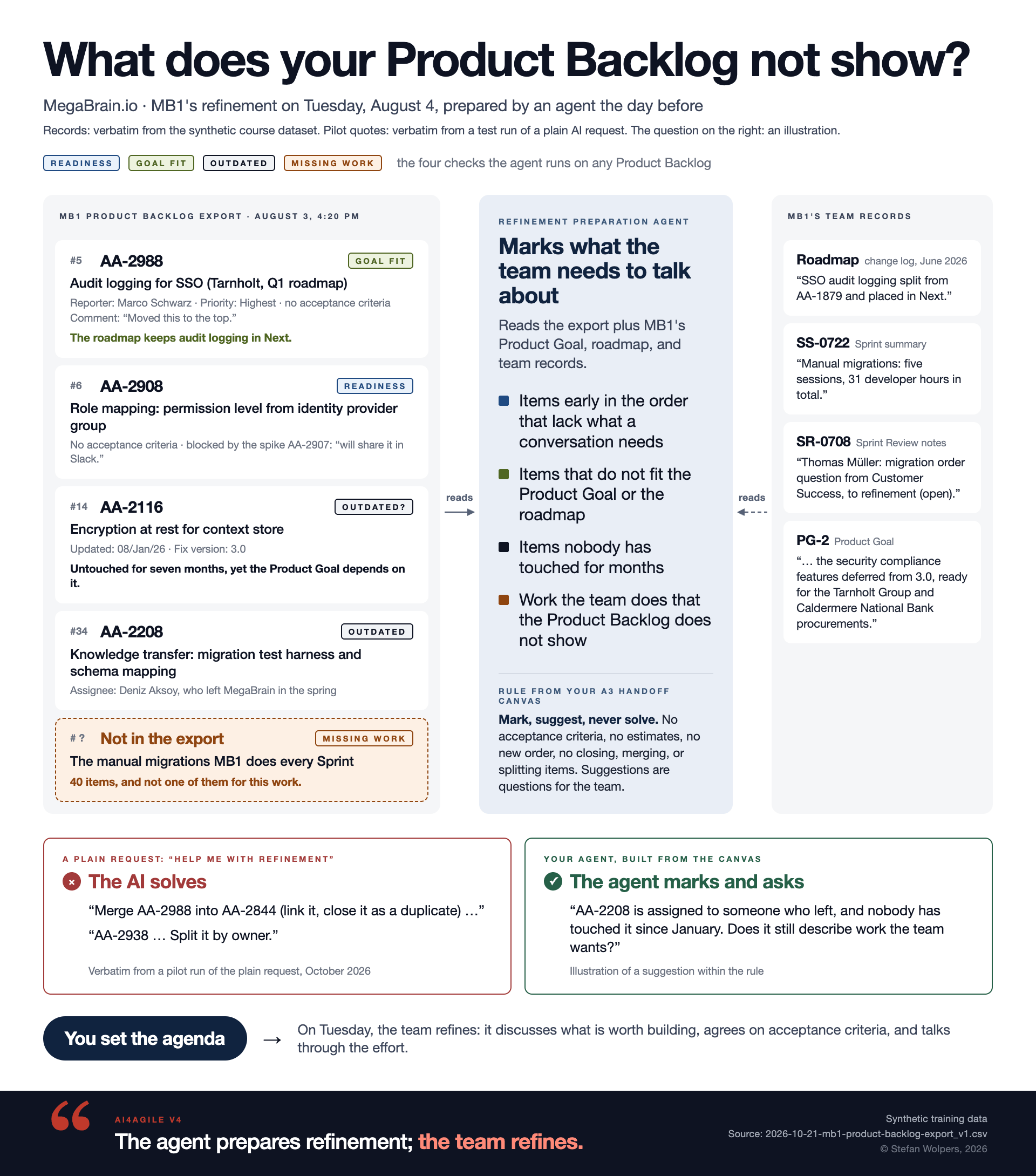
Of the 27 Product Backlog and refinement anti-patterns I have described, many are behavioral and leave no trace in a Jira export. Four do leave traces, provided the agent reads the team’s own records next to the export: the Product Goal, the product roadmap with its change log, the anti-product backlog, the notes from previous Sprint Reviews, and the actions from the last few Retrospectives.
Readiness
The agent looks at items early in the current order and reports what the records contain: whether an item states a problem or an intended outcome, whether it lists open questions, and whether a Product Backlog item waits for an open spike for technical clarification. Whether that is enough for a useful conversation remains the Product Owner’s judgment. A missing acceptance criterion at the start of refinement is no defect; it is an agenda question, because the Product Owner will have ideas about how an item should meet the desired outcome, and the team negotiates the criteria together by the end of refinement. Being early in the order does not preselect an item for the next Sprint, either: the order reflects the team’s best current judgment of how to use its time, and in Sprint Planning, the team first agrees on the Sprint Goal, and then the Developers select Product Backlog items they deem necessary to accomplish the goal.
Goal Fit and Prioritization by Proxy
The agent compares the Product Backlog with the Product Goal, the roadmap, and the anti-product backlog, which lists the ideas and requests the team decided not to build, either not now or not in this product, with the reason for each decision. It marks items that serve no part of the Product Goal and items that revive an idea the team already rejected. It also marks prioritization by proxy, which an export reveals only indirectly, because no outsider has write access to the Product Backlog: a stakeholder can neither create an item nor change its position. What the export does show is a member of the Scrum Team, usually the Product Owner, creating or moving an item on a stakeholder’s behalf: a comment such as “per the sales director’s request,” a label such as “mgmt-request,” a creation date right after an escalation, and no discovery decision and no link to the Product Goal behind the item. An item that skipped discovery because someone with political weight asked for it was never put to the validation test. However, the agent cannot know what the conversation behind the item looked like, or whether a rejected idea deserves a second look; that takes the people involved.
Outdated Items
Items nobody has touched for months, or that still name a release that shipped long ago, deserve a look, because a Product Backlog that turns into a storage for ideas hides the work the Product Goal needs. Age is a signal for inspection, nothing more: an untouched item can be the very work the Product Goal depends on, and a refinement agent that simply sorts by the “Updated” column will happily declare it dead without inspection.
Missing Work
The Scrum Guide calls the Product Backlog “the single source of work undertaken by the Scrum Team.” The agent can hold that claim against the team’s records: open items from the Sprint Review, Retrospective actions, and even work done outside the Sprint Backlog. A discrepancy is a finding. Whether it leads to a new item is for the Product Owner and the team to decide, because the work may sit in another team’s Product Backlog, stay outside it on purpose, or already be resolved. This check is also why the agent needs more than the export, since an export cannot show what is missing from it.
For any of the four checks, “no supported finding” and “insufficient evidence” are valid results.
However, the teams that would gain most from this preparation often keep the fewest records: no anti-product backlog, no product roadmap change log, Sprint Review notes that say little more than “stakeholders loved what we built,” and the reasons behind past decisions stored in the heads of the Product Owner and a few senior engineers, or buried in Slack threads. Such a team will get a brief full of “insufficient evidence.” That brief is still a finding because it shows where the team has no memory of its own decisions. Also, it helps only when people read it as a statement about their records rather than a failed run. Otherwise, the team has added AI on top of a dysfunctional system. A small start is enough to make the checks useful: the Product Goal, the last Sprint Review notes, and the last Retrospective actions all cover readiness and missing work, and a short list of recent “no” decisions, one line of reason each, gives the goal-fit check something to work with. In the agent’s instruction, name only the records the team actually keeps, so the brief does not report the same missing roadmap change log on every run.
Where a Suggestion Turns Into a Decision
A hypothetical example shows where this red line runs; the item keys, people, and dates are invented. A Jira export taken on Monday shows EXP-187, “Export for enterprise accounts,” created last Tuesday by the Product Owner, in the second position of the order, with the Priority field set to “Highest,” a one-line description, and the Product Owner’s own comment “Per the sales director’s request, moved to the top; a big customer is waiting.” The roadmap’s change log keeps the export feature in “Next,” no discovery decision mentions the request, and EXP-112, a CSV export item from June, may cover part of the same need.
A brief that does its job marks this as prioritization by proxy and cites its sources: the comment, the creation date, the position in the order, the roadmap entry, and the missing discovery decision. It adds what it cannot know (which customer, and what problem that customer has), and it may suggest that the Product Owner revisit the request with the sales director before refinement. A brief that crosses the line writes “Close EXP-187 as a duplicate of EXP-112,” or “Move EXP-187 back down the order,” or “Ready candidates for the next Sprint: EXP-187.” Each of these settles a decision that belongs to the Product Owner, however helpful it sounds.
What follows is the Product Owner’s work, and most of it happens outside refinement. The sales director’s request is exactly what my discovery article describes as a passive source: “Product requirements from internal stakeholders, which arrive unrequested and usually with political weight attached.” It goes through the funnel I described in AI-Assisted Product Discovery, where only what serves the general product vision and the current product goal passes the neck and earns a place in the work: it may become a hypothesis to validate with an experiment, an entry in the anti-product backlog with its reason, or an item the Product Owner places where it belongs. Until then, EXP-187 has no claim on the second position, until the Product Owner reconsiders the order of the Product Backlog. A sales director who can push an item to the top through the Product Owner points to an impediment for the Product Owner and the Scrum Master. Also, it is not an agenda item for the Developers, as refinement time stays reserved for work that has legitimately entered the Product Backlog.
Questions that belong in refinement need the same discipline. Take a story that waits for a spike that is still open: “What do we need to learn from the spike before we can negotiate the story’s acceptance criteria?” leaves the conversation to the team. “Should we split the story by permission level?” ends with a question mark, yet it carries a solution, and it leaves the team to say yes or no to an answer the agent chose. A valid refinement suggestion by an AI agent has to pass four tests:
- It rests on the supplied records,
- It makes the uncertainty visible,
- It leaves materially different answers open, and
- It does not assume the disputed resolution.
Why be this strict about a polite suggestion? A ready-made answer shapes the judgment of the person who reads it. In two preregistered experiments with 2,582 participants, Sterling Williams-Ceci, Mor Naaman, and colleagues found that people writing about societal issues with a biased AI writing assistant shifted their attitudes toward its position, most of them unaware of the bias and its influence, and warnings before or after the task did not mitigate the shift (Biased AI Writing Assistants Shift Users’ Attitudes on Societal Issues, Science Advances, 2026). The study tested autocomplete suggestions during writing, which influenced people more than similar arguments shown as a static list. An AI-assisted refinement brief is a static list, so the study is a reason for caution and does not prove that a brief anchors a Product Owner.
Writing the Line Down Before the First Run
Writing the red line down before a refinement agent runs for the first time turns it from an intention into a rule. The A3 Handoff Canvas is the place for it: it records what the agent reads, what its brief looks like, who checks it, what the agent must never do, and the last part goes into the agent’s instruction word for word. For an AI-assisted refinement agent, the stop rules read:
- Never write acceptance criteria,
- Never estimate,
- Never split, reorder, or remove an item, and never move one to the anti-product backlog,
- Never advise closing, merging, splitting, creating, or editing an item; ask the team a question instead,
- Never propose what goes into the next Sprint or what the Sprint Goal should be,
- Never invent a source, a reason, or a figure. (If a record needed for a check was not supplied, cannot be located in the supplied material, or cannot be read, state that limitation under “What I could not check.” Do not infer that the record does not exist. Do not treat an experiment, proposal, or unverified note as a completed decision or shipped release; state the exact status recorded in the source.)
Three of these rules deserve a word. Acceptance criteria stay out because the team negotiates them by the end of refinement, and an agent’s draft would preempt that negotiation; a different workflow can still help with criteria after the team has talked. Estimates stay out because their value lies in the Developers’ discussion that reveals diverging ideas of the effort before work starts, as I argued in Estimates Are Useful, Just Ditch the Numbers; the number was never the point. And the last rule addresses a quieter error: a model that reads a planned experiment as a commitment, or a hypothesis as a result, turns the team’s open question into a fact nobody decided.
In terms of the A3 Framework, this preparation is Assist: “AI expands options. You own the outcome.” The refinement agent works from a read-only export, so it cannot change the Product Backlog even if a rule fails. And if you already run an agent for product discovery, it needs its own Handoff Canvas, because it reads different inputs, delivers different output, and stops at a different line; I consider that AI transparency at the operational level.
The Product Owner Routes Every Finding
A brief that sounds thorough invites a dangerous shortcut: forwarding it to the team unread. Polished AI artifacts quickly fool people into believing that the AI is doing the real job. So the Product Owner opens the item or record behind every finding that could change the agenda and then looks at a few things the brief did not flag, for example, the items nearest the top that it never mentions, because a brief cannot report its own omissions.
Then the Product Owner decides where each finding goes, and only some of them belong in refinement:
- Settled by the Product Owner: Housekeeping, such as an obvious duplicate created by mistake or a release field nobody updated, and restoring the order of the Product Backlog.
- Sent into discovery: Requests that skipped the funnel, such as the sales director’s export, and rejected ideas whose revisit condition may have occurred.
- On the refinement agenda: Questions that need the team’s knowledge, such as what a Product Backlog item needs before the team can negotiate its acceptance criteria.
- Raised as an impediment: Systemic causes, such as stakeholder pressure that bypasses discovery or records the team does not keep, for the Product Owner and the Scrum Master, or for the next Retrospective.
Sharing the agenda with the Developers and the Scrum Master before the session gives them the chance to add the questions the brief missed. If a brief proposes resolutions anyway, correct the instruction and run it again; if it keeps failing, prepare the agenda by hand, the way the Product Owner hopefully did before the agent existed.
The remaining failure mode relates to the Product Owner: Treating the brief as sufficient grounds to settle a question that needs the team’s knowledge brings back the very problem the stop rules were meant to prevent, only with a human signature. The brief must not become a substitute for a discussion that has not happened.
Conclusion: Try It Before Three Refinements, Then Decide
Treat the first runs as a local experiment. Note how long your usual preparation takes, then run the refinement agent on a sanitized export, in an AI account your company has approved, before three or four refinements. Record the total time, including checking the findings that proved useful, the findings the records did not support, and the omissions you noticed, knowing you won’t catch all of them. If checking and correcting the brief keeps taking longer than preparing the agenda by hand, stop, because the agent then costs more than it saves. Otherwise, ask the team whether refinement gained time for the critical discussion, and compare the results with your usual preparation; a few sessions give you the basis to decide whether to continue, adjust, or stop.
If you would rather practice first, the AI4Agile Online Course v4, which launches on November 27, 2026, includes an exercise in which you build this refinement preparation agent: you fill its A3 Handoff Canvas, run it on a 40-item Product Backlog export and the team records of MegaBrain.io, the course’s fictional startup, check its brief, and set the Product Owner’s agenda before comparing your decisions with my worked solution.
When the next brief arrives on your desk the afternoon before refinement, which of its suggestions already contains an answer your team has not given yet?
Key Questions This Article on the Product Backlog Refinement Agent Answers
How Can AI Help a Product Owner Prepare Product Backlog Refinement?
A refinement agent can read the Product Backlog export and the team’s records on the afternoon before refinement and mark Product Backlog anti-patterns: items not ready for a conversation, items that serve no part of the Product Goal or entered at a stakeholder’s request without a discovery decision, outdated items, and work the Product Backlog does not show. The Product Owner checks the brief and routes each finding; the team refines.
What Can an AI Agent Check in a Product Backlog Before Refinement?
Four checks leave traces in an export and a team’s records: readiness, goal fit, outdated items, and missing work. Prioritization by proxy shows only indirectly, because no outsider can write to the Product Backlog: an item the Product Owner created or moved up at a stakeholder’s request, visible in comments, labels, and a missing discovery decision. None of the checks can establish what the team understands or still wants; the people involved need to do that.
How Do You Tell an Open Question From a Disguised Recommendation?
A question passes four tests when it rests on the supplied records, makes uncertainty visible, leaves materially different answers open, and does not assume the disputed resolution. “Should we split the story by permission level?” fails despite its question mark, because it carries a solution. “What do we need to learn from the spike before we can negotiate the acceptance criteria?” leaves the answer to the team.
Should a Refinement Agent Write Acceptance Criteria or Estimates Before the Team Refinement?
Not in a preparation brief. The Product Owner brings ideas about how an item should meet the desired outcome, and the team negotiates the acceptance criteria together by the end of refinement; a refinement agent’s draft would preempt that negotiation. The value of an estimate lies in the Developers’ discussion of diverging ideas of the effort; the Scrum Guide assigns sizing to “the Developers who will be doing the work.”
The Product Backlog Refinement Agent — Related Posts
AI-Assisted Product Discovery: When Code Is Cheap, Judgment Is the Job
AI Transformations And Agile Transformations Rhyme
You Already Have an AI Working Agreement. Write It Down.
If You Can Facilitate a Retrospective, You Can Audit Your AI
The AI Definition of Done: Human in the Loop Is Not a Quality Standard
The AI Delegation Lifecycle: Your Team Has AI Outputs. Where Are the Decisions?
Assist, Automate, Avoid: How Agile Practitioners Stay Irreplaceable with the A3 Framework
The A3 Handoff Canvas: Six Questions That Turn AI Delegation Into a Repeatable Workflow
The A3 Framework: Assist, Automate, Avoid — A Decision System for AI Delegation

👆 Stefan Wolpers: The Scrum Anti-Patterns Guide (Amazon advertisement.)
📅 Training Classes, Workshops, and Events
Learn more about the Product Backlog Refinement Agent with our AI and Scrum training classes, workshops, and events. You can secure your seat directly by following the corresponding link in the table below:
| Date | Class and Language | City | Price |
|---|---|---|---|
| 🖥 🇬🇧 November 27, 2026 | GUARANTEED: Join 700 Peers for the AI4Agile Online Course v4 at $149 on November 27, 2026 (Ai4Agile Certificate; English; Online Course) | Online Course | $149 incl. 19% VAT (If applicable.) |
| 🖥 🇬🇧 Dec 3-17, 2026 | A3 Delegation System Pilot Workshop 2 (English; Live Virtual Class) | Live Virtual Class | $149 incl. 19% VAT (If applicable.) |
| 🖥 🇩🇪 Dec 8-9, 2026 | Professional Scrum Product Owner Training (PSPO I; German; Live Virtual Class) | Live Virtual Class | €1189 incl. 19% VAT (If applicable.) |
| 🖥 🇬🇧 Dec 15-16, 2026 | Professional Scrum Master – Advanced Training (PSM II; English; Live Virtual Class) | Live Virtual Class | €1189 incl. 19% VAT (If applicable.) |
| 🖥 🇩🇪 Feb 16-17, 2027 | Professional Scrum Product Owner Training (PSPO I; German; Live Virtual Class) | Live Virtual Class | €1189 incl. 19% VAT (If applicable.) |
See all upcoming classes here.

You can book your seat for the training directly by following the corresponding links to the ticket shop. If your organization’s procurement process requires a different purchasing approach, please contact Berlin Product People GmbH directly.
✋ Do Not Miss Out and Learn More about the Product Backlog Refinement Agent — Join the 20,000-plus Strong ‘Hands-on Agile’ Slack Community
I invite you to join the “Hands-on Agile” Slack Community and enjoy the benefits of a fast-growing, vibrant community of agile practitioners from around the world.

If you would like to join, all you have to do now is provide your credentials via this Google form, and I will sign you up. By the way, it’s free.
