
TL;DR: The AI Definition of Done
Your team has a Definition of Done for a product increment. It has none for the 20-plus AI-supported outputs that leave the team each week: status reports, stakeholder emails, release notes, and updates for the C-level. Each one carries your team’s name. “I know quality when I see it” is the standard most teams actually run by, and you cannot audit it, teach it to a new colleague, or defend it when a claim turns out to be wrong. The AI Definition of Done fixes that with one page per task class, agreed by the team, before the output ships.
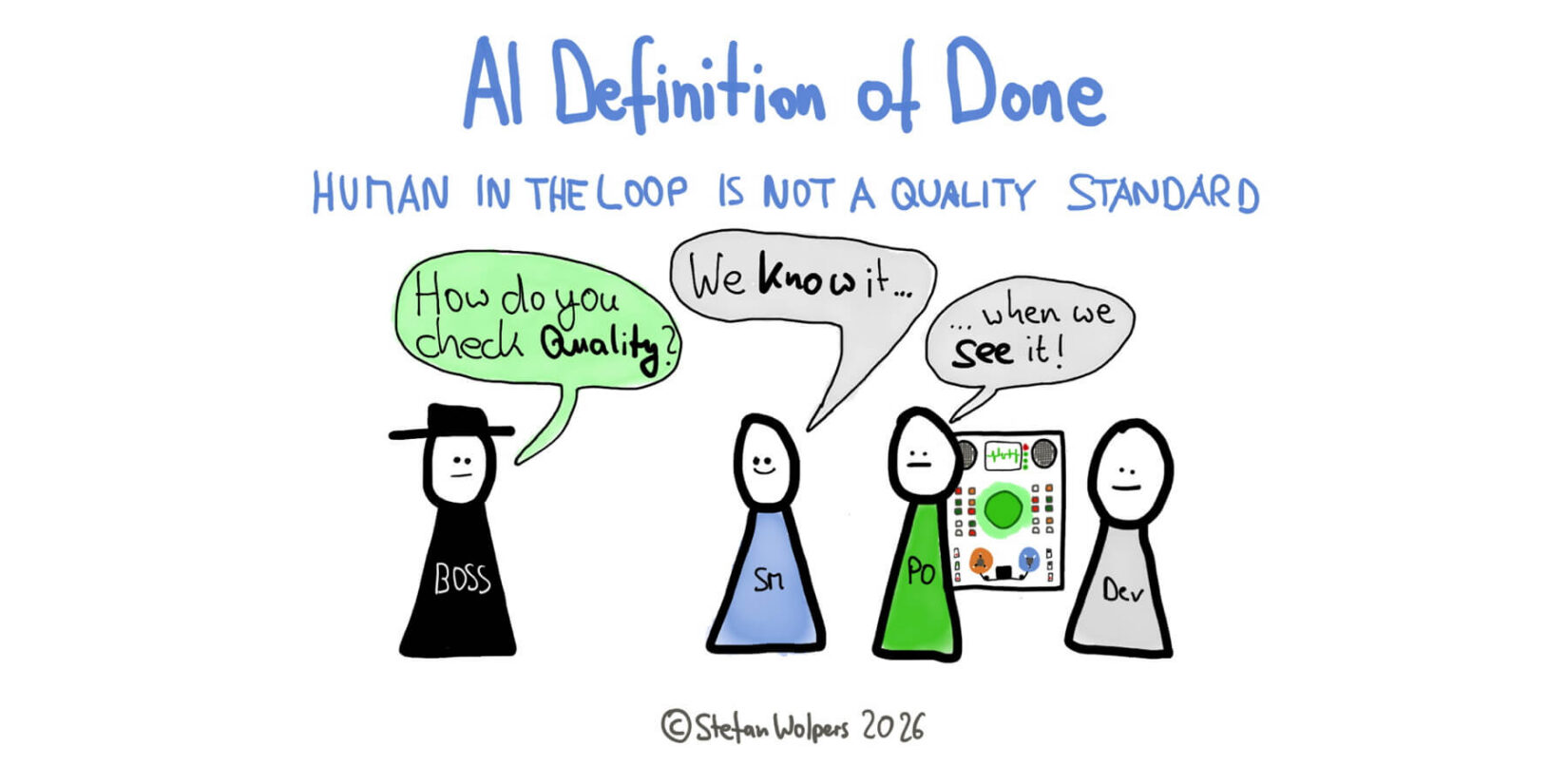
Thesis: The AI Definition of Done is a one-page, team-agreed standard that an AI-assisted output must meet before it leaves the team. You write one per task class, never per task: one for external status communication, one for data analysis summaries, one for backlog item drafts. It borrows the discipline of the Scrum Definition of Done and applies it to work that has been touched, especially outputs that leave the team. This is Stage 4 of the AI Delegation Lifecycle. The sections below cover the four questions it answers and how to write yours in 75 minutes.
🎓 🇬🇧 The AI4Agile Online Course v3 — July 20, 2026, at $149 — Join the Waitlist
Sooner or later, a CFO will ask what your AI use actually returns. "It saves me time" will not survive that meeting.
The first wave of AI adoption rewarded practitioners who learned to prompt. That skill still matters, and this course still teaches it. The second wave rewards something rarer: people who can turn individual AI use into knowledge that survives departures, spend that can be explained and steered, and output that organizations can trust. That work is process design and change management. You have been doing both for years, on harder problems than this.
The AI 4 Agile Online Course v3 is in English. 🇬🇧
What You Will Get:
✅ 16+ hours of self-paced video modules ✅ A cohort-hardened, proven course design ✅ Learn to 10x your effectiveness with AI; your stakeholder will be grateful ✅ Apply AI to classic use cases of “Agile” ✅ The A3 Framework, A3 Handoff Canvas, AI Definition of Done, and Delegation Retrospective as working handouts ✅ The complete MegaBrain.io case package across both acts ✅ All texts, slides, prompts, graphics; you name it ✅ Access custom GPTs, including the “Scrum Anti-Patterns Guide GTP” ✅ Guaranteed: Lifetime access to v3 ✅ AI4Agile Foundation Certificate: 40 questions in 45 minutes.

👉 Please note: The course will be available for $149 from July 20 to 27, 2026! (After that, $249.) 👈
🎓 Join the Waitlist now and be the first to know: The AI4Agile Online Course v3 — July 20, 2026, at $149 — No Coding Required!
🇩🇪 Zur deutschsprachigen Version des Artikels: Die KI-Definition of Done: Human in the Loop ist kein Qualitätsstandard.
🗞 Shall I notify you about articles like this one? Awesome! You can sign up here for the ‘Food for Agile Thought’ newsletter and join 35,000-plus subscribers.
🎓 Join Stefan in one of his upcoming training classes!
Your Increment Has a Standard; Does Your AI Output?
A model turns the Jira board into a Friday status update, and the update tells an enterprise prospect that the security feature is in production. Unfortunately, it is not. The feature was descoped three months ago, but the old ticket title persisted because no one felt responsible. So the model reported the title instead of the reality. Nobody checked the claim against the release notes, because nobody had agreed that someone should. The email was sent with the team's name on the cover.
A functioning agile team should be able to tell you what "done" means for a product increment. Few can tell you what "done" means for that status update. No agreed standard governs it, and it ships every week. The product increment passes through a standard that the team argued over and agreed on. The AI-assisted output passes through one person's gut feeling at the moment they clicked send. One of those you can defend to a stakeholder, an auditor, or a new hire. The other you cannot.
The AI Definition of Done closes that gap without adding a governance department, which is exactly why it survives in organizations where "AI governance" earns eye-rolls. It takes a practice every agile practitioner already owns and points it at the work you have started handing to a model. It is not for everything: skip it for private brainstorming, throwaway prompts, or personal sensemaking, unless the output later informs a decision or leaves the team.
The Four Questions Every AI Definition of Done Answers
The Concept
Verification level: which claims get checked, by whom, against what source, and how? "Looks good" is not a method. A method names the claim, the checker, the source, and the test: every factual claim about product status gets checked against the release notes by the sender, before sending, every time. Where teams get stuck: approval gets mistaken for review. Someone skims a draft, clicks send, and the team's name now sits on a claim nobody verified.
Provenance disclosure: what does the team declare about how the output was produced? Three labels cover practice: a) Human means no material AI contribution to the content, claims, or structure (a spellchecker does not count), b) AI-assisted means AI contributed to drafting, summarizing, or analysis, and a named human reviewed the output and decided, and c) AI-automated means AI produced and sent the output under predefined rules, without human review before release, audited at a set cadence. The line that matters runs through "reviewed": clicking send on an unread draft is approval, never review. An output approved without reading is AI-automated, whatever the team tells itself.
Data hygiene: what never enters a model on the way to this output? Name the exclusions concretely: personal data from team surveys, customer-identifiable information, anything your organization's AI policy restricts. If the input rules in your A3 Handoff Canvas already cover this, point to them. Do not keep two versions of the same rule. Where teams get stuck: nobody wrote the exclusions down, so each person guesses, and the guesses differ.
Sufficiency tier and environment: which model, plan, and data boundary are good enough for this task class, and why? A top-notch frontier model drafting calendar invitation may fail in this regard. The cheapest model, run locally on an old Mac mini, can write a board update but likely fails in the other. Capability is only half of it: a board update may need an enterprise plan with a no-training guarantee or an approved connector, even when a mid-tier model is plenty. If your team has a routing policy, point to the tier and the environment it mandates. If it does not yet, name the model and the plan, and explain in one sentence why both are enough.
Cannot see the form? Please click here.
The AI Definition of Done Template
Four questions, plus two operating controls, one page. Here is the template a team fills in per task class:
| Dimension | Your Standard for This Task Class |
|---|---|
| Task class | |
| Verification level: What is checked, by whom, against what, how | |
| Provenance label: Human (Avoid) / Assist / Automate from the A3 Delegation Framework, and where the label appears | |
| Data hygiene: What never enters the model | |
| Sufficiency tier and environment: Wich model, plan, and data boundary, and why they are enough | |
| Sign-off: Who agreed, on what date, and the review date | |
| Stop rule: When the delegation is paused, downgraded, or returned to manual work |
The last two rows are operational, not definitional: Sign-off records who agreed and when, and the stop rule names the condition that pauses the delegation, because this standard should say not only when an output may ship but when the task class stops being eligible for AI at all. Without it, teams keep tuning the prompt or skill long after the delegation has proven unfit.
A Worked Example: External Status Communication
The status update failure that opened this article maps to one task class, status communication, leaving the company. Here is the team's first AI Definition of Done for it:
| Dimension | Standard |
|---|---|
| Task class | Status communication leaving the company |
| Verification level | Every claim about feature status is checked against the release notes by the sending manager, before sending, every time |
| Provenance label | AI-assisted; footer states "Drafted with AI, reviewed by [name]"; Assist is not permitted for this task class |
| Data hygiene | No customer names, no security-finding details, no internal financials enter the model |
| Sufficiency tier and environment | Mid-tier model on an enterprise plan with no model training; drafting from structured release data needs no frontier model |
| Sign-off | Team agreed, dated; review after the next four status updates |
| Stop rule | If two updates in a review cycle need a factual correction after sending, the task class returns to manual drafting until the standard is revised |
The standard costs the sending manager about four minutes a week, set against an error that can put a flagship deal at risk.
Write Your AI Definition of Done in 75 Minutes
An AI Definition of Done that one person downloads and pastes into the wiki doesn't change anything. The argument over the standard is where the standard takes hold. Run it as a workshop:
- Pick three task classes (10 minutes): Choose from work the team actually shipped in the last two weeks, never hypotheticals. The best candidates are outputs that leave the team.
- Draft in pairs (20 minutes): Each pair fills the template for one task class. Pairs work without comparing notes; divergence is the point.
- Argue the differences (25 minutes): Compare drafts. Where pairs disagree on verification level or provenance, the team has found an unspoken assumption. Resolve each disagreement with a decision, never with "both are fine."
- Set the labels (10 minutes): Agree where provenance labels appear: email footers, document headers, report covers. Visible beats buried.
- Adopt and date (10 minutes): Sign off each AI Definition of Done with a review date, and add the adoption to your AI working agreement.
Ownership stays with the team running the delegation. Compliance, security, or legal may constrain the standard, but they do not write it for the team.
When someone says, "We do not need this for internal outputs," ask what happened the last time an internal draft got forwarded outside the team. Every team has that story.
The Record You Get for Free
Each signed-off AI Definition of Done is a dated, versioned, one-page record. Stack them, and they answer the due diligence question enterprise buyers increasingly ask, "how do you control AI-generated output," with documents instead of assurances. Nobody wrote a governance report. The records came out of normal work.
That answer is already part of procurement and due diligence conversations. Article 4 of the EU AI Act has been applied since February 2, 2025, and requires providers and deployers to ensure a sufficient level of AI literacy among staff and others operating AI systems on their behalf. The EU Commission's Q&A places supervision and enforcement under national market surveillance authorities, with the enforcement rules applying from early August 2026. The practical question underlying the regulation is simpler, and a prospect's procurement team will ask it before any regulator does: can you show the standard that underlies the output you sent us?
Three Ways It Fails
The downloaded standard: A template adopted without the workshop. Nobody argued, so nobody owns it. An AI Definition of Done nobody argued about is one nobody will follow.
The universal standard: One AI Definition of Done for all work. Verification that aligns with external communication suffocates internal brainstorming, and the team abandons the practice within a month. One page per task class. Contrary to the classic Definition of Done, there is no one-size-fits-all in our use case.
The static standard: Written once, reviewed never. Models change, people change, task classes change. The review date is part of the artifact, and your next delegation inspection enforces it.
Conclusion: Pick One Output This Week
Pick one AI-assisted output your team ships regularly. The Friday status update, the Sprint summary, or the stakeholder email. Walk it through the four questions out loud in your next Retrospective: what gets checked and by whom, how we label it, what never enters the model, and which tier is enough. You will likely find at least one question where the honest answer is "nobody decided that." Write the one-page response for that task class, argue it, sign it, and date it. One standard, agreed by the team, is the difference between a team that uses AI and a team that a customer can trust with it.
Which of your AI-assisted outputs has a standard behind it right now, and which one is merely a habit?
Key Questions This Article Answers
What Is an AI Definition of Done?
An AI Definition of Done is a one-page, team-agreed standard that an AI-assisted output must meet before it leaves the team. Teams write one per task class, such as external status communication or data analysis summaries, never one per task. It answers four questions: what gets verified, how the output is labeled, what data never enters the model, and which model and environment are sufficient. It borrows the discipline of the Scrum Definition of Done and applies it to work on a model touched.
What Is the Difference Between Approval and Review for AI Output?
Review means a named human reads the AI-generated output and checks its claims against a source before it ships. Approval means someone clicked send. Clicking send on an unread draft is approval, not review, whatever the team calls it. An output approved without reading is effectively AI-automated, and it should carry that provenance label rather than the AI-assisted label, which implies a human verified it.
How Do You Write an AI Definition of Done?
Run a 75-minute team workshop, not a solo download. Pick three task classes from work shipped in the last two weeks, draft the standard in pairs, then compare and resolve every disagreement with a decision. Agree where provenance labels appear, set a stop rule that returns the task class to manual drafting when outputs repeatedly fail, sign off each standard with a review date, and add the adoption to your AI working agreement. The argument over the standard is what makes the team own it.
How Do Agile Teams Prove They Govern AI Output?
Each signed-off AI Definition of Done is a dated, one-page record. Together, a team's standards answer the procurement and due diligence question "how do you control AI-generated output" with documents rather than assurances. The records are a byproduct of normal work, so no separate governance report is needed. This matters because buyers and regulators, including under the EU AI Act Article 4, increasingly require evidence of controlled AI adoption.
What Are the Four Dimensions of an AI Definition of Done?
Verification level (which claims get checked, by whom, against what source, and how), provenance disclosure (Human, AI-assisted, or AI-automated, and where the label appears), data hygiene (what never enters the model), and sufficiency tier and environment (which model, plan, and data boundary are good enough and why). Each dimension fits on one line of a one-page template, signed off with an adoption date and a stop rule that pauses the delegation when outputs repeatedly fail.
AI Definition of Done — Related Articles
AI4Agile Online Course v3 — Release on July 20, 2026
The AI Delegation Lifecycle: Your Team Has AI Outputs. Where Are the Decisions?
Assist, Automate, Avoid: How Agile Practitioners Stay Irreplaceable with the A3 Framework
The A3 Handoff Canvas: Six Questions That Turn AI Delegation Into a Repeatable Workflow
The A3 Framework: Assist, Automate, Avoid — A Decision System for AI Delegation
Three AI Skills to Sharpen Judgment
No More Cheap Claude: Four First Principles of Token Economics in 2026
👆 Stefan Wolpers: The Scrum Anti-Patterns Guide (Amazon advertisement.)
📅 Training Classes, Workshops, and Events
Learn more about AI Builders with our AI and Scrum training classes, workshops, and events. You can secure your seat directly by following the corresponding link in the table below:
| Date | Class and Language | City | Price |
|---|---|---|---|
| 🖥 💯 🇬🇧 July 20,2026 | GUARANTEED: AI 4 Agile Course v3 — Master AI for Agile Practitioners (English; Self-paced Online Course) | Self-paced Online Course | $149 incl. 19% VAT (If applicable.) (Before and after: $249) |
| 🖥 💯 🇬🇧 July 23,2026 | GUARANTEED: HoA 76: Where Are Your Decisions to Avoid AI Debt? (English) | Meetup | FREE |
| 🖥 🇩🇪 August 25-26, 2026 | Professional Scrum Product Owner Training (PSPO I; German; Live Virtual Class) | Live Virtual Class | €999 incl. 19% VAT (If applicable.) |
| 🖥 💯 🇬🇧 August 27 to September 17,2026 | GUARANTEED: AI4Agile BootCamp #8 (English; Live Virtual Cohort) | Live Virtual Cohort | €499 incl. 19% VAT (If applicable.) |
| 🖥 💯 🇬🇧 Sep 28-29,2026 | GUARANTEED: A3 Delegation System Founding Workshop (English; Live Virtual Class) | Live Virtual Class | $199 incl. 19% VAT (If applicable.) |
| 🖥 🇩🇪 Sep 30 to Oct 1, 2026 | Professional Scrum Product Owner Training (PSPO I; German; Live Virtual Class) | Live Virtual Class | €999 incl. 19% VAT (If applicable.) |
See all upcoming classes here.

You can book your seat for the training directly by following the corresponding links to the ticket shop. If your organization's procurement process requires a different purchasing approach, please contact Berlin Product People GmbH directly.
✋ Do Not Miss Out and Learn More about the AI Definition of Done — Join the 20,000-plus Strong ‘Hands-on Agile’ Slack Community
I invite you to join the “Hands-on Agile” Slack Community and enjoy the benefits of a fast-growing, vibrant community of agile practitioners from around the world.

If you would like to join all you have to do now is provide your credentials via this Google form, and I will sign you up. By the way, it’s free.
