
TL; DR: AI in Product 2026 — Food for Agile Thought #549
Welcome to the 549th edition of the Food for Agile Thought newsletter, shared with 35,498 peers. This week, Product Circle and Product Institute share the AI in Product 2026 survey show AI coding tools spreading faster than stronger operating models, while Elena Verna sees cheaper software creation opening a Mom-and-Pop SaaS lane for domain experts. Petra Wille counters AI possibilities with accountable product principles, and Sam McVeety and Amir Hormati tackle agent-ready context. Also, Isabel Juniewicz and Ed Zitron question whether increasing hyperscaler spending and the economics of generative AI can sustain the rush, or bubble?
Next, Janna Bastow warns that Slack loses product feedback once channels move on, and Sarah Guo argues that AI shifts durable advantage toward private data, judgment, and trust. Aakash Gupta and Rohan Varma push the logic further, describing AI-native teams that build before they coordinate as the AI way, while Matthew Hodgson adds that enterprises need persistent funding and governance to make AI product operating models work. Then, Gregor Ojstersek shows that top engineering teams are already reshaping structures around AI.
Lastly, Mark Graban warns that tone policing in teams drives bad news underground, while Barry O’Reilly argues that AI raises the premium on visible, codified judgment that requires transparency, not enforced harmony. Johanna Rothman and Sonya Siderova shift the focus from faster tasks to slower systems, where wait times and flow debt shape delivery. Finally, Matteo Tittarelli extends that logic to GTM, where context, skills, orchestration, and integrations must compound across cycles.
🎓 🇬🇧 The AI4Agile Online Course v3 — July 20, 2026, at $149 — Join the Waitlist
Sooner or later, a CFO will ask what your AI use actually returns. “It saves me time” will not survive that meeting.
The first wave of AI adoption rewarded practitioners who learned to prompt. That skill still matters, and this course still teaches it. The second wave rewards something rarer: people who can turn individual AI use into knowledge that survives departures, spend that can be explained and steered, and output that organizations can trust. That work is process design and change management. You have been doing both for years, on harder problems than this.
EXCLUSIVE: The new A3 Delegation Lifecycle System with all Templates to make sense of delegating work to AI models.
The AI 4 Agile Online Course v3 is in English. 🇬🇧
What You Will Get:
✅ 16+ hours of self-paced video modules ✅ A cohort-hardened, proven course design ✅ Learn to 10x your effectiveness with AI; your stakeholder will be grateful ✅ Apply AI to classic use cases of “Agile” ✅ The A3 Framework, A3 Handoff Canvas, AI Definition of Done, and Delegation Retrospective as working handouts ✅ The complete MegaBrain.io case package across both acts ✅ All texts, slides, prompts, graphics; you name it ✅ Access custom GPTs, including the “Scrum Anti-Patterns Guide GTP” ✅ Guaranteed: Lifetime access to v3 ✅ AI4Agile Foundation Certificate: 40 questions in 45 minutes.

👉 Please note: The course will be available for $149 from July 20 to 27, 2026! (After that, $249.) 👈
🎓 Join the Waitlist now and be the first to know: The AI4Agile Online Course v3 — July 20, 2026, at $149 — No Coding Required!
Did you miss the previous Food for Agile Thought issue 548?
🗞 Shall I notify you about articles like this one? Awesome! You can sign up here for the ‘Food for Agile Thought’ newsletter and join 35,000-plus subscribers.
🎓 Join Stefan in one of his upcoming training classes!
🏆 The Tip of the Week: AI in Product 2026
: 📖 State of AI in Product 2026
Product Circle and Product Institute find that while 87.7% of product organizations use AI coding assistants, only 36.1% report stronger operating models, suggesting tool adoption far outpaces the organizational changes needed to benefit from it.
🎯 Product
: The Mom-and-Pop SaaS era has arrived
Elena Verna believes that AI-driven cost collapse in software creation unlocks a "Mom-and-Pop SaaS" era, where domain experts, not just developers, turn decades of professional experience into niche software products.
: On helping write the Makers Manifesto
Petra Wille describes co-creating the Makers Manifesto, a set of principles for AI-era product work centered on purpose over possibility, learning loops over launch plans, and human accountability over automation.
(via ProdPad): Why Your Feedback is Stuck in Slack
Janna Bastow proposes that Slack captures feedback well but cannot retain it. Without a system that links feedback to customers, problems, and plans, valuable product signals vanish as channels scroll past.
(via Zen Ex Machina): AI Product Operating Model: Why CIOs Need One
Matthew Hodgson suggests that enterprise AI fails at scale because organizations fund it as a project with an end state, when it needs persistent teams, continuous funding, and outcome-based governance.
: The AI Product Operating Model
Tricky: Aakash Gupta and Rohan Varma propose that AI-native companies invert traditional product development. When building becomes cheap, you build first and evaluate second, collapsing most coordination overhead and process layers.
🧠 Artificial Intelligence
(via Google Cloud Blog): How the Open Knowledge Format can improve data sharing
Sam McVeety and Amir Hormati introduce the Open Knowledge Format. This vendor-neutral, markdown-based specification standardizes how organizations package internal context so AI agents can reliably consume it across tools.
: What the Top 1% of Engineering Teams Do Differently with AI
Gregor Ojstersek shares Weave's data on what top 1% engineering teams do differently with AI: flatter orgs, smaller teams, spec reviews over code reviews, higher AI spending with better cost efficiency, and more deployments without increased bug rates.
(via Epoch AI): Hyperscaler Capex to Exceed Cash Flow by Q3 2026
Isabel Juniewicz reports that combined AI capital spending by the five major hyperscalers is set to surpass their operating cash flow by Q3 2026, forcing a shift to external financing.
: AI's Brokenomics
Ed Zitron believes generative AI lacks a viable business model, noting that enterprise customers revolted against token-based billing within months, forcing OpenAI and Anthropic to consider cuts on unprofitable services.
🖥 💯 🇬🇧 AI4Agile BootCamp #8, August 27 – September 17, 2026
The job market’s shifting. Agile roles are under pressure. AI tools are everywhere. But here’s the truth: the Agile professionals who learn how to work with AI, not against it, will be the ones leading the next wave of high-impact teams. Therefore, Stefan created the AI4Agile BootCamp.
So, become the professional recruiters‘ first call for „AI‑powered Agile.“ Be among the first to master practical AI applications for Scrum Masters, Agile Coaches, Product Owners, Product Managers, and Project Managers. The AI4Agile BootCamp is in English.
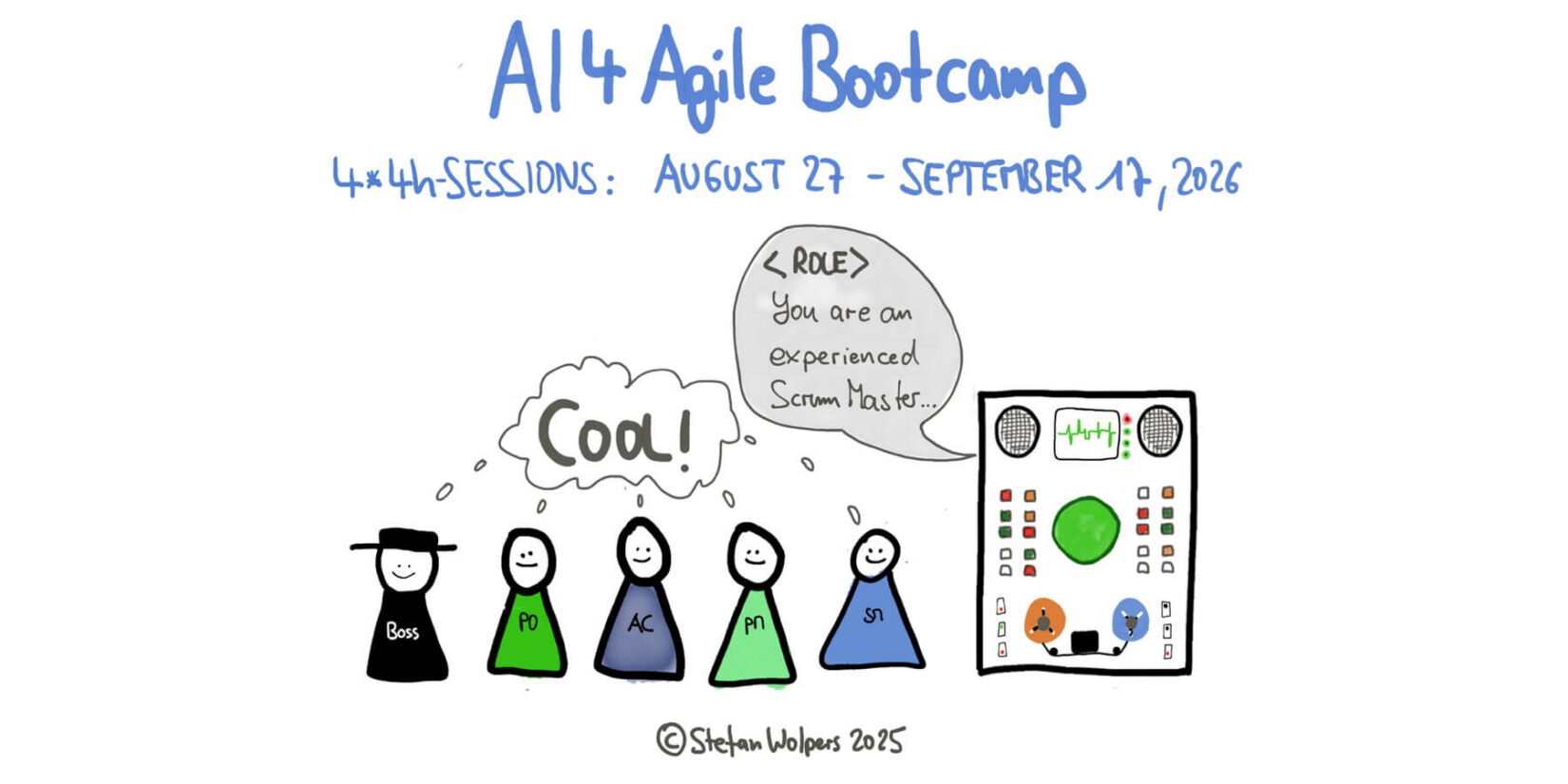
Learn more: 🖥 💯 🇬🇧 AI4Agile BootCamp #8, August 27 – September 17, 2026.
Customer Voice: “Last week, I finished the 𝗔𝗜 𝗳𝗼𝗿 𝗔𝗴𝗶𝗹𝗲 𝗣𝗿𝗮𝗰𝘁𝗶𝘁𝗶𝗼𝗻𝗲𝗿𝘀 course. And I’m mutating… It started on the train. I was scrolling through my messages, half-distracted, when a newsletter from Stefan Wolpers popped up. Stefan, a deep thinker with a hands-on attitude, was launching a new course. A pilot cohort. The mission: explore how AI can actually support us as agile practitioners. I couldn’t resist. I tapped: “𝘚𝘪𝘨𝘯 𝘶𝘱”. What followed were four bi-weekly sessions. Four intense afternoons. Full of exploration, experimentation, and practice. […] At the beginning, Stefan said that 𝘫𝘶𝘴𝘵 𝘴𝘪𝘨𝘯𝘪𝘯𝘨 𝘶𝘱 𝘢𝘭𝘳𝘦𝘢𝘥𝘺 𝘱𝘶𝘵𝘴 𝘶𝘴 𝘢𝘩𝘦𝘢𝘥 𝘰𝘧 𝘮𝘢𝘯𝘺 𝘱𝘳𝘢𝘤𝘵𝘪𝘵𝘪𝘰𝘯𝘦𝘳𝘴. That sounded like a big statement. But somewhere along the way, I noticed a shift… an emerging superpower in how I approach my tasks with AI.⚡And now, as my AI-mutation continues, I catch myself wondering: 💭 𝘏𝘰𝘸 𝘥𝘰 𝘐 𝘶𝘴𝘦 𝘈𝘐 𝘵𝘰 𝘴𝘢𝘷𝘦 𝘵𝘩𝘦 𝘢𝘨𝘪𝘭𝘦 𝘸𝘰𝘳𝘭𝘥?” (Ilya Zaytsev, Leading Agility at HUGO BOSS.)
➿ Agile & Leadership
: How Does Defining Judgment System Improve Leadership Decision-Making?
Barry O'Reilly proposes that the scarcest resource in the AI era is not information but human judgment, and that leaders must expose, refine, and codify how they actually make decisions.
: 'No Debbie Downers' and the Hidden Cost of a Positive Team
Mark Graban suggests that tone filters like "no Debbie Downers" quietly erode psychological safety. A team where nobody brings bad news is not problem-free; the problems have just learned to hide.
: The Untrainable
Sarah Guo proposes that as AI commoditizes measurable work, lasting value shifts to "untrainable" territory: private data, firm-specific judgment, and trust that no model can absorb, no matter how capable it becomes.
📯 The AI Delegation Lifecycle: Your Team Has AI Outputs. Where Are the Decisions?
Your team ships AI outputs nobody decided to trust fully; you needed to be quick, and “dirty” tagged along. Too bad, that that ungoverned automation becomes AI debt when a stakeholder asks who owns it. But do not despair: The AI Delegation Lifecycle turns skills you already use into six decisions you can apply this week to govern that work and prove it, audit-ready and suited for agent harnesses.
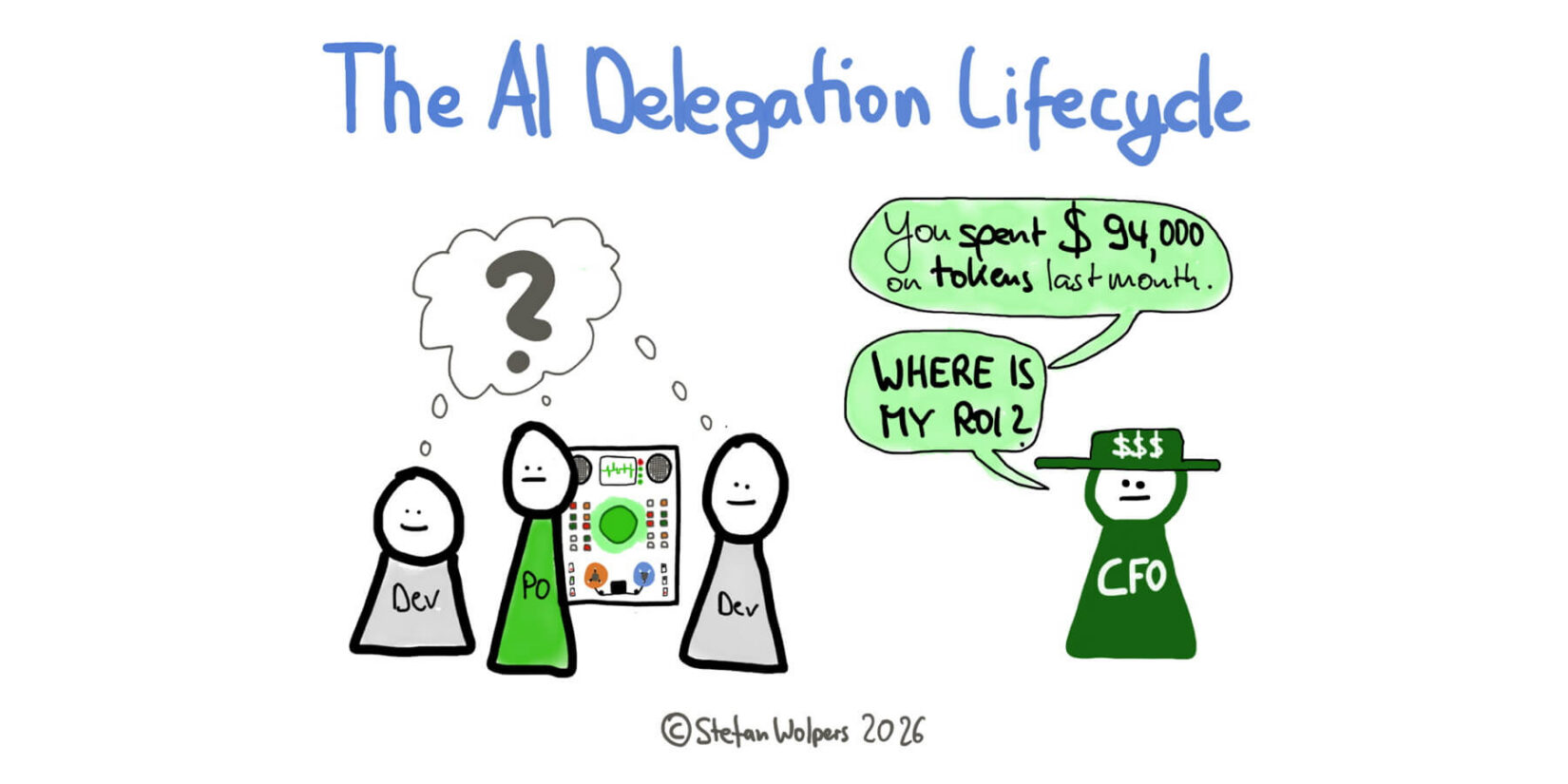
Learn more: The AI Delegation Lifecycle: Your Team Has AI Outputs. Where Are the Decisions?
🛠 Concepts, Practices, Tools & Measuring
(via Nave Blog): Flow Debt: The Hidden Cost of Expediting Work
Sonya Siderova explains that every expedited task borrows cycle time from the rest of your work in progress, creating hidden "flow debt" that quietly erodes predictability before any forecast reveals it.
: How to Use Value Stream Maps to See Where AI Creates Bottlenecks, Part 1
Johanna Rothman uses value stream maps to show that AI speeds up individual work but barely cuts cycle time because the real bottlenecks are wait times, not typing speed.
: How to build your AI GTM system
Matteo Tittarelli proposes a four-layer framework for AI-powered GTM systems: context, skills, orchestration, and integrations. His key point: without a persistent context spine, AI output never compounds across cycles.
📅 Scrum Training & Event Schedule
You can secure your seat for Scrum training classes, workshops, and meetups directly by following the corresponding link in the table below:
| Date | Class and Language | City | Price |
|---|---|---|---|
| 🖥 🇬🇧 November 27, 2026 | GUARANTEED: AI4Agile Online Course v4 (AI4Agile Certificate; English; Online Course) | Online Course | $149 incl. 19% VAT (If applicable.) |
| 🖥 🇬🇧 December 3-17, 2026 | A3 Delegation System Pilot Workshop 2 (English; Live Virtual Class) | Live Virtual Class | $149 incl. 19% VAT (If applicable.) |
| 🖥 🇩🇪 December 8-9, 2026 | Professional Scrum Product Owner Training (PSPO I; German; Live Virtual Class) | Live Virtual Class | €1189 incl. 19% VAT (If applicable.) |
| 🖥 🇬🇧 December 15-16, 2026 | Professional Scrum Master – Advanced Training (PSM II; English; Live Virtual Class) | Live Virtual Class | €1189 incl. 19% VAT (If applicable.) |
| 🖥 🇩🇪 February 16-17, 2027 | Professional Scrum Product Owner Training (PSPO I; German; Live Virtual Class) | Live Virtual Class | €1189 incl. 19% VAT (If applicable.) |
See all upcoming classes here.

You can book your seat for the training directly by following the corresponding links to the ticket shop. If the procurement process of your organization requires a different purchasing process, please contact Berlin Product People GmbH directly.
📺 Join 6,000-plus Agile Peers on Youtube
Now available on the Age-of-Product YouTube channel to improve learning, for example, about ROT (Return on Tokens):
- Stop Writing Prompts. Let AI Do It for You — Hack #01, AI4Agile Online Course v2.
- Socratic Prompting — Hack #10, AI4Agile Online Course v2.
- Check Your AI’s Plan Before — Hack #7, AI4Agile Online Course v2.
- From Product Requirements to Experiments to Learnings — Supported by Generative AI.
- Never Accept an LLM’s First Offer — Improve GenAI’s Usefulness w/ Feedback Loops and Challenges.

✋ Do Not Miss Out: Learn more about ROT (Return on Tokens) — Join the 20,000-plus Strong ‘Hands-on Agile’ Slack Community
I invite you to join the “Hands-on Agile” Slack Community and enjoy the benefits of a fast-growing, vibrant community of agile practitioners from around the world.

If you would like to join, all you have to do now is provide your credentials via this Google form, and I will sign you up. By the way, it’s free.
Help your team to learn about how AI Intensifies Work by pointing them to the free Scrum Anti-Patterns Guide:
🗞️ Last Week’s Food for Agile Thought Edition
Read more: Food for Agile Thought #548: ROT (Return on Tokens), Product Team Health, Engineers & PMs, AI Treadmill.
