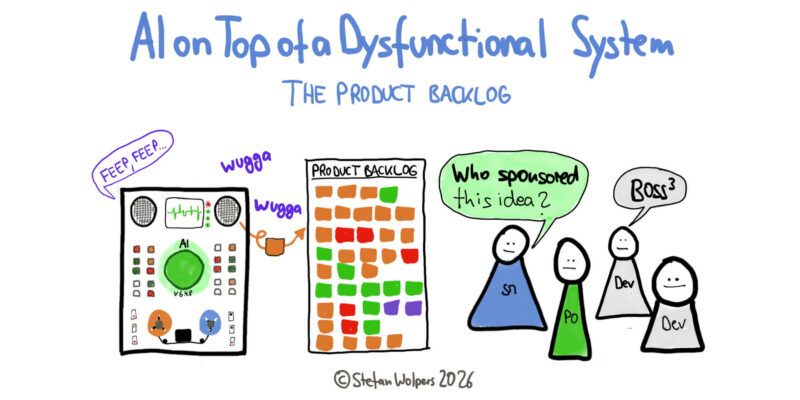
TL;DR: Polished Artifacts, Unchanged Decisions, Or Ten Backlog Anti-Patterns AI Makes Worse
Add AI to a Product Backlog process that already struggles, and everything seems to improve within an afternoon. The problem is that polishing artifacts with AI doesn’t fix the root cause: the basis for the team’s decisions doesn’t change; AI only removes the visible discomfort that used to signal something was broken, along with some of the pressure to fix it. AI applied to a dysfunctional system – here, the Product Backlog process – makes the dysfunction look like progress.
This is the first article of a new series that explains the uselessness of bolting AI onto a dysfunctional system. It explains why generative AI worsens ten Product Backlog anti-patterns, how polished AI artifacts can hide missing evidence and authority, and how teams can check whether their process is fit for AI.
The example anti-patterns accelerated by AI are from my Scrum Anti-Patterns Guide book.
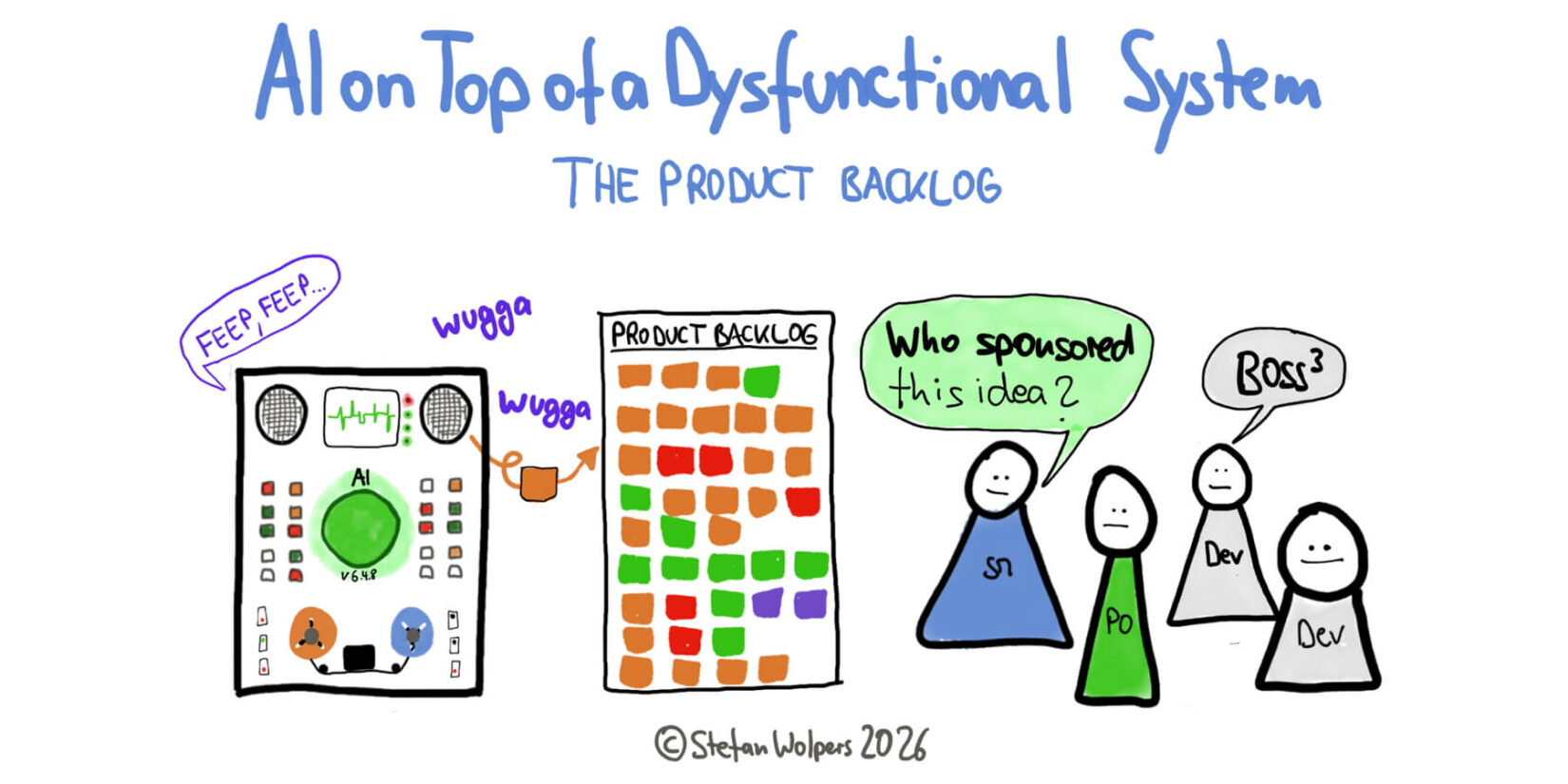
Thesis: Adding AI onto a dysfunctional system, for example, the Product Backlog, makes ten typical backlog anti-patterns worse, because polished AI artifacts hide missing customer evidence, decision authority, and feedback; the article explains these mechanisms, their costs, and how teams test whether their process is ready for AI.
Disclaimer: I am among those who read Charniak/McDermott’s book on “Artificial Intelligence” decades ago; of course, I use AI for research, translations, proofreading, challenging story arcs and article structures, and summarization. It is a production tool, not a substitute for thinking.
🎓 🇬🇧 The A3 Delegation System Founding Workshop to Make Your AI Transformations Work — September 28-29, 2026
Your team already delegates work to AI: reports, research, customer feedback analysis, stakeholder communication, or parts of operational workflows.
But can you answer these questions without improvising?
- What may AI decide, and what must remain a human decision?
- What does “good enough” mean for this particular work?
- Who verifies the result before somebody acts on it?
- Who checks whether the delegation still works after the model or workflow changes?
If those answers live in one person’s head, or nowhere, your problem is no longer prompting. You have a delegation problem.
The A3 Delegation System gives you a practical way to decide what AI may do, hand over the work clearly, define acceptable results, and inspect the delegation over time.
During two hands-on sessions, you will apply the system to a workflow. You will leave with a clear understanding of how to apply the A3 Delegation System to your workflows so that team members or stakeholders can understand, challenge, and continue your AI delegation work. Everything you learn is directly applicable to your situation the next day. The class is in English.

👉 Join the Workshop Now — $199: The A3 Delegation System Founding Workshop — September 28-29, 2026
🇩🇪 Zur deutschsprachigen Version des Artikels: KI auf einem dysfunktionalen System (1): Das Produkt-Backlog?
🗞 Shall I notify you about articles like this one? Awesome! You can sign up here for the ‘Food for Agile Thought’ newsletter and join 35,000-plus subscribers.
🎓 Join Stefan in one of his upcoming training classes!
A Scenario You May Recognize
Consider the following scenario: A Product Owner under pressure feeds stakeholders’ requirement documents into an LLM, adds context such as the product roadmap or access to Jira. Soon, the Product Backlog holds 40 new items, each with a user story, five acceptance criteria, and an “estimated” size. Next Monday, Sprint Planning runs smoothly, and the stakeholders are delighted: finally, the team seems “ready.”
Now ask the four questions nobody asked:
- Which customer problem does this work address?
- Whose evidence says it matters?
- Which alternative did the team consider and reject?
- And who could have stopped it?
If the answers are “whatever the stakeholders requested,” “none,” “none,” and “nobody,” the process didn’t improve; it just stopped showing its flaws. (You may recall that Agile is really good at exposing problems, issues, and flaws.)
What Must Work Before You Accelerate the Process
Product Backlog management runs in a loop. What the team knows and assumes informs its product choices, and refinement exposes the uncertainty in those choices. Experiments, research, and delivered Increments then put those choices in front of customers and produce new evidence, which changes the next choices. That is why the Product Backlog is emergent, and every item comes with an implicit “based on what we know now.” Work may legitimately enter the Product Backlog to investigate an open question; what matters is that people distinguish what they know from what they still need to learn and pick a suitable next step. If a team fails to feed valuable work into this loop, however, Scrum will be just as effective at building things no one needs: garbage in, garbage out. (Keep in mind that Scrum can be an effective delivery framework, but it completely lacks the product discovery part.)
Refinement is a continuous activity within that loop, and it produces a shared understanding sufficient to make the next investment decision, including the decision not to build something at all. Selecting work for a Sprint happens later, in Sprint Planning, once the team has decided on a Sprint Goal: what is most valuable to create?
A dysfunctional Product Backlog process usually announces itself: thin items, awkward Sprint Planning sessions, arguments about scope in the middle of a Sprint. That discomfort is useful, as it is the evidence a Scrum Master brings to the Retrospective and a Product Owner brings to stakeholders. AI can remove it without removing its cause. The Scrum Guide 2020 warning then applies literally: “Transparency enables inspection. Inspection without transparency is misleading and wasteful.”
Google’s announcement of the 2025 DORA report, based on survey responses from nearly 5,000 technology professionals, describes the general pattern: “AI doesn’t fix a team; it amplifies what’s already there.” The same announcement reports positive associations between AI adoption and both delivery throughput and product performance, alongside a continued negative association with delivery stability (Announcing the 2025 DORA Report). The findings cited do not establish the ten mechanisms described below; applying the amplification argument to them is my interpretation.
AI can help repair a dysfunctional process if you deliberately use it to expose gaps: list the assumptions behind an item, find contradictions between a stakeholder request and the Product Goal (or the equivalent planning objective), or organize customer evidence the team already has. However, that only works while everyone stays aware of what the tool is doing. Polished artifacts fool people quickly into believing that AI is doing the real job, and teams need to be very careful not to fall into that trap. The useful question is whether an AI output makes evidence, assumptions, and alternatives easier to examine, or easier to skip. The dangerous intervention is the second: generating more apparently implementation-ready work before addressing the gaps. (AI, given the right context, is really good at papering over flaws and polishing its output.)
Cannot see the form? Please click here.
What “Functional” Means Compared to a Dysfunctional System
A functional Product Backlog process does not need to be flawless, fully documented, or unchanging. It needs to detect and correct poor decisions, which depends on three things:
- Direction: A customer problem or Product Goal makes a piece of work worth considering in the first place.
- Authority: Someone can challenge, change, or reject proposed work, and the organization respects that decision.
- Feedback: When delivery shows that an assumption was wrong, something changes in later decisions.
The ten anti-patterns resulting from putting AI on top of a dysfunctional system below fail on one or more of these, and they fall into three groups:
AI on Top of a Dysfunctional System, Group 1: Choosing Work Without Evidence
1. Prioritization by Proxy
Stakeholders decide what goes into the Product Backlog, and the Product Owner passes their decisions on. With an LLM, a stakeholder now arrives with a ten-page requirements document, including personas and success metrics, produced in an afternoon. The polish does not create the power imbalance; it makes the existing one harder to confront, because rejecting a document that looks finished feels like obstruction and puts your career at risk. A better refinement session will not restore product management here, since the problem lies in who holds decision authority. The team becomes an internal development agency, only faster, and the question of whether something else would serve customers better never gets asked, because the polished document seems to have answered it already.
2. The Oracle Product Owner
The Product Owner involves neither stakeholders nor subject matter experts, and the Product Backlog contains no research tasks, such as building prototypes or spikes. The AI version consults a model instead: synthetic personas and a generated market analysis. Source-backed desk research is legitimate work; the failure occurs when generated hypotheses acquire the status of observed customer demand. Product discovery gets skipped while looking complete, and the team then builds the wrong thing with considerable confidence, which may well be the most expensive way of building it, even if agentic coding makes building simpler. Without relevant customer evidence, generated personas and market narratives remain hypotheses, no matter how convincing they sound.
3. The Copy & Paste Product Owner
The Product Owner breaks stakeholder requirement documents into smaller chunks. A model does this in seconds and returns neatly sliced items. Smaller items, however, do not make the underlying solution appropriate, nor does decomposing a document turn it into incremental learning. The Product Backlog commits prematurely to one solution, and nobody on the team has to understand the problem well enough to propose a cheaper or better-fitting one. The Product Backlog thereby fills with the stakeholder’s solution, cut into Sprint-sized portions, and the later slices quietly turn into assumed commitments, which discourages the team from learning anything from the first slice before building the next one.
4. 100% in Advance
The organization asks the team to rebuild a legacy application one-for-one, so the team prepares the complete Product Backlog upfront. With AI, a model reads the old codebase and produces an apparently complete specification with hundreds of items. The danger lies in treating that extracted description of the existing system as the approved specification for its replacement, including every workaround users have complained about for years. A rebuild is a rare opportunity to improve processes and usability; treating a generated inventory as fixed scope quietly closes that opportunity. I worked with a Scrum Team on such a rebuild for a large utility, and the team delivered two weeks early and under budget while streamlining processes and improving usability; all gains came from questioning inherited requirements. An extracted specification can even make existing behavior easier to question.
AI on Top of a Dysfunctional System, Group 2: Turning Assumptions Into Apparent Readiness
5. Refinement Without the Team
The Product Owner refines with the “lead engineer” and a designer, while the other Developers prefer creating code by herding agents. Asynchronous comments and preparation by a subset of the team are not dysfunctional as such; the problem arises when consequential disagreement never gets resolved. Estimation shows it best. The number was never the point; comparing estimates reveals whether Developers have the same work in mind before they start, as I argued in Estimates Are Useful, Just Ditch the Numbers. Accept an AI-suggested size without independent examination, and no one ever surfaces the split in opinion; the different ideas still exist, but nobody learns about them until the Sprint is underway.
6. Cosmetic Readiness
All items look thoroughly detailed and estimated, yet the team has not applied INVEST in substance. AI makes every item look ready: correct template, complete fields, a checklist passed. Proper formatting, however, cannot prove what readiness depends on: credible evidence, understood uncertainty, workable dependencies, and shared understanding. A model can propose alternatives and analyze potential value; it cannot assert customer value or make an organization willing to negotiate. Sprint Planning then selects work that looks transparent but isn’t, and the Developers discover missing understanding mid-Sprint, after implementation has started, and correcting it may require rework.
7. Acceptance Criteria Inflation
The Product Owner covers every conceivable edge case without negotiating with the Developers. Ask a model for acceptance criteria, and you will typically receive a long list of plausible conditions. My heuristic is that three to five acceptance criteria usually suffice, and needing more often indicates the item needs splitting. The count, as such, is not the problem; the problem is criteria that expand scope without support or add constraints nobody examined, which the team’s agents then build without evidence that real users need them. A separate risk arises when criteria start prescribing the solution instead of describing the required behavior: then the Product Owner drifts from the why and the what into the how, which belongs to the Developers, and the Developers end up negotiating with a document instead of a colleague. This is a particular challenge nowadays, when many organizations expect their product managers or product owners to be product builders, vibe-coding the prototype themselves.
8. The Last-Minute Product Backlog
The team does not invest in Product Backlog management and rushes to fill the Product Backlog right before Sprint Planning. Before AI, the scramble was visible: thin items, a random assortment of stuff to fill the Sprint and appear busy, consequently resulting in a “Sprint Goal” nobody could explain. Now, an hour of prompting produces items that look as if the team had refined them for weeks. The preparation gap becomes much harder to see, although rework, confusion, and missed goals may still expose it later, by which point the cost has already been incurred.
AI on Top of a Dysfunctional System, Group 3: Expanding Work Beyond the Capacity to Inspect and Sustain It
9. The Infinite Product Backlog
Oversized Product Backlogs, Product Backlogs used as storage for ideas, and items nobody has touched for months predate AI. The economics change, though: generating candidates becomes nearly free, while assessing, ordering, and maintaining them still consumes the same human attention. If nobody moves anything to a separate list of permanently or temporarily discarded ideas, what I call the “Anti-Product Backlog,” the most valuable items get buried in noise, and the ordering stops informing any decision. At that point, the Product Owner administers a database, and the team, facing hundreds of plausible items, stops reading the Product Backlog altogether. (Of course, you can instruct an agent to go through that list and flag all entries the agent believes offer no value. But this is a cleanup operation, not a proper process.)
10. What Technical Debt?
The team ships feature after feature, and the Product Backlog reserves no capacity for bugs, refactoring, or platform maintenance. AI-assisted development increases the volume of change, and DORA’s findings on delivery stability point to the risk when control systems, such as automated testing and fast feedback loops, are weak. This is, above all, a product decision: if the organization rewards feature output and never negotiates quality expectations or capacity trade-offs, AI will produce more features faster, and customers will experience the result as instability, not to mention that they are unlikely to pay for the flood of new features they never asked for.
The Cost of Apparent Efficiency
“We created the Product Backlog faster” is an incomplete business case, but typical for bolting AI onto a dysfunctional system. Consider an illustration, not a measured result: saving six hours of preparation has little value if unsupported scope then consumes three Sprints of delivery capacity, plus the review effort for AI output nobody inspected closely, the rework once users react, and the maintenance of features nobody needed. Meanwhile, the more valuable problem waits, and your competitors move ahead.
When reporting after an AI rollout focuses on preparation time, the number of refined items, time spent on creating shared understanding, and the duration of Sprint Planning, none of these costs show up. The dashboard looks like a success while the expensive part of the path, building and maintaining the wrong things, sits in a different budget line and appears months later.
Therefore, evaluate the whole path, from identifying a customer problem to learning whether the delivered change helped, including the effort it takes to inspect what the model produced. The costs also compound: every unexamined decision that “worked” teaches the organization that examination is optional. You can apply the A3 Delegation System to the problem to get a better understanding where AI may support in the process, and where you should avoid using AI, what “good quality of AI outputs” looks, and how to bring transparency to your team’s use of AI.
Conclusion: Can Your Process Reject the Wrong Work?
Before you accelerate product work by employing AI on top of a dysfunctional system, establish that your organization can question the work’s justification, reject it, and learn whether it helped. Inspect a recent, important Product Backlog item and ask yourself which of the following criteria are true for your team:
- Grounding work in a problem: The team can name the evidence supporting the item and distinguish it from assumptions.
- Making choices: Someone can explain why the item took precedence and name a plausible request that was rejected or deferred.
- Exposing uncertainty: The people involved can name open questions and explain how they affect the next step.
- Exercising authority: The accountable person can change or stop the work when its justification fails.
- Learning from results: Feedback from delivered work has changed a later product decision.
A first round producing convincing answers is rarely enough, so follow up and ask for recent examples:
- Which proposed item did the team stop or materially change because its evidence was weak?
- Which discovery or delivery result changed the next product decision?
- When did someone last exercise the authority the team claims to have?
If nobody can point to such examples, generating more apparently ready work will only make the gap harder to see, although AI may still help you expose it.
Key Questions This Article on the Effects of Employing AI on Top of a Dysfunctional System Answers
How Does AI Make Product Backlog Anti-Patterns Worse?
AI makes a dysfunctional Product Backlog process look functional, a typical first impression of bolting AI onto a dysfunctional system. It produces polished items, acceptance criteria, and estimates within minutes, while the basis for the decisions stays the same: missing customer evidence, unclear decision authority, and no working feedback loop. The visible discomfort that used to expose the problem, such as thin items or chaotic Sprint Planning sessions, disappears, and with it some of the pressure to fix the process.
Should a Scrum Team Use AI to Write User Stories and Acceptance Criteria?
Only if the team’s Product Backlog process can already detect and correct poor decisions. AI generates user stories and long lists of acceptance criteria quickly, yet formatting cannot prove credible evidence, understood uncertainty, or shared understanding. Generated criteria also tend to expand scope without support; as a heuristic, three to five acceptance criteria usually suffice, and needing more often signals that the item needs splitting.
How Can a Team Tell Whether Its Product Backlog Process Is Ready for AI?
A process is ready when the organization can question the justification of work, reject it, and learn whether it helped. Test it with recent behavior instead of convincing answers: Which proposed item did the team stop or materially change because its evidence was weak? Which delivery result changed the next product decision? And when did someone last exercise the authority to stop work?
Can AI Help Fix a Dysfunctional Scrum Process?
Yes, when the team deliberately uses AI to expose gaps and stays aware of what the tool is doing. Useful applications include listing the assumptions behind a Product Backlog item, finding contradictions between a stakeholder request and the Product Goal, and organizing customer evidence the team already has. The dangerous use is generating more apparently implementation-ready work before those gaps are addressed.
Why Does Creating a Product Backlog Faster With AI Not Save Money?
Hours saved in preparation lose their value when unsupported scope consumes weeks of delivery capacity. The full cost includes reviewing AI output, rework once users react, maintaining features nobody needed, and the delay in addressing more valuable problems. Reports that focus on preparation time, refined item counts, or Sprint Planning duration miss these costs, because they appear months later in different budget lines.
AI on Top of a Dysfunctional System — Related Posts
Webinar: The A3 Delegation System for AI, Scrum.org, October 6, 2026
27 Product Backlog and Refinement Anti-Patterns
The AI Definition of Done: Human in the Loop Is Not a Quality Standard
The A3 Framework: Assist, Automate, Avoid — A Decision System for AI Delegation

👆 Stefan Wolpers: The Scrum Anti-Patterns Guide (Amazon advertisement.)
📅 Training Classes, Workshops, and Events
Learn more about the effects of bolting AI on Top of a Dysfunctional System with our AI and Scrum training classes, workshops, and events. You can secure your seat directly by following the corresponding link in the table below:
| Date | Class and Language | City | Price |
|---|---|---|---|
| 🖥 💯 🇬🇧 Sep 28-29, 2026 | GUARANTEED: A3 Delegation System Founding Workshop (English; Live Virtual Class) | Live Virtual Class | $199 incl. 19% VAT (If applicable.) |
| 🖥 💯 🇩🇪 Sep 30 to Oct 1, 2026 | GUARANTEED: Professional Scrum Product Owner Training (PSPO I; German; Live Virtual Class) | Live Virtual Class | €999 incl. 19% VAT (If applicable.) |
| 🖥 🇬🇧 October 15 to November 5, 2026 | AI4Agile BootCamp #9 (English; Live Virtual Cohort) | Live Virtual Cohort | €499 incl. 19% VAT (If applicable.) |
| 🖥 🇩🇪 Nov 3-4, 2026 | Professional Scrum Product Owner Training (PSPO I; German; Live Virtual Class) | Live Virtual Class | €1189 incl. 19% VAT (If applicable.) |
| 🖥 🇩🇪 Dec 8-9, 2026 | Professional Scrum Product Owner Training (PSPO I; German; Live Virtual Class) | Live Virtual Class | €1189 incl. 19% VAT (If applicable.) |
| 🖥 🇬🇧 Dec 15-16, 2026 | Professional Scrum Master – Advanced Training (PSM II; English; Live Virtual Class) | Live Virtual Class | €1189 incl. 19% VAT (If applicable.) |
See all upcoming classes here.

You can book your seat for the training directly by following the corresponding links to the ticket shop. If your organization’s procurement process requires a different purchasing approach, please contact Berlin Product People GmbH directly.
✋ Do Not Miss Out and Learn More about AI on Top of a Dysfunctional System — Join the 20,000-plus Strong ‘Hands-on Agile’ Slack Community
I invite you to join the “Hands-on Agile” Slack Community and enjoy the benefits of a fast-growing, vibrant community of agile practitioners from around the world.

If you would like to join, all you have to do now is provide your credentials via this Google form, and I will sign you up. By the way, it’s free.
