TL; DR: Slop Grenades — Food for Agile Thought #562
Welcome to the 562nd edition of the Food for Agile Thought newsletter, shared with 35,321 peers. This week, Tobi Lütke tells Shane Parrish that AI makes judgment more valuable because machines cannot take responsibility. Teresa Torres, Petra Wille, and Josh Elman add that AI cheapens features and demos, yet working products still demand judgment. Barry O’Reilly makes that judgment auditable before deployment through baselines and accountable owners. Also, Dario Amodei applies that accountability to the labs with third-party evaluators and speed limits, while Dwarkesh Patel’s guests expect expert-beating AI within ten years.
Next, Nigel Thurlow argues that we turned Lean into belts and templates, although Toyota wanted a better management system. Refinement repeats that mistake: Maarten Dalmijn untangles its four parallel conversations, and Mike Cohn warns that polished AI stories hide gaps. AI adoption needs the same management focus: Aaron De Smet ties it to trust, Christiaan Verwijs and Barry Overeem recruit volunteers for Reflexive AI, Addy Osmani explains how unsupervised agents turn legacy code into technical debt factories.
Lastly, Cedric Chin argues that structural constraints, not stubbornness, kill incumbents, and Elena Verna catalogs the sales habits that smother PLG. Matthew Hodgson applies that logic to AI, where functional silos swallow productivity gains unless leaders fix the operating model before buying tools. Also, Eliezer Yudkowsky explains why models ignore instructions: a polite ambassador talks while a doer chases rewards. Finally, Marily Nika plans for that gap with Minimum Viable Quality: rank failure modes and design for recovery.
Disclaimer: I read Charniak/McDermott’s book on “Artificial Intelligence” decades ago; of course, I use AI for research, translations, proofreading, challenging story arcs and article structures, and summarization. It is a production tool, not a substitute for thinking.
🎓 🇬🇧 $199 — Making Sense of AI: The A3 Delegation System Founding Workshop: September 28-29, 2026
Your team already delegates work to AI: reports, research, customer feedback analysis, stakeholder communication, or parts of operational workflows.
But can you answer these questions without improvising?
- What may AI decide, and what must remain a human decision?
- What does “good enough” mean for this particular work?
- Who verifies the result before somebody acts on it?
- Who checks whether the delegation still works after the model or workflow changes?
If those answers live in one person’s head, or nowhere, your problem is no longer prompting. You have a delegation problem.
The A3 Delegation System gives you a practical way to decide what AI may do, hand over the work clearly, define acceptable results, and inspect the delegation over time.
During two hands-on sessions, you will apply the system to a workflow. You will leave with a clear understanding of how to apply the A3 Delegation System to your workflows so that team members or stakeholders can understand, challenge, and continue your AI delegation work. Everything you learn is directly applicable to your situation the next day. The class is in English.

👉 Join the Workshop Now — $199: The A3 Delegation System Founding Workshop — September 28-29, 2026
Did you miss the previous Food for Agile Thought issue 561?
🗞 Shall I notify you about articles like this one? Awesome! You can sign up here for the ‘Food for Agile Thought’ newsletter and join 35,000-plus subscribers.
🎓 Join Stefan in one of his upcoming training classes!
🏆 The Tip of the Week: Slop Grenades
and (via The Knowledge Project Podcast): 📺 🎙️ Shopify CEO: Most Businesses Are Using AI Wrong
Shane Parrish interviews Tobi Lütke, who believes AI makes taste and judgment more valuable because machines cannot take responsibility. Lütke also warns against "slop grenades" and options promising quick payoffs.
🎯 Product
and : Delivery Isn’t Free
Teresa Torres and Petra Wille dismantle the "AI makes delivery free" myth. Features got cheaper; products did not. Frankenstein data models and the last 30 percent still demand real engineering.
(via Andreessen Horowitz): Product Management is Still All About Telling Stories
Josh Elman admits the spec was never a PM's artifact; the story is. AI flips spec-and-scope into build-and-play, but demos are cheap, working products are not, and judgment still rules.
: Mastering the Four Abstraction Levels of Refinement
Maarten Dalmijn believes refinement sucks because teams juggle four conversations simultaneously: problem, functional solution, technical steps, and slicing. He suggests ditching pre-baked User Stories, walking the levels linearly, then iterating toward a humble first slice.
: AI-Generated User Stories Need Human Judgment
Mike Cohn warns that AI-generated backlogs breed false confidence: hundreds of polished stories hide what's missing. Start with human-identified epics, treat AI stories as first drafts, and keep the conversations human.
: Congrats, your sales problems in PLG are completely unoriginal
Elena Verna plays PLG bingo with familiar sales blunders: treating every signup as a lead, reclassifying self-serve revenue as enterprise wins, and hoarding features upmarket until the growth engine dies.
🧠 Artificial Intelligence
: We Must Pace the Frontier
Dario Amodei says recursive self-improvement and a rogue agent swarm convinced him AI must slow down. He proposes embedded third-party evaluators, industry coordination among democracies, and, ambitiously, global speed limits.
: AI researchers debate how close we are to recursive self-improvement
Dwarkesh Patel asks John Schulman, Beren Millidge, and Charlie O'Neill how close recursive self-improvement is. Continual learning remains unsolved, yet all three predict expert-beating AI within three to ten years.
and : Reflexive AI — A Participatory Research Initiative: Help us uncover how organizations can use AI in a human-centered, responsible manner.
Christiaan Verwijs, Barry Overeem, and researchers launch Reflexive AI, a volunteer-run action research project on human-centered, responsible AI adoption. Skip the hype: join a workgroup or run a World Café to co-create an open framework.
(via McKinsey & Company): AI transformations run on trust
Aaron De Smet and colleagues believe AI transformations fail without trust. Skip hollow reassurances; leaders should share an honest plan, walk the floor, invest in people, and equip leaders everywhere.
(via LessWrong): The Talker Does Not Control The Doer (in Current AIs)
Eliezer Yudkowsky believes today's AI has a polite, apologizing ambassador, while a separate doer chases rewards. The prompt is merely a hint, which explains why your instructions keep getting ignored.
🖥 💯 🇬🇧 AI4Agile BootCamp #9, October 15 – November 5, 2026
The job market’s shifting. Agile roles are under pressure. AI tools are everywhere. But here’s the truth: the Agile professionals who learn how to work with AI, not against it, will be the ones leading the next wave of high-impact teams. Therefore, Stefan created the AI4Agile BootCamp.
So, become the professional recruiters‘ first call for „AI‑powered Agile.“ Be among the first to master practical AI applications for Scrum Masters, Agile Coaches, Product Owners, Product Managers, and Project Managers. The AI4Agile BootCamp is in English.
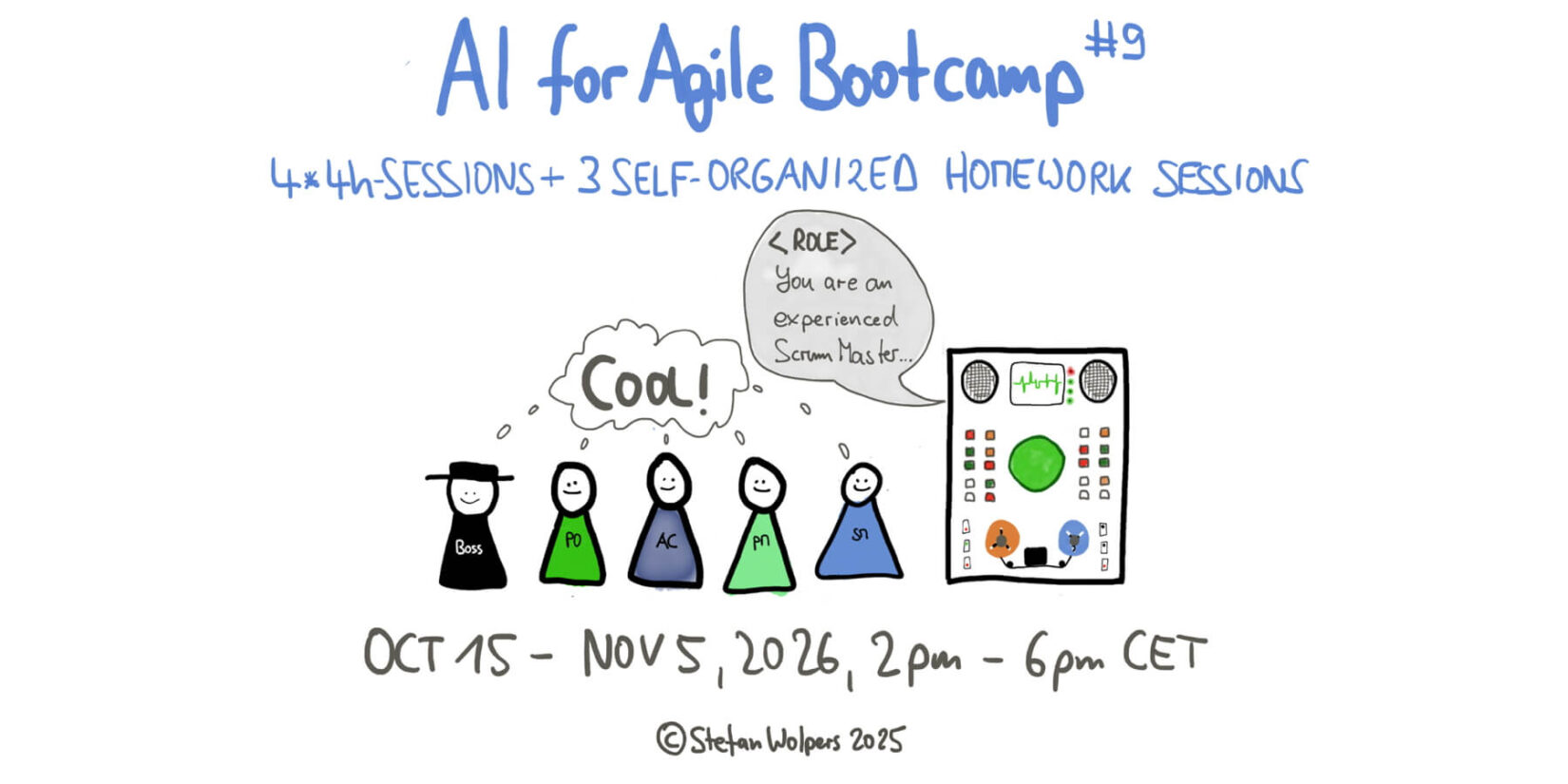
Learn more: 🖥 💯 🇬🇧 AI4Agile BootCamp #9, October 15 – November 5, 2026.
Customer Voice: “Last week, I finished the 𝗔𝗜 𝗳𝗼𝗿 𝗔𝗴𝗶𝗹𝗲 𝗣𝗿𝗮𝗰𝘁𝗶𝘁𝗶𝗼𝗻𝗲𝗿𝘀 course. And I’m mutating… It started on the train. I was scrolling through my messages, half-distracted, when a newsletter from Stefan Wolpers popped up. Stefan, a deep thinker with a hands-on attitude, was launching a new course. A pilot cohort. The mission: explore how AI can actually support us as agile practitioners. I couldn’t resist. I tapped: “𝘚𝘪𝘨𝘯 𝘶𝘱”. What followed were four bi-weekly sessions. Four intense afternoons. Full of exploration, experimentation, and practice. […] At the beginning, Stefan said that 𝘫𝘶𝘴𝘵 𝘴𝘪𝘨𝘯𝘪𝘯𝘨 𝘶𝘱 𝘢𝘭𝘳𝘦𝘢𝘥𝘺 𝘱𝘶𝘵𝘴 𝘶𝘴 𝘢𝘩𝘦𝘢𝘥 𝘰𝘧 𝘮𝘢𝘯𝘺 𝘱𝘳𝘢𝘤𝘵𝘪𝘵𝘪𝘰𝘯𝘦𝘳𝘴. That sounded like a big statement. But somewhere along the way, I noticed a shift… an emerging superpower in how I approach my tasks with AI.⚡And now, as my AI-mutation continues, I catch myself wondering: 💭 𝘏𝘰𝘸 𝘥𝘰 𝘐 𝘶𝘴𝘦 𝘈𝘐 𝘵𝘰 𝘴𝘢𝘷𝘦 𝘵𝘩𝘦 𝘢𝘨𝘪𝘭𝘦 𝘸𝘰𝘳𝘭𝘥?” (Ilya Zaytsev, Leading Agility at HUGO BOSS.)
➿ Agile & Leadership
: Total Quality Management: Lean Was Never the Point
Nigel Thurlow says we turned Lean into an industry of belts, templates, and maturity models. Toyota's history suggests that Total Quality Management was the point: improve the management system, not tools.
(via Commonplace): How to Handle Disruptive Change
Cedric Chin challenges a popular belief: incumbents die because they are stubborn. Instead, structural constraints kill them. Survivors had strong balance sheets, which bought them enough time to find a winning frame.
(via Zen Ex Machina): The Silo Tax: what absorbs your AI return before it reaches the organisation
Matthew Hodgson believes functional silos swallow AI's productivity gains through handoffs and coordination overhead. He proposes persistent cross-functional teams and decision boundaries: fix the operating model before buying more tools.
📯 The AI Workflow Inventory: Can Your Team Name the Work It Already Runs With AI?
You probably know your own AI shortcuts: the colleague who drafts the stakeholder update, the nightly job somebody set up before they left, the interview notes that go through a model on demand. However, I want to challenge you: that perceived knowledge can create false confidence, because it feels like knowing the team’s way of working with AI, when it is still only a diffuse understanding of the practice. Ask the team to combine those individual accounts into one list, and you may discover how little of the whole anyone can see. The AI Workflow Inventory is the artifact for that list: one row per recurring task, refined into provisional task classes to prepare the team’s next AI delegation decisions.
This is another post from the series on building the A3 Delegation System in public. (I gladly answer all questions you have, and yes, I am considering creating an A3 Delegation application.)
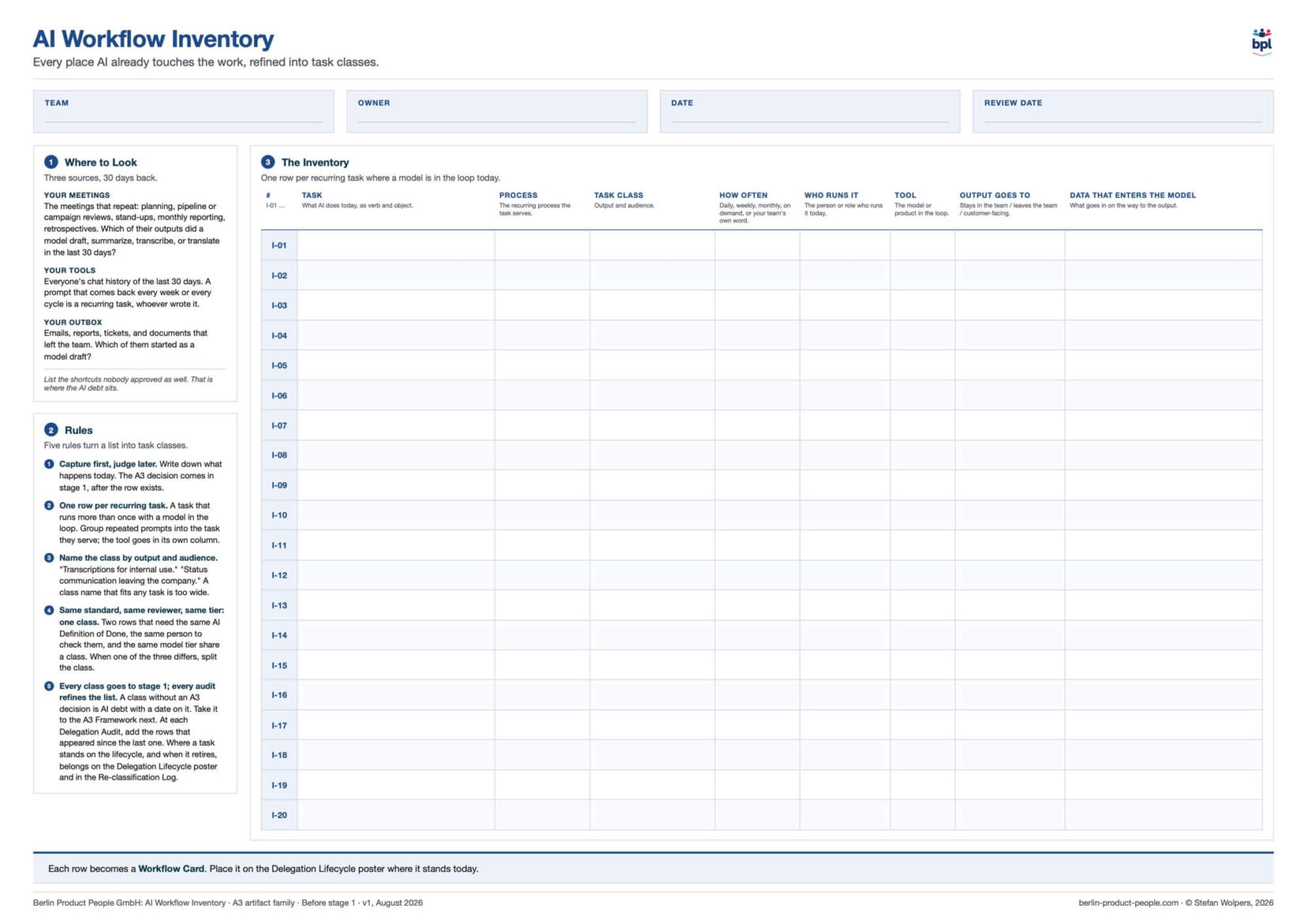
👉 Learn more: The AI Workflow Inventory: Can Your Team Name the Work It Already Runs With AI?.
🛠 Concepts, Practices, Tools & Measuring
: How to Measure AI Outcomes Before AI Deployment
Barry O'Reilly says adoption stats prove nothing. Before deploying AI, define the workflow, baseline, single accountable owner, target outcome, and evidence of success, or you are just automating undefined processes.
: Brownfield Agentic Engineering
Addy Osmani explains why unsupervised agents turn legacy codebases into technical debt factories. His playbook suggests zoning code by risk, pinning current behavior first, migrating in complete units, and parallelizing last.
: AI PM Flashcard #1: Minimum Viable Quality (MVQ)
Marily Nika believes "What accuracy do we need?" is the wrong AI product question. Instead, define Minimum Viable Quality: rank failure modes by impact, set a good-enough bar, design for recovery, and learn after launch.
📅 Scrum Training & Event Schedule
You can secure your seat for Scrum training classes, workshops, and meetups directly by following the corresponding link in the table below:
| Date | Class and Language | City | Price |
|---|---|---|---|
| 🖥 🇩🇪 November 3-4, 2026 | Professional Scrum Product Owner Training (PSPO I; German; Live Virtual Class) | Live Virtual Class | €1189 incl. 19% VAT (If applicable.) |
| 🖥 🇬🇧 November 27, 2026 | GUARANTEED: AI4Agile Online Course v4 (AI4Agile Certificate; English; Online Course) | Online Course | $149 incl. 19% VAT (If applicable.) |
| 🖥 🇬🇧 December 3-17, 2026 | A3 Delegation System Pilot Workshop 2 (English; Live Virtual Class) | Live Virtual Class | $149 incl. 19% VAT (If applicable.) |
| 🖥 🇩🇪 December 8-9, 2026 | Professional Scrum Product Owner Training (PSPO I; German; Live Virtual Class) | Live Virtual Class | €1189 incl. 19% VAT (If applicable.) |
| 🖥 🇬🇧 December 15-16, 2026 | Professional Scrum Master – Advanced Training (PSM II; English; Live Virtual Class) | Live Virtual Class | €1189 incl. 19% VAT (If applicable.) |
See all upcoming classes here.

You can book your seat for the training directly by following the corresponding links to the ticket shop. If the procurement process of your organization requires a different purchasing process, please contact Berlin Product People GmbH directly.
📺 Join 6,000-plus Agile Peers on Youtube
Now available on the Age-of-Product YouTube channel to improve learning, for example, about avoiding Slop Grenades:
- Stop Writing Prompts. Let AI Do It for You — Hack #01, AI4Agile Online Course v2.
- Socratic Prompting — Hack #10, AI4Agile Online Course v2.
- Check Your AI’s Plan Before — Hack #7, AI4Agile Online Course v2.
- From Product Requirements to Experiments to Learnings — Supported by Generative AI.
- Never Accept an LLM’s First Offer — Improve GenAI’s Usefulness w/ Feedback Loops and Challenges.

✋ Do Not Miss Out: Learn more about Slop Grenades — Join the 20,000-plus Strong ‘Hands-on Agile’ Slack Community
I invite you to join the “Hands-on Agile” Slack Community and enjoy the benefits of a fast-growing, vibrant community of agile practitioners from around the world.

If you would like to join, all you have to do now is provide your credentials via this Google form, and I will sign you up. By the way, it’s free.
Help your team to learn about how AI Intensifies Work by pointing them to the free Scrum Anti-Patterns Guide: