TL; DR: AI Token Fraud — Food for Agile Thought #571
Welcome to the 571st edition of the Food for Agile Thought newsletter, leading with AI Token Fraud and shared with 35,168 peers.
📺 Short on time? Watch the 68-second teaser video now!
This week, Claire Vo shows free AI trials give fraudsters compute, while Michael Goitein warns AI savings aren’t free when leaders cut roles without asking whether they hold tasks or jobs. Pavel A. Samsonov sees outages born of velocity obsession, Itamar Gilad rejects ICE rankings that replace discussion, and Lake Faith treats throwaway tools as planning. Also, Allan Kelly finds Toyota’s Chief Engineer fits Product Management on curiosity, going to the source, and schedule discipline.
Next, Elizabeth Silliman, Jack Trotter, and Kelsey Robinson see agentic commerce becoming e-commerce’s new engine despite unready infrastructure, while Tomasz Tunguz believes companies block shopping agents to protect upsell profits. Nicolas de Bellefonds et al. recommend owned agents as AI search optimization commoditizes, and Jim O’Shaughnessy and Jun Kwak discuss Kwak’s belief that SaaS must become services. Rob Strechay finds cost, not compute, stalls AI projects, and only 26% can defend returns to finance.
Lastly, Jenny Wanger advises new executives to weigh options against themselves, their department, or the company, while Mike Fisher wants reorganizations measured. Roberto Priolo judges AI by whether freed hours return to workers, and Mark Graban interviews Jeffrey Liker, who sees technology as a countermeasure to defined problems. Vanitha Kumar proposes costing agents per completed task, Eric T. Bradlow recommends matching models to tasks, and Mike Cannon-Brookes sees AI shifting the hard work to planning, review, testing, and release.
Disclaimer: I read Charniak/McDermott’s book on “Artificial Intelligence” decades ago; of course, I use AI for research, translations, proofreading, challenging story arcs and article structures, and summarization. It is a production tool, not a substitute for thinking.
🎓 🇬🇧 The AI4Agile Online Course v4 — November 27, 2026, at $149 — Join the Waitlist
Sooner or later, a CFO will ask what your AI use actually returns. “It saves me time” will not survive that meeting.
The first wave of AI adoption rewarded practitioners who learned to prompt. That skill still matters, and this course still teaches it. The second wave rewards something rarer: people who can turn individual AI use into knowledge that survives departures, spend that can be explained and steered, and output that organizations can trust. That work is process design and change management. You have been doing both for years, on harder problems than this.
BRAND-NEW: Hands-on exercises to build AI Agents, with your tactical work, covering, for example, Jira-based stakeholder reports, product discovery, AI Impact on metrics, or preparation for backlog refinement. All exercises use realistic data and context to simulate reality as closely as possible in a fail-safe environment.
EXCLUSIVE: The new A3 Delegation Lifecycle System with seven ready-to-use templates, from the AI Workflow Inventory to the AI Definition of Done to the AI Working Agreement, to make sense of delegating work to AI models.
The AI 4 Agile Online Course v4 is in English. 🇬🇧
What You Will Get:
✅ New agent-based exercises: Jira report, product discovery, refinement prep, measuring AI impact ✅ 4 Live onboarding sessions ✅ A cohort-hardened, proven course design ✅ Learn to 10x your effectiveness with AI; your stakeholders will be grateful ✅ Apply AI to classic use cases of “Agile” ✅ The A3 Delegation System comprising seven ready-to-use templates ✅ All texts, slides, prompts, and graphics ✅ Guaranteed: Lifetime access to v4 ✅ AI4Agile Foundation Certificate: 40 questions in 45 minutes.

👉 Please note: The course will be available for $149 from November 27-30, 2026! (After that, $249.) 👈
🎓 Join the Waitlist now and be the first to know: The AI4Agile Online Course v4 — November 27, 2026, at $149 — No Coding Required!
Did you miss the previous Food for Agile Thought issue 570?
🗞 Shall I notify you about articles like this one? Awesome! You can sign up here for the ‘Food for Agile Thought’ newsletter and join 35,000-plus subscribers.
🎓 Join Stefan in one of his upcoming training classes!
🏆 The Tip of the Week: AI Token Fraud
: 📺 Token fraud is here and it’s BAD. Here’s what you need to know.
Claire Vo shows why a free AI trial is a compute giveaway: fraudsters farmed her ChatPRD trials, resold promo codes, and ran a custom MCP as a 24/7 worker. She describes six abuse patterns, controls that slow fraud, and why she killed trials. If you sell AI, you sell compute.
🎯 Product
(via tldraw): What’s worth building when software is disposable?
Lake Faith suggests AI makes single-purpose software disposable. Throwaway tools become a form of planning: the most worthwhile ones help you understand, decide, or explain something faster, then get dropped.
: What can Product Managers learn from Chief Engineers?
Allan Kelly suggests that Toyota’s Chief Engineer resembles a Product Manager. Testing Naoto Kitagawa’s 17 principles against Product Management, he finds curiosity, going to the source, and schedule discipline fit, though many apply to any leader.
: 5 Ways You’re Misusing ICE Scoring
Itamar Gilad suggests the ICE score is meaningless. Teams that sort a spreadsheet and pick the top items misuse it; ICE should keep discussions concrete and honest, not replace them.
: AI created the culture that broke all the planes
Pavel A. Samsonov suggests the FAA and Microsoft outages reflect a culture obsessed with velocity, which LLMs now amplify. Efficiency leaves single points of failure; resilience, not speed, makes organizations productive.
: Why Most AI Product Strategies Have No Clue What Kind of Work They’re Replacing
Michael Goitein suggests AI savings aren't free when leaders cut roles without asking whether they hold tasks or jobs. Klarna’s later rehiring of support staff shows the cost of skipping that question.
🧠 Artificial Intelligence
(via McKinsey & Company): Who wins when AI does the shopping? New evidence on agentic commerce
Elizabeth Silliman, Jack Trotter, and Kelsey Robinson suggest agentic commerce is becoming e-commerce’s new engine: 17% of US AI users have bought through AI, yet companies’ infrastructure is not ready.
: No Shirt, No Shoes, No Service for Bots
Tomasz Tunguz suggests that companies blocking AI shopping agents are protecting upsell profits, not security. Amazon ads, United upgrades, and Dell warranties carry the profit, and bots skip every one.
(via Boston Consulting Group): Are CPG Companies Ready for Agentic Commerce?
Nicolas de Bellefonds et al. suggest AI search optimization will become commoditized, so brands need owned agents and ecosystem partnerships, yet 59% of surveyed CPG firms lack meaningful agentic capabilities.
and (via Infinite Loops): 📺 AI Agents and the Future of Commerce (Ep. 335)
Jim O'Shaughnessy and Jun Kwak discuss Kwak's belief that B2B SaaS must become service businesses, and that complex data, not software, defends against frontier AI labs. Agents may squeeze marketplaces.
(via Venturebeat): AI projects stall on cost more than compute
Rob Strechay suggests cost, not compute, stalls AI projects: 38% of surveyed organizations delayed or canceled one because of overruns, 12% over capacity, and only 26% can defend returns to finance.
🖥 🇬🇧 The A3 Delegation System Pilot Workshop, December 3-17, 2026, Starting at $149
Your team already delegates work to AI: reports, research, customer feedback analysis, stakeholder communication, or parts of operational workflows.
But can you answer these questions without improvising?
- What may AI decide, and what must remain a human decision?
- What does “good enough” mean for this particular work?
- Who verifies the result before somebody acts on it?
- Who checks whether the delegation still works after the model or workflow changes?
If those answers live in one person’s head, or nowhere, your problem is no longer prompting. You have a delegation problem.
The A3 Delegation System gives you a practical way to decide what AI may do, hand over the work clearly, define acceptable results, and inspect the AI delegation over time. The class is in English. 🇬🇧
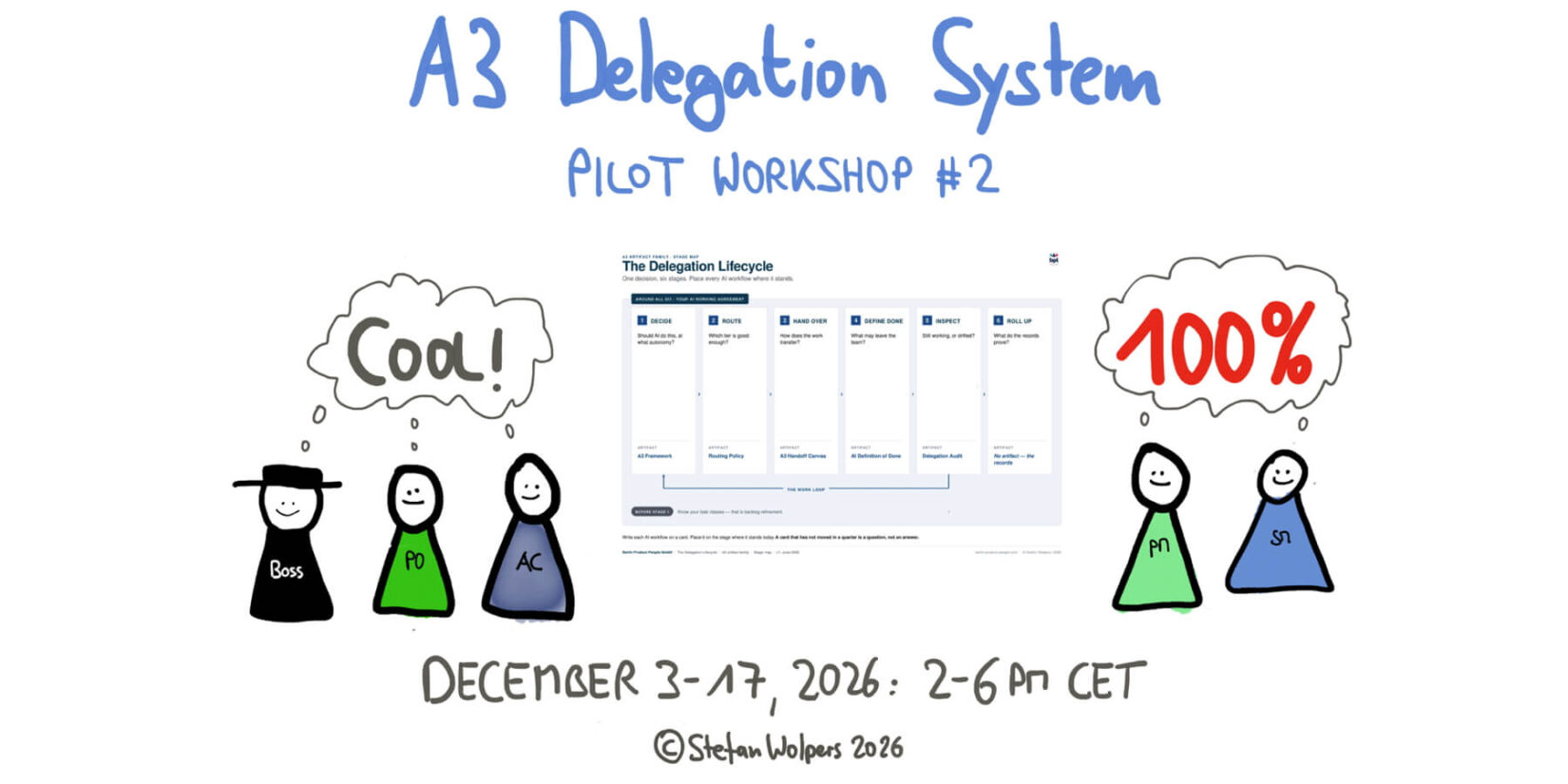
Learn more: 🖥 🇬🇧 The A3 Delegation System Pilot Workshop, December 3-17, 2026, Starting at $149.
➿ Agile, Leadership & Career
: What I tell new execs who can't decide
Jenny Wanger suggests a new executive who cannot decide is wearing the wrong hat. Weigh each option against you, your department, or the company: the right move often feels scary.
and : 🎙️ Tech and AI, the Toyota Way: Jeffrey Liker on Problem-First Technology
Mark Graban interviews Jeffrey Liker, who suggests Toyota uses technology to counter a clearly defined problem. A goal to get everyone using AI chases tools rather than outcomes.
(via Lean Enterprise Institute): Yes, Lean Thinkers Are Luddites. The Original Kind.
Roberto Priolo suggests lean thinkers are Luddites in the original sense, objecting to how technology arrives. His AI test is whether freed hours return to workers or become job cuts.
: Reorganized
Mike Fisher suggests leaders rarely count the cost of reorganizations. His former employer’s data showed intact teams regained velocity in about six weeks, reshuffled ones in twelve. He wants it measured.
📯 AI Adoption Failures: Why Your Successful AI Pilot Is No Reason to Scale
Thesis: This article explains seven AI adoption failures that follow a successful AI pilot, from unready data to overloaded reviewers and premature cuts, and how practitioners set the standard, collect the evidence, and inspect the results before scaling anything.
Your AI pilot worked: the demo impressed the steering committee, the time savings on the slide looked fantastic, and the sponsor is already drafting the rollout budget. However, the AI pilot answered a narrower question than the budget. It showed that the technology can do the task under test conditions, with clean data, a hand-picked team, and a process that mainly exists in the standard operating procedures. Two questions remain open, and nobody has collected evidence for them: whether ordinary teams can run the workflow reliably, and whether expanding beyond the pilot pays off.
Here are seven AI adoption failures that keep recurring in legacy organizations in 2026, each with a warning sign you can check this week, a countermeasure, plus five questions for the scaling decision itself. You do not need to own the budget to use them, because the evidence a scaling decision needs comes from the people closest to the work: they agree on the quality standard, for example, using the AI Definition of Done before the trial, collect the evidence while the workflow runs, and inspect the delegation over time in an AI Delegation Audit. Spoiler alert for the seasoned agile practitioner: If you lived through an Agile transformation, most of the failures will look familiar. History rhymes, and AI, as Agile, is no exception.
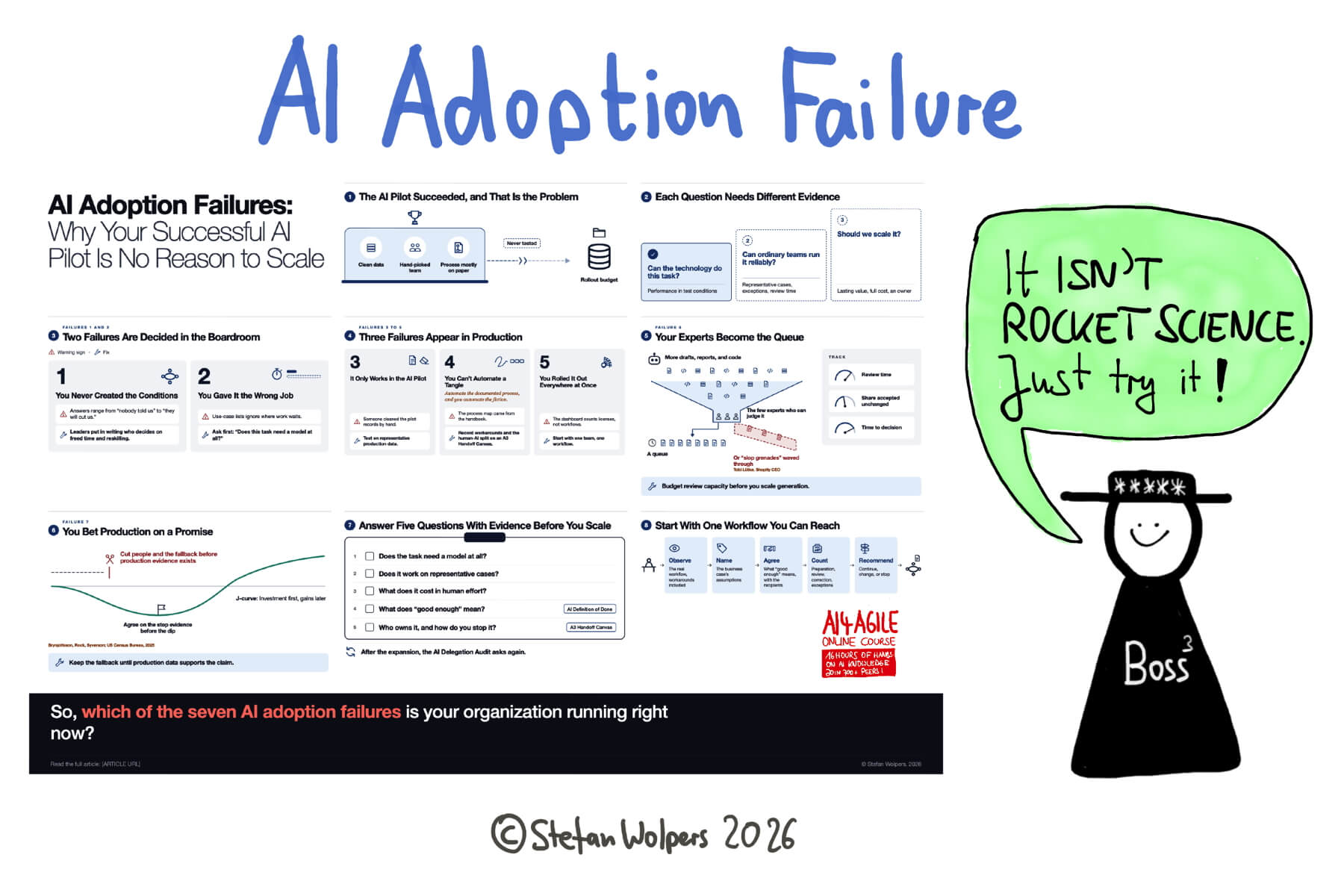
📺 Watch the article’s video: AI Adoption Failures: Why Your Successful AI Pilot Is No Reason to Scale.
👉 Learn more: AI Adoption Failures: Why Your Successful AI Pilot Is No Reason to Scale.
🛠 Concepts, Practices, Tools & Measuring
(via Knowledge @ Wharton): Wharton-Accenture Agentic Cost Framework (WAcX): What Does Agentic AI Really Cost?
Eric T. Bradlow suggests that roughly 90% of agentic tasks suit cheaper models, since complex tasks make up only 6% to 11% of the workload, so leaders should match the model to the task.
(via Atlassian): Introducing the Atlassian AI SDLC Index: What the data shows about AI and real work
Mike Cannon-Brookes suggests that AI made writing code cheap but not building software easier: the hard work has moved to planning before coding and to review, testing, and release after.
(via ThoughtWorks): The AI factory stack
Vanitha Kumar suggests that a budget built on price per million tokens misses the real cost of agentic AI: agent loops re-read context, and subagents retry. She proposes measuring cost per completed task instead.
📅 Scrum Training & Event Schedule
You can secure your seat for Scrum training classes, workshops, and meetups directly by following the corresponding link in the table below:
| Date | Class and Language | City | Price |
|---|---|---|---|
| 🖥 💯 🇬🇧 November 27, 2026 | GUARANTEED: AI4Agile Online Course v4 (AI4Agile Certificate; English; Online Course) | Online Course | $149 incl. 19% VAT (If applicable.) |
| 🖥 💯 🇩🇪 December 8-9, 2026 | GUARANTEED: Professional Scrum Product Owner Training (PSPO I; German; Live Virtual Class) | Live Virtual Class | €1099 incl. 19% VAT (If applicable.) |
| 🖥 🇬🇧 December 15-16, 2026 | Professional Scrum Master – Advanced Training (PSM II; English; Live Virtual Class) | Live Virtual Class | €1189 incl. 19% VAT (If applicable.) |
| 🖥 🇩🇪 February 16-17, 2027 | Professional Scrum Product Owner Training (PSPO I; German; Live Virtual Class) | Live Virtual Class | €1099 incl. 19% VAT (If applicable.) |
See all upcoming classes here.

You can book your seat for the training directly by following the corresponding links to the ticket shop. If the procurement process of your organization requires a different purchasing process, please contact Berlin Product People GmbH directly.
📺 Join 6,000-plus Agile Peers on Youtube
Now available on the Age-of-Product YouTube channel to improve learning, for example, about AI Token Fraud:
- AI Adoption Failures: Why Your Successful AI Pilot Is No Reason to Scale.
- We’re Not Paid to Practice Scrum — Answer These 5 Product Questions Instead.
- AI Refinement Prep Traps and How to Avoid Them.
- AI-Assisted Product Discovery — Agent Assists, Team Decides.
- Before You Switch the AI Model: The Hidden Cost of "Updating" Models.
- How the A3 Delegation System Helps to Avoid AI Debt.
- OUT NOW: The AI4Agile Course v3 — Master AI for Agile Practitioners.
✋ Do Not Miss Out: Learn more about AI Token Fraud — Join the 20,000-plus Strong ‘Hands-on Agile’ Slack Community
I invite you to join the “Hands-on Agile” Slack Community and enjoy the benefits of a fast-growing, vibrant community of agile practitioners from around the world.

If you would like to join, all you have to do now is provide your credentials via this Google form, and I will sign you up. By the way, it’s free.
Help your team to learn about AI's Götterdämmerung by pointing them to the free Scrum Anti-Patterns Guide: