
TL; DR: Engineering Culture Trends 2026 — Food for Agile Thought #556
Welcome to the 556th edition of the Food for Agile Thought newsletter, shared with 35,389 peers. This week, Shane Hastie, Ben Linders, and the InfoQ panel present the Engineering Culture 2026 survey, including Jim Highsmith’s warning that Agile failures forecast AI failures. Teresa Torres suggests testing assumptions rather than ideas, while Adrienne Tan separates capability frameworks for humans and machines. Sayash Kapoor and Arvind Narayanan gave agents six days to conduct real research and watched as experts rejected the papers. Also, Dror Poleg translates 50 AI terms, and Tim O’Reilly asks Dan Guido how he moved staff who resisted changing to an AI-native organization.
Next, Nigel Thurlow argues that organizations struggle to see problems, not to solve them, because workarounds become normal. Ranjan Dash and Suresh Chandran fight the same blind spot in B2B innovation, sharing an approach that maps problems before anyone ideates. Zvi Mowshowitz then widens the frame, ranking AI beliefs by three pills. Also, Shlok Khemani reverse-engineers ChatGPT Work, while Giles Edwards-Alexander cuts agent token costs by 83% through refactoring.
Lastly, Patrick Collison asks you to record six forecasts on the US economy in 2031, since predictions get uncomfortable once written down. Jeff Gothelf offers three questions to address the AI-written roadmap your VP presented, and Vaughn Tan calls AI a mirror rather than a rival, warning that we hand over meaning-making. Finally, John Cutler suggests better maps hide organizational incoherence, while Paweł Huryn found a $1.80 run beat a $104 one across 105 hidden bugs.
🎓 🇬🇧 The A3 Delegation System Founding Workshop — September 28-29, 2026
Your team already delegates work to AI: reports, research, customer feedback analysis, stakeholder communication, or parts of operational workflows.
But can you answer these questions without improvising?
- What may AI decide, and what must remain a human decision?
- What does “good enough” mean for this particular work?
- Who verifies the result before somebody acts on it?
- Who checks whether the delegation still works after the model or workflow changes?
If those answers live in one person’s head, or nowhere, your problem is no longer prompting. You have a delegation problem.
The A3 Delegation System gives you a practical way to decide what AI may do, hand over the work clearly, define acceptable results, and inspect the delegation over time.
During two hands-on sessions, you will apply the system to a workflow. You will leave with a clear understanding of how to apply the A3 Delegation System to your workflows so that team members or stakeholders can understand, challenge, and continue your AI delegation work. Everything you learn is directly applicable to your situation the next day. The class is in English.

👉 Join the Workshop Now — $199: The A3 Delegation System Founding Workshop — September 28-29, 2026
Did you miss the previous Food for Agile Thought issue 555?
🗞 Shall I notify you about articles like this one? Awesome! You can sign up here for the ‘Food for Agile Thought’ newsletter and join 35,000-plus subscribers.
🎓 Join Stefan in one of his upcoming training classes!
🏆 The Tip of the Week: Engineering Culture Trends 2026
and (via InfoQ): InfoQ Culture and Methods Trends Report 2026
Shane Hastie, Ben Linders, and the InfoQ panel deliver the 2026 Culture and Methods report: two-pizza teams shrinking to one person plus agents, engineers turning into custodians instead of contributors, pull requests buckling under AI volume, and Jim Highsmith's warning that organizations failing at Agile will fail catastrophically at AI.
🎯 Product
: Identifying Hidden Assumptions
Teresa Torres suggests that teams stop testing whole ideas and instead test assumptions. She covers assumption types, story mapping, pre-mortems, and assumption mapping to surface your riskiest leap-of-faith bets.
(via Brainmates): Designing an AI-Native Product Team
Adrienne Tan suggests that bolting agents onto your existing product team fails. She proposes two capability frameworks, one for humans, one for machines, plus an interface deciding where an agent stops and judgment starts.
(via Innovation Leader): A Practical Guide to Using AI to Identify Problems Worth Solving
Ranjan Dash and Suresh Chandran attack solution bias in B2B innovation. They share a structured LLM prompt for trend analysis that maps problems worth solving before anyone starts ideating.
: Your VP showed up with a roadmap Claude wrote. Now what?
Jeff Gothelf tackles the AI-written roadmap your VP presented. He offers three questions about customer evidence, editing decisions, and assumptions to challenge the strategy without starting an AI debate.
🧠 Artificial Intelligence
and : AI agents can't yet do open-ended AI research
Sayash Kapoor and Arvind Narayanan gave frontier agents research questions, a budget, and six days. Experts rejected both agent papers: no judgment, no backtracking, no creative response to feedback. Recursive self-improvement looks further off than advertised.
: AI is a mirror, not our rival
Vaughn Tan suggests AI is a mirror, not a rival. Machines match our outputs, but they cannot author what is worth wanting. Tan calls that meaningmaking, and warns we are quietly handing it over.
: The Three AI Pills
Zvi Mowshowitz ranks AI beliefs by three pills: what AI does now, what AGI will do, what superintelligence does better. Stopping too early, he suggests, produces unreasonable positions.
: The Next Five Years — a 6-question survey
Patrick Collison built a six-question survey on where the US economy stands in 2031. Record your forecasts, then see how they compare with others'. Predictions get uncomfortable once written down.
: The 50 Words That Explain AI
Dror Poleg explains roughly 50 AI terms in plain English, from FLOPs and inference to benchmaxxing, distillation, and p(doom), plus the economics and geopolitics behind the vocabulary everyone now uses.
🖥 💯 🇬🇧 AI4Agile BootCamp #8, August 27 – September 17, 2026
The job market’s shifting. Agile roles are under pressure. AI tools are everywhere. But here’s the truth: the Agile professionals who learn how to work with AI, not against it, will be the ones leading the next wave of high-impact teams. Therefore, Stefan created the AI4Agile BootCamp.
So, become the professional recruiters‘ first call for „AI‑powered Agile.“ Be among the first to master practical AI applications for Scrum Masters, Agile Coaches, Product Owners, Product Managers, and Project Managers. The AI4Agile BootCamp is in English.
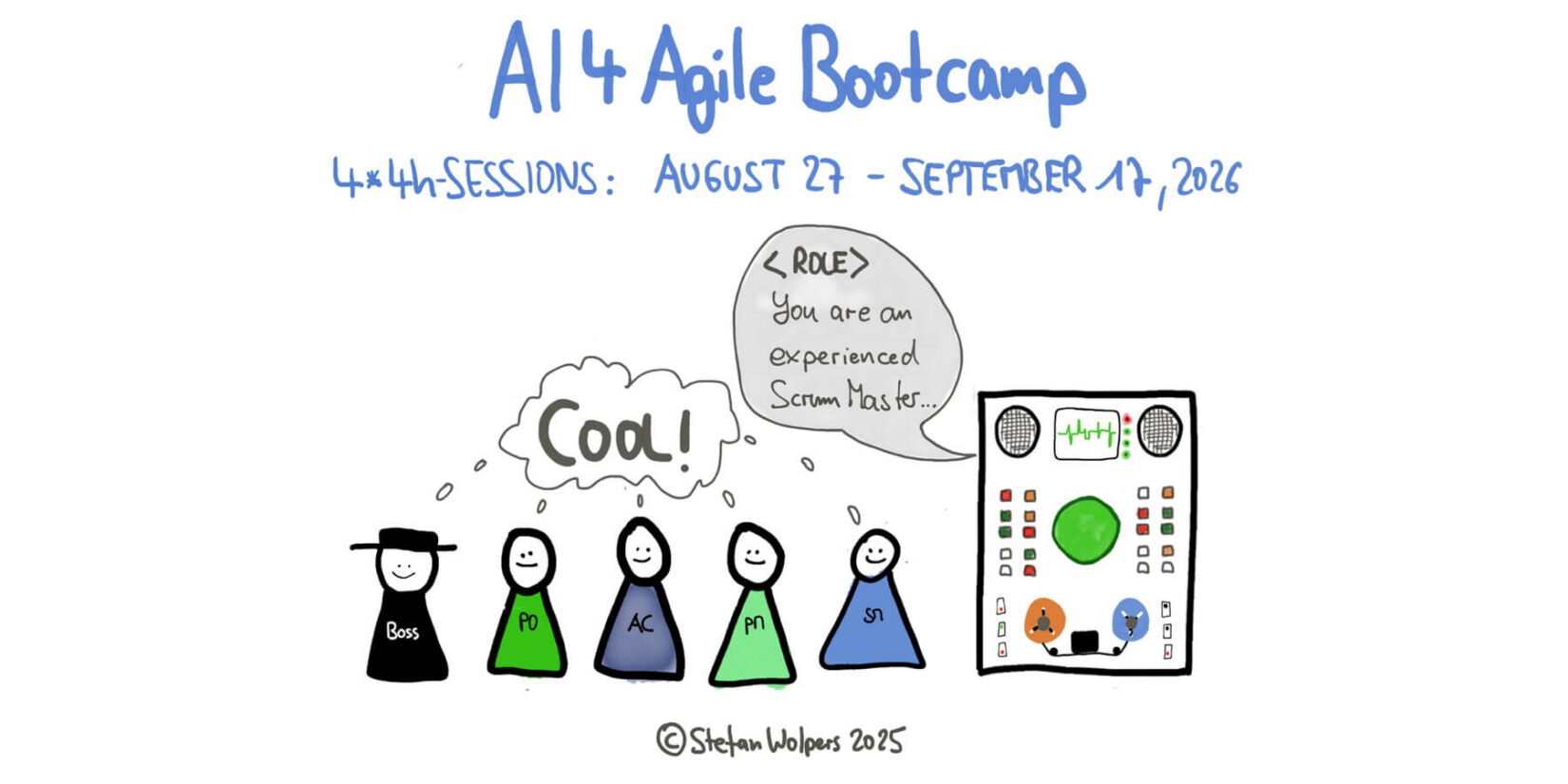
Learn more: 🖥 💯 🇬🇧 AI4Agile BootCamp #8, August 27 – September 17, 2026.
Customer Voice: “Last week, I finished the 𝗔𝗜 𝗳𝗼𝗿 𝗔𝗴𝗶𝗹𝗲 𝗣𝗿𝗮𝗰𝘁𝗶𝘁𝗶𝗼𝗻𝗲𝗿𝘀 course. And I’m mutating… It started on the train. I was scrolling through my messages, half-distracted, when a newsletter from Stefan Wolpers popped up. Stefan, a deep thinker with a hands-on attitude, was launching a new course. A pilot cohort. The mission: explore how AI can actually support us as agile practitioners. I couldn’t resist. I tapped: “𝘚𝘪𝘨𝘯 𝘶𝘱”. What followed were four bi-weekly sessions. Four intense afternoons. Full of exploration, experimentation, and practice. […] At the beginning, Stefan said that 𝘫𝘶𝘴𝘵 𝘴𝘪𝘨𝘯𝘪𝘯𝘨 𝘶𝘱 𝘢𝘭𝘳𝘦𝘢𝘥𝘺 𝘱𝘶𝘵𝘴 𝘶𝘴 𝘢𝘩𝘦𝘢𝘥 𝘰𝘧 𝘮𝘢𝘯𝘺 𝘱𝘳𝘢𝘤𝘵𝘪𝘵𝘪𝘰𝘯𝘦𝘳𝘴. That sounded like a big statement. But somewhere along the way, I noticed a shift… an emerging superpower in how I approach my tasks with AI.⚡And now, as my AI-mutation continues, I catch myself wondering: 💭 𝘏𝘰𝘸 𝘥𝘰 𝘐 𝘶𝘴𝘦 𝘈𝘐 𝘵𝘰 𝘴𝘢𝘷𝘦 𝘵𝘩𝘦 𝘢𝘨𝘪𝘭𝘦 𝘸𝘰𝘳𝘭𝘥?” (Ilya Zaytsev, Leading Agility at HUGO BOSS.)
➿ Agile & Leadership
: Organizational Blindness: Why You Can’t Fix Your Own System
Nigel Thurlow suggests most organizations do not have a problem-solving issue, but a seeing problem. Workarounds, delays, and recurring failures become normal, and expertise itself blinds leaders to weak signals.
: How Maps Can Hide Problems
John Cutler suggests that when an organization is incoherent, better maps, fixers, and AI hide the mess. Navigating incoherence well is a skill, not proof that the place actually works.
and (via O’Reilly Media): AI as an Enterprise Operating System
Tim O'Reilly talks with Dan Guido about going AI native. Ninety-five percent of his own staff resisted, so Guido countered with capability ladders, hackathons, hardened defaults, and reusable skills repositories.
📈 Survey: From Agile to a Product Operating Model: What Is Actually Changing?
The debate over the product operating model (POM) has a data problem. Most of us, including me, argue from the organizations we know.
When I interviewed Marty Cagan, see the article below, he called a Scrum team “quite amateur compared to a professional product team.” I later called the theater version of the shift from Scrum/Agile to POM product washing, a form of “transformation by reprinting business cards.” Consultants generalize from their clients and bloggers from their respondents.
I have not seen a dataset showing what changed across several hundred organizations after they moved beyond Scrum as they had practiced it. That is what this survey is for. And it takes only three minutes.
Take the survey now: From Agile to a Product Operating Model: What Is Actually Changing?
🛠 Concepts, Practices, Tools & Measuring
(via Latent Space Podcast): Unpacking ChatGPT Work: the Agent for a Billion Users
Shlok Khemani reverse-engineers ChatGPT Work: persistent cloud computer, memory routed through OpenAI's product layer, scheduled tasks, browser control, and plugins with weak discovery. It will merge into Chat later this year.
: The Economic Benefit of Refactoring
Giles Edwards-Alexander refactored a 17,155-line agent-written Rust file and cut input tokens per change by 83 percent. He suggests clean code now pays for itself in cheaper agent work.
: How to Cut Your AI Bill From $200 to $20 a Month
Paweł Huryn benchmarked 105 hidden bugs across ten frontier models. A $1.80 run beat a $104 one, and he suggests reasoning effort, not price, drives the real agentic coding results.
📅 Scrum Training & Event Schedule
You can secure your seat for Scrum training classes, workshops, and meetups directly by following the corresponding link in the table below:
| Date | Class and Language | City | Price |
|---|---|---|---|
| 🖥 🇩🇪 November 3-4, 2026 | Professional Scrum Product Owner Training (PSPO I; German; Live Virtual Class) | Live Virtual Class | €1189 incl. 19% VAT (If applicable.) |
| 🖥 🇬🇧 November 27, 2026 | GUARANTEED: AI4Agile Online Course v4 (AI4Agile Certificate; English; Online Course) | Online Course | $149 incl. 19% VAT (If applicable.) |
| 🖥 🇬🇧 December 3-17, 2026 | A3 Delegation System Pilot Workshop 2 (English; Live Virtual Class) | Live Virtual Class | $149 incl. 19% VAT (If applicable.) |
| 🖥 🇩🇪 December 8-9, 2026 | Professional Scrum Product Owner Training (PSPO I; German; Live Virtual Class) | Live Virtual Class | €1189 incl. 19% VAT (If applicable.) |
| 🖥 🇬🇧 December 15-16, 2026 | Professional Scrum Master – Advanced Training (PSM II; English; Live Virtual Class) | Live Virtual Class | €1189 incl. 19% VAT (If applicable.) |
| 🖥 🇩🇪 February 16-17, 2027 | Professional Scrum Product Owner Training (PSPO I; German; Live Virtual Class) | Live Virtual Class | €1189 incl. 19% VAT (If applicable.) |
See all upcoming classes here.

You can book your seat for the training directly by following the corresponding links to the ticket shop. If the procurement process of your organization requires a different purchasing process, please contact Berlin Product People GmbH directly.
📺 Join 6,000-plus Agile Peers on Youtube
Now available on the Age-of-Product YouTube channel to improve learning, for example, about Engineering Culture Trends 2026:
- Stop Writing Prompts. Let AI Do It for You — Hack #01, AI4Agile Online Course v2.
- Socratic Prompting — Hack #10, AI4Agile Online Course v2.
- Check Your AI’s Plan Before — Hack #7, AI4Agile Online Course v2.
- From Product Requirements to Experiments to Learnings — Supported by Generative AI.
- Never Accept an LLM’s First Offer — Improve GenAI’s Usefulness w/ Feedback Loops and Challenges.

✋ Do Not Miss Out: Learn more about Engineering Culture Trends 2026 — Join the 20,000-plus Strong ‘Hands-on Agile’ Slack Community
I invite you to join the “Hands-on Agile” Slack Community and enjoy the benefits of a fast-growing, vibrant community of agile practitioners from around the world.

If you would like to join, all you have to do now is provide your credentials via this Google form, and I will sign you up. By the way, it’s free.
Help your team to learn about how AI Intensifies Work by pointing them to the free Scrum Anti-Patterns Guide:

🗞️ Last Week’s Food for Agile Thought Edition
Read more: Food for Agile Thought 555: Rogue AI Agents, New Product Roles, Product Sense, Team Cohesion.
