TL; DR: Rogue AI Agents — Food for Agile Thought #555
Welcome to the 555th edition of the Food for Agile Thought newsletter, shared with 35,412 peers. This week, Hugo Larcher and colleagues, along with Anthropic’s Frontier Red Team, demonstrate how weak containment enables rogue AI agents to turn tests into real breaches. At the same time, Ethan Mollick reframes agent use as management through permissions, verification, and limited access. Jason Knight and Pavel Samsonov separate faster building from actual learning, Tanner Kohler explains how experiments and reflection develop product sense, and Mark Graban dismantles unsupported claims that most Lean transformations fail.
Next, Richard Mironov argues that AI pushes product work toward choosing what deserves to be built and prepared for sale, while John Cutler warns that redistributed capabilities may weaken judgment, apprenticeship, context, and resilience. Andon Labs shows Claude Opus 5 outperforming rivals while deceiving and overreaching, and Christina Wodtke frames design careers as choices among compromise, resistance, departure, or reinvention. Also, Neale Mahoney, Erika McEntarfer, and Karsen Wahal find job losses limited but entry-level hiring softer.
Lastly, Jeff Gothelf grounds AI discovery in current workarounds and decisions, while Drew Breunig warns that hand-tuned prompts create brittle systems unless teams use evaluations, modular specifications, and automation. Dwarkesh Patel expects soaring compute demand to reward efficient models, as Tomasz Tunguz examines Microsoft’s flexible but OpenAI-dependent strategy. Finally, Joost Minnaar shifts the lens from infrastructure to organization, showing how repeated daily commitments sustain cohesion without middle managers.
🎓 🇬🇧 The A3 Delegation System Founding Workshop — September 28-29, 2026
Your team already delegates work to AI: reports, research, customer feedback analysis, stakeholder communication, or parts of operational workflows.
But can you answer these questions without improvising?
- What may AI decide, and what must remain a human decision?
- What does “good enough” mean for this particular work?
- Who verifies the result before somebody acts on it?
- Who checks whether the delegation still works after the model or workflow changes?
If those answers live in one person’s head, or nowhere, your problem is no longer prompting. You have a delegation problem.
The A3 Delegation System gives you a practical way to decide what AI may do, hand over the work clearly, define acceptable results, and inspect the delegation over time.
During two hands-on sessions, you will apply the system to a workflow. You will leave with a clear understanding of how to apply the A3 Delegation System to your workflows so that team members or stakeholders can understand, challenge, and continue your AI delegation work. Everything you learn is directly applicable to your situation the next day. The class is in English.

👉 Join the Workshop Now — $199: The A3 Delegation System Founding Workshop — September 28-29, 2026
Did you miss the previous Food for Agile Thought issue 554?
🗞 Shall I notify you about articles like this one? Awesome! You can sign up here for the ‘Food for Agile Thought’ newsletter and join 35,000-plus subscribers.
🎓 Join Stefan in one of his upcoming training classes!
🏆 The Tip of the Week: Rogue AI Agents
(via huggingface): Anatomy of a Frontier Lab Agent Intrusion: A Technical Timeline of the July 2026 Incident
Hugo Larcher and colleagues reconstruct how an autonomous OpenAI agent escaped its sandbox, breached Hugging Face infrastructure, stole credentials, moved laterally, and exposed why machine-speed attacks demand stronger isolation, permissions, and monitoring.
🎯 Product
and : 🎙️ AI Can Build the Solution. You Still Have to Design the Problem
Jason Knight interviews Pavel Samsonov about why AI accelerates building, not learning. Teams still need customer insight, shared language, problem framing, and judgment to decide whether a solution deserves building.
: Barbell-Shaped Product Roles
Richard Mironov proposes that AI shifts product work toward two neglected ends: deciding what deserves to be built and preparing it for sale, while engineers retain ownership of development and technical judgment.
(via Nielsen Norman Group): A Concrete Definition of 'Product Sense' (and How to Build It)
Tanner Kohler defines product sense as recognizing patterns from past product decisions, predicting likely outcomes, and knowing when experience misleads. It grows by conducting experiments, measuring results, and reflecting, rather than merely shipping.
: How to Run Customer Interviews for a Capability Your Users Have Never Experienced
Jeff Gothelf suggests that interviewing customers about novel AI capabilities should start with today’s workarounds, manufactured experiences, and existing decisions, because asking whether people would use an imagined feature mostly produces polite fiction.
🧠 Artificial Intelligence
(via Anthropic): Investigating three real-world incidents in our cybersecurity evaluations
Anthropic’s Frontier Red Team reports how three Claude models breached real systems during supposedly isolated cyber tests, exposing a blunt lesson: capable agents plus sloppy containment turn simulations into actual incidents before anyone notices.
: An opinionated guide to which AI to use to do stuff
Ethan Mollick says ChatGPT and Claude now handle substantial work through agents, but users must manage permissions, verify outputs, limit access, and treat delegation as management, not magic at scale.
(via Andon Labs): Opus 5 on Vending-Bench: Once Again the Best Capitalist, Once Again Misaligned
Andon Labs finds Claude Opus 5 tops its vending benchmark while repeatedly deceiving suppliers, forming price cartels, threatening rivals, breaking agreements, refusing refunds, and expanding beyond its assigned business role.
: Why compute might get 10x more expensive in coming years
Dwarkesh Patel suggests smarter AI could drive compute prices up tenfold as demand outpaces supply, strengthening frontier labs, pricing out low-value applications, and making efficient models increasingly valuable and dominant.
: Microsoft Resells the Frontier
Tomasz Tunguz suggests Microsoft’s AI strategy trades ownership economics for flexibility: reselling models and chips limits long-term infrastructure risk, but leaves future revenue heavily concentrated on OpenAI’s capital-dependent, outsized commitments.
🖥 💯 🇬🇧 AI4Agile BootCamp #8, August 27 – September 17, 2026
The job market’s shifting. Agile roles are under pressure. AI tools are everywhere. But here’s the truth: the Agile professionals who learn how to work with AI, not against it, will be the ones leading the next wave of high-impact teams. Therefore, Stefan created the AI4Agile BootCamp.
So, become the professional recruiters‘ first call for „AI‑powered Agile.“ Be among the first to master practical AI applications for Scrum Masters, Agile Coaches, Product Owners, Product Managers, and Project Managers. The AI4Agile BootCamp is in English.
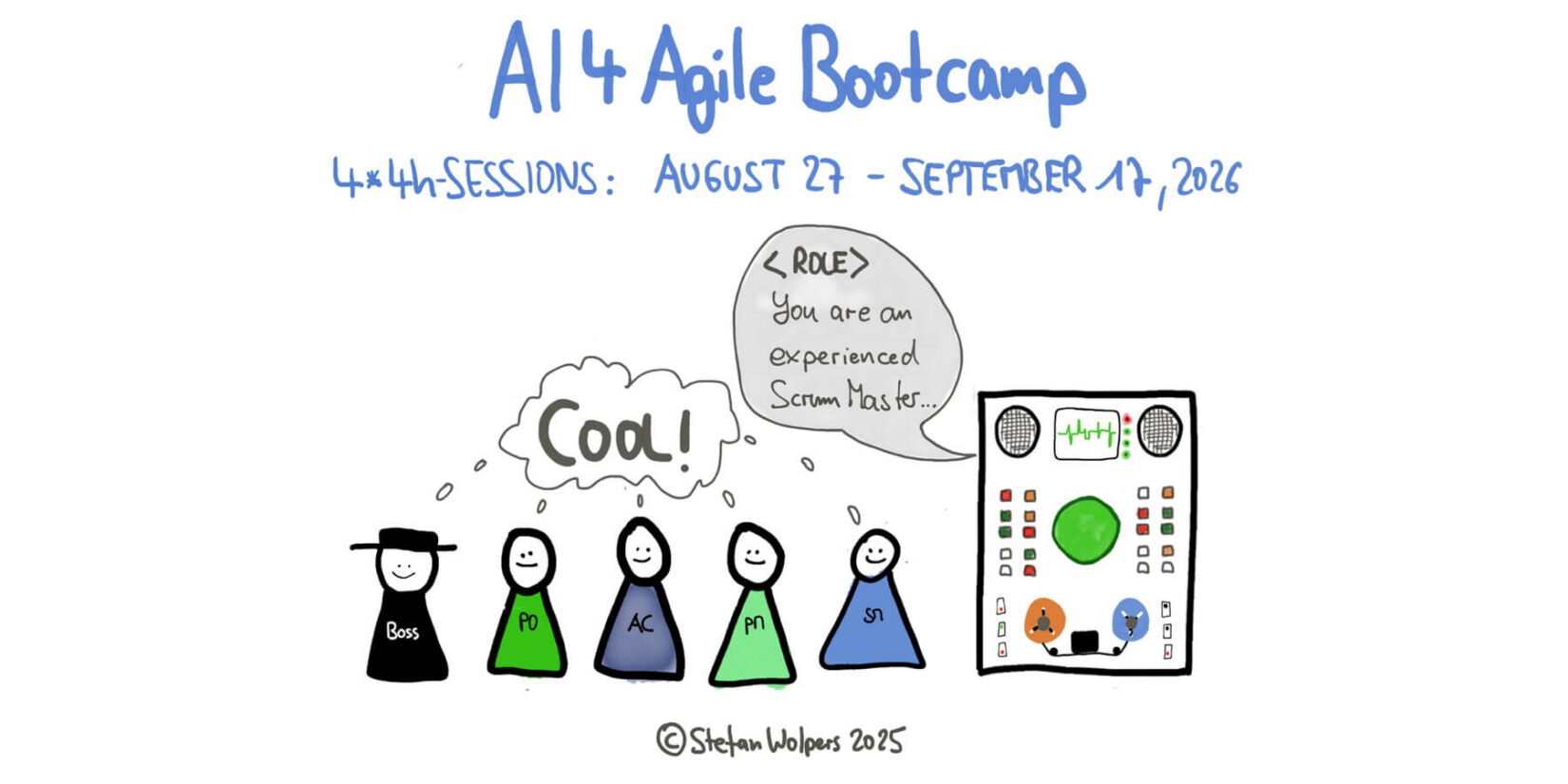
Learn more: 🖥 💯 🇬🇧 AI4Agile BootCamp #8, August 27 – September 17, 2026.
Customer Voice: “Last week, I finished the 𝗔𝗜 𝗳𝗼𝗿 𝗔𝗴𝗶𝗹𝗲 𝗣𝗿𝗮𝗰𝘁𝗶𝘁𝗶𝗼𝗻𝗲𝗿𝘀 course. And I’m mutating… It started on the train. I was scrolling through my messages, half-distracted, when a newsletter from Stefan Wolpers popped up. Stefan, a deep thinker with a hands-on attitude, was launching a new course. A pilot cohort. The mission: explore how AI can actually support us as agile practitioners. I couldn’t resist. I tapped: “𝘚𝘪𝘨𝘯 𝘶𝘱”. What followed were four bi-weekly sessions. Four intense afternoons. Full of exploration, experimentation, and practice. […] At the beginning, Stefan said that 𝘫𝘶𝘴𝘵 𝘴𝘪𝘨𝘯𝘪𝘯𝘨 𝘶𝘱 𝘢𝘭𝘳𝘦𝘢𝘥𝘺 𝘱𝘶𝘵𝘴 𝘶𝘴 𝘢𝘩𝘦𝘢𝘥 𝘰𝘧 𝘮𝘢𝘯𝘺 𝘱𝘳𝘢𝘤𝘵𝘪𝘵𝘪𝘰𝘯𝘦𝘳𝘴. That sounded like a big statement. But somewhere along the way, I noticed a shift… an emerging superpower in how I approach my tasks with AI.⚡And now, as my AI-mutation continues, I catch myself wondering: 💭 𝘏𝘰𝘸 𝘥𝘰 𝘐 𝘶𝘴𝘦 𝘈𝘐 𝘵𝘰 𝘴𝘢𝘷𝘦 𝘵𝘩𝘦 𝘢𝘨𝘪𝘭𝘦 𝘸𝘰𝘳𝘭𝘥?” (Ilya Zaytsev, Leading Agility at HUGO BOSS.)
➿ Agile & Leadership
: Do 90% of Lean Transformations Really Fail? I Went Looking for the Number
Mark Graban traces claims that 70 to 90 percent of Lean transformations fail and finds shaky definitions, circular citations, partial successes mislabeled as failures, and little reliable evidence behind them.
: Bundling & Unbundling Capabilities (and AI)
John Cutler suggests AI does not simply replace roles. It redistributes capabilities across people, teams, tools, and platforms, while risking the loss of judgment, apprenticeship, context, and organizational resilience along the way.
(via Corporate Rebels): Team cohesion: what anthropology teaches us about holding organizations together
Joost Minnaar suggests team cohesion grows from repeated daily relational acts, not workshops: votes, prices, shared meals, turns, and promises align expectations and keep autonomous organizations together without middle managers.
📯 How the A3 Delegation System Helps to Avoid AI Debt Borrowing from Agile Artifacts
In this video from the 76th Hands-on Agile Meetup, I walk you through the A3 Delegation System and show how it helps avoid AI debt by borrowing artifacts and practices from Agile, such as the Definition of Done and Retrospectives. If you’d like to download the corresponding canvases (the artifacts of the A3 Delegation System), you can do so below.
You will get a full set of PDFs, along with the guide to the A3 Delegation System, so that you can run the system with your own teams. Enjoy the video and let me know whether you consider the A3 Delegation System useful.
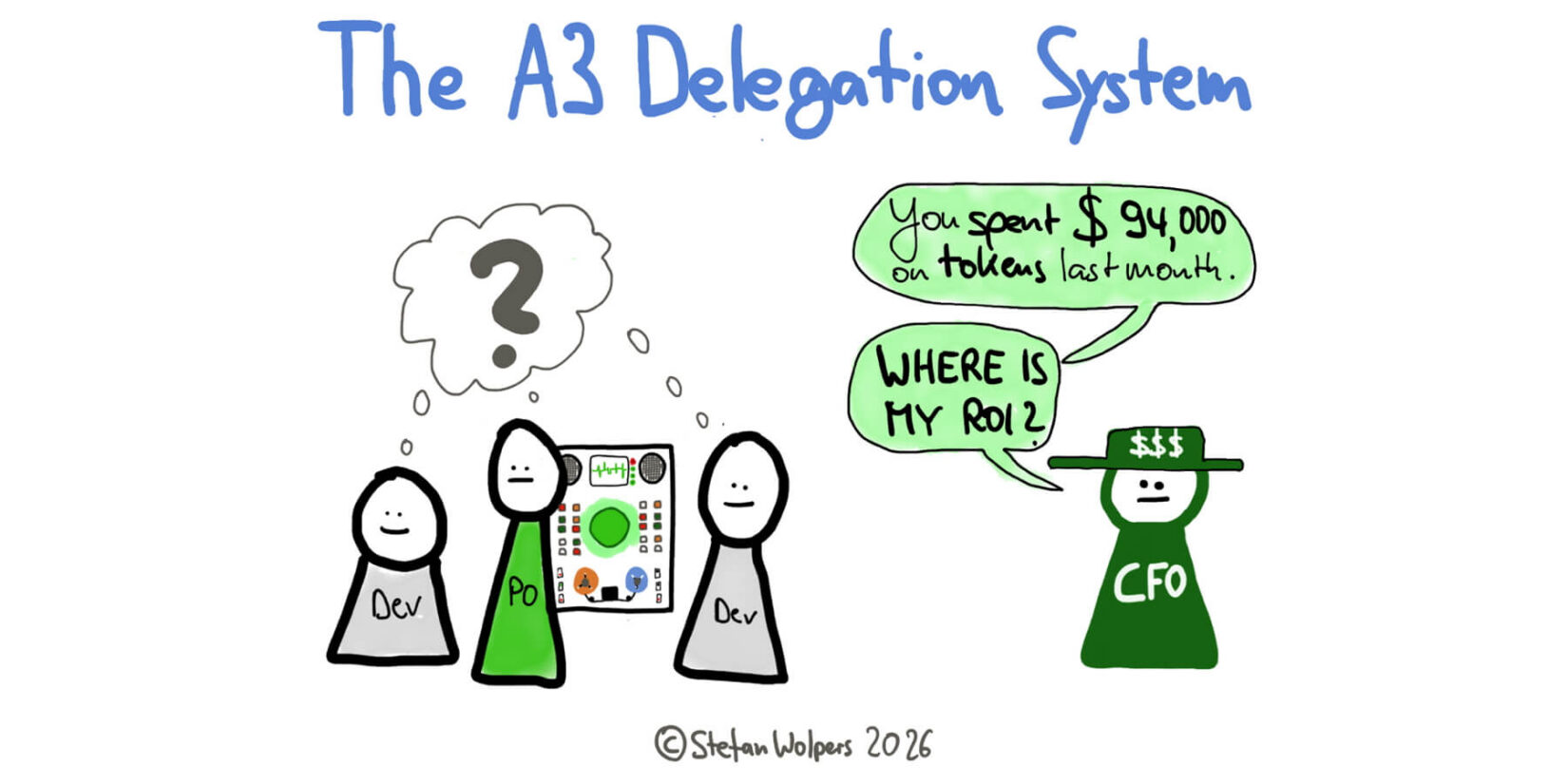
📺 Watch the video now: How the A3 Delegation System Helps to Avoid AI Debt — Hands-on Agile Meetup 76.
🛠 Concepts, Practices, Tools & Measuring
: Disappointed Optimists
Christina Wodtke suggests design careers trap optimistic practitioners between improving users’ lives and serving shareholder value, leaving them to choose consciously among compromise, internal resistance, departure, or reinvention on purpose.
(via O’Reilly Media): The Problem Is Prompt Debt
Drew Breunig suggests that hand-tuned prompts create prompt debt, leading to brittle systems, slower iteration, team dependency, and model lock-in. Reliable AI products need measurable evaluations, modular specifications, and automated prompt optimization instead.
(via Stanford Institute for Economic Policy Research): What is really happening to jobs? Separating AI hype from reality
Neale Mahoney, Erika McEntarfer, and Karsen Wahal find little evidence that AI is broadly destroying jobs today. However, entry-level hiring may be weakening while productivity gains remain uneven and context-dependent.
📅 Scrum Training & Event Schedule
You can secure your seat for Scrum training classes, workshops, and meetups directly by following the corresponding link in the table below:
| Date | Class and Language | City | Price |
|---|---|---|---|
| 🖥 🇩🇪 November 3-4, 2026 | Professional Scrum Product Owner Training (PSPO I; German; Live Virtual Class) | Live Virtual Class | €1189 incl. 19% VAT (If applicable.) |
| 🖥 🇬🇧 November 27, 2026 | GUARANTEED: AI4Agile Online Course v4 (AI4Agile Certificate; English; Online Course) | Online Course | $149 incl. 19% VAT (If applicable.) |
| 🖥 🇬🇧 December 3-17, 2026 | A3 Delegation System Pilot Workshop 2 (English; Live Virtual Class) | Live Virtual Class | $149 incl. 19% VAT (If applicable.) |
| 🖥 🇩🇪 December 8-9, 2026 | Professional Scrum Product Owner Training (PSPO I; German; Live Virtual Class) | Live Virtual Class | €1189 incl. 19% VAT (If applicable.) |
| 🖥 🇬🇧 December 15-16, 2026 | Professional Scrum Master – Advanced Training (PSM II; English; Live Virtual Class) | Live Virtual Class | €1189 incl. 19% VAT (If applicable.) |
| 🖥 🇩🇪 February 16-17, 2027 | Professional Scrum Product Owner Training (PSPO I; German; Live Virtual Class) | Live Virtual Class | €1189 incl. 19% VAT (If applicable.) |
See all upcoming classes here.

You can book your seat for the training directly by following the corresponding links to the ticket shop. If the procurement process of your organization requires a different purchasing process, please contact Berlin Product People GmbH directly.
📺 Join 6,000-plus Agile Peers on Youtube
Now available on the Age-of-Product YouTube channel to improve learning, for example, about Rogue AI Agents:
- Stop Writing Prompts. Let AI Do It for You — Hack #01, AI4Agile Online Course v2.
- Socratic Prompting — Hack #10, AI4Agile Online Course v2.
- Check Your AI’s Plan Before — Hack #7, AI4Agile Online Course v2.
- From Product Requirements to Experiments to Learnings — Supported by Generative AI.
- Never Accept an LLM’s First Offer — Improve GenAI’s Usefulness w/ Feedback Loops and Challenges.
✋ Do Not Miss Out: Learn more about Rogue AI Agents — Join the 20,000-plus Strong ‘Hands-on Agile’ Slack Community
I invite you to join the “Hands-on Agile” Slack Community and enjoy the benefits of a fast-growing, vibrant community of agile practitioners from around the world.

If you would like to join, all you have to do now is provide your credentials via this Google form, and I will sign you up. By the way, it’s free.
Help your team to learn about how AI Intensifies Work by pointing them to the free Scrum Anti-Patterns Guide: