The tenth Hands-on Agile webinar Sprint Retrospective anti-patterns covers twelve anti-patterns of the sprint retrospective—from #NoRetro to the dispensable buffer to UNSMART action items to a missing product owner.
by Stefan Wolpers|Agile and ScrumAgile TransitionWebinars
TL;DR: Webinar Scrum Master Anti-Patterns
The eighth Hands-on Agile webinar Scrum Master Anti-Patterns addresses twelve anti-patterns of your Scrum Master—from ill-suited personal traits and the pursuit of individual agendas to frustration with the team itself.
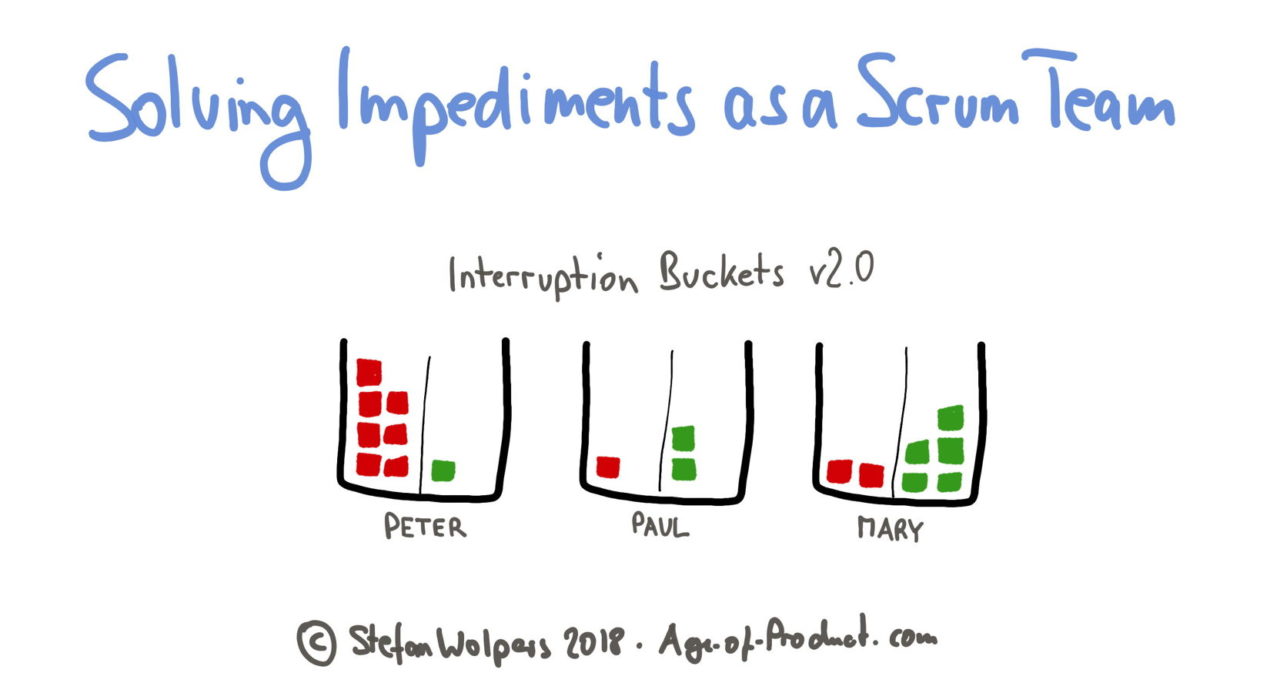
The main message of the retrospective was clear: there are too many interruptions by stakeholders and senior management. The interruptions impeded the flow of work through the team. Consequently, achieving the sprint goal had been at risk several times in the past. Moreover, the team missed the sprint goal twice recently. Solving impediments as a team has become a necessity.
Learn more on how to tackle impediments as a team by running experiments and iterating on the solution.
No matter if you are a Scrum Master or an agile coach, sooner or later, you will run into a problem that’s outside of the team’s sphere of control. The question is: How do you solve impediments of this kind? What approach has worked best for you in the past?
Barry Overeem, Christiaan Verwijs and I teamed up to provide some transparency in this matter and share your best techniques and approach with the agile community. All it takes to contribute is five minutes of your time to participate in the anonymous ‘how to solve impediments’ survey. (We expect results to be available in November.)
Scrum Master Duties: supposedly, a great scrum master serves only one scrum team — that’s at least a popular narrative in the scrum community. Nevertheless, there is also a loud voice that doubts that approach: what would you do the whole day – with a single team? Aren’t they supposed to become self-organizing over time? And if so, does the scrum then need a scrum master 24/7?
As I worked for years as a product owner on scrum teams without a dedicated scrum master-which was working well-I was curious to learn more about that question, too. Hence I ran a survey in late June and early July 2018, the results of which are presented here.
In total, 261 scrum masters participated in this non-representative survey in the two weeks before July 5th, 2018. 19 participants chose not to provide their consent to Google processing and to store their answers. Hence their contributions were deleted, resulting in a sample size of 242 responses.
TL;DR: Scrum Master Trends Survey 2018 — An Anonymous Poll by Scrum.org and Age of Product
The purpose of this the anonymous Scrum Master Trends Survey is to create a clear, data-backed benchmark that allows everyone in the agile community to get an understanding of Scrum Masters, their background, how they got there and where their compensation falls in comparison to others in the community.
By the way, the report will cover Scrum Masters as well as Agile Coaches, both employed and freelancing.