Food for Agile Thought #185: Agile Values in Work and Life, Hiring Agile Teams, Splitting User Stories, Project to Product Focus

Food for Agile Thought’s issue #185—shared with 21,547 peers—covers agile values and the path from project to product-focused organizations. We also learn what to look for when hiring agile teams, and take away lessons learned along the way of becoming an acknowledged agile coach.

Moreover, we address the rationale behind splitting user stories, how to deal with customer churn effectively from a learning perspective, and why ‘done’ tends to clash with ‘validated’ so often when engineers talk to UX folks.

Lastly, we enjoy a new book—available for free as a PDF—that takes a look at what the values of the Agile Manifesto mean when you try to apply them to work and life.

Did you miss last week’s Food for Agile Thought’s issue #184?

Food for Agile Thought #185: Agile Values in Work and Life, Hiring Agile Teams, Splitting User Stories, Project to Product Focus
Continue reading Food for Agile Thought #185: Agile Values in Work and Life, Hiring Agile Teams, Splitting User Stories, Project to Product Focus

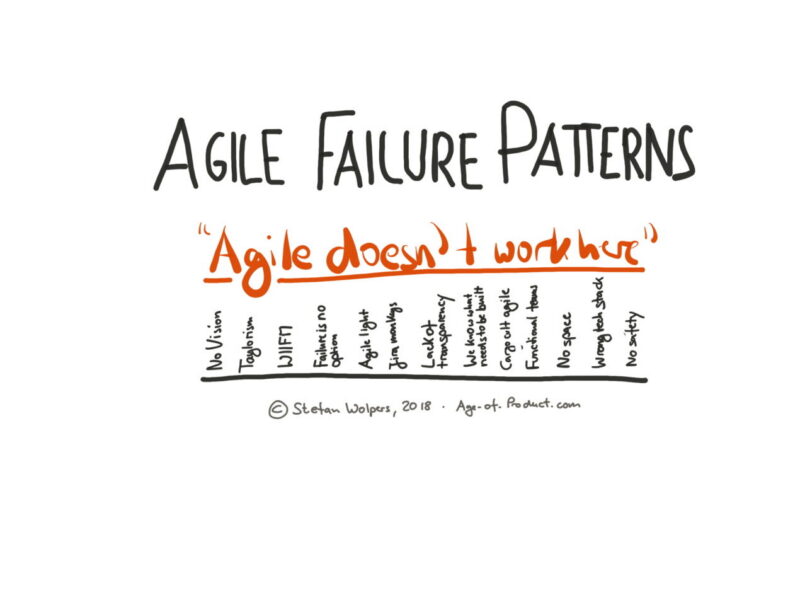
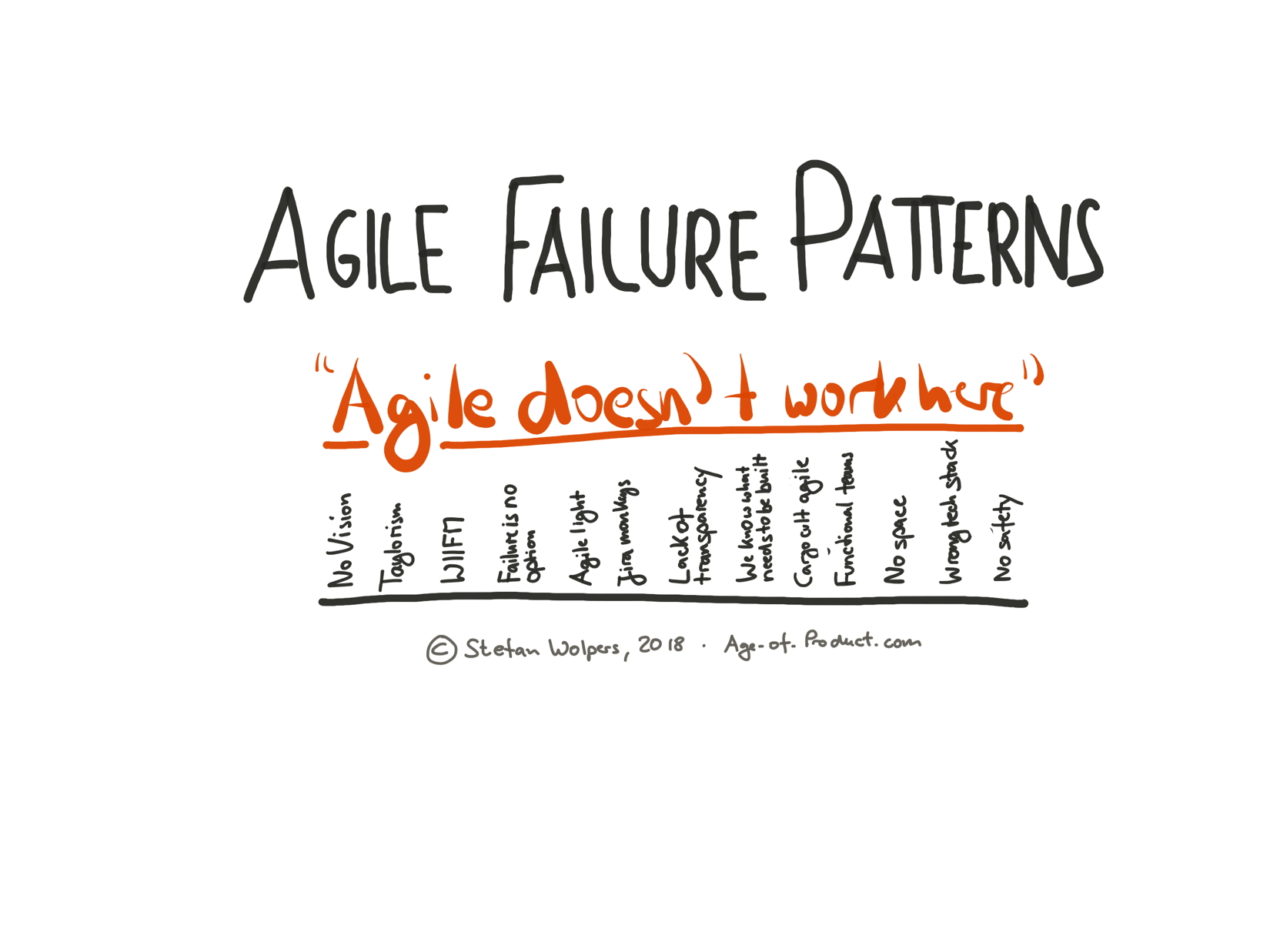
Agile Failure Patterns in Organizations 2.0

TL;DR: Agile Failure Patterns — Why Agile is Simple and Complex at the Same Time

Agile failure seems to be increasingly more prominent nowadays despite all the efforts undertaken by numerous organization embarking on their journeys to become agile.

The funny thing is: Who would disagree that the four core principles of the Agile Manifesto

  1. Individuals and interactions over processes and tools
  2. Working software over comprehensive documentation
  3. Customer collaboration over contract negotiation
  4. Responding to change over following a plan

— are derived from applying common sense to a challenging problem? Moreover, the application of those principles might be suited to fix numerous organizational dysfunctions and reduce an error-prone and complex social setting to maybe just a complicated one?

Age of Product: Agile Failure Patterns in Organizations
Continue reading Agile Failure Patterns in Organizations 2.0

Food for Agile Thought #184: Agile Management Trends, Waste, Twyman’s Law, 251 Free PM Resources

Food for Agile Thought’s issue #184—shared with 21,451 peers—covers eight winning agile management trends, we dive into waste in software creation, and we learn why Microsoft prevailed where General Electric failed.

We also address how to place a growth mindset at the core of your product strategy; we bring clarity to what data-driven means, and we applaud fyi for curating an enormous list of free product management resources.

Lastly, we bust trust building myths when you are in a leadership position—be surprised by the data!

Did you miss last week’s Food for Agile Thought’s issue #183?

Food for Agile Thought #184: Agile Management Trends, Waste, Twyman’s Law, 251 Free PM Resources
Continue reading Food for Agile Thought #184: Agile Management Trends, Waste, Twyman’s Law, 251 Free PM Resources

Food for Agile Thought #183: Leadership Health Check, InfoQ’s State of Practices, Feedback Fails Us, Courageous Leader Myth

Food for Agile Thought’s issue #183—shared with 21,403 peers—covers a new leadership health check tool by Crisp, InfoQ’s State of Practices report 2019—Liberating Structures made it onto the list—, and we analyze what ‘executive sponsorship’ means for change in reality.

We also address how to move from an output-minded to outcome-minded organization; we attempt to figure out whether there is an end to customer development and we warm up to a coaching tool for product managers looking for excellence.

Lastly, we dive into the issue that providing feedback does not seem to have a real impact on other people. What does that mean for retrospectives and self-organizing teams?

Did you miss last week’s Food for Agile Thought’s issue #182?
Food for Agile Thought #183: Leadership Health Check, InfoQ’s State of Practices, Feedback Fails Us, Courageous Leader Myth

🏆 The Essential Read

Shane Hastie and Ben Linders (via InfoQ): Culture & Methods – the State of Practice in 2019

Shane Hastie and Ben Linders report on the state of practices adoption in 2019—from Liberating Structures to mobbing, to remote-only teams, to vanilla Agile.


Agile & Scrum

Jimmy Janlén (via Crisp): Health checks for Teams and Leadership

Jimmy JanlĂ©n shares a powerful tool—the Leadership Health Check—to help you become stronger as a management team by revealing improvement opportunities.

Venkatesh Rao: What ‘Executive Sponsorship’ Actually Means

Venkatesh Rao busts the myth that a wise and courageous leader inspires change, pointing at the complexity of the situation given the incumbents’ opposing interests.

Marcus Buckingham (via Harvard Business Review): Why Feedback Rarely Does What It’s Meant To

There is more myth busting, this time by Marcus Buckingham who claims that feedback as a technique is regularly failing us at triggering change in other people.


Advertisement

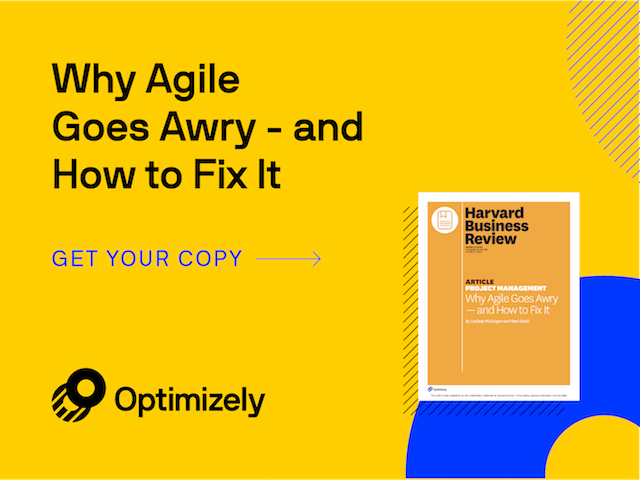
Learn Why Agile Goes Awry & How to Fix It

More organizations are adopting Agile software development as they strive to become more adaptive and nimble. While Agile can have tremendous benefits for collaboration, learning, and responding to change, it can also end up hurting teams when implemented incorrectly. The best product and engineering teams focus on understanding what customers want and what will motivate them to buy, thus trying to maximize their “speed to truth.” To do this, teams need to experiment and iterate quickly, as highlighted in this new article from Harvard Business Review.
Optimizely: Learn Why Agile Goes Awry & How to Fix It

Get your complimentary copy, courtesy of Optimizely.


Product & Lean

Tristan Kromer: How Do I Know When I’m Done with Customer Discovery?

Tristan Kromer shares his thought on the question of whether the customer discovery process ever comes to an end.

Teresa Torres (via Product Talk): Adopting a Continuous Discovery Mindset Across the Organization

Teresa Torres shares insights from her Northwestern University classes on how to achieve the mindset shift within an organization that enables continuous discovery.

Marty Cagan: Coaching Tools—The Narrative

Marty Cagan discusses his single favorite coaching tool for product managers in search of professional excellence.

đŸ“ș Join 1,225-plus Agile Peers on Youtube

Now available on the Age-of-Product Youtube channel:

✋ Do Not Miss Out and Learn about the Leadership Health Check: Join the 4,975-plus Strong ‘Hands-on Agile’ Slack Community

I invite you to join the “Hands-on Agile” Slack Community and enjoy the benefits of a fast-growing, vibrant community of agile practitioners from around the world.

Large scale agile: Join the Hands-on Agile Slack Group

If you like to join all you have to do now is provide your credentials via this Google form, and I will sign you up. By the way, it’s free.

Scrum Master Interview Question: free download of the most popular ebook on Scrum Master job interviews — by Age-of-Product

đŸ—žïž Last Week’s Food for Agile Thought Edition

Read more: Food for Agile Thought #182: Agile-Industrial Complex, Pro Scrum, Cynefin 2019, Marie Kondo Your Product Backlog.
Food for Agile Thought #182: Agile-Industrial Complex, Pro Scrum, Cynefin 2019, Marie Kondo Your Product Backlog

Food for Agile Thought’s issue #182—shared with 21,278 peers—addresses the agile-industrial complex, the stages of progress in becoming agile—provided your organization belongs to the lucky few—, and the state of Cynefin in 2019.

We also learn more on how to deal with complaints that your user stories are not detailed enough—and why it is worth to get to the ground of this notion—; why strategy maps are essential to building valuable products, and how to Marie Kondo your product backlog.

Lastly, we understand why capability maturity models are unsuited for assessing any form of agility.

Did you miss last week’s Food for Agile Thought’s issue #180?

Food for Agile Thought #182: Agile-Industrial Complex, Pro Scrum, Cynefin 2019, Marie Kondo Your Product Backlog
Continue reading Food for Agile Thought #182: Agile-Industrial Complex, Pro Scrum, Cynefin 2019, Marie Kondo Your Product Backlog

Food for Agile Thought #181: Dark Agile, Agile Governance, Scrum Master Trends Report, Product Reviews

Food for Agile Thought’s issue #181—shared with 21,092 peers—addresses transparency, the lack thereof and other forms of dark agile. Moreover, we get a backstage view at the Scrum Master Trends Report, and we borrow from Atlassian’s team health tool.

We also get some new ideas about how to create product reviews people like to participate in; we refresh our memory why the traditional governance approach is unsuited for ’agile,’ and embrace the idea that product launches do not have to be a troublesome thing.

Lastly, Ron Jeffries asks what the agile community can do to reach out to those practitioners who haven’t yet experienced the real thing as outlined in the Manifesto for Agile Software Development. What are your thoughts?

Did you miss last week’s Food for Agile Thought’s issue #180?

Food for Agile Thought #181: Dark Agile, Agile Governance, Scrum Master Trends Report, Product Reviews
Continue reading Food for Agile Thought #181: Dark Agile, Agile Governance, Scrum Master Trends Report, Product Reviews