

TL; DR: Stakeholder Management — Food for Agile Thought #534
Welcome to the 534th edition of the Food for Agile Thought newsletter, shared with 35,693 peers. This week, Venkatesh Rao explores how AI coding clears intention debt and frees people to take on new creative work. Janna Bastow shares stakeholder management practices, and Teresa Torres pushes product teams to tie decisions to evidence, outcomes, and visible discovery. Grant Harvey reports GPT 5.4’s leap in coding and knowledge work, while Cornelia C. Walther urges human-centered AI leadership. Also, Michael Lopp names the workplace behaviors that quietly drain leaders’ attention.
Next, Chad McAllister shares Mike Hyzy’s view of Taylor Swift as a model for product strategy, and Martin Eriksson reframes empowerment as a spectrum of decision ownership. Steve Newman examines how AI agents shift work toward goals and feedback; Tom Wojcik warns that AI coding can weaken engineering judgment, and Paweł Huryn maps product frameworks into AI workflows. Moreover, Maarten Dalmijn uses Force Mapping to help teams tackle root causes instead of symptoms.
Then, Shreyas Doshi argues that as AI tools become commodities, product sense will separate strong product leaders from the rest. Peter Yang shows how AI-native companies treat agents as teammates, and Andi Roberts reminds leaders that systems shape behavior more than slogans do. Also, Mike Cohn challenges the old cost of change curve. Finally, Yuri Vonchitzki warns that poor data, not AI, is often the driver of disappointing results.
🎓 🇬🇧 🤖 OUT NOW — The AI 4 Agile Online Course v2 at $149
The AI4Agile Online Course v2 teaches you to use AI in your daily agile work. Every lesson uses MegaBrain.io, a fictional startup where you apply AI to Sprint Retrospectives, stakeholder reports, product discovery, and backlog analysis.
72 video lessons. 13+ hours. 9 hands-on exercises. 155+ downloadable resources. 11 modules covering prompt engineering, Claude Skills, Claude Cowork, data analysis, and a framework for deciding where AI helps and where it does not.
No coding required. You leave knowing which tools to use and where to draw the line. This course shows you how to do that precisely .
The latest Version 2 is now available and comes with an introductory price of $149 instead of $249—don’t miss this opportunity to save $100!
👉 Join 500+ Peers and Save $100—But Only Until March 9: AI4Agile Online Course v2 at $149.
Did you miss the previous Food for Agile Thought issue 533?
🗞 Shall I notify you about articles like this one? Awesome! You can sign up here for the ‘Food for Agile Thought’ newsletter and join 35,000-plus subscribers.
🎓 Join Stefan in one of his upcoming Professional Scrum training classes!
🏆 The Tip of the Week
: Archival Selves: What happens when you pay off all your intention debts?
Venkatesh Rao reflects on how AI coding tools help individuals finish long-delayed projects and clear accumulated intention debt. By turning past work into organized archives, people construct archival selves. Completing these backlogs may shift attention from unfinished past commitments toward confronting a blank creative future.
If you’re like me, you’re already past the first hypomanic transition across the event horizon of Claude-Code-powered frenzied bespoke-personal-project execution paralysis.
🎯 Product: Stakeholder Management
(via ProdPad): Proving Product ROI: How to Demonstrate the Value of Product Work
Janna Bastow suggests that product teams struggle to prove ROI because organizations measure output rather than outcomes. She proposes linking initiatives to objectives, evidence, and results so product work connects to business impact and builds credibility.
: Stakeholder Management for Product Teams: Show Your Work, Don't Sell Your Conclusions
Teresa Torres proposes that product teams avoid opinion battles by showing their discovery work to stakeholders. By sharing outcomes, opportunities, experiments, and evidence, teams invite collaboration and build alignment rather than defend roadmap conclusions.
and : 🎙 From Country to Billionaire – Taylor Swift’s Product Management Masterclass
🎙 Chad McAllister features Mike Hyzy explaining how Taylor Swift’s career mirrors a strong product strategy. Through audience insight, experiments, portfolio moves, and fan engagement, she demonstrates how teams test ideas, pivot markets, and build loyalty.
: How Empowered Is Your Team, Really?
Martin Eriksson suggests team empowerment is not binary but a spectrum shaped by decision ownership and strategic context. Using the Decision Stack, leaders can diagnose real autonomy levels and ensure empowerment becomes a deliberate organisational choice.
: Why Product Sense is the only product skill that will matter in the AI age
Shreyas Doshi suggests AI tools will soon be commoditized, leaving Product Sense as the key differentiator for product leaders. Empathy, strategic thinking, simulation skills, taste, and creative execution will determine who turns AI insight into winning product decisions.
🧠 Artificial Intelligence
(via The Neuron): GPT-5.4 Review: OpenAI's Best Model Yet (Full Breakdown)
Grant Harvey reports that GPT 5.4 integrates advanced coding, computer use, tool orchestration, and massive 1-million-token context reasoning into a single model. Early tests show improved productivity for software development and professional knowledge work.
(via Knowledge @ Wharton): How the Last Analog Generation Can Shape AI
Cornelia C. Walther proposes that people raised in the analog era have a unique responsibility to shape AI development. She believes leaders should prioritize human potential, ethics, and planetary well-being rather than optimizing technology solely for profit.
: 45 Thoughts About Agents
Steve Newman reflects on the rapid rise of AI agents, noting they evolve faster than models and reshape workflows by making execution cheap. The real challenge shifts to defining goals, feedback, and meaningful human decisions.
: What AI coding costs you
Tom Wojcik suggests AI coding boosts productivity but carries hidden costs. Overreliance can erode developers’ understanding, debugging skills, and learning pathways. Teams must calibrate AI use carefully, or short-term velocity may quietly undermine long-term engineering capability.
: Your New Job Is to Onboard AI Agents: How AI Native Companies Actually Operate
Peter Yang remarks that AI native companies treat agents as teammates. Teams assign work to agents, automate tasks, and encode expertise into reusable skills, shifting human roles toward supervising systems and defining problems.
🖥 💯 🇬🇧 AI for Agile BootCamp #6 — March 19 to April 16, 2026
The job market’s shifting. Agile roles are under pressure. AI tools are everywhere. But here’s the truth: the Agile pros who learn how to work with AI, not against it, will be the ones leading the next wave of high-impact teams.
So, become the one who professional recruiters call first for “AI‑powered Agile.” Be among the first to master practical AI applications for Scrum Masters, Agile Coaches, Product Owners, Product Managers, and Project Managers.
The class is in English. 🇬🇧
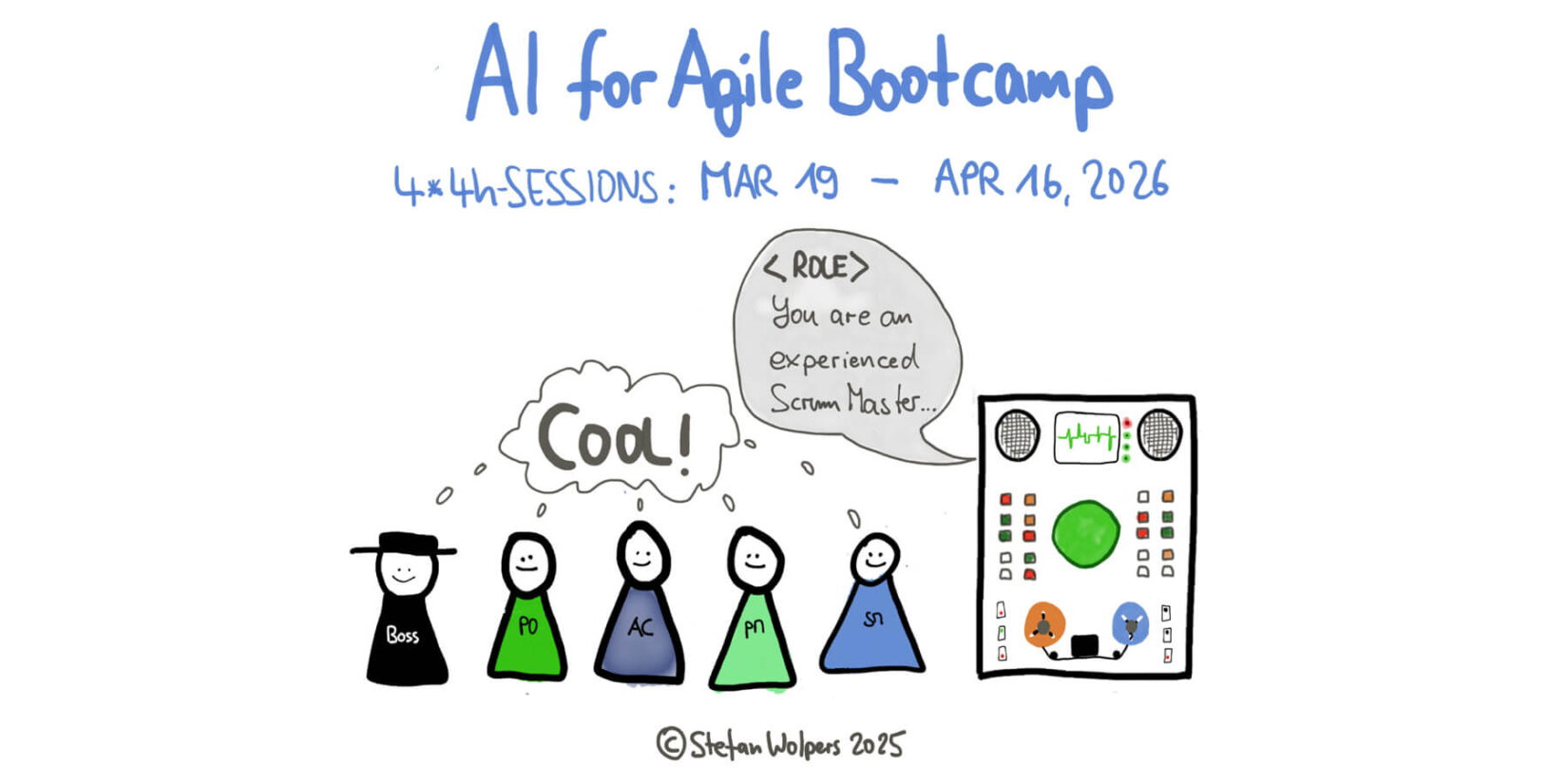
Learn more: 🖥 💯 🇬🇧 AI for Agile BootCamp #6 — March 19 to April 16, 2026.
Customer Voice: “The AI for Agilists course is an absolute essential for anyone working in the field! If you want to keep up with the organizations and teams you support, this course will equip you with not only knowledge of how to leverage AI for your work as an Agilist but will also give you endless tips & tricks to get better results and outcomes. I thoroughly enjoyed the course content, structure, and activities. Working in teams to apply what we learned was the best part, as it led to great insights for how I could apply what I was learning. After the first day on the course, I already walked away with many things I could apply at work. I highly recommend this course to anyone looking to better understand AI in general, but more specifically, how to leverage AI for Agility.” (Lauren Tuffs, Change Leader | Business Agility.)
➿ Agile & Leadership
: The Complicators, The Drama Aggregators, and The Avoiders
Michael Lopp identifies three workplace archetypes that drain leaders’ time: Complicators who endlessly tinker, Drama Aggregators who amplify rumors, and Avoiders who dodge responsibility. Effective leadership requires understanding motivations and addressing behaviors constructively.
: The Architecture of Change: Using Lewin’s Formula for Leadership
Andi Roberts explains that teams resist change not because of stubborn people, but because behaviour depends on both individual motivation and the environment. Leaders succeed by reducing friction, supporting learning, and designing systems that make the new behaviour easier.
: The Cost of Change Curve Is Outdated
Mike Cohn is convinced that the famous cost of change curve no longer reflects modern software development. With agile practices, automation, and AI, coding changes are cheaper, shifting the real bottleneck from development effort to slow feedback.
📯 How I Learned to Stop Worrying and Love the LLM in Agile
Most agile practitioners are still debating whether AI matters. I stopped debating and started using it. Over two-plus years, AI went from proofreading my book manuscript to designing Retrospectives based on team data, to running an entire product development process for a new course, to working with autonomous AI agents. Each phase revealed what the previous one could not teach. Finally, I went Kubrick and started loving the LLM in Agile.
The window of opportunity to build this competence is open now, but it will not remain open indefinitely. Start acting.
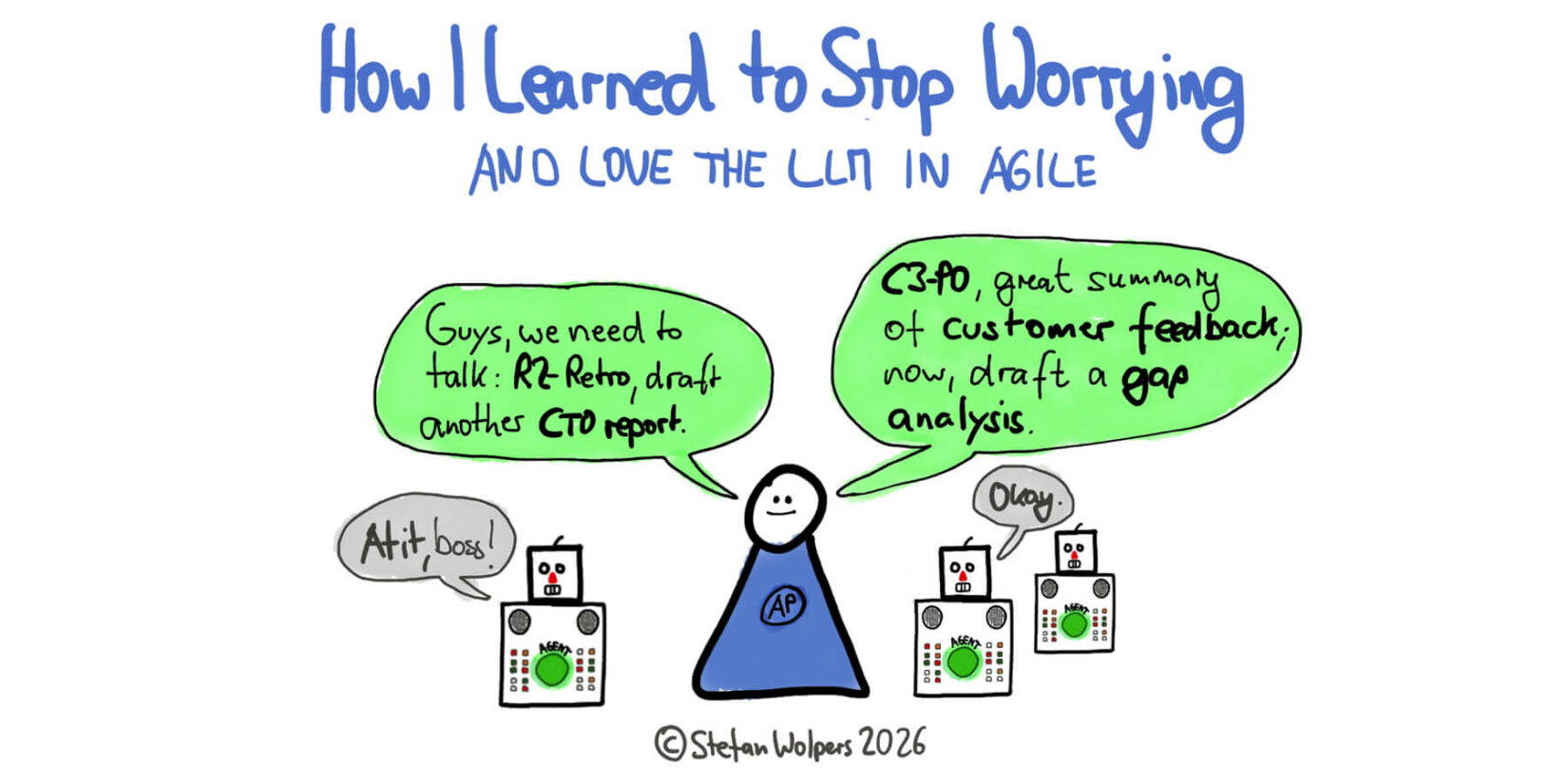
Learn more: How I Learned to Stop Worrying and Love the LLM in Agile.
🛠 Concepts, Practices, Tools & Measuring
: PM Skills Marketplace: An AI Operating System for Better Product Decisions
Paweł Huryn presents an open source PM Skills Marketplace that embeds product frameworks into AI workflows. The system links discovery, strategy, and execution tasks, helping product managers structure decisions and automate routine analysis.
: Force Mapping: A Tool For Fixing Systemic Organizational Issues
Maarten Dalmijn explains that organizations often chase symptoms instead of root causes. Using Force Mapping, teams visualize problems, behaviors, and systemic forces to build shared understanding and run experiments that address underlying organizational issues.
: Stop blaming your AI. Your data is the real problem.
Yuri Vonchitzki suggests teams blaming AI for poor results overlook the real issue: messy data. Models amplify inconsistent, incomplete, or outdated records. Before automation or prompting, organizations must fix data structure, ownership, and process clarity.
📅 Scrum Training & Event Schedule
You can secure your seat for Scrum training classes, workshops, and meetups directly by following the corresponding link in the table below:
| Date | Class and Language | City | Price |
|---|---|---|---|
| 🖥 🇬🇧 November 27, 2026 | GUARANTEED: AI4Agile Online Course v4 (AI4Agile Certificate; English; Online Course) | Online Course | $149 incl. 19% VAT (If applicable.) |
| 🖥 🇬🇧 December 3-17, 2026 | A3 Delegation System Pilot Workshop 2 (English; Live Virtual Class) | Live Virtual Class | $149 incl. 19% VAT (If applicable.) |
| 🖥 🇩🇪 December 8-9, 2026 | Professional Scrum Product Owner Training (PSPO I; German; Live Virtual Class) | Live Virtual Class | €1189 incl. 19% VAT (If applicable.) |
| 🖥 🇬🇧 December 15-16, 2026 | Professional Scrum Master – Advanced Training (PSM II; English; Live Virtual Class) | Live Virtual Class | €1189 incl. 19% VAT (If applicable.) |
| 🖥 🇩🇪 February 16-17, 2027 | Professional Scrum Product Owner Training (PSPO I; German; Live Virtual Class) | Live Virtual Class | €1189 incl. 19% VAT (If applicable.) |
See all upcoming classes here.

You can book your seat for the training directly by following the corresponding links to the ticket shop. If the procurement process of your organization requires a different purchasing process, please contact Berlin Product People GmbH directly.
📺 Join 6,000-plus Agile Peers on Youtube
Now available on the Age-of-Product YouTube channel to improve learning, for example, about Stakeholder Management:
- Hands-on Agile #68: How to Analyze Unstructured Team Interview Data with AI.
- Fabrice Bernhard: The Lean Tech Manifesto.
- Maarten Dalmijn: The 5 Obstacles to Empowered Teams.
- Roman Pichler: The Top Reasons Why a Product Strategy Fails.
- Johanna Rothman: How to Instill Agility, not Agile Practices.
- Hands-on Agile EXTRA: How Elon Musk Would Run YOUR Business with Joe Justice.

✋ Do Not Miss Out: Learn more about Stakeholder Management — Join the 20,000-plus Strong ‘Hands-on Agile’ Slack Community
I invite you to join the “Hands-on Agile” Slack Community and enjoy the benefits of a fast-growing, vibrant community of agile practitioners from around the world.

If you would like to join, all you have to do now is provide your credentials via this Google form, and I will sign you up. By the way, it’s free.
Help your team to learn about how AI Intensifies Work by pointing them to the free Scrum Anti-Patterns Guide: