TL; DR: AI Success Factors — Food for Agile Thought #572
Welcome to the 572nd edition of the Food for Agile Thought newsletter, leading with AI Token Fraud and shared with 35,156 peers.
📺 Short on time? Watch the 72-second teaser video now!
This week, Nathan Wilmers, Maxim Massenkoff, and Peter McCrory argue that AI success factors are rooted in reorganizing around bottlenecks rather than distributing AI tools, which Roman Pichler doubts will rescue disempowered product managers. Marty Cagan tells Joe Murray the bottleneck is deciding what to build, a habit Janna Bastow’s weekly feedback triage enforces, while Teresa Torres and Petra Wille favor fixing AI errors by category. Kyle Poyar shows Gumloop pricing AI at cost plus 8%, yet suggests most vendors mark up only differentiators.
Next, Simon Willison sees AI crossing three thresholds, including reliable coding agents. At the same time, Steve Newman, less doubtful of an intelligence explosion, ties it to taste, judgment, and learning from few examples. Judgment also protects consultants, Rod Moshtagi and Sayash Kapoor believe, whereas Philipp D. Dubach suggests that, ultimately, labor budgets must fund AI. Also, Olivia Moore and Justine Moore find shopping agents stalling at logins, and Matt Marshall reports 70% of model switchers needing weeks of engineering.
Lastly, Yuval Yeret observes that AI mandates breeding theater, and Mike Fisher sees old rationing rituals like story points keeping cheap AI from building for customers. Robert Glaser, citing Conway’s law, wants product teams, not engineers alone, building the software factory. Tim O’Reilly reads AI as repeating Silicon Valley’s value extraction, while Jeff Gothelf proposes measuring customer behavior behind revenue. Finally, Ben Burtenshaw and Kashif Rasul show four agents sharing information reach 82.3% training success with fewer tokens.
Disclaimer: I read Charniak/McDermott’s book on “Artificial Intelligence” decades ago; of course, I use AI for research, translations, proofreading, challenging story arcs and article structures, and summarization. It is a production tool, not a substitute for thinking.
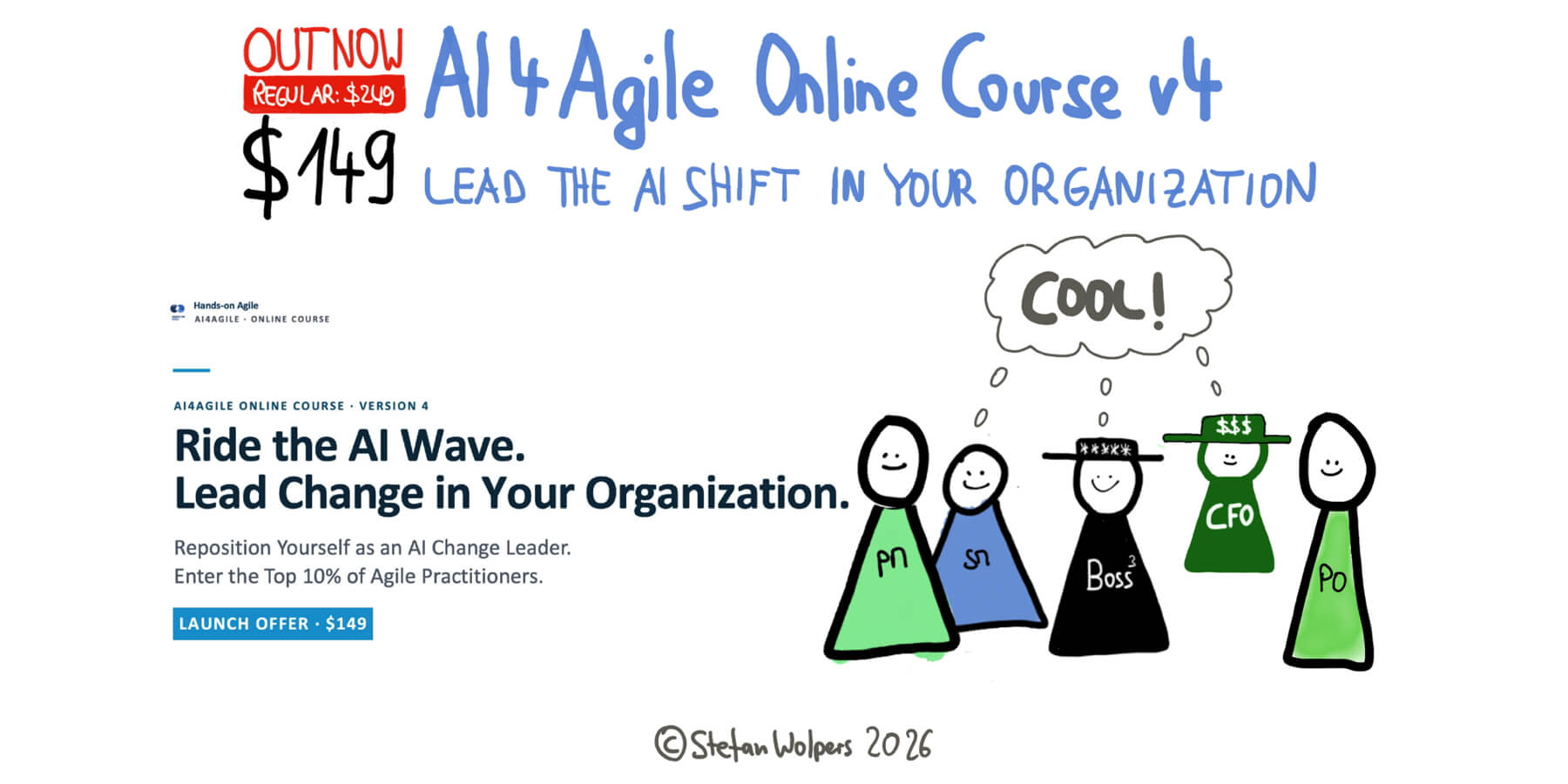
🎉 The AI4Agile Online Course v4 Is Out!
Code, drafts, and reports now cost almost nothing, so judgment becomes the scarce skill, and helping organizations change has always been your work. That makes this an exciting moment for Scrum Masters, Product Owners, Agile Coaches, and Product Managers.
In v4 of the AI4Agile Online Course, you practice with realistic data, make your own decisions, and check each call against my answer keys. The AI4Agile Online Course v4 is in English. 🇬🇧
What You Will Get:
✅ New agent-based exercises: Jira report, product discovery, refinement prep, measuring AI impact ✅ 4 Live onboarding sessions ✅ A cohort-hardened, proven course design ✅ Learn to 10x your effectiveness with AI; your stakeholders will be grateful ✅ Apply AI to classic use cases of “Agile” ✅ The A3 Delegation System comprising seven ready-to-use templates ✅ All texts, slides, prompts, and graphics ✅ Guaranteed: Lifetime access to v4 ✅ AI4Agile Foundation Certificate: 40 questions in 45 minutes.

🎓 Join Now: The AI4Agile Online Course v4 at $149 — No Coding Required!
👉 Please note: The course will be available for $149 from November 21-30, 2026, including a 14-Day Refund Policy–No Questions Asked! (After that, $249.) 👈
Did you miss the previous Food for Agile Thought issue 571?
🗞 Shall I notify you about articles like this one? Awesome! You can sign up here for the ‘Food for Agile Thought’ newsletter and join 35,000-plus subscribers.
🎓 Join Stefan in one of his upcoming training classes!
🏆 The Tip of the Week
(via Anthropic): Working with AI: To understand businesses’ experiences better, we conducted 66 interviews with 58 of Anthropic’s enterprise customers.
Nathan Wilmers, Maxim Massenkoff, and Peter McCrory interviewed 58 companies and suggest that handing out AI tools is not enough. The biggest gains come from reorganizing roles and workflows around bottlenecks.
🎯 Product
(via ThoughtWorks): Building what matters in the AI era with Marty Cagan
Joe Murray talks with Marty Cagan, who suggests that faster AI-assisted coding misses the bottleneck (deciding what to build) and that value and viability (the risks that often sink products) usually have no owner.
and : 🎙️ Bugs
Teresa Torres and Petra Wille suggest AI products blur what counts as a bug; patching prompts per complaint backfires. Teams should instead fix error categories and agree on good enough.
(via ProdPad): Your Feedback Backlog is a Triage Problem
Janna Bastow suggests most teams collect feedback but rarely decide what to do with it. She proposes weekly triage, giving every item one of four exits; tagging is not one.
: Why Product Management is Still Hard
Roman Pichler suggests AI has not made product management easier. Incomplete knowledge and limited empowerment often reduce product managers to feature brokers, and handing them AI tools rarely leads to breakthroughs.
: A transparent pricing model for AI
Kyle Poyar shows Gumloop passing AI costs through at cost plus 8% and reporting a 42% higher Pro trial conversion. Still, he suggests most vendors mark up only what sets them apart.
🧠 Artificial Intelligence
: Three LLM inflection points in twelve months
Simon Willison suggests AI crossed three thresholds in twelve months: reliable coding agents, models that brute-force clearly defined goals, and 3D work, including a model that seemingly understood fun.
and : Management consulting is not a thin wrapper on intelligence
Rod Moshtagi and Sayash Kapoor doubt that AI will largely replace consultants, since clients also pay for judgment, coordination, credibility, and accountability. Organizational change from AI may create more consulting work.
(via Andreessen Horowitz): Welcome to the B2A Economy: How Agents Buy
Olivia Moore and Justine Moore show AI agents now shortlist products for buyers, weighing full costs and return policies. Every agent checkout attempt stopped early at stores demanding a login.
: Jevons Paradox in AI: Cheaper Tokens Won't Pay for Capex
Philipp D. Dubach shows token prices falling about as fast as volume grows, undercutting the bet that cheaper inference will pay for AI capex. He suggests the money must come from today's labor budgets.
: The Final Goalpost: Is learning to do the things AI is bad at something AI can be good at?
Steve Newman doubts an imminent intelligence explosion less firmly than before. He believes it hinges on whether AI can master what it lacks: taste, judgment, and learning from few examples.
(via Venturebeat): Why swapping AI models takes weeks of work
Matt Marshall shows that swapping AI models is rarely a configuration change: 70% of switchers needed weeks of extra engineering because prompts, tools, and tests were tailored to the old model.
➿ Agile, Leadership & Career
: Stop Pushing AI Change. Build a Product People Pull.
Yuval Yeret suggests AI access mostly produces experimentation and mandates breed theater. Lasting change is pulled by people with real problems and personal payoffs, at a pace organizations can absorb.
(via O’Reilly Media): What Happened to Silicon Valley?
Tim O'Reilly believes Silicon Valley has traded value creation for value extraction, and the AI boom repeats the pattern. He suggests fixing rules and incentives to favor openness and interoperability.
: Jammed Typewriters
Mike Fisher suggests AI made building cheap, yet gains don't reach customers because rituals built to ration scarce coding time (story points, Sprint batching, release gates) still run the show.
📯 Lead the AI Shift in Your Organization: The AI4Agile Online Course v4 Is Available
If you work as a Scrum Master, Product Owner, or Agile Coach, you have probably noticed that the ground under your role has shifted, and that chatting with ChatGPT no longer sets you apart from anyone in the building. The AI4Agile Online Course v4 is available now. It trains you to take the next step after chatting on realistic data, before it counts at your job: producing AI-assisted work your stakeholders can check, from a discovery analysis to a status report for your CTO to an answer to your CFO's question: Where is the AI's beef?
Thesis: This article announces version 4 of the AI4Agile Online Course, a self-paced course for agile practitioners that now includes four hands-on exercises on a fictional startup's data, with answer keys, so practitioners can deliver checkable AI-assisted product discovery, refinement, Jira status reporting, and AI impact work.
The launch price is $149 from now through November 30, 2026, and the regular price of $249 applies from December 1, 2026.
📺 Watch the video now: The $100,000 Scrum Master Job Is Gone. What Agile Practitioners Do.
👉 Learn more: Lead the AI Shift in Your Organization: The AI4Agile Online Course v4 Is Available.
🛠 Concepts, Practices, Tools & Measuring
: Conway’s law just hit your software factory
Robert Glaser suggests Conway's law turns a software factory built by engineering alone into tooling for existing silos. The product team should build it, so its checks carry product judgment.
and (via huggingface): Swarms, Flocks, Gangs: How to build, train, and evaluate multi-agent systems
Ben Burtenshaw and Kashif Rasul suggest bigger agent swarms may buy more compute. Their four agents learned to share information, boosting training success to 82.3 percent while using fewer tokens.
: How to add a behaviour layer to your goal system before AI turns it into a feature factory
Jeff Gothelf suggests AI makes output and revenue easier to count, while customer behavior (the link between them) goes unmeasured. He proposes adding two or three behaviors per revenue target.
📅 Scrum Training & Event Schedule
You can secure your seat for Scrum training classes, workshops, and meetups directly by following the corresponding link in the table below:
| Date | Class and Language | City | Price |
|---|---|---|---|
| 🖥 💯 🇬🇧 November 27, 2026 | GUARANTEED: AI4Agile Online Course v4 (AI4Agile Certificate; English; Online Course) | Online Course | $149 incl. 19% VAT (If applicable.) |
| 🖥 💯 🇩🇪 December 8-9, 2026 | GUARANTEED: Professional Scrum Product Owner Training (PSPO I; German; Live Virtual Class) | Live Virtual Class | €1099 incl. 19% VAT (If applicable.) |
| 🖥 🇬🇧 December 15-16, 2026 | Professional Scrum Master – Advanced Training (PSM II; English; Live Virtual Class) | Live Virtual Class | €1189 incl. 19% VAT (If applicable.) |
| 🖥 🇩🇪 February 16-17, 2027 | Professional Scrum Product Owner Training (PSPO I; German; Live Virtual Class) | Live Virtual Class | €1099 incl. 19% VAT (If applicable.) |
See all upcoming classes here.

You can book your seat for the training directly by following the corresponding links to the ticket shop. If the procurement process of your organization requires a different purchasing process, please contact Berlin Product People GmbH directly.
📺 Join 6,000-plus Agile Peers on Youtube
Now available on the Age-of-Product YouTube channel to improve learning, for example, about AI Success Factors:
- The $100,000 Scrum Master Job Is Gone. What Agile Practitioners Do Now.
- AI Adoption Failures: Why Your Successful AI Pilot Is No Reason to Scale.
- We’re Not Paid to Practice Scrum — Answer These 5 Product Questions Instead.
- AI Refinement Prep Traps and How to Avoid Them.
- AI-Assisted Product Discovery — Agent Assists, Team Decides.
- Before You Switch the AI Model: The Hidden Cost of "Updating" Models.
- How the A3 Delegation System Helps to Avoid AI Debt.
- OUT NOW: The AI4Agile Course v3 — Master AI for Agile Practitioners.

✋ Do Not Miss Out: Learn more about AI Success Factors — Join the 20,000-plus Strong ‘Hands-on Agile’ Slack Community
I invite you to join the “Hands-on Agile” Slack Community and enjoy the benefits of a fast-growing, vibrant community of agile practitioners from around the world.

If you would like to join, all you have to do now is provide your credentials via this Google form, and I will sign you up. By the way, it’s free.
Help your team to learn about AI's Götterdämmerung by pointing them to the free Scrum Anti-Patterns Guide: