

TL; DR: Sabotaging AI — Food for Agile Thought #516
Welcome to the 516th edition of the Food for Agile Thought newsletter, shared with 40,359 peers. This week, Jenn Spykerman addresses unknowingly sabotaging AI according to a 1944 manual, masquerading endless committees, perfectionism, and cautious delays as good governance. Leah Tharin challenges claims that LLMs can stand in for real customer insight, warning that dashboards can fuel strategy theater, while John Cutler connects prioritization to strategic leverage and power dynamics. Jing Hu reframes AI failure stats as early-stage noise, and Duncan Brown warns that AI favors the visible over the messy, human glue that makes effective teams work.
Next, Chetan Kapoor shows how eBay uses feature flags as discovery tools to validate demand early and surface usability issues. Kyle Poyar critiques popular SaaS pricing models and shares fixes that avoid complete overhauls. Ethan Mollick maps the current AI landscape with practical guidance on tools, tiers, and tactics. At the same time, Zvi Mowshowitz highlights key takeaways from Karpathy’s AGI views, and James Shore reframes engineering accountability through product bets instead of features and deadlines.
Lastly, Anthropic’s Claude receives “skills” as modular guides for specialized tasks, now open-sourced on GitHub. One author explores how great teams grow through targeted support and bold delegation, and Jeff Sauro and Jim Lewis dissect NPS claims, separating useful signals from misleading noise. Charlie Guo calls out the creeping signs of AI-generated content and its cost to authenticity. Finally, Karen Dahut presents Google Skills, a vast new learning platform for AI and tech upskilling.

Did you miss the previous Food for Agile Thought issue 515?
🗞 Shall I notify you about articles like this one? Awesome! You can sign up here for the ‘Food for Agile Thought’ newsletter and join 40,000-plus subscribers.
🎓 Join Stefan in one of his upcoming Professional Scrum training classes!
🏆 The Tip of the Week: Sabotaging AI
: The Sabotage Manual: How We're Using 80-Year-Old Tactics to Kill AI Innovation and Adoption
Jenn Spykerman warns that many organizations are unknowingly following a World War II sabotage manual by forming endless committees, demanding perfection, multiplying paperwork, and hiding in caution, all while competitors ship and learn.
🎯 Product
: Why AI cannot simulate your customers behaviour
Leah Tharin dissects a widely shared LLM study, arguing that simulating customer intent is not the same as understanding real behavior. She warns that replacing conversations with dashboards leads to strategy theater rather than product insight.
: Prioritization Starts With Strategic Prioritization
John Cutler connects strategy and prioritization by framing every value or urgency judgment as a strategic choice. He unpacks the concepts of benefit types, decay, leverage, and power dynamics to ground prioritization in a real strategic context.
: Beyond release management: Feature flags for product discovery
Chetan Kapoor shows how feature flags go far beyond release toggles and become strategic tools for faster product discovery. He shares three practical techniques that helped eBay validate demand, prove value, and uncover usability issues early.
: Your pricing is (probably) broken
Kyle Poyar argues that every SaaS pricing model has flaws, from flat-fee subscriptions to outcome-based pricing. He breaks down why each approach tends to fall short and offers tactical ways to improve without overhauling everything.
🧠 Artificial Intelligence
: Why Everyone Misread MIT’s 95% AI “Failure” Statistic?
Jing Hu unpacks why MIT’s 95% AI project “failure” stat misleads, showing it reflects deep transformation hurdles, not disinterest. AI adoption mirrors past tech waves, driven by marginal gains rather than boardroom KPIs.
: An Opinionated Guide to Using AI Right Now
Ethan Mollick offers a hands-on, up-to-date guide to navigating current AI tools, showing how to choose between free and paid models like ChatGPT, Claude, and Gemini, when to use Deep Research, and why playful experimentation builds future-ready intuition.
: On Dwarkesh Patel’s Podcast With Andrej Karpathy
Zvi Mowshowitz dissects Andrej Karpathy’s podcast with Dwarkesh Patel, highlighting tensions between AGI optimism and caution. Karpathy foresees decade-long timelines, gradual progress, and cognitive limitations in today’s models despite their rapid adoption.
(via Anthropic): Anthropics/skills: Public repository for Skills
Anthropic’s Claude uses “skills” as modular task guides that improve performance on specialized workflows, from brand-compliant documents to data analysis. The full set of examples is available in the anthropics GitHub repository for skills.
🖥 💯 🇬🇧 AI for Agile BootCamp #4 — November 6 – December 4, 2025
The job market’s shifting. Agile roles are under pressure. AI tools are everywhere. But here’s the truth: the Agile pros who learn how to work with AI, not against it, will be the ones leading the next wave of high-impact teams.
So, become the one who professional recruiters call first for “AI‑powered Agile.” Be among the first to master practical AI applications for Scrum Masters, Agile Coaches, Product Owners, Product Managers, and Project Managers.
Tickets also include lifetime access to the corresponding online course, once it is published. The class is in English. 🇬🇧
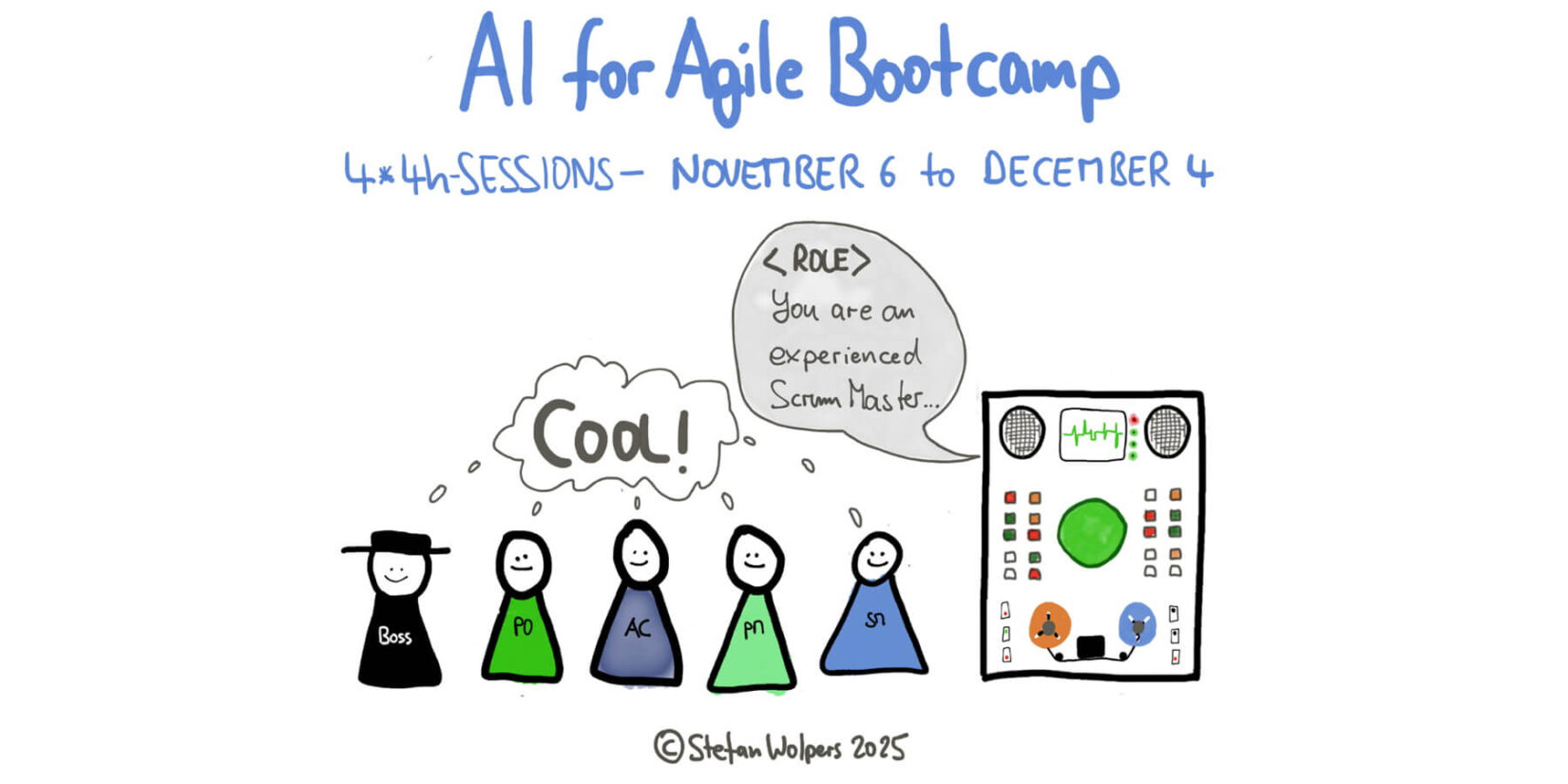
Learn more: 🖥 💯 🇬🇧 AI for Agile BootCamp #4 — November 6 – December 4, 2025.
Customer Voice: “The AI for Agilists course is an absolute essential for anyone working in the field! If you want to keep up with the organizations and teams you support, this course will equip you with not only knowledge of how to leverage AI for your work as an Agilist but will also give you endless tips & tricks to get better results and outcomes. I thoroughly enjoyed the course content, structure, and activities. Working in teams to apply what we learned was the best part, as it led to great insights for how I could apply what I was learning. After the first day on the course, I already walked away with many things I could apply at work. I highly recommend this course to anyone looking to better understand AI in general, but more specifically, how to leverage AI for Agility.” (Lauren Tuffs, Change Leader | Business Agility.)
➿ Agile & Leadership
: Team dynamics after AI
Duncan Brown explores how AI adoption reshapes team dynamics, arguing that it amplifies the legible while sidelining the social, the political, and the illegible, which is the real work that makes teams effective and human.
: The Accountability Problem
James Shore explores how engineering leaders can reclaim accountability from outdated project-based governance by shifting focus from features and deadlines to “product bets” that align with business value, risk, and strategic outcomes.
: Leveling Up Teams Fast and Slow
The author argues that strong teams are built slowly by consistently improving the weakest, and rapidly by handing ownership of critical work to top performers who cut through noise and lead with visible, competent direction.
📯 The Dangerous Middle: Agile Roles That AI Will Erode First
Peter Yang, a renowned product leader, argues that AI will split product roles into two groups: Generalists who can prototype end-to-end with AI, and specialists in the top 5% of their fields. Everyone else in the dangerous middle risks being squeezed.
How does this apply to agile practitioners: Scrum Masters, Product Owners, Agile Coaches, and transformation leads? It does, with important nuances.

Learn more: The Dangerous Middle: Agile Roles That AI Will Erode First.
🛠 Concepts, Practices, Tools & Measuring
(via Measuring Usability): A Report Card for the Net Promoter Score
Jeff Sauro and Jim Lewis assess 13 claims about the Net Promoter Score using empirical data. Their verdict: NPS is reliable and sometimes helpful, but overreliance or misuse leads to flawed decisions and false certainty.
(via Google): Start learning all things AI on the new Google Skills
Karen Dahut introduces Google Skills, a new platform offering nearly 3,000 AI and tech courses, labs, and credentials. With hands-on labs, gamified learning, and free options, it's built to support learners and organizations alike.
: The Field Guide to AI Slop
Charlie Guo unpacks the subtle fingerprints of AI-generated writing, from em dashes and snappy triads to empty metaphors and formatting quirks, and argues that AI slop is eroding both content quality and human authenticity.
📅 Scrum Training & Event Schedule
You can secure your seat for Scrum training classes, workshops, and meetups directly by following the corresponding link in the table below:
| Date | Class and Language | City | Price |
|---|---|---|---|
| 🖥 🇬🇧 November 27, 2026 | GUARANTEED: AI4Agile Online Course v4 (AI4Agile Certificate; English; Online Course) | Online Course | $149 incl. 19% VAT (If applicable.) |
| 🖥 🇬🇧 December 3-17, 2026 | A3 Delegation System Pilot Workshop 2 (English; Live Virtual Class) | Live Virtual Class | $149 incl. 19% VAT (If applicable.) |
| 🖥 🇩🇪 December 8-9, 2026 | Professional Scrum Product Owner Training (PSPO I; German; Live Virtual Class) | Live Virtual Class | €1189 incl. 19% VAT (If applicable.) |
| 🖥 🇬🇧 December 15-16, 2026 | Professional Scrum Master – Advanced Training (PSM II; English; Live Virtual Class) | Live Virtual Class | €1189 incl. 19% VAT (If applicable.) |
| 🖥 🇩🇪 February 16-17, 2027 | Professional Scrum Product Owner Training (PSPO I; German; Live Virtual Class) | Live Virtual Class | €1189 incl. 19% VAT (If applicable.) |
See all upcoming classes here.

You can book your seat for the training directly by following the corresponding links to the ticket shop. If the procurement process of your organization requires a different purchasing process, please contact Berlin Product People GmbH directly.
📺 Join 6,000-plus Agile Peers on Youtube
Now available on the Age-of-Product YouTube channel to improve learning, for example, about avoiding sabotaging AI:
- Hands-on Agile #68: How to Analyze Unstructured Team Interview Data with AI.
- Fabrice Bernhard: The Lean Tech Manifesto.
- Maarten Dalmijn: The 5 Obstacles to Empowered Teams.
- Roman Pichler: The Top Reasons Why a Product Strategy Fails.
- Johanna Rothman: How to Instill Agility, not Agile Practices.
- Hands-on Agile EXTRA: How Elon Musk Would Run YOUR Business with Joe Justice.

✋ Do Not Miss Out: Learn more about Avoiding Sabotaging AI — Join the 20,000-plus Strong ‘Hands-on Agile’ Slack Community
I invite you to join the “Hands-on Agile” Slack Community and enjoy the benefits of a fast-growing, vibrant community of agile practitioners from around the world.

If you would like to join, all you have to do now is provide your credentials via this Google form, and I will sign you up. By the way, it’s free.
Help your team to learn about Personal AI Productivity by pointing them to the free Scrum Anti-Patterns Guide: