
TL; DR: Poor Decisions by Managers — Food for Agile Thought #515
Welcome to the 515th edition of the Food for Agile Thought newsletter, shared with 40,381 peers. This week, Henrik Mårtensson explores six decision-making traps managers fall into and how to overcome poor decisions with candor and deliberate practice. Janna Bastow highlights how skipping feasibility checks sabotages product delivery, offering lightweight tactics for trust and clarity in the AI era. Also, Teresa Torres and Petra Wille explore how product leaders shape their legacy through their impact, values, and reflection. Meanwhile, Jacob Poushter and team find AI anxiety outweighs optimism, and Maarten Dalmijn warns how process bloat kills team ownership.
Next, Melissa Suzuno outlines how product operating models shift focus from outputs to outcomes, scaling through pilot teams and leadership support. Roger Snyder addresses the tension between PM and PO, emphasizing the importance of alignment on purpose, ownership, and cadence, while Charlie Guo examines LLM performance drift, providing mitigation strategies. Barry O’Reilly lists 21 signs your AI project might be undead, and Martin Eriksson warns that empowerment fails without a strategic context and a deliberate shift in leadership stance.
Lastly, Pawel Brodzinski warns that autonomous AI agents lack the trust needed for broad adoption without transparency and alignment. Jens Meyer critiques veto-heavy cultures and calls for genuine accountability, where saying yes means accepting the outcome. Also, Emily Webber shares tips on selecting meaningful icebreakers that promote safety and connection, and Steve Blank defends science as the engine of innovation. Finally, Matt Kamelman stresses that smart AI starts with context, not just more data.
🎓 🇬🇧 🤖 The AI 4 Agile Online Course at $129 — Only Until Next Monday!
I developed the self-paced AI 4 Agile Online Course for agile practitioners, including Product Owners, Product Managers, Scrum Masters, Agile Coaches, and delivery professionals who want to integrate artificial intelligence into their workflows with clarity, ethics, and purpose.
You don’t need to become an AI expert. However, you do need to understand how LLMs like ChatGPT, Claude, or Gemini can support real agile work and where their limitations lie. Like Jim Highsmith said, AI isn’t just a tool, but a new context for agility.
This course shows you how to do precisely that.
What’s Included:
- 8+ hours of self-paced video modules
- A cohort-hardened, proven course design
- Learn to 10x your effectiveness with AI; your stakeholders will be grateful
- Delve into classic agile use cases of AI
- Help your team create more customer value
- All texts, slides, prompts, graphics; you name it
- Access custom GPTs, including the “Scrum Anti-Patterns Guide GTP”
- Guaranteed: Lifetime access to all course updates and materials; there is a lot more to come
- AI 4 Agile Certificate.

👉 Please note: The course will only be available for sign-up at $129 until October 20, 2025! 👈
🎓 Enroll in the AI 4 Agile Online Course Now: Master AI Integration for Agile Practitioners—No AI Expertise Required!
Did you miss the previous Food for Agile Thought issue 514?
🗞 Shall I notify you about articles like this one? Awesome! You can sign up here for the ‘Food for Agile Thought’ newsletter and join 40,000-plus subscribers.
🎓 Join Stefan in one of his upcoming Professional Scrum training classes!
🏆 The Tip of the Week: Poor Decisions by Managers
: Six Reasons Why Managers Make Poor Decisions
Henrik Mårtensson explains management mistakes through six lenses: bounded rationality, satisficing, double-loop learning, OODA, politics, neuroscience, advocating candor, decision tools, time-savvy heuristics, and deliberate practice to improve outcomes.
🎯 Product
and : Product & Leadership Legacy
Teresa Torres and Petra Wille unpack product and leadership legacy, contrasting impact and craft, linking brand and values, offering reflection prompts to guide growth, transitions, and how teams remember you.
(via ProdPad): The Feasibility Fallacy: Why Teams Still Trip Over Technical Feasibility
Janna Bastow demonstrates how skipping technical feasibility can derail trust and timelines, citing late discovery and unclear ownership. She advocates for five-minute checks, visible assumptions, pre-mortems, shared ownership, and addressing the costs, performance, and compliance of the AI era.
: The Product Operating Model Explained: From Pilot Teams to Full Transformation
Melissa Suzuno explains the product operating model, contrasting it with projects, stressing outcomes, continuous discovery, pilot teams, leader roles, handling resistance, and scaling pilots into organization-wide transformation, including regulated industries.
(via Productside): Product Manager Vs Product Owner: From Friction To Forward Motion
Roger Snyder argues that PM and PO friction stems from misaligned context, not competence. He recommends aligning on purpose, clarifying ownership, establishing cadence and language, managing stakeholders, and using outcome scorecards to align roadmap and backlog.
🧠 Artificial Intelligence
(via Pew Research Center): How People Around the World View AI
Jacob Poushter, Moira Fagan, and Manolo Corichi report on global public opinion regarding AI, finding that awareness is high, but concern outweighs excitement. Trust favors domestic regulators and the EU, with youth, education, and Internet use correlating with enthusiasm.
: LLMs are getting dumber and we have no idea why
Charlie Guo argues LLMs show performance drift, examines five theories: quantization, stale training data, seasonal human mimicry, user bias, and post-training tweaks, and recommends RAG, fine-tuning, and strong eval suites.
: We Will Not Trust Autonomous AI Agents Anytime Soon
Pawel Brodzinski says we still will not trust autonomous AI agents. Autonomy requires transparency, alignment, clear boundaries, technical excellence, and care; models often lack these essential elements. Expect narrow, constrained uses and ongoing cat-and-mouse exploits.
: When AI Projects Are Zombies, Ghosts, or Ghouls and How to Spot Them
Barry O'Reilly explains how to spot undead AI ventures with 21 red flags: endless pilots, no learning loop, hidden data, vanity metrics, overstated claims, missing demos, unclear ROI, and fragile scalability.
🖥 💯 🇬🇧 AI for Agile BootCamp #4 — November 6 – December 4, 2025
The job market’s shifting. Agile roles are under pressure. AI tools are everywhere. But here’s the truth: the Agile pros who learn how to work with AI, not against it, will be the ones leading the next wave of high-impact teams.
So, become the one who professional recruiters call first for “AI‑powered Agile.” Be among the first to master practical AI applications for Scrum Masters, Agile Coaches, Product Owners, Product Managers, and Project Managers.
Tickets also include lifetime access to the corresponding online course, once it is published. The class is in English. 🇬🇧
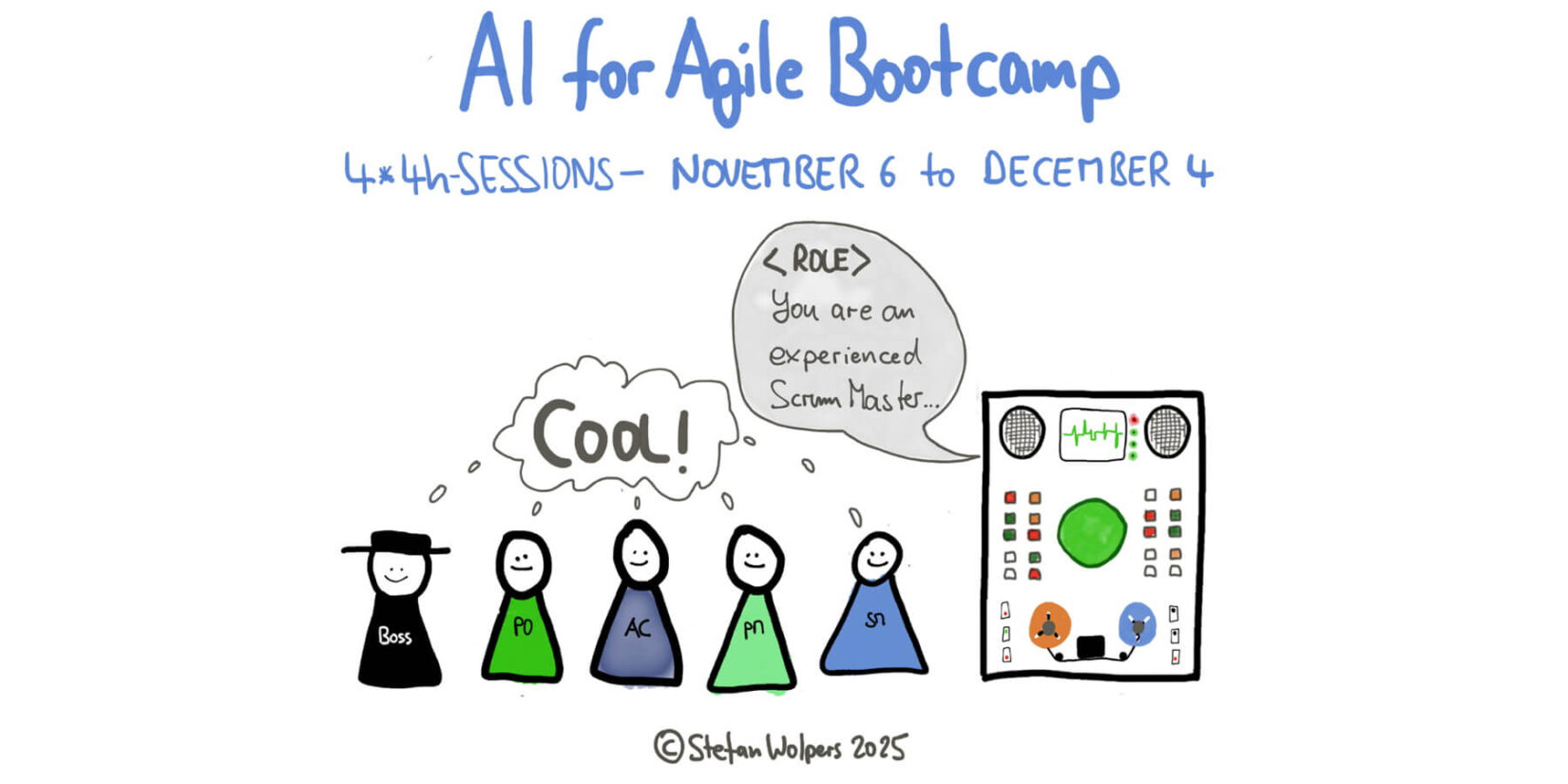
Learn more: 🖥 💯 🇬🇧 AI for Agile BootCamp #4 — November 6 – December 4, 2025.
Customer Voice: “The AI for Agilists course is an absolute essential for anyone working in the field! If you want to keep up with the organizations and teams you support, this course will equip you with not only knowledge of how to leverage AI for your work as an Agilist but will also give you endless tips & tricks to get better results and outcomes. I thoroughly enjoyed the course content, structure, and activities. Working in teams to apply what we learned was the best part, as it led to great insights for how I could apply what I was learning. After the first day on the course, I already walked away with many things I could apply at work. I highly recommend this course to anyone looking to better understand AI in general, but more specifically, how to leverage AI for Agility.” (Lauren Tuffs, Change Leader | Business Agility.)
➿ Agile & Leadership
: How Big Is Your Kraken?
Maarten Dalmijn uses the Kraken metaphor to illustrate how bureaucracy and distrust shift teams from ownership to orchestration, hindering collaboration and delivery; he urges leaders to cut their tentacles, avoid SAFe, and stay close to the work.
: You Can't Just Flip the Switch on Empowerment
Martin Eriksson says empowerment fails when leaders skip stages; teams need a shift from directing to coaching, supporting, and then delegating, along with strategic context via Decision Stack. Directive leadership is appropriate.
(via INSEAD Knowledge): The Curious Comfort of Saying ‘No’
Jens Meyer argues that misaligned authority and accountability make saying no the safest move, hiding opportunity costs; urges shifting power to accountable doers, shrinking veto cultures, and designing systems where yes carries responsibility and consequences.
📯 Mastering AI as Agile Practitioners — The AI 4 Agile Course Is Out!
The Mastering AI with the AI 4 Agile Online Course launches this week, and I am proud that I avoided another delay. Scope creep happened despite my supposed expertise in preventing exactly that. The course expanded from a simple prompt collection to over 8 hours of video, custom GPTs, and materials that I’ll apparently continue to update indefinitely, as I’m still not satisfied that it’s comprehensive enough. (Also, the field is advancing so rapidly.)
At least the $129 lifetime access means you will benefit from my urge to fight my imposter syndrome with perfectionism and from my inability to call a project “done.” I guess we are in for the long term. 🙂
🎓 🛒 The AI 4 Agile Online Course Is Available — Join Now at $ 129 until October 20, 2025: AI 4 Agile — Master AI Integration for Agile Practitioners.
🛠 Concepts, Practices, Tools & Measuring
: (More) Icebreakers for meetings and workshops that don’t suck (no really)
Emily Webber explains how to choose icebreakers that help: focus on context, inclusivity, and purpose to lower participation barriers, boost psychological safety, energize, and connect people and content with examples.
: No Science, No Startups: The Innovation Engine We’re Switching Off
Steve Blank argues science underpins power and startups, explaining the roles of scientists, engineers, entrepreneurs, and VCs, the role of universities, and how cutting basic research erodes innovation; AI augments scientists, not replaces them.
(via ThoughtWorks): Why context engineering is like teaching AI to skip stones
Matt Kamelman argues that effective AI requires context engineering: selecting and routing the right information, not more. Blend embeddings, graphs, and RAG with dual memories for compliant, stable, adaptable reasoning outputs.
📅 Scrum Training & Event Schedule
You can secure your seat for Scrum training classes, workshops, and meetups directly by following the corresponding link in the table below:
| Date | Class and Language | City | Price |
|---|---|---|---|
| 🖥 🇬🇧 November 27, 2026 | GUARANTEED: AI4Agile Online Course v4 (AI4Agile Certificate; English; Online Course) | Online Course | $149 incl. 19% VAT (If applicable.) |
| 🖥 🇬🇧 December 3-17, 2026 | A3 Delegation System Pilot Workshop 2 (English; Live Virtual Class) | Live Virtual Class | $149 incl. 19% VAT (If applicable.) |
| 🖥 🇩🇪 December 8-9, 2026 | Professional Scrum Product Owner Training (PSPO I; German; Live Virtual Class) | Live Virtual Class | €1189 incl. 19% VAT (If applicable.) |
| 🖥 🇬🇧 December 15-16, 2026 | Professional Scrum Master – Advanced Training (PSM II; English; Live Virtual Class) | Live Virtual Class | €1189 incl. 19% VAT (If applicable.) |
| 🖥 🇩🇪 February 16-17, 2027 | Professional Scrum Product Owner Training (PSPO I; German; Live Virtual Class) | Live Virtual Class | €1189 incl. 19% VAT (If applicable.) |
See all upcoming classes here.

You can book your seat for the training directly by following the corresponding links to the ticket shop. If the procurement process of your organization requires a different purchasing process, please contact Berlin Product People GmbH directly.
📺 Join 6,000-plus Agile Peers on Youtube
Now available on the Age-of-Product YouTube channel to improve learning, for example, about Poor Decisions:
- Hands-on Agile #68: How to Analyze Unstructured Team Interview Data with AI.
- Fabrice Bernhard: The Lean Tech Manifesto.
- Maarten Dalmijn: The 5 Obstacles to Empowered Teams.
- Roman Pichler: The Top Reasons Why a Product Strategy Fails.
- Johanna Rothman: How to Instill Agility, not Agile Practices.
- Hands-on Agile EXTRA: How Elon Musk Would Run YOUR Business with Joe Justice.
✋ Do Not Miss Out: Learn more about Poor Decisions — Join the 20,000-plus Strong ‘Hands-on Agile’ Slack Community
I invite you to join the “Hands-on Agile” Slack Community and enjoy the benefits of a fast-growing, vibrant community of agile practitioners from around the world.

If you would like to join, all you have to do now is provide your credentials via this Google form, and I will sign you up. By the way, it’s free.
Help your team to learn about Personal AI Productivity by pointing them to the free Scrum Anti-Patterns Guide: