
TL; DR: State of AI Report 2025 — Food for Agile Thought #514
Welcome to the 514th edition of the Food for Agile Thought newsletter, shared with 40,403 peers. This week, Nathan Benaich’s State of AI Report 2025 highlights advancements in reasoning, China’s momentum, massive compute, sharper geopolitics, and a pragmatic shift toward reliability and governance. Jenny Wanger offers a hands-on way to surface implicit strategy through learner-mode interviews, drafting, and iterative feedback, while John Cutler tackles product-centricity in non-digital firms, urging a networked operating model that links funding, intent, collaboration, architecture, and outcomes. Nino Paoli notes Citi’s prompt training push while warning that real impact needs ongoing upskilling and integration. Additionally, Maarten Dalmijn highlights trust as the actual bottleneck that must be addressed before AI can effectively amplify execution.
Next, Roman Pichler sharpens stakeholder management with a power-interest focus, trust building, early involvement, and NVC for real conflict resolution. David Pereira draws out Ryan Singer on keeping six-week bets lean through framing, alignment, and timely founder input, while David Shapiro challenges “AI pilot failure” myths, focusing on integration and governance issues. Then, Sangeet Paul Choudary shifts AI agent talk to coordination and standards, and Dave Rooney marks 25 years of XP, calling for TDD, pairing, CD, and lean flow.
Lastly, Casey Newton probes OpenAI’s platform push, weighing integrations against privacy, incentives, and trust. Teresa Torres urges teams to own interview synthesis, then use AI to spot cross-patterns without losing empathy or skill. Sean Goedecke demonstrates that staff engineers can influence politics by aligning momentum and delivering visible wins, and Shane Hastie and Marcos Arribas share culture-at-scale practices from autonomy to right-sized quality. Finally, Anton Zaides advocates ruthless meeting hygiene to protect deep engineering flow.
🎓 🇬🇧 🤖 The AI 4 Agile Online Course at $129 — October 13, 2025
I developed the self-paced AI 4 Agile Online Course for agile practitioners, including Product Owners, Product Managers, Scrum Masters, Agile Coaches, and delivery professionals who want to integrate artificial intelligence into their workflows with clarity, ethics, and purpose.
You don’t need to become an AI expert. However, you do need to understand how LLMs like ChatGPT, Claude, or Gemini can support real agile work and where their limitations lie. Like Jim Highsmith said, AI isn’t just a tool, but a new context for agility.
This course shows you how to do precisely that.
What’s Included:
- 8+ hours of self-paced video modules
- A cohort-hardened, proven course design
- Learn to 10x your effectiveness with AI; your stakeholders will be grateful
- Delve into classic agile use cases of AI
- Help your team create more customer value
- All texts, slides, prompts, graphics; you name it
- Access custom GPTs, including the “Scrum Anti-Patterns Guide GTP”
- Enjoy community access for peer learning
- Guaranteed: Lifetime access to all course updates and materials; there is a lot more to come
- Certificate of completion.

👉 Please note: The course will only be available for sign-up at $129 until October 20, 2025! 👈
🎓 Join the Waitlist of the AI 4 Agile Online Course Now: Master AI Integration for Agile Practitioners—No AI Expertise Required!
Did you miss the previous Food for Agile Thought issue 513?
🗞 Shall I notify you about articles like this one? Awesome! You can sign up here for the ‘Food for Agile Thought’ newsletter and join 40,000-plus subscribers.
🎓 Join Stefan in one of his upcoming Professional Scrum training classes!
🏆 The Tip of the Week: State of AI Report 2025
(via Air Street Capital): State of AI Report 2025
Nathan Benaich introduces the State of AI Report 2025, which covers research, industry, politics, safety, surveys, and predictions. Its highlights include reasoning breakthroughs, China’s rise, mainstream adoption, industrial-scale computing, tougher geopolitics, and a pragmatic shift toward safety, focusing on reliability and governance.
🎯 Product
: What to Do When Your Manager Doesn’t Have a Strategy
Jenny Wanger outlines a practical playbook to surface implicit product or business strategy from managers: approach as a learner, interview like user research, draft the strategy, flag assumptions, iterate with feedback, and help leaders communicate clearly.
: Product-Centricity When You Don't Sell A Digital Product
John Cutler explains why non-digital enterprises struggle with product-centricity, highlighting funding mismatches, translation layers, dependency-bound flow, and longer feedback loops. He advocates for a networked operating model that integrates team funding, intent, collaboration, architecture, and outcomes to facilitate coherent investment and execution.
: 5 Tips to Succeed with Stakeholder Management
Roman Pichler outlines five key moves for effective stakeholder management: focus on key players using a power-interest grid, build trust, align on outcome-based goals, involve stakeholders early through regular workshops, and resolve conflicts using Non-Violent Communication to avoid weak compromises.
and : 📺 The Missing Part That Makes or Breaks Most Product Decisions
David Pereira interviews Ryan Singer on avoiding bloated bets: frame before shaping, secure alignment for impact, delay high fidelity, engage founders at key moments, and pursue ruthless clarity so that six-week projects stay on track and in their timebox.
🧠 Artificial Intelligence
(via Fortune): Citi begins retraining 175,000 employees in working with AI: 'great prompting versus basic prompting to generate impactful results'
Nino Paoli reports Citi is mandating prompt-writing training for 175,000 employees to boost productivity, framing AI as a co-pilot. Critics note that training alone is insufficient without continuous upskilling, integration, and leadership that empowers purposeful use.
: They are lying to you about AI failures
David Shapiro argues the “95% of AI pilots fail” meme misreads enterprise reality, where pilots are designed to fail. Success hinges on integration, governance, and fit; small, well-embedded wins compound while hype distracts from operational learning.
: The problem with agentic AI in 2025
Sangeet Paul Choudary argues that agentic AI is less about automating tasks and more about coordination; leaders must redesign workflows, kill unnecessary steps, and build governance standards so that many agents act coherently and compound advantages over time.
: OpenAI’s platform play
Casey Newton analyzes OpenAI’s push to turn ChatGPT into a platform, enabling in-app integrations and commerce, while raising concerns about data privacy, incentive distortions, and trust, echoing Facebook’s platform era and its eventual retreat.
🖥 💯 🇬🇧 AI for Agile BootCamp #4 — November 6 – December 4, 2025
The job market’s shifting. Agile roles are under pressure. AI tools are everywhere. But here’s the truth: the Agile pros who learn how to work with AI, not against it, will be the ones leading the next wave of high-impact teams.
So, become the one who professional recruiters call first for “AI‑powered Agile.” Be among the first to master practical AI applications for Scrum Masters, Agile Coaches, Product Owners, Product Managers, and Project Managers.
Tickets also include lifetime access to the corresponding online course, once it is published. The class is in English. 🇬🇧
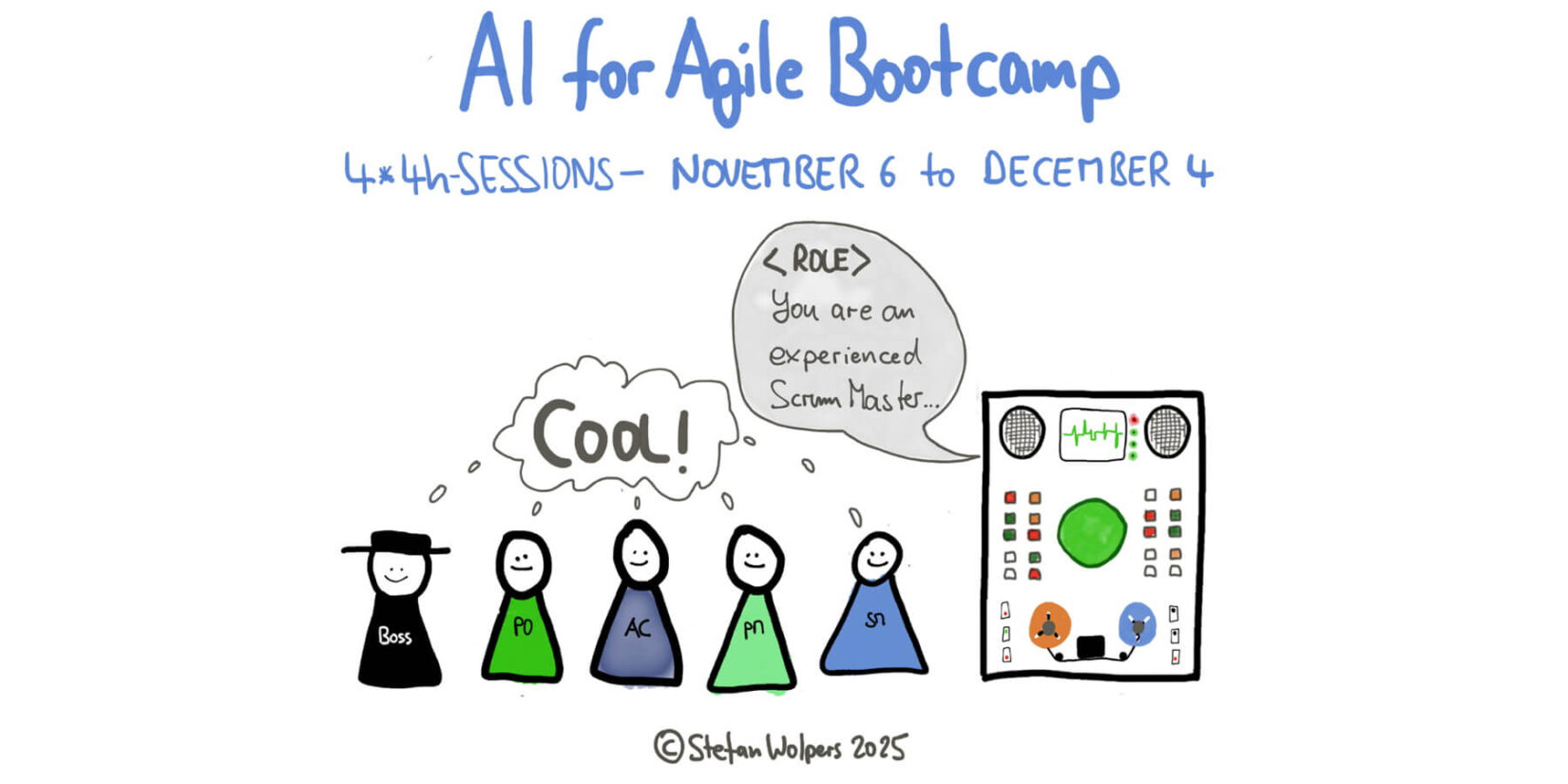
Learn more: 🖥 💯 🇬🇧 AI for Agile BootCamp #4 — November 6 – December 4, 2025.
Customer Voice: “The AI for Agilists course is an absolute essential for anyone working in the field! If you want to keep up with the organizations and teams you support, this course will equip you with not only knowledge of how to leverage AI for your work as an Agilist but will also give you endless tips & tricks to get better results and outcomes. I thoroughly enjoyed the course content, structure, and activities. Working in teams to apply what we learned was the best part, as it led to great insights for how I could apply what I was learning. After the first day on the course, I already walked away with many things I could apply at work. I highly recommend this course to anyone looking to better understand AI in general, but more specifically, how to leverage AI for Agility.” (Lauren Tuffs, Change Leader | Business Agility.)
➿ Agile & Leadership
: How Time Flies: A Quarter Century of Extreme Programming
Dave Rooney reflects on 25 years of Extreme Programming, celebrating enduring values like TDD, pairing, and continuous delivery, warning Scrum without XP practices is unsustainable, and urging lean flow, simple forecasting, and renewed focus on technical excellence.
(via InfoQ): 🎙 Building Engineering Culture Through Autonomy and Ownership
Shane Hastie interviews Marcos Arribas on scaling engineering culture: empower autonomous teams with ownership, use feature flags for safe speed, keep PRs small, right-size quality to product maturity, apply AI to POCs, and keep hiring juniors to sustain growth.
: Most Organizations Will Never Reap the Benefits of AI
Maarten Dalmijn argues most firms miss AI’s benefits because trust, not technology, is the bottleneck; distrust breeds bureaucracy and weak teams. Build high-performing, empowered teams first, then use AI to amplify real execution.
📯 The Agile AI Manifesto
The Agile world is splitting into two camps: Those convinced AI will automate practitioners out of existence, and those dismissing it as another crypto-level fad. Both are wrong. The evidence reveals something far more interesting and urgent: Principles written in 2001, before anyone imagined GPT-Whatever, align remarkably well with the most transformative technology of recent years. This is not a coincidence. I believe it is proof that human-centric values transcend technological disruption; it is the Agile AI Manifesto.

🎓 Learn more: The Agile AI Manifesto: The Agile Manifesto Predicted AI.
🛠 Concepts, Practices, Tools & Measuring
: Customer Interview Analysis: Where AI Helps and Hurts
Teresa Torres warns against outsourcing customer interview synthesis to AI, urging teams to master story-based interviews, synthesize per interview before having the AI create cross-interview patterns, use AI as a collaborator for notes and perspectives, and protect empathy, context, and skills.
: How I influence tech company politics as a staff software engineer
Sean Goedecke demonstrates that staff engineers can influence politics without scheming: by riding executive waves, aligning pet projects with current priorities, maintaining ready-made technical programs, and making high-profile efforts succeed to earn capital for future impact.
(via Weave): Distracting software engineers is way more harmful than most managers think
Anton Zaides warns that meeting creep destroys deep work for engineers, even with AI tools. He urges ruthless meeting hygiene, shared focus blocks, lighter PR rituals, and leadership modeling to protect long, uninterrupted flow that drives quality and speed.
📅 Scrum Training & Event Schedule
You can secure your seat for Scrum training classes, workshops, and meetups directly by following the corresponding link in the table below:
| Date | Class and Language | City | Price |
|---|---|---|---|
| 🖥 🇬🇧 November 27, 2026 | GUARANTEED: AI4Agile Online Course v4 (AI4Agile Certificate; English; Online Course) | Online Course | $149 incl. 19% VAT (If applicable.) |
| 🖥 🇬🇧 December 3-17, 2026 | A3 Delegation System Pilot Workshop 2 (English; Live Virtual Class) | Live Virtual Class | $149 incl. 19% VAT (If applicable.) |
| 🖥 🇩🇪 December 8-9, 2026 | Professional Scrum Product Owner Training (PSPO I; German; Live Virtual Class) | Live Virtual Class | €1099 incl. 19% VAT (If applicable.) |
| 🖥 🇬🇧 December 15-16, 2026 | Professional Scrum Master – Advanced Training (PSM II; English; Live Virtual Class) | Live Virtual Class | €1189 incl. 19% VAT (If applicable.) |
| 🖥 🇩🇪 February 16-17, 2027 | Professional Scrum Product Owner Training (PSPO I; German; Live Virtual Class) | Live Virtual Class | €1099 incl. 19% VAT (If applicable.) |
See all upcoming classes here.

You can book your seat for the training directly by following the corresponding links to the ticket shop. If the procurement process of your organization requires a different purchasing process, please contact Berlin Product People GmbH directly.
📺 Join 6,000-plus Agile Peers on Youtube
Now available on the Age-of-Product YouTube channel to improve learning, for example, about the State of AI Report 2025:
- Hands-on Agile #68: How to Analyze Unstructured Team Interview Data with AI.
- Fabrice Bernhard: The Lean Tech Manifesto.
- Maarten Dalmijn: The 5 Obstacles to Empowered Teams.
- Roman Pichler: The Top Reasons Why a Product Strategy Fails.
- Johanna Rothman: How to Instill Agility, not Agile Practices.
- Hands-on Agile EXTRA: How Elon Musk Would Run YOUR Business with Joe Justice.

✋ Do Not Miss Out: Learn more about the State of AI Report 2025 — Join the 20,000-plus Strong ‘Hands-on Agile’ Slack Community
I invite you to join the “Hands-on Agile” Slack Community and enjoy the benefits of a fast-growing, vibrant community of agile practitioners from around the world.

If you would like to join, all you have to do now is provide your credentials via this Google form, and I will sign you up. By the way, it’s free.
Help your team to learn about Personal AI Productivity by pointing them to the free Scrum Anti-Patterns Guide: