Food for Agile Thought’s issue #122—shared with 13,241 peers—supports your New Year’s resolution to read more industry news with the top agile blogs, we learn why software product development sometimes feels like playing Tetris, and how we might deal with fixed scope/fixed deadline projects in 2018.
We also listen to Steve Jobs how good people manage themselves, why including the sales guys may preserve the competitive edge over your competition, and what the next ten years in tech will bring according to Benedict Evans and a16z.
Have a chillaxing holiday season! We will be back with Food for Agile Thought #123 on January 7th, 2018.
Food for Agile Thought’s issue #121—shared with 13,152 peers—travels back in time, illuminating the Agile Manifesto history. We learn how Scrum and Lean UX complement each other, and why software development frameworks could be labeled ‘collective fiction.’
We also improve our understanding of learning organizations and how Sociocracy 3.0 contributes to their creation. Hiten Shah shares five mental models that help grow a product, and Mind the Product makes a compelling offer to binge-watch product talks.
Lastly, I published the last post from the Scrum anti-patterns series; there are now 160-plus of them. This article addresses the majority of the readers of this newsletter: Scrum Masters.
Food for Agile Thought’s issue #120—shared with 12,993 peers—focuses on agile trends as we have a look at the latest edition of ThoughtWork’s Tech Radar as well as at the domains of business agility in the 21. Century.
We also point at suitable agile metrics beyond velocity and at moments that reveal you’re a lucky member of a high-performing team.
Lastly, we learn how to apply product management principles to internal products, and how to make the best out of customer feedback.
Food for Agile Thought’s issue #119—shared with 12,907 peers—addresses the decision process in groups, how XScale’s business agility approach works, and why cargo cult agile usually means running in circles.
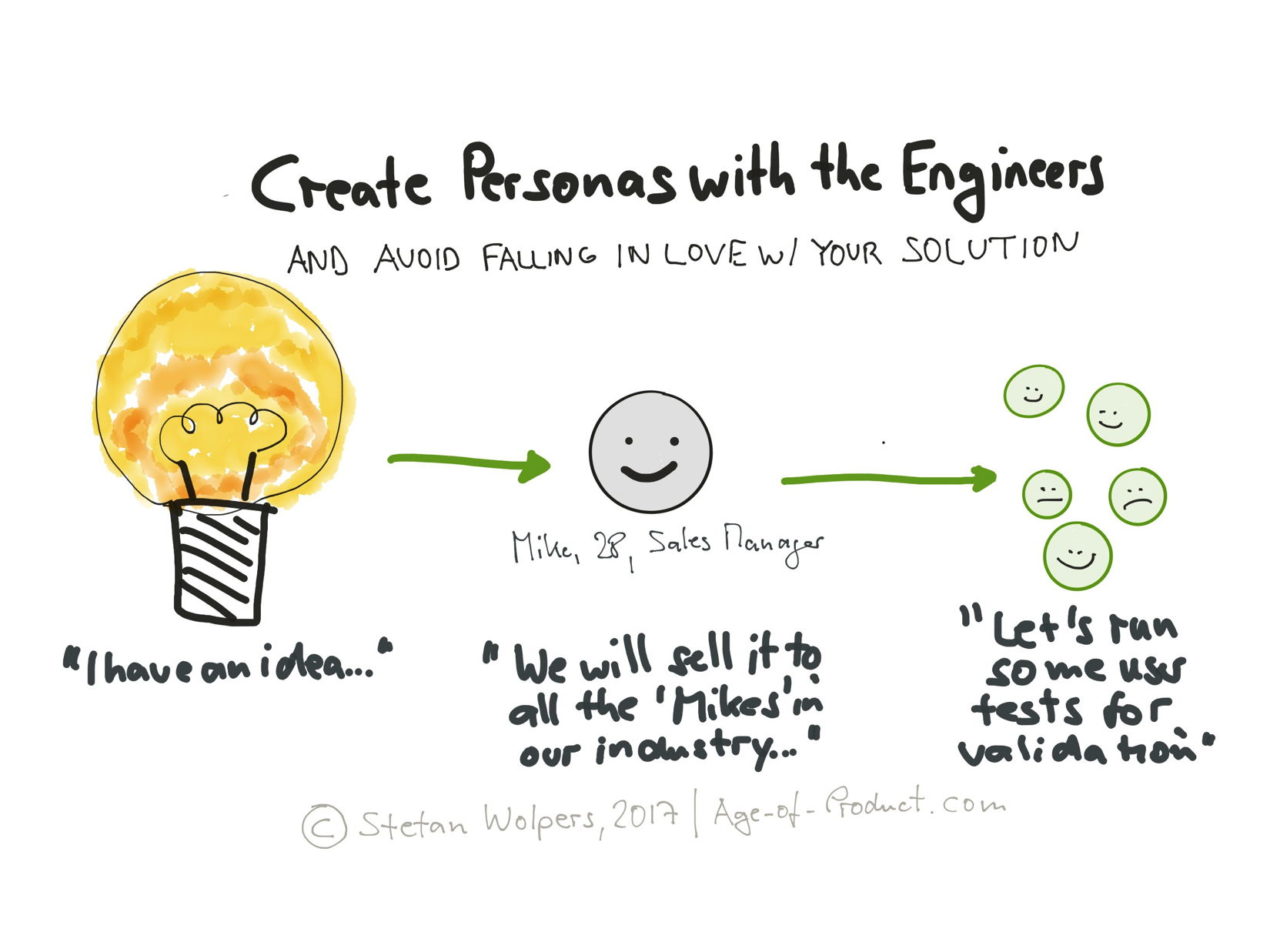
We share a handy guide on how to deal with engineering teams, and why you need to include them in any persona creation activity. We also have a look at Buffer’s 6-week product cycle.
Lastly, we cover why product management by committee is doomed from the start, and we learn about how hard it is as a corporation to get from a big idea to a sustainable product.
Food for Agile Thought’s issue #118—shared with 12,812 peers—addresses the not so apparent Scrum troubles: it is hard, expensive and utterly useless if implemented half-heartedly.
Jeff Patton explains a range of human flaws and failures during product discovery, which is the reason that AirBnB runs experiments diligently—learn from Jan how that works in detail.
Lastly, we cover once more the issue of brilliant engineers who also happen to be jerks, and the pointy-haired Boss finally reveals the purpose of predictions.
by Stefan Wolpers|Agile TransitionLean and Product
TL; DR: Create Personas with the Help of the Engineers
Creating valuable software requires knowing the customer—we all agree on that, right? The first question that then comes to mind is how to support this product discovery process in a meaningful manner in an agile environment? And the second question follows swiftly: who shall participate in the process—designers and business analysts or the engineers, too?
Read on and learn why personas are useful for product discovery purposes, how to create personas, and why the complete team—including the engineers—needs to participate in their creation.