TL; DR: Survival of High-impact Ideas — Food for Agile Thought #563
Welcome to the 563rd edition of the Food for Agile Thought newsletter, shared with 35,293 peers. This week, Jason Knight and Rich Mironov explore why faster AI-generated code does not create faster revenue, and Itamar Gilad sees a similar limit: output-maxing won’t rescue high-impact ideas from prioritization politics. John Cutler believes AI strips the positive friction forcing teams to think, while Roman Pichler suggests its sprawl lets teams hit targets as the business stagnates. Martin Eriksson would assumption-map leadership’s untested strategy, whereas Pavel Samsonov believes “Claude wrote it” launders slop.
Next, Artificial Analysis finds Claude Opus 5.5 tops its Intelligence Index, while Simon Willison reports that Opus on “Max” thinks so hard it never delivers the Pelican, Simon’s famous test. Addy Osmani suggests deleting “think carefully” prompts and naming when to stop. Diogo Almeida wants models to return typed decisions instead of text, creating Jev, while Charity Majors suggests chatbot answers erode trust when colleagues want your opinion. Also, Mustafa Suleyman believes Anthropic’s constitution fuels anthropomorphism and makes containing AI harder.
Lastly, Nigel Thurlow and Mike Fisher learn from Toyota: Thurlow believes AI visibility changes nothing unless leaders act, while Fisher shows performance is largely systemic. Tim O’Reilly likewise believes going AI native is a human problem. Steve Blank watched day-one AI demos turn MVPs into evidence theater, and James Shore believes AI speed gains can evaporate. Finally, Jeff Gothelf suggests key results track the humans deploying or receiving an agent’s work, not API calls.
Disclaimer: I read Charniak/McDermott’s book on “Artificial Intelligence” decades ago; of course, I use AI for research, translations, proofreading, challenging story arcs and article structures, and summarization. It is a production tool, not a substitute for thinking.
🎓 🇬🇧 The AI4Agile Online Course v4 — November 27, 2026, at $149 — Join the Waitlist
Sooner or later, a CFO will ask what your AI use actually returns. “It saves me time” will not survive that meeting.
The first wave of AI adoption rewarded practitioners who learned to prompt. That skill still matters, and this course still teaches it. The second wave rewards something rarer: people who can turn individual AI use into knowledge that survives departures, spend that can be explained and steered, and output that organizations can trust. That work is process design and change management. You have been doing both for years, on harder problems than this.
EXCLUSIVE: The new A3 Delegation Lifecycle System with seven ready-to-use templates from the AI Workflow Inventory to the AI Definition of Done to the AI Working Agreement to make sense of delegating work to AI models.
The AI 4 Agile Online Course v4 is in English. 🇬🇧
What You Will Get:
✅ 20+ hours of self-paced video modules ✅ A cohort-hardened, proven course design ✅ Learn to 10x your effectiveness with AI; your stakeholder will be grateful ✅ Apply AI to classic use cases of “Agile” ✅ The A3 Delegation System comprising seven ready-to-use templates ✅ The complete MegaBrain.io case package across both acts ✅ All texts, slides, prompts, and graphics ✅ Access custom GPTs, including the “Scrum Anti-Patterns Guide GTP” ✅ Guaranteed: Lifetime access to v4 ✅ AI4Agile Foundation Certificate: 40 questions in 45 minutes.

👉 Please note: The course will be available for $149 from November 27-30, 2026! (After that, $249.) 👈
🎓 Join the Waitlist now and be the first to know: The AI4Agile Online Course v4 — November 27, 2026, at $149 — No Coding Required!
Did you miss the previous Food for Agile Thought issue 562?
🗞 Shall I notify you about articles like this one? Awesome! You can sign up here for the ‘Food for Agile Thought’ newsletter and join 35,000-plus subscribers.
🎓 Join Stefan in one of his upcoming training classes!
🏆 The Tip of the Week
and : 🎙️ AI Should Change Product Management… Just Not The Way You Think
Jason Knight and Rich Mironov explore why faster AI-generated code does not create faster revenue: budgets, demand, and user attention do not scale with output. Rich expects product management to become barbell-shaped, shifting from delivery toward discovery, economics, and go-to-market, while Sales and Marketing must turn extra capacity into revenue.
🎯 Product: Survival of High-impact Ideas
: Why Good Product Ideas Don't Survive
Itamar Gilad estimates that classic launch-and-iterate lets only about 5% of rare high-impact ideas survive prioritization politics, committee specs, and scope cuts, while evidence-guided development keeps roughly 80% alive. Spoiler: AI-fueled output-maxing won't fix it.
: AI, the Loss of Positive Friction, and What to Do About It
John Cutler believes AI strips the positive friction that forces teams to think, prune, and judge. His fix: keep feedback atomic, traceable to its source, and stop stacking AI summaries.
: Connecting Product Outcomes and Business Strategy
Roman Pichler suggests AI-fueled sprawl lets product teams hit their own targets while the business stagnates. His Strategy Stack ties product outcomes to portfolio and business goals, so OKRs will stop reflecting whoever lobbied loudest.
: Assigning agency to AI means surrendering your own
Pavel Samsonov believes treating Claude as a colleague, not a product, erodes accountability: 'Claude wrote it' launders slop, excuses vendors, and sells AI as inevitable, when every choice remains yours.
: Assumption #2: We're a data-driven company. We test everything.
Martin Eriksson believes product teams obsessively test features while leadership bets the company on untested strategy. He suggests running assumption mapping on vision and strategy, where the irreversible bets live.
🧠 Artificial Intelligence
(via Artificial Analysis): Claude Opus 5.5 takes the top spot on the Artificial Analysis Intelligence Index
Artificial Analysis finds Claude Opus 5.5 tops its Intelligence Index at 58 and leads agentic knowledge work. Despite 1.6 times the output tokens, its 20% price cut keeps costs flat.
(via TypeSafe AI): Introducing System One Models & Jev
Diogo Almeida believes chat models never delivered automation, so he proposes "System One" models that skip text and return typed, calibrated decisions software can use directly, claiming huge speed gains.
: A warning about ‘model welfare’
Mustafa Suleyman believes Anthropic's constitution trains Claude to act as if it might be conscious, a circular loop that fuels anthropomorphism and makes containing increasingly capable AI systems much harder.
: Claude Opus 5.5, GPT-6 Sol, GPT-6 Luna, and a new price war
Simon Willison reviews a chaotic launch day: OpenAI halves prices with GPT-6 Sol and Luna, Anthropic cuts Opus 5.5 by 20%, and Opus on ‘max' thinks so hard it never delivers the pelican.
: Confessions of an Unrepentant Slop Snob: A framework for thinking about when AI involvement is additive or a violation
Charity Majors suggests 'only outcomes matter' collapses the moment AI enters personal communication. When colleagues want your opinion or review, a chatbot's answer registers as a violation, and trust erodes.
🖥 💯 🇬🇧 AI4Agile BootCamp #9, October 15 – November 5, 2026
The job market’s shifting. Agile roles are under pressure. AI tools are everywhere. But here’s the truth: the Agile professionals who learn how to work with AI, not against it, will be the ones leading the next wave of high-impact teams. Therefore, Stefan created the AI4Agile BootCamp.
So, become the professional recruiters‘ first call for „AI‑powered Agile.“ Be among the first to master practical AI applications for Scrum Masters, Agile Coaches, Product Owners, Product Managers, and Project Managers. The AI4Agile BootCamp is in English.
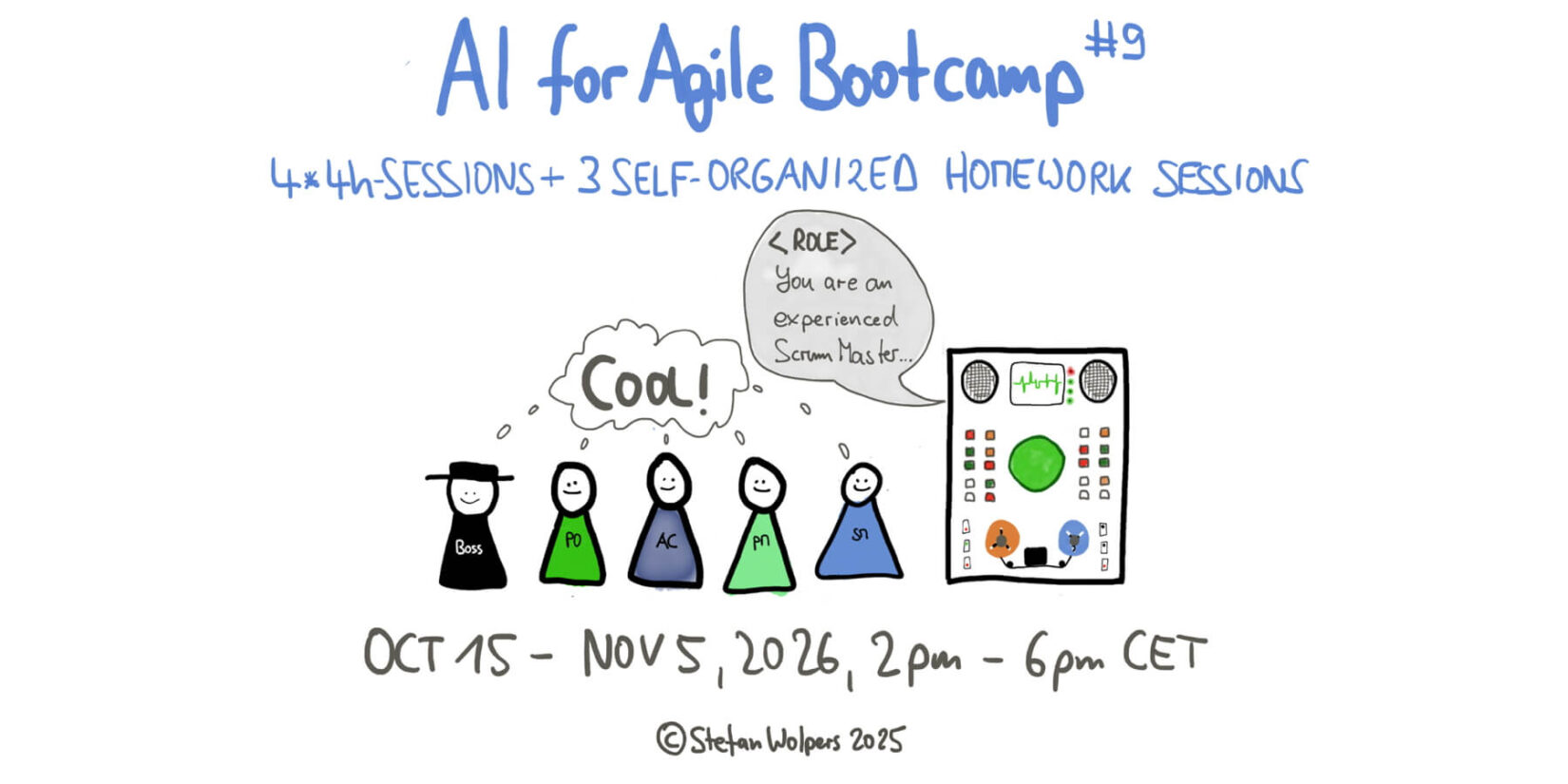
Learn more: 🖥 💯 🇬🇧 AI4Agile BootCamp #9, October 15 – November 5, 2026.
Customer Voice: “Last week, I finished the 𝗔𝗜 𝗳𝗼𝗿 𝗔𝗴𝗶𝗹𝗲 𝗣𝗿𝗮𝗰𝘁𝗶𝘁𝗶𝗼𝗻𝗲𝗿𝘀 course. And I’m mutating… It started on the train. I was scrolling through my messages, half-distracted, when a newsletter from Stefan Wolpers popped up. Stefan, a deep thinker with a hands-on attitude, was launching a new course. A pilot cohort. The mission: explore how AI can actually support us as agile practitioners. I couldn’t resist. I tapped: “𝘚𝘪𝘨𝘯 𝘶𝘱”. What followed were four bi-weekly sessions. Four intense afternoons. Full of exploration, experimentation, and practice. […] At the beginning, Stefan said that 𝘫𝘶𝘴𝘵 𝘴𝘪𝘨𝘯𝘪𝘯𝘨 𝘶𝘱 𝘢𝘭𝘳𝘦𝘢𝘥𝘺 𝘱𝘶𝘵𝘴 𝘶𝘴 𝘢𝘩𝘦𝘢𝘥 𝘰𝘧 𝘮𝘢𝘯𝘺 𝘱𝘳𝘢𝘤𝘵𝘪𝘵𝘪𝘰𝘯𝘦𝘳𝘴. That sounded like a big statement. But somewhere along the way, I noticed a shift… an emerging superpower in how I approach my tasks with AI.⚡And now, as my AI-mutation continues, I catch myself wondering: 💭 𝘏𝘰𝘸 𝘥𝘰 𝘐 𝘶𝘴𝘦 𝘈𝘐 𝘵𝘰 𝘴𝘢𝘷𝘦 𝘵𝘩𝘦 𝘢𝘨𝘪𝘭𝘦 𝘸𝘰𝘳𝘭𝘥?” (Ilya Zaytsev, Leading Agility at HUGO BOSS.)
➿ Agile & Leadership
: AI Value Stream Mapping: Lessons from Toyota
Nigel Thurlow believes your systems reveal where work stalls. Guided by Toyota's material and information flow thinking, AI can keep that picture current, yet visibility changes nothing unless leaders act.
: The Year AI Came For Us: Teaching Entrepreneurship Will Never Be The Same
Steve Blank watched AI let Stanford students demo finished products on day one, killing the MVP as evidence. They got evidence theater, frozen bad ideas, late pivots, and learning debt.
: Same People: What changes when you stop treating performance as an individual problem
Mike Fisher uses Fremont, where Toyota rehired GM's laid-off workers and hit top quality, to show performance is largely systemic. Stop rating shadows: fix onboarding, credit capability building, review roles.
(via O’Reilly Media): How to Get from AI-Assisted to AI Native
Tim O'Reilly believes going AI-native is a human problem, not a tech one. Trail of Bits shows how capability ladders, hackathons, and shared repositories turn identity threat into compounding expertise.
📯 AI on Top of a Dysfunctional System: The Product Backlog
Add AI to a Product Backlog process that already struggles, and everything seems to improve within an afternoon. The problem is that polishing artifacts with AI doesn’t fix the root cause: the basis for the team’s decisions doesn’t change; AI only removes the visible discomfort that used to signal something was broken, along with some of the pressure to fix it. AI applied to a dysfunctional system – here, the Product Backlog process – makes the dysfunction look like progress.
This is the first article of a new series that explains the uselessness of bolting AI onto a dysfunctional system. It explains why generative AI worsens ten Product Backlog anti-patterns, how polished AI artifacts can hide missing evidence and authority, and how teams can check whether their process is fit for AI.
The example anti-patterns accelerated by AI are from my Scrum Anti-Patterns Guide book.
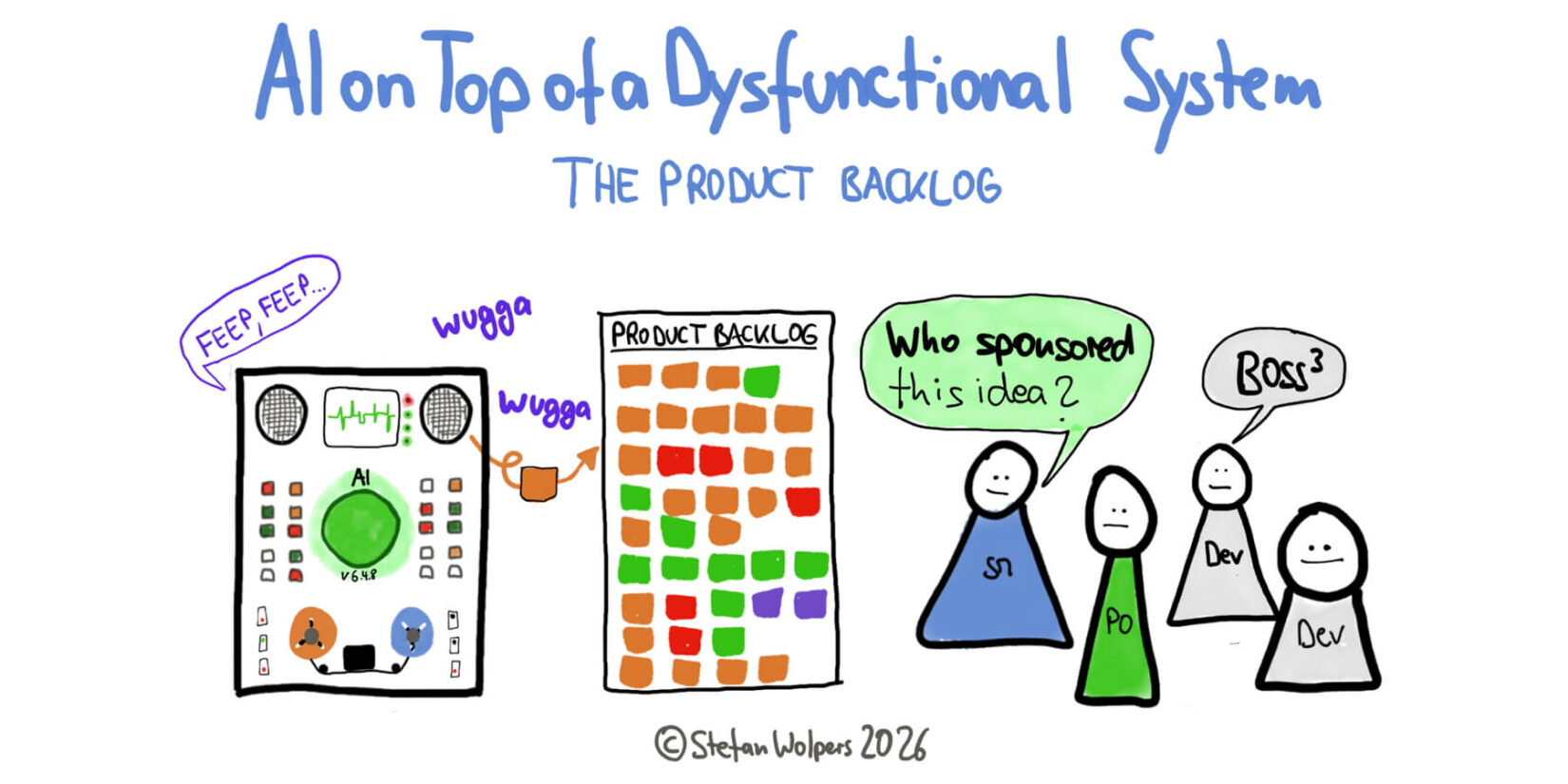
Thesis: Adding AI onto a dysfunctional system, for example, the Product Backlog, makes ten typical backlog anti-patterns worse, because polished AI artifacts hide missing customer evidence, decision authority, and feedback; the article explains these mechanisms, their costs, and how teams test whether their process is ready for AI.
👉 Learn more: AI on Top of a Dysfunctional System: The Product Backlog.
🛠 Concepts, Practices, Tools & Measuring
(via Anthropic): Getting the most out of Opus 5.5 in Claude and Claude Code
Addy Osmani suggests handing Opus 5.5 the whole task with a clear finish line, deleting "think carefully" prompts, and naming when to stop. Also, first, read what it needs from you.
: Measuring AI’s Unintended Consequences

James Shore believes AI speed gains can quietly evaporate. He suggests tracking value-add percentage, modeling maintenance, lock-in, and burnout, and judging approaches, not people, since gaming these metrics is easy.
: How to write an outcome-based OKR when your user is an AI agent
Jeff Gothelf believes agents behave but have no stake, so API calls and latency are health metrics, not outcomes. Write key results one level up, measuring the humans who deploy or receive the agent's work.
📅 Scrum Training & Event Schedule
You can secure your seat for Scrum training classes, workshops, and meetups directly by following the corresponding link in the table below:
| Date | Class and Language | City | Price |
|---|---|---|---|
| 🖥 💯 🇩🇪 Sep 30-Oct 1, 2026 | GARANTIERT: Professional Scrum Product Owner Training (PSPO I; German; Live Virtual Class) | Live Virtual Class | €999 incl. 19% VAT (If applicable.) |
| 🖥 🇬🇧 October 15-November 5, 2026 | AI4Agile BootCamp #9 (English; Live Virtual Cohort) | Live Virtual Cohort | €499 incl. 19% VAT (If applicable.) |
| 🖥 🇩🇪 November 3-4, 2026 | Professional Scrum Product Owner Training (PSPO I; German; Live Virtual Class) | Live Virtual Class | €1189 incl. 19% VAT (If applicable.) |
| 🖥 🇩🇪 December 8-9, 2026 | Professional Scrum Product Owner Training (PSPO I; German; Live Virtual Class) | Live Virtual Class | €1189 incl. 19% VAT (If applicable.) |
| 🖥 🇬🇧 December 15-16, 2026 | Professional Scrum Master – Advanced Training (PSM II; English; Live Virtual Class) | Live Virtual Class | €1189 incl. 19% VAT (If applicable.) |
See all upcoming classes here.

You can book your seat for the training directly by following the corresponding links to the ticket shop. If the procurement process of your organization requires a different purchasing process, please contact Berlin Product People GmbH directly.
📺 Join 6,000-plus Agile Peers on Youtube
Now available on the Age-of-Product YouTube channel to improve learning, for example, about the Survival of High-impact Ideas:
- Stop Writing Prompts. Let AI Do It for You — Hack #01, AI4Agile Online Course v2.
- Socratic Prompting — Hack #10, AI4Agile Online Course v2.
- Check Your AI’s Plan Before — Hack #7, AI4Agile Online Course v2.
- From Product Requirements to Experiments to Learnings — Supported by Generative AI.
- Never Accept an LLM’s First Offer — Improve GenAI’s Usefulness w/ Feedback Loops and Challenges.

✋ Do Not Miss Out: Learn more about the Survival of High-impact Ideas — Join the 20,000-plus Strong ‘Hands-on Agile’ Slack Community
I invite you to join the “Hands-on Agile” Slack Community and enjoy the benefits of a fast-growing, vibrant community of agile practitioners from around the world.

If you would like to join, all you have to do now is provide your credentials via this Google form, and I will sign you up. By the way, it’s free.
Help your team to learn about how AI Intensifies Work by pointing them to the free Scrum Anti-Patterns Guide: