The Dangerous Middle: Agile Roles That AI Will Erode First

TL; DR: Dangerous Middle and the Future of Scrum Masters and Agile Coaches

Peter Yang, a renowned product leader, argues that AI will split product roles into two groups: Generalists who can prototype end-to-end with AI, and specialists in the top 5% of their fields. Everyone else in the dangerous middle risks being squeezed.

How does this apply to agile practitioners: Scrum Masters, Product Owners, Agile Coaches, and transformation leads? It does, with important nuances.

The Dangerous Middle: Peter Yang's Product Role Framework Reveals About the Future of Agile Practitioners — Age-of-Product.com
Continue reading The Dangerous Middle: Agile Roles That AI Will Erode First

Food for Agile Thought #515: Poor Decisions by Managers, LLMs Getting Dumber, POM Explained, AI Zombie Projects

TL; DR: Poor Decisions by Managers — Food for Agile Thought #515

Welcome to the 515th edition of the Food for Agile Thought newsletter, shared with 40,381 peers. This week, Henrik Mårtensson explores six decision-making traps managers fall into and how to overcome poor decisions with candor and deliberate practice. Janna Bastow highlights how skipping feasibility checks sabotages product delivery, offering lightweight tactics for trust and clarity in the AI era. Also, Teresa Torres and Petra Wille explore how product leaders shape their legacy through their impact, values, and reflection. Meanwhile, Jacob Poushter and team find AI anxiety outweighs optimism, and Maarten Dalmijn warns how process bloat kills team ownership.

Next, Melissa Suzuno outlines how product operating models shift focus from outputs to outcomes, scaling through pilot teams and leadership support. Roger Snyder addresses the tension between PM and PO, emphasizing the importance of alignment on purpose, ownership, and cadence, while Charlie Guo examines LLM performance drift, providing mitigation strategies. Barry O’Reilly lists 21 signs your AI project might be undead, and Martin Eriksson warns that empowerment fails without a strategic context and a deliberate shift in leadership stance.

Lastly, Pawel Brodzinski warns that autonomous AI agents lack the trust needed for broad adoption without transparency and alignment. Jens Meyer critiques veto-heavy cultures and calls for genuine accountability, where saying yes means accepting the outcome. Also, Emily Webber shares tips on selecting meaningful icebreakers that promote safety and connection, and Steve Blank defends science as the engine of innovation. Finally, Matt Kamelman stresses that smart AI starts with context, not just more data.

Food for Agile Thought #515: Poor Decisions by Managers, LLMs Getting Dumber, POM Explained, AI Zombie Projects — Age-of-Product.com
Continue reading Food for Agile Thought #515: Poor Decisions by Managers, LLMs Getting Dumber, POM Explained, AI Zombie Projects

Earn Your Free AI 4 Agile Certificate — Test-Drive the Questions

TL; DR: Test-Drive the Questions of the AI 4 Agile Assessment

Help me QA the questions for the AI 4 Agile Certificate by taking three short practice quizzes on the intersection of AI and Agile. In return, pass 2 out of 3 and get a free shot at the real AI 4 Agile Certification (40 questions, 45 minutes). The top performer of this small competition also receives the full AI 4 Agile online course.

Your feedback on the questions matters tremendously and helps shape a better curriculum for all practitioners.

Earn Your Free AI 4 Agile Certificate — Test-Drive the Questions — Age-of-Product.com
Continue reading Earn Your Free AI 4 Agile Certificate — Test-Drive the Questions

Mastering AI as Agile Practitioners — The AI 4 Agile Course Is Out!

TL; DR: Mastering AI 4 Agile with the Best Self-Paced Online Course

The Mastering AI with the AI 4 Agile Online Course launches this week, and I am proud that I avoided another delay. Scope creep happened despite my supposed expertise in preventing exactly that. The course expanded from a simple prompt collection to over 8 hours of video, custom GPTs, and materials that I’ll apparently continue to update indefinitely, as I’m still not satisfied that it’s comprehensive enough. (Also, the field is advancing so rapidly.)

At least the $129 lifetime access means you will benefit from my urge to fight my imposter syndrome with perfectionism and from my inability to call a project “done.” I guess we are in for the long term. 🙂

Mastering AI: Sign up for the AI 4 Agile BootCamp Online Course by Stefan Wolpers, scheduled for release on October 13, 2025.

🎓 🛒 The AI 4 Agile Online Course Is Available — Join Now at $ 129 until October 20, 2025: AI 4 Agile — Master AI Integration for Agile Practitioners.

Continue reading Mastering AI as Agile Practitioners — The AI 4 Agile Course Is Out!

Food for Agile Thought #514: State of AI Report 2025, Stakeholder Management, What Breaks Product Decisions, 25 Years of XP

TL; DR: State of AI Report 2025 — Food for Agile Thought #514

Welcome to the 514th edition of the Food for Agile Thought newsletter, shared with 40,403 peers. This week, Nathan Benaich’s State of AI Report 2025 highlights advancements in reasoning, China’s momentum, massive compute, sharper geopolitics, and a pragmatic shift toward reliability and governance. Jenny Wanger offers a hands-on way to surface implicit strategy through learner-mode interviews, drafting, and iterative feedback, while John Cutler tackles product-centricity in non-digital firms, urging a networked operating model that links funding, intent, collaboration, architecture, and outcomes. Nino Paoli notes Citi’s prompt training push while warning that real impact needs ongoing upskilling and integration. Additionally, Maarten Dalmijn highlights trust as the actual bottleneck that must be addressed before AI can effectively amplify execution.

Next, Roman Pichler sharpens stakeholder management with a power-interest focus, trust building, early involvement, and NVC for real conflict resolution. David Pereira draws out Ryan Singer on keeping six-week bets lean through framing, alignment, and timely founder input, while David Shapiro challenges “AI pilot failure” myths, focusing on integration and governance issues. Then, Sangeet Paul Choudary shifts AI agent talk to coordination and standards, and Dave Rooney marks 25 years of XP, calling for TDD, pairing, CD, and lean flow.

Lastly, Casey Newton probes OpenAI’s platform push, weighing integrations against privacy, incentives, and trust. Teresa Torres urges teams to own interview synthesis, then use AI to spot cross-patterns without losing empathy or skill. Sean Goedecke demonstrates that staff engineers can influence politics by aligning momentum and delivering visible wins, and Shane Hastie and Marcos Arribas share culture-at-scale practices from autonomy to right-sized quality. Finally, Anton Zaides advocates ruthless meeting hygiene to protect deep engineering flow.
Food for Agile Thought #514: State of AI Report 2025, Stakeholder Management, What Breaks Product Decisions, XP at 25 — Age-of-Product.com
Continue reading Food for Agile Thought #514: State of AI Report 2025, Stakeholder Management, What Breaks Product Decisions, 25 Years of XP

The Agile AI Manifesto

TL;DR: The Agile Manifesto Anticipated AI

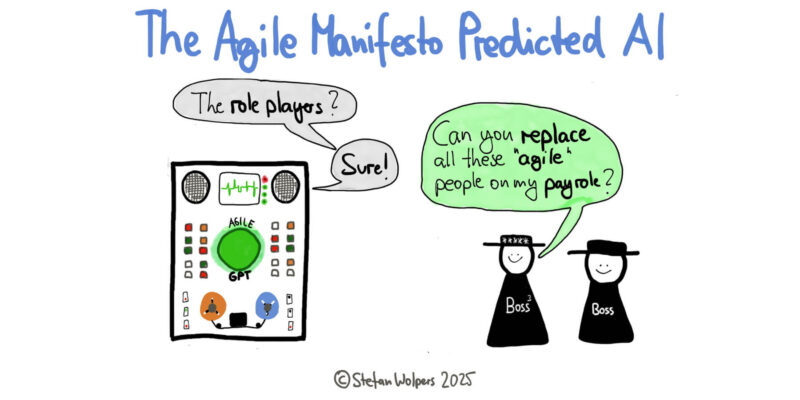
The Agile world is splitting into two camps: Those convinced AI will automate practitioners out of existence, and those dismissing it as another crypto-level fad. Both are wrong. The evidence reveals something far more interesting and urgent: Principles written in 2001, before anyone imagined GPT-Whatever, align remarkably well with the most transformative technology of recent years. This is not a coincidence. I believe it is proof that human-centric values transcend technological disruption; it is the Agile AI Manifesto.

And coming back to the two camps, here is what both miss: The biggest threat is not that AI replaces agile practitioners. It is AI that reveals what many organizations have suspected. They never needed Agile practitioners. They needed someone to manage Jira.

If your value proposition is running ceremonies, I deliberately do not refer to them as “events,” maintaining Product Backlogs, and generating burndown charts, AI reveals you were doing work the organization could have automated a decade ago. The separation is between practitioners who do real Agile work and those who perform Agile theater. AI is an expertise detector.

The Agile AI Manifesto: The Agile Manifesto Predicted AI and AI Maximalists and AI Luddites Are Wrong — Age-of-Product.com
Continue reading The Agile AI Manifesto