
TL; DR: AI Riches — Food for Agile Thought #510
Welcome to the 510th edition of the Food for Agile Thought newsletter, shared with 40,508 peers. This week, Jerry Neumann analyzes AI Riches, contrasting generative AI with containerization, predicting it will create widespread value but little new wealth for startups or investors. Martin Eriksson shows how product leaders can turn vague growth targets into actionable strategies by mapping opportunities and validating assumptions, and Stephanie Leue challenges the “Shipping Illusion,” advocating for outcome-driven teams that prioritize impact over busyness. Zvi Mowshowitz highlights how rapid AI progress is underestimated and urges preparation for imminent AGI, while Horace He unpacks why LLM reproducibility issues arise and how batch-invariant kernels offer a fix.
Next, Andrew Chen highlights why strong early retention, category fit, timing, and differentiation are crucial for new tech products, as poor retention is nearly impossible to fix later. Steve Newman raises concerns about looming AI agent security risks reminiscent of the early Windows era, and Andi Roberts reframes influence as a daily, relational practice, advocating varied approaches. Simon Powers proposes experiment-driven, people-led change over rigid frameworks, and Roman Pichler clarifies the interplay between strategy, OKRs, and KPIs.
Lastly, Jeff Gothelf urges mid-career product managers to prioritize humility and continuous learning as AI transforms their roles, emphasizing the importance of hands-on AI skills. Ash Maurya explains why billions in AI startup funding vanished, blaming tech without paying customers, ChatGPT competition, and needless complexity, while Joost Minnaar outlines the human skills essential for self-management in flat organizations. Finally, Maarten Dalmijn highlights the hidden costs of high work in progress versus the discomfort of true focus.
🎓 🇬🇧 🤖 The AI 4 Agile Online Course at $129 — October 13, 2025
I developed the self-paced AI 4 Agile Online Course for agile practitioners, including Product Owners, Product Managers, Scrum Masters, Agile Coaches, and delivery professionals who want to integrate artificial intelligence into their workflows with clarity, ethics, and purpose.
You don’t need to become an AI expert. However, you do need to understand how LLMs like ChatGPT, Claude, or Gemini can support real agile work and where their limitations lie. Like Jim Highsmith said, AI isn’t just a tool, but a new context for agility.
This course shows you how to do precisely that.
What’s Included:
- 10+ hours of self-paced video modules
- A cohort-hardened, proven course design
- Learn to 10x your effectiveness with AI; your stakeholders will be grateful
- Delve into classic agile use cases of AI
- Help your team create more customer value
- All texts, slides, prompts, graphics; you name it
- Access custom GPTs, including the “Scrum Anti-Patterns Guide GTP”
- Enjoy community access for peer learning
- Guaranteed: Lifetime access to all course updates and materials; there is a lot more to come
- Certificate of completion.

👉 Please note: The course will only be available for sign-up at $129 until October 20, 2025! 👈
🎓 Join the Waitlist of the AI 4 Agile Online Course Now: Master AI Integration for Agile Practitioners—No AI Expertise Required!
Did you miss the previous Food for Agile Thought issue 509?
🗞 Shall I notify you about articles like this one? Awesome! You can sign up here for the ‘Food for Agile Thought’ newsletter and join 40,000-plus subscribers.
🎓 Join Stefan in one of his upcoming Professional Scrum training classes!
🏆 The Tip of the Week: AI Riches
(via Colossus): AI Will Not Make You Rich
Jerry Neumann argues that generative AI will likely resemble containerization rather than the microprocessor, creating enormous societal value but little new wealth for startups or investors. Instead, most gains will be captured by incumbents and consumers, leaving entrepreneurs and investors with fewer opportunities than in earlier technological waves.
🎯 Product
: From ‘Grow 25%’ to Real Strategy: How to Create Direction When None Exists
Martin Eriksson explains how product leaders can transform vague top-down growth targets into a real strategy by mapping opportunities, applying strategic filters, validating assumptions, and iterating with their teams, rather than waiting for direction.
: The Shipping Illusion: A Trap of Looking Busy (While Standing Still)
Stephanie Leue describes the Shipping Illusion, where teams look busy shipping features but see no real impact. She urges a shift from output to outcomes, clarity on strategy, research, and celebrating real change over sheer activity.
: Why retention is so hard for new tech products
Andrew Chen explains why retention is difficult for new tech products, noting that poor retention is nearly impossible to fix with minor changes. Success requires strong early retention, the right product category, timing, and meaningful differentiation.
: The Era of the Middle-Aged Product Manager
Jeff Gothelf warns that mid-career product managers must embrace humility and continuous learning to stay relevant as AI changes the field. Building real skills with AI tools and fundamentals is now essential for career longevity.
🧠 Artificial Intelligence
: Yes, AI Continues To Make Rapid Progress, Including Towards AGI
Zvi Mowshowitz argues that rapid AI progress is being underestimated, especially after GPT-5’s muted rollout. He criticizes narratives dismissing imminent AGI, noting even conservative experts predict it within 8–15 years. He urges policy and strategy not to assume business-as-usual, since “crazy soon” AGI remains a real possibility.
(via Thinking Machines): Defeating Nondeterminism in LLM Inference
Horace He reveals that LLM reproducibility issues—where identical prompts yield different results—stem mainly from batch size and kernel implementation, not just randomness, and shows how batch-invariant kernels solve this problem.
: We’re In the Windows 95 Era of AI Agent Security
Steve Newman warns that AI agents are heading into a Windows 95-style security mess: flexible, widely adopted, and fundamentally insecure by design. Attacks are still rare, but core vulnerabilities remain unsolved as adoption accelerates.
: The $2.3B AI Startup Graveyard: 3 Patterns You Must Avoid
Ash Maurya dissects why $2.3B in AI startup funding evaporated in 2023, identifying three repeating failure patterns: building cool tech no one pays for, landing in the ChatGPT killzone, and adding complexity instead of value. He argues the winners aren’t AI-first but problem-first.
🖥 💯 🇬🇧 AI for Agile BootCamp Cohort #3: October 1 – November 12, 2025
The job market’s shifting. Agile roles are under pressure. AI tools are everywhere. But here’s the truth: the Agile pros who learn how to work with AI, not against it, will be the ones leading the next wave of high-impact teams.
So, become the one who professional recruiters call first for “AI‑powered Agile.” Be among the first to master practical AI applications for Scrum Masters, Agile Coaches, Product Owners, Product Managers, and Project Managers.
Tickets also include lifetime access to the corresponding online course, once it is published. The class is in English. 🇬🇧
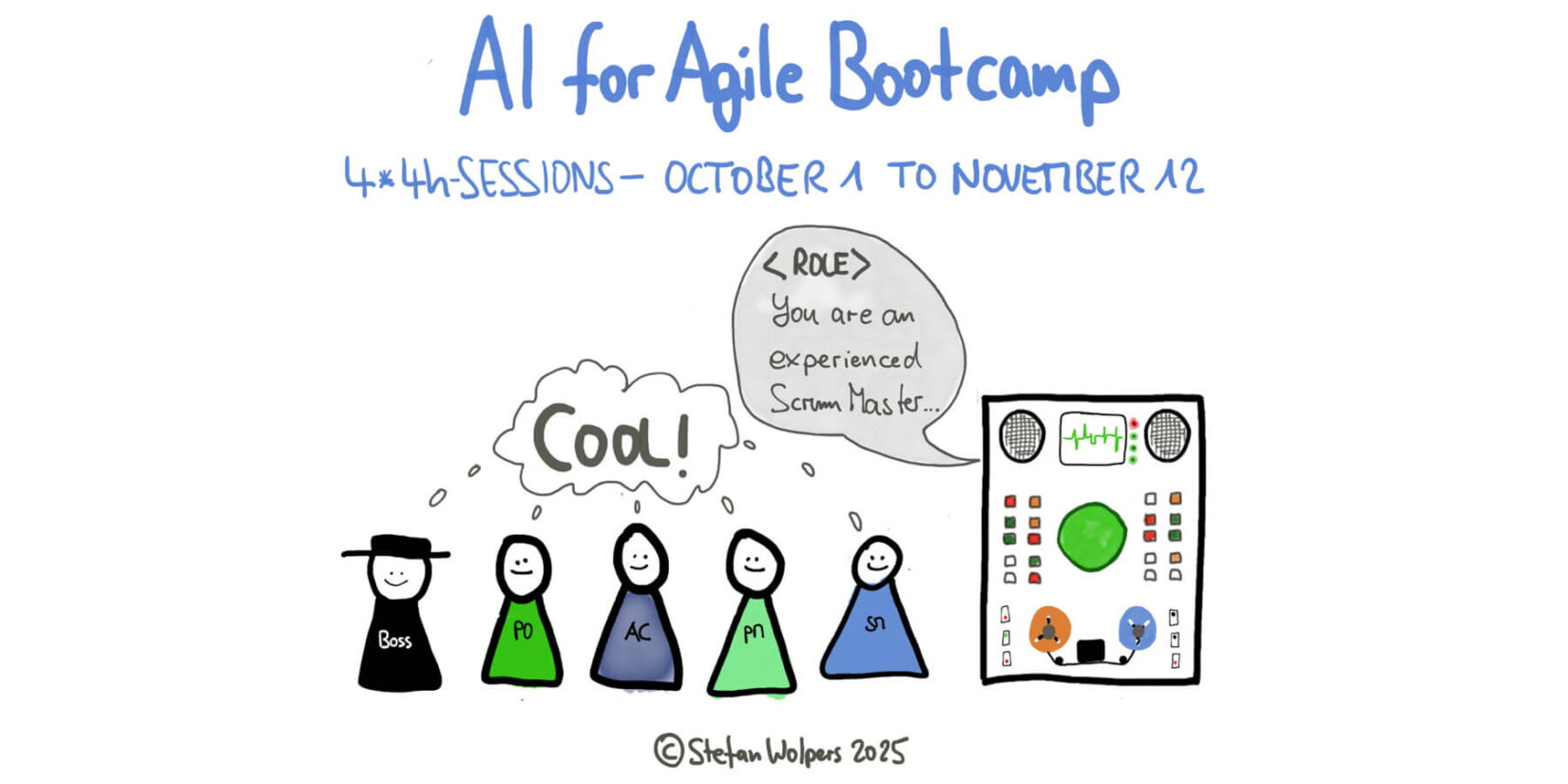
Learn more: 🖥 💯 🇬🇧 AI for Agile BootCamp Cohort #3 — October 1 – November 12.
Customer Voice: “The AI for Agilists course is an absolute essential for anyone working in the field! If you want to keep up with the organizations and teams you support, this course will equip you with not only knowledge of how to leverage AI for your work as an Agilist but will also give you endless tips & tricks to get better results and outcomes. I thoroughly enjoyed the course content, structure, and activities. Working in teams to apply what we learned was the best part, as it led to great insights for how I could apply what I was learning. After the first day on the course, I already walked away with many things I could apply at work. I highly recommend this course to anyone looking to better understand AI in general, but more specifically, how to leverage AI for Agility.” (Lauren Tuffs, Change Leader | Business Agility.)
➿ Agile & Leadership
: The Enterprise Change Pattern: A Human Approach to Organisational Transformation
Simon Powers argues that traditional transformation frameworks fail because they impose rigid narratives on complex, adaptive systems. His Enterprise Change Pattern offers a people-led, experiment-driven alternative that nurtures trust, learning, and sustainable organizational change without relying on top-down solutions.
(via Corporate Rebels): The 4 Human Skills That Make Self-Management Work
Joost Minnaar explains that self-management in flat organizations depends on four human skills: self-awareness, solution-focused communication, personal leadership, and emotional intelligence; without these, old parent-child dynamics persist despite structural change.
: How can I influence others without manipulating them?
Andi Roberts explains influence as a daily, relational act rather than manipulation, introducing five doors: Rationalising, Asserting, Negotiating, Inspiring, and Bridging. He suggests consciously choosing different approaches to build authentic commitment and overcome our default persuasion style.
📯 The AI FOMO Paradox: Why Agile Practitioners Are Perfectly Positioned for the AI Era
AI FOMO comes from seeing everyone’s polished AI achievements while you see all your own experiments, failures, and confusion.
The constant drumbeat of AI breakthroughs triggers legitimate anxiety for Scrum Masters, Product Owners, Business Analysts, and Product Managers: "Am I falling behind? Will my role be diminished?"
But here's the truth: You are not late. Most teams are still in their early stages and uneven. There are no "AI experts" in agile yet—only pioneers and experimenters treating AI as a drafting partner that accelerates exploration while they keep judgment, ethics, and accountability.
Disclaimer: I used a Deep Research report by Gemini 2.5 Pro to research sources for this article.
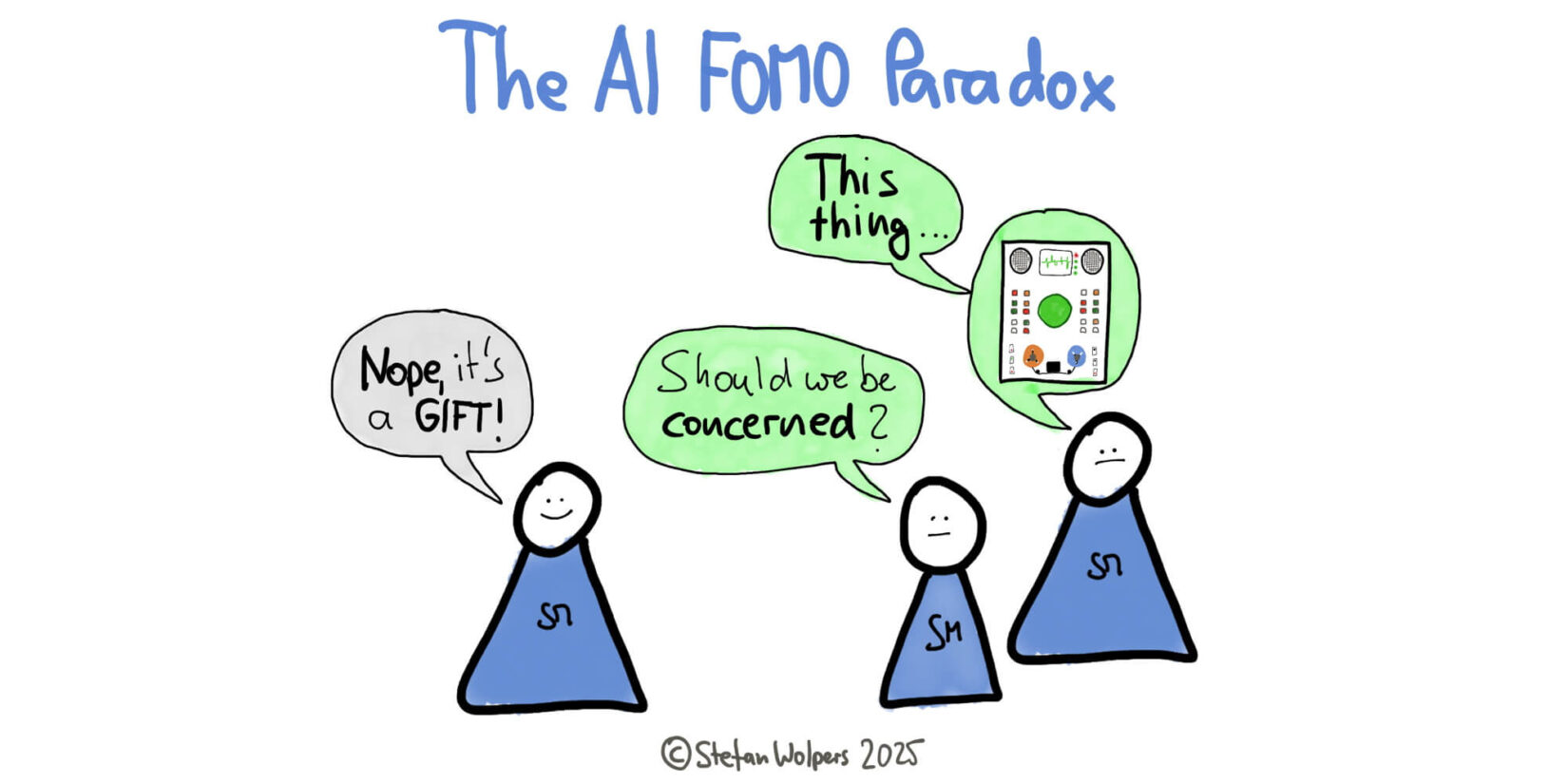
🎓 Learn more: The AI FOMO Paradox: Why Agile Practitioners Are Perfectly Positioned for the AI Era.
🛠 Concepts, Practices, Tools & Measuring
: Reducing WIP: It's All In Our Head
Maarten Dalmijn argues that reducing work in progress feels painful because it makes stakeholder discomfort immediate. At the same time, high WIP creates the illusion of progress but only delays real misery and slows true delivery.
: How to Combine Product Strategy, OKRs, and KPIs
Roman Pichler clarifies that product strategy, OKRs, and KPIs are distinct yet reinforcing tools. Strategy guides which objectives to pursue, OKRs define outcomes, and KPIs measure progress, ensuring product decisions are outcome-driven and value-focused.
📅 Scrum Training & Event Schedule
You can secure your seat for Scrum training classes, workshops, and meetups directly by following the corresponding link in the table below:
| Date | Class and Language | City | Price |
|---|---|---|---|
| 🖥 💯 🇬🇧 February 3, 2026 | Guaranteed: Hands-on Agile #71: A3 Framework — Assist, Automate, Avoid — Let’s Build a Playbook! (English; Live Virtual Meetup) | Meetup | FREE |
| 🖥 💯 🇩🇪 February 10-11, 2026 | Guaranteed: Professional Scrum Product Owner Training (PSPO I; German; Live Virtual Class) | Live Virtual Class | €1,299 incl. 19% VAT |
| 🖥 💯 🇬🇧 February 19, 2026 | Guaranteed: Hands-on Agile #72: Become Your Organization's AI Champion: A Crowdsourced Playbook (English; Live Virtual Meetup) | Meetup | FREE |
| 🖥 🇬🇧 March 10-11, 2026 | Professional Scrum Master—Advanced Training (PSM II; English; Live Virtual Class) | Live Virtual Class | €1,299 incl. 19% VAT |
| 🖥 💯 🇬🇧 March 19 to April 16, 2026 | Guaranteed: AI4Agile BootCamp #6 (English; Live Virtual Cohort) | Live Virtual Cohort | €499 incl. 19% VAT |
| 🖥 🇩🇪 March 24-25, 2026 | Professional Scrum Product Owner Training (PSPO I; German; Live Virtual Class) | Live Virtual Class | €1,299 incl. 19% VAT |
See all upcoming classes here.

You can book your seat for the training directly by following the corresponding links to the ticket shop. If the procurement process of your organization requires a different purchasing process, please contact Berlin Product People GmbH directly.
📺 Join 6,000-plus Agile Peers on Youtube
Now available on the Age-of-Product YouTube channel to improve learning, for example, about AI Riches:
- Hands-on Agile #68: How to Analyze Unstructured Team Interview Data with AI.
- Fabrice Bernhard: The Lean Tech Manifesto.
- Maarten Dalmijn: The 5 Obstacles to Empowered Teams.
- Roman Pichler: The Top Reasons Why a Product Strategy Fails.
- Johanna Rothman: How to Instill Agility, not Agile Practices.
- Hands-on Agile EXTRA: How Elon Musk Would Run YOUR Business with Joe Justice.

✋ Do Not Miss Out: Learn more about AI Riches — Join the 20,000-plus Strong ‘Hands-on Agile’ Slack Community
I invite you to join the “Hands-on Agile” Slack Community and enjoy the benefits of a fast-growing, vibrant community of agile practitioners from around the world.

If you would like to join, all you have to do now is provide your credentials via this Google form, and I will sign you up. By the way, it’s free.
Help your team to learn about Personal AI Productivity by pointing them to the free Scrum Anti-Patterns Guide: