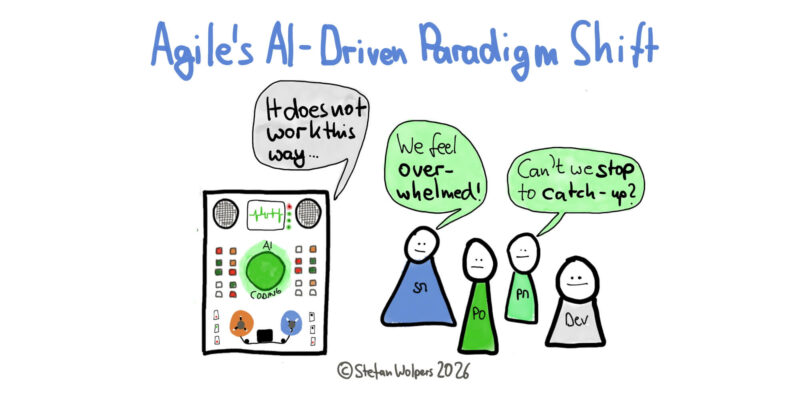
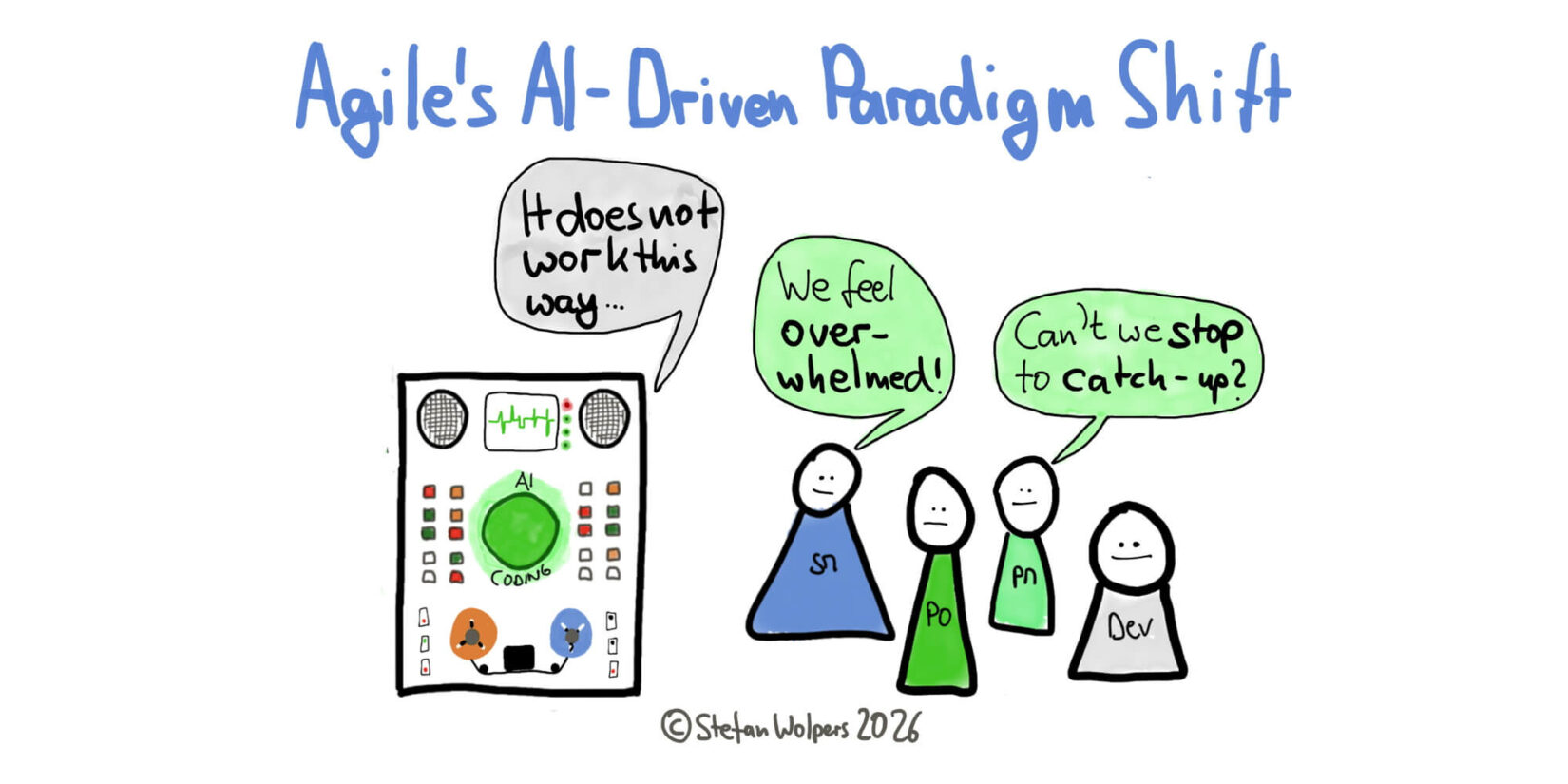
TL; DR: Agile’s AI-Driven Paradigm Shift
The paradigm shift is here. Andrej Karpathy, former Tesla AI director and OpenAI co-founder, recently admitted he has never felt this far behind as a programmer. If Karpathy feels overwhelmed, how should the rest of us feel?
This article maps the shift across three levels: strategic, product, and individual. Each level demands different responses, while “good enough Agile” no longer provides an income or perspective. The question is where you are on the journey.
🎓 🇬🇧 🤖 The AI 4 Agile Online Course v2 at $149 — March 2, 2026
I developed the self-paced AI 4 Agile Online Course for agile practitioners, including Product Owners, Product Managers, Scrum Masters, Agile Coaches, and delivery professionals who want to integrate artificial intelligence into their workflows with clarity, ethics, and purpose.
You don’t need to become an AI expert. However, you do need to understand how LLMs like ChatGPT, Claude, or Gemini can support real agile work and where their limitations lie. As Jim Highsmith said, AI isn’t just a tool, but a new context for agility. This course shows you how to do that precisely .
The latest Version 2 will be released on March 2 and comes with an introductory price of $149 instead of $249—don’t miss this opportunity to save $100!
👉 Don’t like to wait until March 2? Go shopping Version 1 now at $199. (The upgrade to version 2 is included.)
Join 400-plus Peers — What Is Included:
- 10+ hours of self-paced video modules: Hacks, Skills, Agents
- A cohort-hardened, proven course design
- Learn to 10x your effectiveness with AI; your stakeholders will be grateful
- Delve into classic agile use cases of AI
- Help your team create more customer value
- All texts, slides, prompts, graphics; you name it
- Access custom GPTs, including the “Scrum Anti-Patterns Guide GTP”
- Enjoy community access for peer learning
- Guaranteed: Lifetime access to all course updates and materials; there is a lot more to come
- The AI4Agile Foundation Certificate.

👉 Please note: The course will only be available for sign-up at $149 until March 9, 2026! 👈
🎓 Join the Waitlist of the AI 4 Agile Online Course v2 Now: Master AI Integration for Agile Practitioners—No AI Expertise Required!
🇩🇪 Zur deutschsprachigen Version des Artikels: Agiles KI-getriebener Paradigmenwechsel.
🗞 Shall I notify you about articles like this one? Awesome! You can sign up here for the ‘Food for Agile Thought’ newsletter and join 35,000-plus subscribers.
When Karpathy Feels Behind, Pay Attention
Andrej Karpathy posted something on December 26, 2025, that should concern every agile practitioner:
“I’ve never felt this much behind as a programmer. The profession is being dramatically refactored as the bits contributed by the programmer are increasingly sparse and between. I have a sense that I could be 10X more powerful if I just properly string together what has become available over the last ~year and a failure to claim the boost feels decidedly like skill issue.” (Source: Andrej Karpathy on X).
Andrej is not a junior developer complaining about JavaScript frameworks. He is a prominent AI practitioner, admitting he cannot keep up.
The paradigm shift before our eyes is overwhelming. I wish we could all agree on a pause to digest what has happened and what the implications might be before more facts on the ground are established: data centers, power infrastructure, and adjacent investments that demand a return. We do live in interesting times.
Roy Amara’s Law applies here: “We tend to overestimate the effect of a technology in the short run and underestimate the effect in the long run.” What we can say with certainty is that Agile will never be the same. The times when summarizing stickies from a Retrospective provided a good income are ending.
I observe Agile’s AI-driven paradigm shift at three levels: strategic, product, and individual. Each demands a different response:
The Strategic Level: This Is a People Problem, Not a Tool Problem
The critical question at the strategic level is when to use AI in an agile organization that employs a product operating model to create value for customers.
The A3 Framework (Assist, Automate, Avoid) provides a starting point. But as with every change initiative, the challenge is less intellectual than emotional. Helping people understand why change benefits not just the organization but also them matters more than explaining the technology. Applying AI is a people issue, not an AI tool issue.
In this respect, using AI in an agile context, considering the organization’s culture and governance requirements, resembles a classic transformation challenge rather than a technical one. The patterns of failure are familiar.
The reason so many AI pilot projects fail is the underlying greenfield approach. Leaders decouple the AI pilot from creating real customer value. They ignore alignment with the organization’s culture and governance requirements. Then they wonder why adoption stalls.
We have seen this before; the Agile transformation playbook failed for the same reasons: installing a process without changing the conditions that make it work. AI transformation often repeats the pattern.
Cannot see the form? Please click here.
The Product Level: Code Is Cheap, Product Is Expensive
Ralph Wiggum delivers software while you sleep.
The one factor that made us selective in the past, deciding where to invest while figuring out what is worth building to solve our customers’ problems, increasingly becomes less important: the cost of coding.
When Anthropic released Claude Cowork over Christmas, practically developed by Claude Code, the change became obvious. By the end of 2026, I expect the vast majority of software will be created by AI agents. This is speculation, but the trajectory is clear to me.
This shift has profound implications for product work. The traditional cost gate that prevented us from blindly following any idea of what our customers might appreciate will vanish. Coding cost used to enforce discipline. When building is nearly free, what enforces discipline?
The importance of product discovery will increase massively. Discovery practices themselves will shift. Where two years ago a paper prototype might have sufficed, people now expect a vibe-coded prototype. Christina Wodtke calls this “discovery coding”: building to learn rather than building to ship.
Product people will see their responsibilities expand. I expect Product Managers and Product Owners will need to acquire coding-adjacent skills sooner rather than later. Not to write production code, but to create prototypes that test assumptions faster than competitors can.
This opportunity is a double-edged sword. While AI engineering opens possibilities for classic SaaS products, it also enables something new: the era of “software for one.” For the first time, creating software with an idiosyncratic touch becomes possible. Software perfect for a single use case.
Imagine having agents pulling customer feedback from Slack, email, your organization’s customer support system, meeting transcripts, and customer interviews, extracting the core messages, turning them into Markdown files, adding them to your context system, and creating a morning update report for you at 8 am, pointing to actual trends in customer and stakeholder sentiment, recommending further actions if necessary. No vendor offers this exact workflow. No one else needs it exactly this way.
I am curious to learn when the answer to “what tools are you using?” will be “I created them myself.”
The Individual Level: The Practitioner’s Journey
The typical journey of applying AI as an agile practitioner follows a predictable arc.
You start prompting AI to help with certain problems. Then you discover that AI is good at prompting itself. Once you embrace the idea of memory, you find that creating GPTs, Projects, or Gems massively improves the quality and quantity of your work. (Note: Many stop here, treating the AI as a better search engine rather than a reasoning partner.)
Then you understand the importance of context and start organizing your files appropriately. Now you can use connectors and external file sources to provide context to models. (Note the trap: Merely accumulating files without structure until you hit context limits and wonder why the AI “forgot” everything. Models do not excel at finding needles in haystacks.)
Then you discover a new capability: Skills. You move from actively prompting a model to do something specific to setting up a system that autonomously decides when to use instructions and knowledge to support task fulfillment. (Note the risk of skill sprawl: Building skills that overlap or conflict, creating confusion rather than capability.)
The next step is AI agents that work autonomously for you. There is a reason Claude Code has become so popular since the release of Claude Opus 4.5. Also, there is a reason people have started embracing Markdown documents and organizing their knowledge in interlinked file systems with tools like Obsidian.
For the first time, you can create a personal operating system that truly serves your way of working, including all your idiosyncrasies. Moreover, what was available largely to those who feel comfortable with a CLI is now available to the rest of us: Claude Cowork is a revelation for understanding the importance of autonomous AI agents as agile practitioners. It is the new frontier.
Conclusion: Where Are You on This Journey?
The paradigm shift operates at three levels:
- Strategic: Treating AI adoption as a culture challenge, not a tool rollout.
- Product: Accepting that cheap code means discovery matters more, not less.
- Individual: Progressing from prompting to agents.
Note: Progress at the individual level without strategic alignment creates islands of capability that the organization cannot absorb. The capable individuals notice, get frustrated, and leave. In the war for AI talent, strategic failure becomes a retention crisis.
Most practitioners I talk to are somewhere in the middle of the individual journey. They use ChatGPT or Claude for specific tasks. They have not yet organized their work to use skills or agents.
That is fine. Everyone starts somewhere. But the gap between “I prompt sometimes” and “I have AI agents working for me” is widening. Those who cross it gain an advantage. Those who do not will find their value proposition shrinking.
Where are you on this AI-driven Paradigm Shift journey? And what is the next step you could take next Monday?
📖 Agile’s AI-Driven Paradigm Shift — Related Posts
Ralph Wiggum Ships Code While You Sleep. Agile Asks: Should It?
Assist, Automate, Avoid: How Agile Practitioners Stay Irreplaceable with the A3 Framework
Agile Is Dead, Long Live Agility
The Reformation That Became the Church
The Immunity Response: How Organizations Neutralize Change

👆 Stefan Wolpers: The Scrum Anti-Patterns Guide (Amazon advertisement.)
📅 Scrum Training Classes, Workshops, and Events
Learn more about the Agile AI Manifesto with our AI and Scrum training classes, workshops, and events. You can secure your seat directly by following the corresponding link in the table below:
| Date | Class and Language | City | Price |
|---|---|---|---|
| 🖥 💯 🇬🇧 February 3, 2026 | GUARANTEED: Hands-on Agile #71: A3 Framework — Assist, Automate, Avoid — Let’s Build a Playbook! (English) | Live Virtual Workshop | FREE |
| 🖥 💯 🇩🇪 February 10-11, 2026 | GUARANTEED: Professional Scrum Product Owner Training (PSPO I; German; Live Virtual Class) | Live Virtual Class | €1.299 incl. 19% VAT |
| 🖥 💯 🇬🇧 February 19, 2026 | GUARANTEED: Hands-on Agile #72: Become Your Organization’s AI Champion: A Crowdsourced Playbook (English) | Live Virtual Workshop | FREE |
| 🖥 🇬🇧 March 10-11, 2026 | Professional Scrum Master—Advanced Training (PSM II; English; Live Virtual Class) | Live Virtual Class | €1299 incl. 19% VAT |
| 🖥 💯 🇬🇧 March 19-April 16,2026 | GUARANTEED: AI4Agile BootCamp #6 — March 19-April 16,2026 (English; Live Virtual Cohort) | Live Virtual Cohort | €499 incl. 19% VAT |
| 🖥 🇩🇪 March 24-25, 2026 | Professional Scrum Product Owner Training (PSPO I; German; Live Virtual Class) | Live Virtual Class | €1.299 incl. 19% VAT |
See all upcoming classes here.

You can book your seat for the training directly by following the corresponding links to the ticket shop. If your organization’s procurement process requires a different purchasing approach, please contact Berlin Product People GmbH directly.
✋ Do Not Miss Out and Learn More about Agile’s AI-Driven Paradigm Shift — Join the 20,000-plus Strong ‘Hands-on Agile’ Slack Community
I invite you to join the “Hands-on Agile” Slack Community and enjoy the benefits of a fast-growing, vibrant community of agile practitioners from around the world.

If you would like to join all you have to do now is provide your credentials via this Google form, and I will sign you up. By the way, it’s free.
