
TL; DR: Transformation Failure — Food for Agile Thought #558
Welcome to the 558th edition of the Food for Agile Thought newsletter, shared with 35,366 peers. This week, Nigel Thurlow and Stephanie Leue tackle leadership: Thurlow analyzes patterns of transformation failure, showing that leaders seek change only when they hold power, while Stephanie Leue proposes that steady presence, not control, builds authority. That maturity matters because, as Roman Pichler warns, bolting AI onto broken practices accelerates dysfunction. Andreas Horn reveals how agentic AI costs spiral unchecked, John Gruber calls Anthropic’s text watermarking a sacrifice of clarity, and Aaron Horwath asks what happens when AI strips knowledge work of meaning.
Next, Eddie Pratt warns that PMs who use AI solo build “reasoning silos,” while David Pereira proposes that decision-making, not building, is the real bottleneck. Pavel Samsonov agrees: velocity without judgment ships net-negative software faster. Governance lags, as VB Staff reports that 21% of enterprises lack cost controls despite running an average of three orchestration platforms, and Zvi Mowshowitz finds Anthropic’s safety case weaker than advertised. Also, Rudrendu Paul and Sourav Nandy urge B2B sellers to redesign for AI agent buyers.
Lastly, Jenny Wanger proposes that influence grows from trust and a readiness to change your own mind, a theme Ryan Murphy extends: good managers coach rather than control the room’s mood. On the tooling front, Paweł Huryn compares four AI prototyping platforms for PMs, and Avi Chawla walks through SpaceXAI’s Grok Bot, which features persistent cloud agents. Finally, John Cutler warns that “return on tokens” risks becoming the next proxy trap, echoing story points.
Disclaimer: I belong to those who read Charniak/McDermott’s book on “Artificial Intelligence” decades ago. Of course, I make use of AI, for example, for research, proofreading, challenging story arcs and article structures, or summarization.
🎓 🇬🇧 $199 — The A3 Delegation System Founding Workshop: September 28-29, 2026
Your team already delegates work to AI: reports, research, customer feedback analysis, stakeholder communication, or parts of operational workflows.
But can you answer these questions without improvising?
- What may AI decide, and what must remain a human decision?
- What does “good enough” mean for this particular work?
- Who verifies the result before somebody acts on it?
- Who checks whether the delegation still works after the model or workflow changes?
If those answers live in one person’s head, or nowhere, your problem is no longer prompting. You have a delegation problem.
The A3 Delegation System gives you a practical way to decide what AI may do, hand over the work clearly, define acceptable results, and inspect the delegation over time.
During two hands-on sessions, you will apply the system to a workflow. You will leave with a clear understanding of how to apply the A3 Delegation System to your workflows so that team members or stakeholders can understand, challenge, and continue your AI delegation work. Everything you learn is directly applicable to your situation the next day. The class is in English.

👉 Join the Workshop Now — $199: The A3 Delegation System Founding Workshop — September 28-29, 2026
Did you miss the previous Food for Agile Thought issue 557?
🗞 Shall I notify you about articles like this one? Awesome! You can sign up here for the ‘Food for Agile Thought’ newsletter and join 35,000-plus subscribers.
🎓 Join Stefan in one of his upcoming training classes!
🏆 The Tip of the Week: Transformation Failure
: Why Transformations Fail: Leaders Want Results, Not Change
Nigel Thurlow proposes that transformations fail because leaders want better results without changing how they lead. His 'Thurlow's Law' describes how leaders seek change until they acquire power, then defend the status quo. Instead of buying transformation theater from consulting firms, organizations need targeted interventions and leaders willing to be transformed themselves.
🎯 Product
: Grounded Authority: Stop Explaining. Start Leading.
Stephanie Leue introduces 'Grounded Authority,' proposing that leadership presence built on steadiness, not control or title, prevents the erosion of trust. When leaders get defensive or overexplain, they signal that the ground beneath them is moving.
: Product Operating Model: The Crucial Enabler for AI Success
Roman Pichler contends that bolting AI onto immature product operating models only accelerates existing dysfunction. Organizations must first fix their product management practices before AI can deliver real value.
: The Art of Simplifying Decisions.
David Pereira suggests that decision-making, not building, is now the real bottleneck in product work and proposes categorizing decisions by impact and reversibility, then matching each to the right method.
(via Product Focus): Are your PMs building reasoning silos?
Eddie Pratt warns that PMs using AI individually risk creating 'reasoning silos,' where valuable context, methods, and decision logic remain personal, making the organization faster but not collectively smarter.
: No amount of velocity can shield your team from opportunity cost
Pavel Samsonov suggests that no amount of AI-driven delivery speed can compensate for ignoring opportunity cost. When organizations only value feature output, more velocity simply produces more net-negative software faster.
🧠 Artificial Intelligence
: Anthropic’s ‘Watermark’ Text Adulteration in Claude Is a Perversion of Writing
John Gruber calls Anthropic's plan to watermark all Claude-generated text a perversion of writing because biasing word choices for steganographic detection sacrifices precision and clarity to comply with an impractical EU regulation that punishes only honest users.
(via O’Reilly Media): When Your Buyer Is an AI Agent
Rudrendu Paul and Sourav Nandy propose that B2B sellers must redesign pricing, sales processes, and product surfaces for AI agent buyers or risk being excluded from shortlists before any human conversation begins.
: The honest math behind enterprise AI agents
Andreas Horn explains why enterprise AI costs are exploding as chatbots turn agentic, with context snowballing at each step, and offers five practical levers to bring the real total cost under control.
(via Venturebeat): Agentic orchestration: Enterprise AI organizations know how to govern agents but still can't meter what they cost
VB Staff reports that enterprises run an average of three AI agent orchestration platforms, prioritize governance and flexibility over model loyalty, yet 21% still lack real-time cost controls for runaway agents.
: Anthropic Risk Report: August 2026
Zvi Mowshowitz reviews Anthropic's 186-page risk report, appreciating its transparency while finding the safety arguments weaker than expected, noting multiple disclosed process failures and proposing the overall risk level should be 'medium,' not 'low.'
🖥 💯 🇬🇧 AI4Agile BootCamp #8, August 27 – September 17, 2026
The job market’s shifting. Agile roles are under pressure. AI tools are everywhere. But here’s the truth: the Agile professionals who learn how to work with AI, not against it, will be the ones leading the next wave of high-impact teams. Therefore, Stefan created the AI4Agile BootCamp.
So, become the professional recruiters‘ first call for „AI‑powered Agile.“ Be among the first to master practical AI applications for Scrum Masters, Agile Coaches, Product Owners, Product Managers, and Project Managers. The AI4Agile BootCamp is in English.
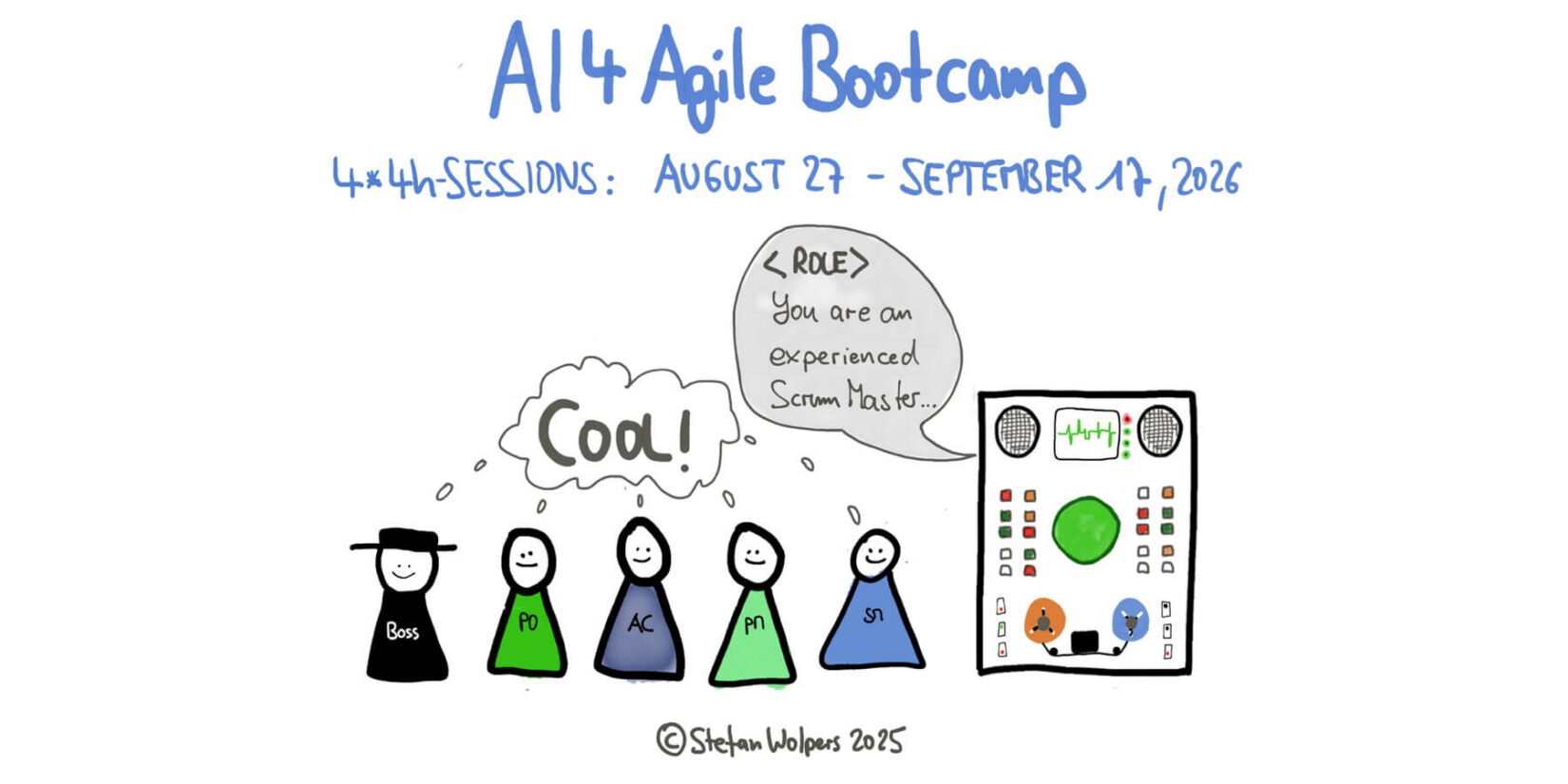
Learn more: 🖥 💯 🇬🇧 AI4Agile BootCamp #8, August 27 – September 17, 2026.
Customer Voice: “Last week, I finished the 𝗔𝗜 𝗳𝗼𝗿 𝗔𝗴𝗶𝗹𝗲 𝗣𝗿𝗮𝗰𝘁𝗶𝘁𝗶𝗼𝗻𝗲𝗿𝘀 course. And I’m mutating… It started on the train. I was scrolling through my messages, half-distracted, when a newsletter from Stefan Wolpers popped up. Stefan, a deep thinker with a hands-on attitude, was launching a new course. A pilot cohort. The mission: explore how AI can actually support us as agile practitioners. I couldn’t resist. I tapped: “𝘚𝘪𝘨𝘯 𝘶𝘱”. What followed were four bi-weekly sessions. Four intense afternoons. Full of exploration, experimentation, and practice. […] At the beginning, Stefan said that 𝘫𝘶𝘴𝘵 𝘴𝘪𝘨𝘯𝘪𝘯𝘨 𝘶𝘱 𝘢𝘭𝘳𝘦𝘢𝘥𝘺 𝘱𝘶𝘵𝘴 𝘶𝘴 𝘢𝘩𝘦𝘢𝘥 𝘰𝘧 𝘮𝘢𝘯𝘺 𝘱𝘳𝘢𝘤𝘵𝘪𝘵𝘪𝘰𝘯𝘦𝘳𝘴. That sounded like a big statement. But somewhere along the way, I noticed a shift… an emerging superpower in how I approach my tasks with AI.⚡And now, as my AI-mutation continues, I catch myself wondering: 💭 𝘏𝘰𝘸 𝘥𝘰 𝘐 𝘶𝘴𝘦 𝘈𝘐 𝘵𝘰 𝘴𝘢𝘷𝘦 𝘵𝘩𝘦 𝘢𝘨𝘪𝘭𝘦 𝘸𝘰𝘳𝘭𝘥?” (Ilya Zaytsev, Leading Agility at HUGO BOSS.)
➿ Agile & Leadership
(via NOEMA): Why Is Everyone In Tech So Sad?
Aaron Horwath explores how AI is breaking the spell of 'Workism' by abstracting knowledge workers so far from the actual work that the illusion of meaning collapses, triggering a wave of existential disillusionment.
: How to Tell if Your Manager is Actually Good?
Ryan Murphy identifies three signs of a good manager: they treat you like an adult, they do not dictate the team's mood, and they go beyond giving feedback by actively coaching you to grow.
: Influence doesn't come with the promotion
Jenny Wanger proposes that influence is not earned through sharper arguments or bigger titles, but by building trust over time, listening to others' goals, and proving you are willing to be persuaded yourself.
📯 The Folly of Tokenmaxxing, or What AI Learns About Legacy Organizations That Agile Already Knows
Your organization counts AI tokens, seats, and pilots, but can anyone name a single decision those numbers actually changed? Tokenmaxxing is only the symptom; five old Agile Laws explain the cause, and each one comes with a test you can run this week. There is no need to reinvent the wheel with AI transformations and learn the hard way what the veterans of other transformations already figured out.
Thesis: Tokenmaxxing is the vanity metric of pushing low-value work through an AI tool solely to inflate usage metrics. Tokenmaxxing emerged in 2026, when large technology companies began ranking employees by token consumption on internal leaderboards. The behavior is rational for the individual but useless for the organization because tokens measure input rather than outcomes. The five Agile Laws in this article explain why organizations keep making this mistake and what to measure instead.
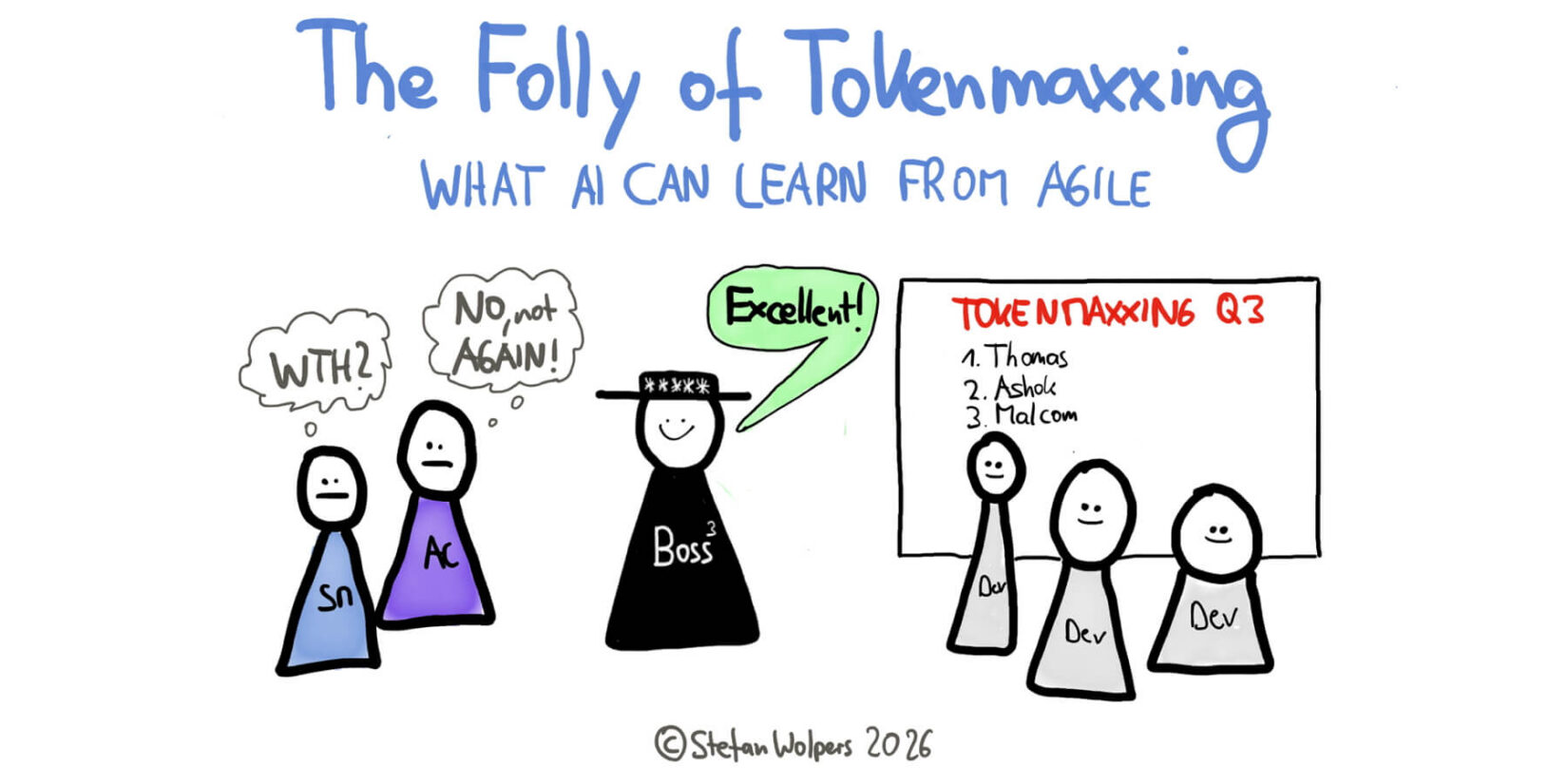
Learn more: The Folly of Tokenmaxxing, or What AI Learns About Legacy Organizations That Agile Already Knows.
🛠 Concepts, Practices, Tools & Measuring
: AI Prototyping in 2026: The PM Field Guide
Paweł Huryn builds the same CRM in Lovable, Google AI Studio, Claude Design, and Claude Code, comparing each tool's strengths to help PMs pick the right one for AI prototyping.
(via Daily Dose of Data Science): Grok Bot Masterclass: Everything you need to understand, set up, and get real work out of Grok Bot
Avi Chawla walks through SpaceXAI's Grok Bot, which gives each user one persistent cloud computer shared across named agent roles, enabling zero-cost handoffs, saved skills, and routines that run unattended.
: Tokens, Hours, Points, and Other Curious Proxies
John Cutler draws parallels between 'return on tokens' and older proxy traps like hours and story points, showing that precise token costs still sit inside deeply uncertain value systems.
📅 Scrum Training & Event Schedule
You can secure your seat for Scrum training classes, workshops, and meetups directly by following the corresponding link in the table below:
| Date | Class and Language | City | Price |
|---|---|---|---|
| 🖥 🇬🇧 November 27, 2026 | GUARANTEED: AI4Agile Online Course v4 (AI4Agile Certificate; English; Online Course) | Online Course | $149 incl. 19% VAT (If applicable.) |
| 🖥 🇬🇧 December 3-17, 2026 | A3 Delegation System Pilot Workshop 2 (English; Live Virtual Class) | Live Virtual Class | $149 incl. 19% VAT (If applicable.) |
| 🖥 🇩🇪 December 8-9, 2026 | Professional Scrum Product Owner Training (PSPO I; German; Live Virtual Class) | Live Virtual Class | €1189 incl. 19% VAT (If applicable.) |
| 🖥 🇬🇧 December 15-16, 2026 | Professional Scrum Master – Advanced Training (PSM II; English; Live Virtual Class) | Live Virtual Class | €1189 incl. 19% VAT (If applicable.) |
| 🖥 🇩🇪 February 16-17, 2027 | Professional Scrum Product Owner Training (PSPO I; German; Live Virtual Class) | Live Virtual Class | €1189 incl. 19% VAT (If applicable.) |
See all upcoming classes here.

You can book your seat for the training directly by following the corresponding links to the ticket shop. If the procurement process of your organization requires a different purchasing process, please contact Berlin Product People GmbH directly.
📺 Join 6,000-plus Agile Peers on Youtube
Now available on the Age-of-Product YouTube channel to improve learning, for example, about Transformation Failure:
- Stop Writing Prompts. Let AI Do It for You — Hack #01, AI4Agile Online Course v2.
- Socratic Prompting — Hack #10, AI4Agile Online Course v2.
- Check Your AI’s Plan Before — Hack #7, AI4Agile Online Course v2.
- From Product Requirements to Experiments to Learnings — Supported by Generative AI.
- Never Accept an LLM’s First Offer — Improve GenAI’s Usefulness w/ Feedback Loops and Challenges.

✋ Do Not Miss Out: Learn more about Transformation Failure — Join the 20,000-plus Strong ‘Hands-on Agile’ Slack Community
I invite you to join the “Hands-on Agile” Slack Community and enjoy the benefits of a fast-growing, vibrant community of agile practitioners from around the world.

If you would like to join, all you have to do now is provide your credentials via this Google form, and I will sign you up. By the way, it’s free.
Help your team to learn about how AI Intensifies Work by pointing them to the free Scrum Anti-Patterns Guide:

🗞️ Last Week’s Food for Agile Thought Edition
Read more: Food for Agile Thought 557: AI Watermarks, A New Product Role, Skill Loss and GenAI, Do We Prioritize Value?.
