
TL; DR: Vibe Coding Best Practices — Food for Agile Thought #538
Welcome to the 538th edition of the Food for Agile Thought newsletter, shared with 35,647 peers. This week, Teresa Torres shows non-engineers how to embrace vibe coding best practices, for example, by upfront Markdown planning and a separate review agent, while Ethan Mollick identifies interface design, not model capability, as AI’s real bottleneck. Lenny Rachitsky interviews Simon Willison on why November 2025 marks AI’s inflection point and why mid-career engineers face the greatest displacement risk. David Pereira and Jason Knight, Janna Bastow, and Saeed Khan all warn that product managers lean on AI to ship faster while abandoning discovery and strategy, and Maarten Dalmijn reminds us that deliberately chosen constraints are what make great products possible.
Next, Martin Eriksson warns that strategy drift is silent, with executives believing they are 82% aligned, while actual alignment sits at just 23%, and Kyle Poyar adds that AI agents are becoming B2B buyers who will actively disqualify products with opaque pricing and “contact sales” CTAs. Viktor Cessan argues that LLMs are exposing large codebases and headcounts as liabilities. Also, Jack Dorsey, Roelof Botha, and Joost Minnaar each propose that AI makes traditional hierarchies obsolete in favor of small, autonomous, radically transparent teams. Jeff Gothelf rounds things out by offering a four-dimensional rubric to make product judgment visible and teachable as AI collapses execution costs.
Lastly, Nate Herk extracts eight practical insights from the leaked Claude Code source code, from hidden slash commands to multi-agent architecture, and Sachin Rekhi outlines ten AI-powered discovery workflows that accelerate customer research without replacing human judgment. Janelle Teng sees Physical AI approaching an inflection point as six catalysts converge, and Tristan Kromer frames the gap between AI deployment and business impact as a practice problem, mapping six maturity levels from passive consumer to multi-agent architect. Finally, Tracy St.Dic shows how Zapier has already operationalized that shift by raising its hiring bar to require embedded AI use and provable adoption leadership.
🎓 💯 🇬🇧 The Claude Cowork BootCamp — $199
Cowork turns Claude into an autonomous AI agent who works on your tasks independently; no coding required.
In this guaranteed hands-on founding cohort, you will build your own AI agents from scratch, using your real work challenges:
- Three Wednesday sessions, three hours each, April 15 to 29, 2026, at 3 pm CEST / 9 am ET. Limited spots.
- Prerequisite: Claude Pro subscription and the Claude Desktop app on macOS or Windows.
👉 Start Building Agents: Claude Cowork BootCamp: Build Your Own AI Agent, No Coding Required.
Did you miss the previous Food for Agile Thought issue 537?
🗞 Shall I notify you about articles like this one? Awesome! You can sign up here for the ‘Food for Agile Thought’ newsletter and join 35,000-plus subscribers.
🎓 Join Stefan in one of his upcoming Professional Scrum training classes!
🏆 The Tip of the Week: Vibe Coding Best Practices
: Vibe Coding Best Practices: Avoid the Doom Loop with Planning and Code Reviews
Teresa Torres explains how non-engineers can escape the vibe coding doom loop by planning in Markdown before touching code and using a separate AI agent to review output before testing anything.
🎯 Product
, and : 🎙 The State of B2B Product Management
Jason Knight and Janna Bastow interview Saeed Khan about B2B product management research, exposing a sales-driven roadmap reality, a striking leadership perception gap, weak strategic foundations, and AI used tactically rather than transformatively.
: Most PMs Aren't Real PMs
David Pereira warns that AI is accelerating a damaging trend: most product managers are becoming supercharged backlog managers, shipping faster while abandoning customer discovery, strategic thinking, and outcome-focused work entirely.
: Strategy Drift: How to Spot It, Fix It, and Stop It From Happening
Martin Eriksson warns that strategy drift is silent and costly, even though executives believe they are 82% aligned. In comparison, actual alignment sits at just 23%, and proposes regular how/why laddering as the fix.
: Your next customer might be an AI agent
Kyle Poyar proposes that AI agents are becoming B2B buyers and that opaque pricing pages, charm pricing, and "contact sales" CTAs will actively disqualify products from agent-driven shortlists.
: AI Powered Customer Discovery
Sachin Rekhi outlines ten AI-powered workflows accelerating customer discovery, from automated survey analysis and AI-moderated interviews to synthetic user feedback and metric dashboards, while insisting human judgment must remain central to product decisions.
🧠 Artificial Intelligence
and : 🎙 📺 An AI state of the union: We’ve passed the inflection point, dark factories are coming, and automation timelines
Lenny Rachitsky interviews Simon Willison on why November 2025 was AI's inflection point, how agentic engineering is reshaping software development, and why mid-career engineers face the greatest displacement risk.
: Claude Code Source Code Just Leaked… 8 Things You Must Do
Nate Herk breaks down eight practical insights from the leaked Claude Code source code, covering hidden slash commands, the CLAUDE.md memory file, permission configuration, multi-agent architecture, and context management as disciplines that separate casual users from power users.
: Claude Dispatch and the Power of Interfaces
Ethan Mollick proposes that AI's real bottleneck is not model capability but interface design, since chatbot formats impose measurable cognitive overload, and purpose-built or on-demand interfaces will unlock AI's full potential for knowledge workers.
: Physical AI: Why now and what’s different?
Janelle Teng Wade proposes that Physical AI is approaching its inflection point because six catalysts, including foundation models, easing data constraints, cheaper hardware, and talent inflows, are compounding simultaneously rather than unfolding sequentially as in previous robotics cycles.
🖥 💯 🇬🇧 AI4Agile BootCamp #7, May 28 to June 25, 2026
The job market’s shifting. Agile roles are under pressure. AI tools are everywhere. But here’s the truth: the Agile pros who learn how to work with AI, not against it, will be the ones leading the next wave of high-impact teams.
So, become the one who professional recruiters call first for “AI‑powered Agile.” Be among the first to master practical AI applications for Scrum Masters, Agile Coaches, Product Owners, Product Managers, and Project Managers.
The class is in English. 🇬🇧
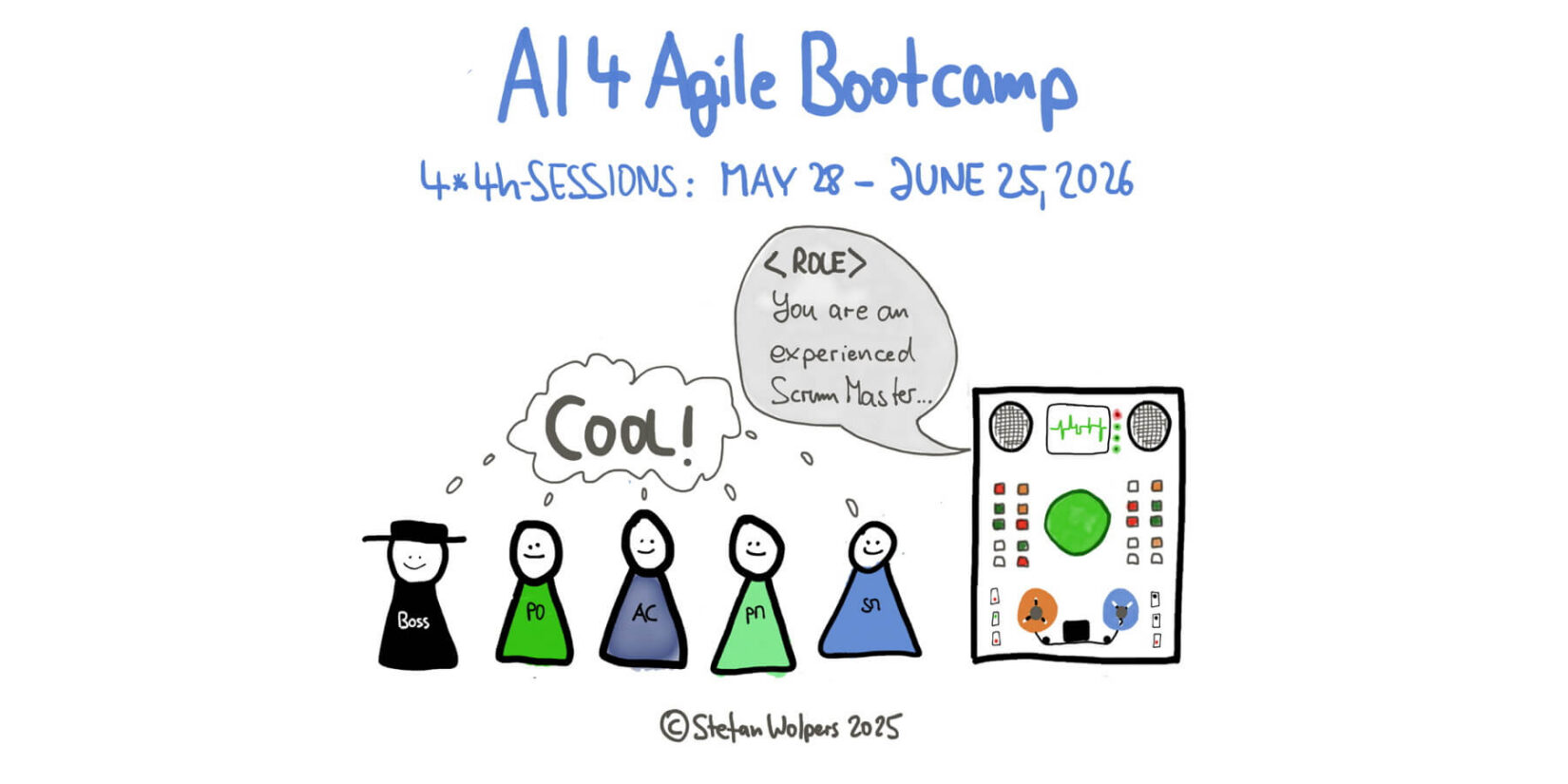
Learn more: 🖥 💯 🇬🇧 AI4Agile BootCamp #7, May 28 to June 25, 2026.
Customer Voice: “The AI for Agilists course is an absolute essential for anyone working in the field! If you want to keep up with the organizations and teams you support, this course will equip you with not only knowledge of how to leverage AI for your work as an Agilist but will also give you endless tips & tricks to get better results and outcomes. I thoroughly enjoyed the course content, structure, and activities. Working in teams to apply what we learned was the best part, as it led to great insights for how I could apply what I was learning. After the first day on the course, I already walked away with many things I could apply at work. I highly recommend this course to anyone looking to better understand AI in general, but more specifically, how to leverage AI for Agility.” (Lauren Tuffs, Change Leader | Business Agility.)
➿ Agile & Leadership
: The Economics of Software Teams: Why Most Engineering Organizations Are Flying Blind
Viktor Cessan argues that most engineering organizations fly blind financially, never connecting team costs to actual economic return, and that LLMs are now exposing accumulated codebases and large headcounts as liabilities rather than competitive assets.
(via Corporate Rebels): 🤟 Your teams are too big. Science proved it in 1880.
Joost Minnaar connects Ringelmann's social loafing, Galton's crowd wisdom, Metcalfe's network value, and Brooks's coordination drag to show how small autonomous teams with radical transparency beat traditional hierarchies at scale.
(via Block): From Hierarchy to Intelligence
Jack Dorsey and Roelof Botha block propose that two thousand years of hierarchical management were just a workaround for limited information routing, and that AI finally makes it possible to replace the whole system rather than merely augment it.
(via Zapier): Raising the AI fluency bar for every Zapier hire
Tracy St.Dic explains how Zapier raised its hiring bar to require embedded AI use, repeatable systems, and explicit accountability, while managers now must prove they led their teams through real AI adoption.
📯 The AI4Agile Foundational Assessment: A Free Practical Judgment Benchmark for Agile Practitioners
You use ChatGPT at work. That does not mean you understand AI well enough to trust your own judgment. The problem is not that agile practitioners ignore AI. The problem is that many already use it confidently without knowing where their judgment breaks down. The free AI4Agile Foundational Assessment measures precisely this skill gap. (Download your access file below.)
The assessment comprises 40 scenario-based questions. It does not ask for definitions, but puts you into situations that agile coaches, product managers, and Scrum Masters face every week: weak prompting producing generic output, misleading data analysis, questionable agent output, and, possibly, organizational pressure to treat AI output as "good enough" to go with it.
Most people who use AI do not fail because they lack knowledge, but because they cannot distinguish between plausible outputs and trustworthy judgment. But see for yourself!
Learn more: The AI4Agile Foundational Assessment: A Free Practical Judgment Benchmark for Agile Practitioners.
🛠 Concepts, Practices, Tools & Measuring
: Blessed With Constraints: Part I
Maarten Dalmijn uses bees and product history to show that too few, too many, or the wrong constraints kill innovation, and that great products require deliberately choosing the right constraints to bound the search space.
(via Kromatic): Six Levels of AI Adoption: From Bystander to Architect
Tristan Kromer proposes a six-level AI adoption maturity model, from passive consumer to multi-agent architect, arguing the gap between broad AI deployment and actual business impact is a practice problem, not a technology problem.
: You Can Quantify Cost. Here Are Four Ways to Measure Judgment.
Jeff Gothelf proposes that as AI collapses execution costs, product judgment becomes the critical differentiator, and offers a four-dimensional scoring rubric to make good decision-making visible, teachable, and consistently practiced across product teams.
📅 Scrum Training & Event Schedule
You can secure your seat for Scrum training classes, workshops, and meetups directly by following the corresponding link in the table below:
| Date | Class and Language | City | Price |
|---|---|---|---|
| 🖥 🇩🇪 November 3-4, 2026 | Professional Scrum Product Owner Training (PSPO I; German; Live Virtual Class) | Live Virtual Class | €1189 incl. 19% VAT (If applicable.) |
| 🖥 🇬🇧 November 27, 2026 | GUARANTEED: AI4Agile Online Course v4 (AI4Agile Certificate; English; Online Course) | Online Course | $149 incl. 19% VAT (If applicable.) |
| 🖥 🇬🇧 December 3-17, 2026 | A3 Delegation System Pilot Workshop 2 (English; Live Virtual Class) | Live Virtual Class | $149 incl. 19% VAT (If applicable.) |
| 🖥 🇩🇪 December 8-9, 2026 | Professional Scrum Product Owner Training (PSPO I; German; Live Virtual Class) | Live Virtual Class | €1189 incl. 19% VAT (If applicable.) |
| 🖥 🇬🇧 December 15-16, 2026 | Professional Scrum Master – Advanced Training (PSM II; English; Live Virtual Class) | Live Virtual Class | €1189 incl. 19% VAT (If applicable.) |
| 🖥 🇩🇪 February 16-17, 2027 | Professional Scrum Product Owner Training (PSPO I; German; Live Virtual Class) | Live Virtual Class | €1189 incl. 19% VAT (If applicable.) |
See all upcoming classes here.

You can book your seat for the training directly by following the corresponding links to the ticket shop. If the procurement process of your organization requires a different purchasing process, please contact Berlin Product People GmbH directly.
📺 Join 6,000-plus Agile Peers on Youtube
Now available on the Age-of-Product YouTube channel to improve learning, for example, about Vibe Coding Best Practices:
- Stop Writing Prompts. Let AI Do It for You — Hack #01, AI4Agile Online Course v2.
- Socratic Prompting — Hack #10, AI4Agile Online Course v2.
- Check Your AI’s Plan Before — Hack #7, AI4Agile Online Course v2.
- From Product Requirements to Experiments to Learnings — Supported by Generative AI.
- Never Accept an LLM’s First Offer — Improve GenAI’s Usefulness w/ Feedback Loops and Challenges.
✋ Do Not Miss Out: Learn more about Vibe Coding Best Practices — Join the 20,000-plus Strong ‘Hands-on Agile’ Slack Community
I invite you to join the “Hands-on Agile” Slack Community and enjoy the benefits of a fast-growing, vibrant community of agile practitioners from around the world.

If you would like to join, all you have to do now is provide your credentials via this Google form, and I will sign you up. By the way, it’s free.
Help your team to learn about how AI Intensifies Work by pointing them to the free Scrum Anti-Patterns Guide: