
TL; DR: Non-Coder Claude Code — Food for Agile Thought #527
Welcome to the 527th edition of the Food for Agile Thought newsletter, shared with 35,767 peers. This week, Grant Harvey and Alberto Romero track Claude Cowork, the non-coder Claude Code, bringing agentic work to non-coders. They highlight safety limits plus the human judgment behind “autonomy.” Laura Klein questions “empowered” teams when dependencies and certainty demands drive feature shipping, and Janna Bastow reframes prioritization as decision confidence, built through strategy, evidence, and decision logs. Also, Dwarkesh Patel, Michael Burry, Patrick McKenzie, and Jack Clark challenge the AI boom with doubts about productivity, shifting leadership, and energy constraints.
Next, Lenny Rachitsky, Aishwarya Naresh Reganti, and Kiriti Badam explain why probabilistic AI products need careful control, gradual autonomy, and production monitoring grounded in real workflows. Roman Pichler offers a five-step strategy reset for existing products, backed by data, risk testing, and outcome roadmaps, while Zach Bruggeman, Jason Quense, and Rahul Sengottuvelu show how sandboxed coding agents use tests and telemetry to stay reliable. Anthropic’s November 2025 usage report maps autonomy and success, and John Cutler highlights the importance of ownership and a weekly doc cadence to prevent drift for product models.
Then, Scott A. Snyder suggests incentives, not tools, unlock AI adoption by rewarding responsible experiments and outcomes. Joost Minnaar and Mark Graban show how blame and rushed oversight kill learning, while trust, transparency, and consistent presence build improvement. Peter Yang describes Claude Skills as reusable instruction folders that standardize recurring work across chats. Finally, Jason Crawford reminds us that complex systems resist prediction, so build buffers, monitor signals, and use simple leverage points.
🎓 🇬🇧 🤖 The AI 4 Agile Online Course v2 at $149 — March 2, 2026
I developed the self-paced AI 4 Agile Online Course for agile practitioners, including Product Owners, Product Managers, Scrum Masters, Agile Coaches, and delivery professionals who want to integrate artificial intelligence into their workflows with clarity, ethics, and purpose.
You don’t need to become an AI expert. However, you do need to understand how LLMs like ChatGPT, Claude, or Gemini can support real agile work and where their limitations lie. As Jim Highsmith said, AI isn’t just a tool, but a new context for agility.
This course shows you how to do that precisely .
The latest Version 2 will be released on March 2 and comes with an introductory price of $149 instead of $249—don’t miss this opportunity to save $100!
👉 Don’t like to wait until March 2? Go shopping now at $199. (The upgrade to version 2 is included.)
Join 400-plus Peers — What Is Included:
- 10+ hours of self-paced video modules: Hacks, Skills, Agents
- A cohort-hardened, proven course design
- Learn to 10x your effectiveness with AI; your stakeholders will be grateful
- Delve into classic agile use cases of AI
- Help your team create more customer value
- All texts, slides, prompts, graphics; you name it
- Access custom GPTs, including the “Scrum Anti-Patterns Guide GTP”
- Enjoy community access for peer learning
- Guaranteed: Lifetime access to all course updates and materials; there is a lot more to come
- The AI4Agile Foundation Certificate.

👉 Please note: The course will only be available for sign-up at $149 until March 9, 2026! 👈
🎓 Join the Waitlist of the AI 4 Agile Online Course v2 Now: Master AI Integration for Agile Practitioners—No AI Expertise Required!
Did you miss the previous Food for Agile Thought issue 526?
🗞 Shall I notify you about articles like this one? Awesome! You can sign up here for the ‘Food for Agile Thought’ newsletter and join 35,000-plus subscribers.
🎓 Join Stefan in one of his upcoming Professional Scrum training classes!
🏆 The Tip of the Week
(via The Neuron): Claude Cowork, Explained: Everything to Know about Anthropic's Answer to Claude Code for Normies
Grant Harvey explains Claude Cowork as a research preview that brings Claude Code-like autonomy to non-coders, letting Claude work in folders to organize files and draft documents, while raising questions about safety and access policies.
🎯 Product
(via Nielsen Norman Group): Why Most Product Teams Aren't Really Empowered
Laura Klein suggests most product teams are not truly empowered because shared components, dependencies, and executive demands for certainty force feature delivery. She proposes reducing dependencies, designing around journeys, improving coordination, and aligning metrics.
(via ProdPad): Why Product Teams Don’t Have a Prioritization Problem, They Have a Decision Confidence Problem
Janna Bastow says prioritization pain is low decision confidence. Teams hide uncertainty behind scoring. Build confidence with a clear strategy, evidence, trade-offs, decision logs, and leaders who stick with bets.
: How to Build a Strategy for an Existing Product
Roman Pichler proposes a five-step process to clarify an existing product strategy: capture current choices, assess with data, update via research and risk testing, translate into outcome-based roadmaps, and review quarterly.
: 📺 Why most AI products fail: Lessons from 50+ AI deployments at OpenAI, Google & Amazon
Lenny Rachitsky, Aishwarya Naresh Reganti, and Kiriti Badam explain that AI products are probabilistic, so teams should start with high control, gradually increase autonomy, calibrate behavior continuously, monitor in production, and design around real workflows.
🧠 Artificial Intelligence
: The AI revolution is here. Will the economy survive the transition?
Michael Burry, Dwarkesh Patel, Patrick McKenzie, and Jack Clark debate whether AI investment creates durable returns or a capital bubble. They discuss rapid capability shifts, weak productivity evidence, rotating leaders, rising energy constraints, and the need for better measurement and policy attention.
: Claude Code Coded Claude Cowork
Alberto Romero notes Claude Code built Cowork, extending coding agents to non-coders. He suggests this hints at recursive toolmaking, yet warns that human judgment, prompts, and tacit knowledge shape outcomes.
(via Ramp Builders): Why We Built Our Own Background Agent
Zach Bruggeman, Jason Quense, and Rahul Sengottuvelu describe building a background coding agent that runs in sandboxed environments, verifies changes with tests and telemetry, syncs across clients like Slack and web, and supports concurrent sessions and collaboration.
(via Anthropic): Anthropic Economic Index report: Economic primitives
The report introduces metrics from usage in November 2025, mapping skills, task complexity, autonomy, and success. It finds uneven adoption, coding dominance, use with income, and limits on complex tasks.
🖥 💯 🇬🇧 AI for Agile BootCamp #6 — March 19 to April 16, 2026
The job market’s shifting. Agile roles are under pressure. AI tools are everywhere. But here’s the truth: the Agile pros who learn how to work with AI, not against it, will be the ones leading the next wave of high-impact teams.
So, become the one who professional recruiters call first for “AI‑powered Agile.” Be among the first to master practical AI applications for Scrum Masters, Agile Coaches, Product Owners, Product Managers, and Project Managers.
The class is in English. 🇬🇧
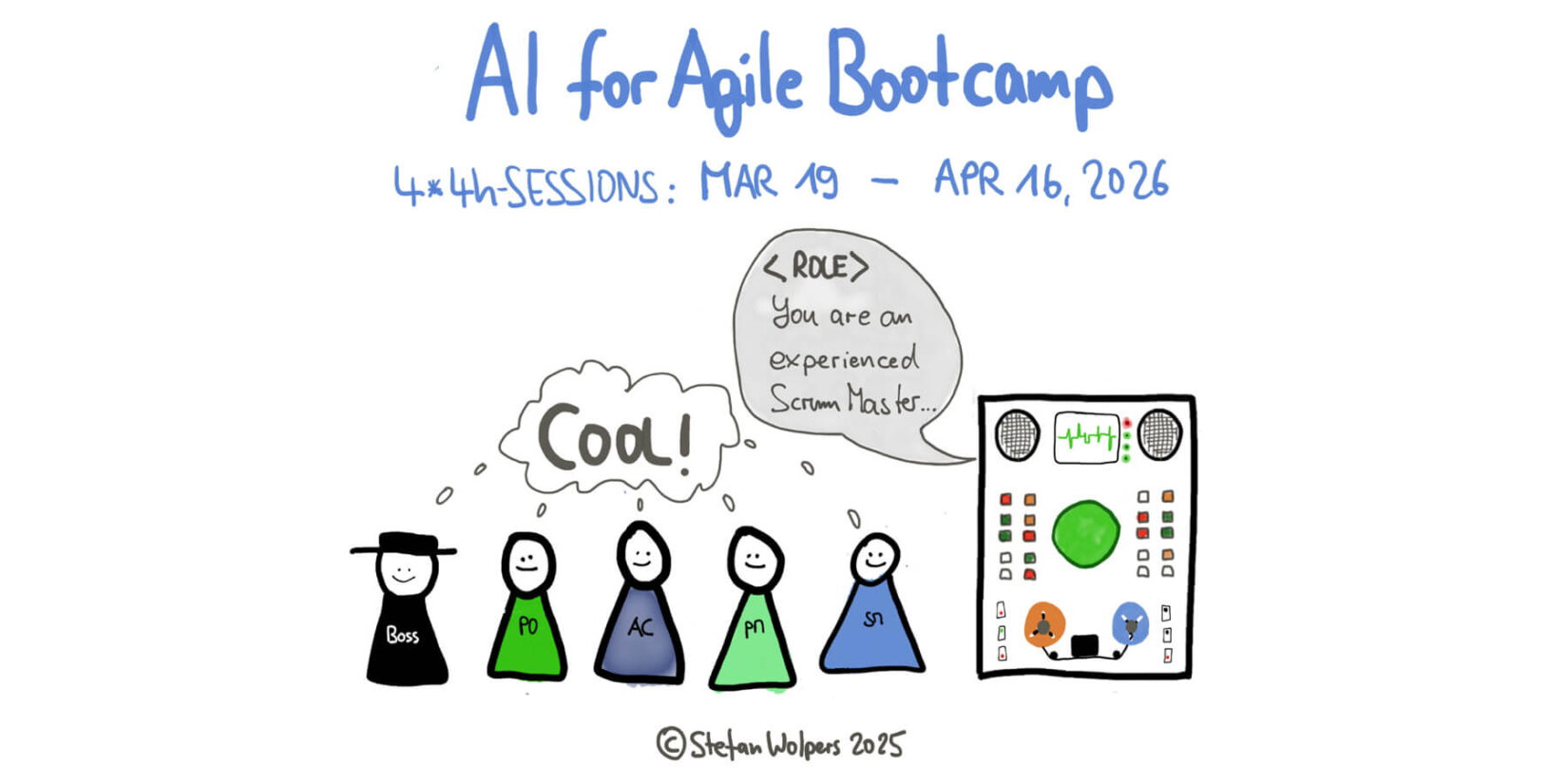
Learn more: 🖥 💯 🇬🇧 AI for Agile BootCamp #6 — March 19 to April 16, 2026.
Customer Voice: “The AI for Agilists course is an absolute essential for anyone working in the field! If you want to keep up with the organizations and teams you support, this course will equip you with not only knowledge of how to leverage AI for your work as an Agilist but will also give you endless tips & tricks to get better results and outcomes. I thoroughly enjoyed the course content, structure, and activities. Working in teams to apply what we learned was the best part, as it led to great insights for how I could apply what I was learning. After the first day on the course, I already walked away with many things I could apply at work. I highly recommend this course to anyone looking to better understand AI in general, but more specifically, how to leverage AI for Agility.” (Lauren Tuffs, Change Leader | Business Agility.)
➿ Agile & Leadership
: Solving Problems the Hard Way
John Cutler shares how a leader built lasting momentum by shaping a few workstreams, assigning real ownership, and running a simple weekly doc review. The manual routine forced thinking, exposed drift early, and beat performative planning and brittle frameworks.
(via Knowledge @ Wharton): How Can Companies Incentivize AI Adoption?
Scott A. Snyder proposes that AI adoption stalls because incentives reward old behaviors. He suggests aligning rewards for leaders, teams, and individuals around responsible experimentation, shared gains, and measurable outcomes, while avoiding vanity metrics and trust erosion.
(via Corporate Rebels): The Blame Game: How Bureaucracy Eats Responsibility
Joost Minnaar describes how bureaucracy turns failures into blame hunts, adding rules that drain initiative and hide risk. He uses Challenger and Columbia to show that process compliance can still fail, and proposes replacing control with trust, transparency, and learning.
📯 The A3 Framework: Assist, Automate, Avoid — A Decision System for AI Delegation
The A3 Framework categorizes AI delegation before you prompt: Assist (AI drafts, you actively review and decide), Automate (AI executes under explicit rules and audit cadences), or Avoid (stays entirely human when failure would damage trust or relationships). Most AI training teaches better prompting. The A3 Framework teaches the prior question: Should you be prompting at all? Categorize first, then prompt.
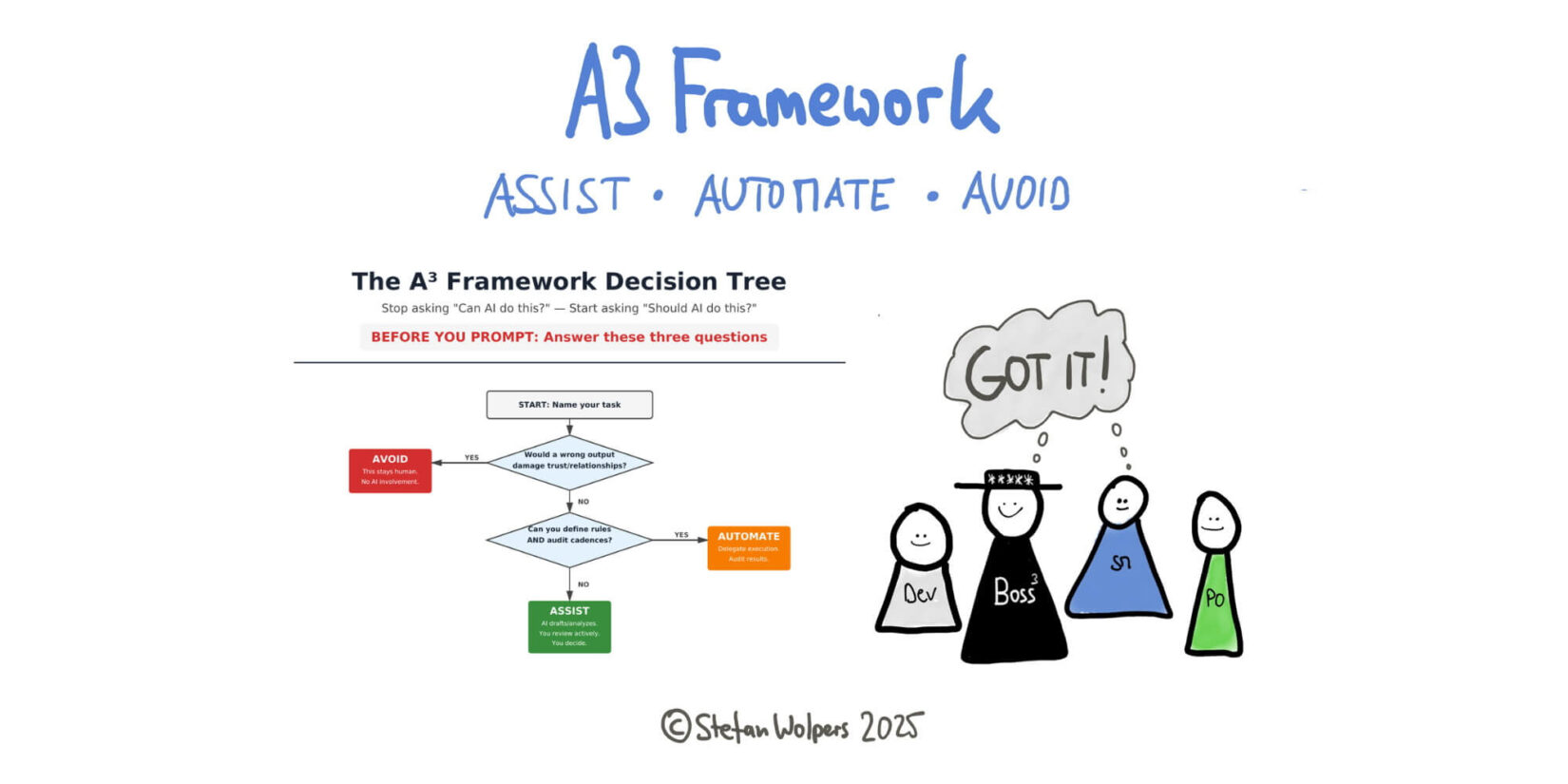
Learn more: The A3 Framework: Assist, Automate, Avoid — A Decision System for AI Delegation.
🛠 Concepts, Practices, Tools & Measuring
: 📺 Claude Skills, Clearly Explained in 15 Minutes
Peter Yang describes Claude Skills as reusable workflow folders that package instructions plus optional templates or scripts so that Claude can apply consistent expertise across chats. Skills reduce repetitive prompting, speed up drafting, and standardize outputs for common work like writing, planning, and strategy docs.
: Gemba Walks, Daily Improvement, and the Leadership Behaviors That Make Kaizen Possible
Mark Graban explains that Gemba walks succeed when leaders slow down, show up consistently, and learn without blaming. He shares practical behavior traps to avoid and links daily improvement to trust, relationships, and psychological safety.
: How to tame a complex system
Jason Crawford suggests complex systems stay unpredictable, yet humans reduce risk by building buffers, monitoring early signals, and exploiting simple leverage points. He uses weather and disease to show progress without full control.
📅 Scrum Training & Event Schedule
You can secure your seat for Scrum training classes, workshops, and meetups directly by following the corresponding link in the table below:
| Date | Class and Language | City | Price |
|---|---|---|---|
| 🖥 🇬🇧 November 27, 2026 | GUARANTEED: AI4Agile Online Course v4 (AI4Agile Certificate; English; Online Course) | Online Course | $149 incl. 19% VAT (If applicable.) |
| 🖥 🇬🇧 December 3-17, 2026 | A3 Delegation System Pilot Workshop 2 (English; Live Virtual Class) | Live Virtual Class | $149 incl. 19% VAT (If applicable.) |
| 🖥 🇩🇪 December 8-9, 2026 | Professional Scrum Product Owner Training (PSPO I; German; Live Virtual Class) | Live Virtual Class | €1099 incl. 19% VAT (If applicable.) |
| 🖥 🇬🇧 December 15-16, 2026 | Professional Scrum Master – Advanced Training (PSM II; English; Live Virtual Class) | Live Virtual Class | €1189 incl. 19% VAT (If applicable.) |
| 🖥 🇩🇪 February 16-17, 2027 | Professional Scrum Product Owner Training (PSPO I; German; Live Virtual Class) | Live Virtual Class | €1099 incl. 19% VAT (If applicable.) |
See all upcoming classes here.

You can book your seat for the training directly by following the corresponding links to the ticket shop. If the procurement process of your organization requires a different purchasing process, please contact Berlin Product People GmbH directly.
📺 Join 6,000-plus Agile Peers on Youtube
Now available on the Age-of-Product YouTube channel to improve learning, for example, about the Non-Coder Claude Code:
- Hands-on Agile #68: How to Analyze Unstructured Team Interview Data with AI.
- Fabrice Bernhard: The Lean Tech Manifesto.
- Maarten Dalmijn: The 5 Obstacles to Empowered Teams.
- Roman Pichler: The Top Reasons Why a Product Strategy Fails.
- Johanna Rothman: How to Instill Agility, not Agile Practices.
- Hands-on Agile EXTRA: How Elon Musk Would Run YOUR Business with Joe Justice.

✋ Do Not Miss Out: Learn more about Non-Coder Claude Code — Join the 20,000-plus Strong ‘Hands-on Agile’ Slack Community
I invite you to join the “Hands-on Agile” Slack Community and enjoy the benefits of a fast-growing, vibrant community of agile practitioners from around the world.

If you would like to join, all you have to do now is provide your credentials via this Google form, and I will sign you up. By the way, it’s free.
Help your team to learn about Career Success Factors by pointing them to the free Scrum Anti-Patterns Guide: