
TL; DR: Psychology of Bad Decisions — Food for Agile Thought #520
Welcome to the 520th edition of the Food for Agile Thought newsletter, shared with 40,332 peers. This week, Shane Parrish explores Charlie Munger’s take on the psychology of bad decisions, revealing mental pitfalls that sabotage judgment. Teresa Torres distills how AI product teams earn trust and learn faster by narrowing focus and embracing uncertainty. Lenny Rachitsky talks with Stewart Butterfield about building useful products without falling for the founder’s ego, and Jim Highsmith warns that alignment fails without accountability. Also, Christina draws a clear line between tracking performance and setting meaningful, time-bound goals.
Next, Dean Peters presents AI workflows that help PMs stress-test ideas faster and reveal shallow thinking, while Ethan Mollick explains how Gemini 3 behaves like a junior teammate, not just a chatbot. Benedict Evans positions AI as a platform shift, still searching for business models. Maik Seyfert shows how informal shadow systems drive real decisions, and Laura Klein breaks down the costly myths behind skipping user research and the cultural blocks that enable them.
Last, Jenn Spykerman shares tactics for surviving AI chaos when leadership checks out, including spotting failure early and scoping for safety. Gergely Orosz talks with Martin Fowler about how AI reshapes coding while core engineering still holds firm, and Brian Balfour shows how AI prototyping slashes costs and accelerates product alignment. Then, Maarten Dalmijn warns against premature complexity in architecture. Finally, Max Woolf explores Nano Banana’s edge in precise image generation despite style transfer issues and IP risks.
Black Friday & Cyber Monday Deals—Join 600-plus Peers & Change Your Career Because Agility Matters
👉 Don’t wait too long; the deals are only available from November 28 to December 1, 2025:
🇬🇧 The AI 4 Agile Online Course at $129 Instead of $199 — 35% OFF

Secure Your Black Friday Discount Now: AI 4 Agile Online Course—No Prior AI Expertise Required!
🇬🇧 The Advanced Product Backlog Management Course w/ AI at $109 Instead of $169 — 35% OFF

Secure Your Black Friday Discount Now: Advanced Product Backlog Management w/ AI Online Course!
Did you miss the previous Food for Agile Thought issue 519?
🗞 Shall I notify you about articles like this one? Awesome! You can sign up here for the ‘Food for Agile Thought’ newsletter and join 40,000-plus subscribers.
🎓 Join Stefan in one of his upcoming Professional Scrum training classes!
🏆 The Tip of the Week: Psychology of Bad Decisions
: 🎙 Charlie Munger: The Psychology of Human Misjudgment [Outliers]
In this podcast, Shane Parrish explores Charlie Munger’s framework on why capable people make poor decisions, breaking down the psychological forces that distort judgment and offering a clear look at patterns that quietly shape how we think and act.
🎯 Product
: Lessons from 9 AI Product Teams: Emerging Themes from Just Now Possible
Teresa Torres shares insights from AI product teams shipping real features, highlighting patterns like starting narrow, leaning on domain expertise, evolving evals, managing integrations, and building trust by teaching models to say “I don’t know.”
and : 🎙 Slack founder: Mental models for building products people love ft. Stewart Butterfield
Lenny Rachitsky interviews Stewart Butterfield, who shares product-building insights like utility curves, the owner’s delusion, and hyper-realistic workflows, offering grounded advice for crafting useful products and leading with clarity.
(via Reforge): How to Implement AI Prototyping In Your Product Development Cycle
Brian Balfour explains how AI prototyping reshapes product development by radically reducing costs, enabling faster iteration, and helping PMs align stakeholders, validate solutions, and spec features before committing engineering resources.
(via Productside): The AI Product Management Workflows Every PM Needs In 2026
Dean Peters outlines four AI product management workflows every PM should master in 2026: context engineering, synthetic evals, agentic research loops, and vibe-coded prototypes that compress feedback cycles and expose weak product thinking.
🧠 Artificial Intelligence
: Three Years from GPT-3 to Gemini 3
Ethan Mollick reflects on the rapid evolution from GPT-3 to Google’s Gemini 3, which now behaves less like a chatbot and more like a capable digital coworker: planning tasks, coding independently, conducting research, and even co-authoring academic-style papers, all while keeping the human in control.
: AI Eats the World — Autumn 2025
Benedict Evans explores the generative AI boom as a major platform shift, highlighting explosive capex, unclear business models, and early usage patterns that echo past tech cycles but hint at massive long-term impact.
: AI without Adults: How to Deliver When Leadership is Checked Out
Jenn Spykerman offers a blunt survival guide for delivering real AI results when leadership is disengaged, outlining tactics for spotting doomed initiatives, scoping small wins, building political cover, and protecting your career.
and : 🎙 How AI will change software engineering
Gergely Orosz interviews Martin Fowler on how AI changes software engineering, from navigating non-determinism and refactoring with LLMs to why core engineering skills and Agile principles still matter in complex, messy organizations.
🖥 💯 🇬🇧 AI for Agile BootCamp #5 — January 29 – February 19, 2026
The job market’s shifting. Agile roles are under pressure. AI tools are everywhere. But here’s the truth: the Agile pros who learn how to work with AI, not against it, will be the ones leading the next wave of high-impact teams.
So, become the one who professional recruiters call first for “AI‑powered Agile.” Be among the first to master practical AI applications for Scrum Masters, Agile Coaches, Product Owners, Product Managers, and Project Managers.
Tickets also include lifetime access to the corresponding online course, once it is published. The class is in English. 🇬🇧
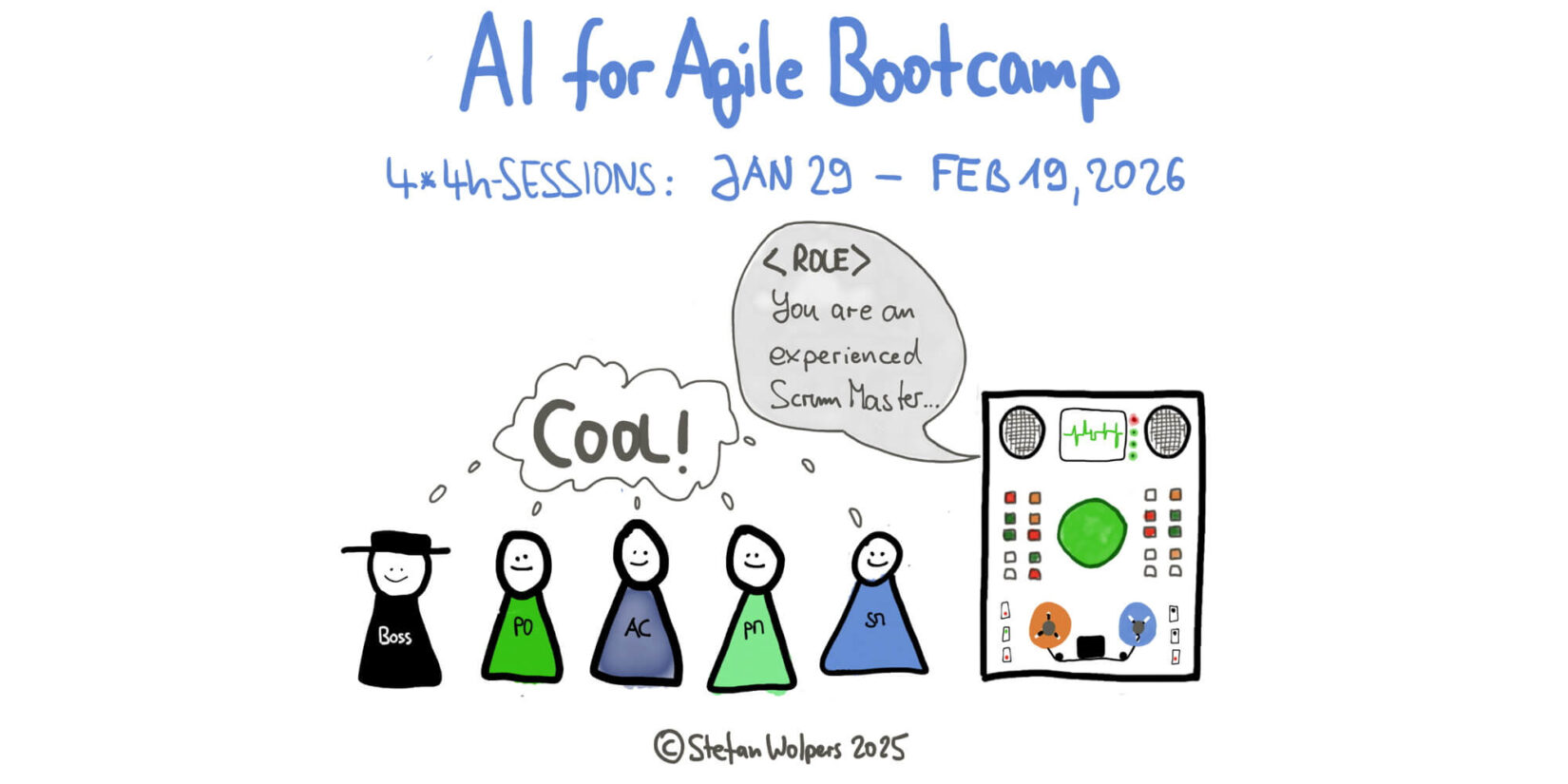
Learn more: 🖥 💯 🇬🇧 AI for Agile BootCamp #5 — January 29 – February 19, 2026.
Customer Voice: “The AI for Agilists course is an absolute essential for anyone working in the field! If you want to keep up with the organizations and teams you support, this course will equip you with not only knowledge of how to leverage AI for your work as an Agilist but will also give you endless tips & tricks to get better results and outcomes. I thoroughly enjoyed the course content, structure, and activities. Working in teams to apply what we learned was the best part, as it led to great insights for how I could apply what I was learning. After the first day on the course, I already walked away with many things I could apply at work. I highly recommend this course to anyone looking to better understand AI in general, but more specifically, how to leverage AI for Agility.” (Lauren Tuffs, Change Leader | Business Agility.)
➿ Agile & Leadership
: Alignment Without Accountability Is Theater
Jim Highsmith concludes his AAA Triangle series with a sharp narrative on how alignment without accountability collapses into performance. Real alignment, he argues, only lasts when outcomes, ownership, and feedback loops stay tightly connected.
: Shadow Structures: The Unofficial Systems That Actually Run Your Organization
Maik Seyfert explains how shadow structures, informal networks of trust and influence, quietly shape decisions and outcomes. Understanding and integrating them is essential for leaders seeking real change beyond the org chart.
: Both Architecture-First and Delivery-First Suck
Maarten Dalmijn argues that architecture without delivery is as flawed as delivery without architecture, warning that complex systems built upfront violate YAGNI and Gall’s Law and reduce future reversibility and optionality.
📯 Plans for 2026: More Online Courses, Rejuvenating the Agile Camp, and Less Public Scrum Training
The public Scrum training market is shrinking, while demand for self-paced AI and Product courses is growing among agile practitioners. Consequently, I will shift toward online courses on AI for Agile and Product Operating Models in 2026. And I will rejuvenate the Agile Camp Berlin in the summer of 2026. Learn more about what is in the pipeline.

Learn more: Plans for 2026: More Online Courses, Rejuvenating the Agile Camp, and Less Public Scrum Training.
🛠 Concepts, Practices, Tools & Measuring
: KPIs Are Your Dashboard. OKRs Are Your GPS to Somewhere New.
Christina explains that KPIs track steady performance while OKRs drive intentional change. OKRs should reflect specific transformations, not vague aspirations like “be high-performing,” and should be used only when change is required.
(via Nielsen Norman Group): Why Organizations Don’t Do User Research and How to Change That
Laura Klein dissects the many excuses organizations give for avoiding user research, from time and cost to fragile egos and bad incentives, arguing that skipping research wastes far more than it saves.
: Nano Banana can be prompt engineered for extremely nuanced AI image generation
Max Woolf shows how Google’s Nano Banana model delivers unusually precise prompt adherence, complex edits, and structured input handling, outperforming diffusion models while still struggling with style transfer and posing notable IP and moderation concerns.
📅 Scrum Training & Event Schedule
You can secure your seat for Scrum training classes, workshops, and meetups directly by following the corresponding link in the table below:
| Date | Class and Language | City | Price |
|---|---|---|---|
| 🖥 🇬🇧 November 27, 2026 | GUARANTEED: AI4Agile Online Course v4 (AI4Agile Certificate; English; Online Course) | Online Course | $149 incl. 19% VAT (If applicable.) |
| 🖥 🇬🇧 December 3-17, 2026 | A3 Delegation System Pilot Workshop 2 (English; Live Virtual Class) | Live Virtual Class | $149 incl. 19% VAT (If applicable.) |
| 🖥 🇩🇪 December 8-9, 2026 | Professional Scrum Product Owner Training (PSPO I; German; Live Virtual Class) | Live Virtual Class | €1189 incl. 19% VAT (If applicable.) |
| 🖥 🇬🇧 December 15-16, 2026 | Professional Scrum Master – Advanced Training (PSM II; English; Live Virtual Class) | Live Virtual Class | €1189 incl. 19% VAT (If applicable.) |
| 🖥 🇩🇪 February 16-17, 2027 | Professional Scrum Product Owner Training (PSPO I; German; Live Virtual Class) | Live Virtual Class | €1189 incl. 19% VAT (If applicable.) |
See all upcoming classes here.

You can book your seat for the training directly by following the corresponding links to the ticket shop. If the procurement process of your organization requires a different purchasing process, please contact Berlin Product People GmbH directly.
📺 Join 6,000-plus Agile Peers on Youtube
Now available on the Age-of-Product YouTube channel to improve learning, for example, about the Psychology of Bad Decisions:
- Hands-on Agile #68: How to Analyze Unstructured Team Interview Data with AI.
- Fabrice Bernhard: The Lean Tech Manifesto.
- Maarten Dalmijn: The 5 Obstacles to Empowered Teams.
- Roman Pichler: The Top Reasons Why a Product Strategy Fails.
- Johanna Rothman: How to Instill Agility, not Agile Practices.
- Hands-on Agile EXTRA: How Elon Musk Would Run YOUR Business with Joe Justice.
✋ Do Not Miss Out: Learn more about the Psychology of Bad Decisions — Join the 20,000-plus Strong ‘Hands-on Agile’ Slack Community
I invite you to join the “Hands-on Agile” Slack Community and enjoy the benefits of a fast-growing, vibrant community of agile practitioners from around the world.

If you would like to join, all you have to do now is provide your credentials via this Google form, and I will sign you up. By the way, it’s free.
Help your team to learn about the AI Bubble Benefits by pointing them to the free Scrum Anti-Patterns Guide:
🗞️ Last Week’s Food for Agile Thought Edition
Read more: Food for Agile Thought #519: AI Bubble Benefits, Deadly OKRs, Why Agility Matters, Show Me the Money, AI!
