Food for Agile Thought #373: ChatGPT and Disruption, Stakeholder Management, The Value of Agile Coaching, The Product Strategy Document

TL; DR: ChatGPT and Disruption, The Value of Agile Coaching — Food for Agile Thought #373

Welcome to the 373rd edition of the Food for Agile Thought newsletter, shared with 36,412 peers. This week, we suggest how AI, in general, and ChatGPT and its successors, in particular, may disrupt our current world. Additionally, we delve into how agile coaches can communicate the benefits of their work to organizations, suggesting the NABC value proposition scheme. Plus, we point to the many benefits of cognitive diversity to avoid blind spots and adapt to changing environments. Also, Adam Grant interviews John and Julie Gottman, renowned researchers of marital relationships, on how to play the infinite game. We can apply many of their findings to creating trust and rapport professionally.

Then, we share a comprehensive guide to a critical artifact, the product strategy document, covering the dos & don’ts, what it needs to cover, and its subsequent inspection and adaptation. Moreover, we share “how to use the product discovery loop to build high-growth products” while discussing all things stakeholder management, from its general benefits to the nitty-gritty details of creating alignment. By the way, an excellent tool to create alignment is the Product Goal Canvas; see below.

Finally, we detail how to apply a hugely valuable flow metric to your work and point to the all-so-human flaw of falling for vanity metrics to measure “success” when it is all about solving problems and building relationships. Lastly, we try to answer a compelling question: Is ChatGPT a game-changer? And if so, from whom?

I hope you have a fantastic season filled with joy and happiness. Whether you’re celebrating Christmas, Hanukkah, Kwanzaa, or something else, I hope the season brings you good cheer and lots of time to spend with the people you love.

This edition will be the last for 2022; Food for Agile Thought will be back on January 8, 2023. ​

Food for Agile Thought #373: ChatGPT and Disruption, Stakeholder Management, The Value of Agile Coaching, The Product Strategy Document — Age-of-Product.com
Continue reading Food for Agile Thought #373: ChatGPT and Disruption, Stakeholder Management, The Value of Agile Coaching, The Product Strategy Document

Your Unfit Product Goal and the Product Goal Canvas — Making Your Scrum Work (28)

TL; DR: Your Unfit Product Goal and the Product Goal Canvas

We plan a lot in Scrum: There is a daily plan when the Developers think about progressing toward the Sprint Goal during the Daily Scrum. Of course, the Sprint Goal reflects an intermediate target the Scrum team considers valuable to solve their customers’ problems. Moreover, there is the Product Goal, a mid- or long-term objective of the Scrum team.

The problem is that when Scrum teams already struggle with embracing the concept of the Sprint Goal—first, you agree on the objective of the Sprint, then you pick the work you consider necessary to accomplish it—they most likely also struggle with proper Product Goals.

Let’s check three critical issues Scrum teams have with Product Goals and a practical tool that helps you avoid the mess.

Your Unfit Product Goal and the Product Goal Canvas — Making Your Scrum Work (28) — Age-of-Product.com
Continue reading Your Unfit Product Goal and the Product Goal Canvas — Making Your Scrum Work (28)

Food for Agile Thought #372: State of Agile Report 2022, Annual Planning in Uncertain Times, ChatGPT on Agile and Scrum, The Art and Science of Pricing

TL; DR: State of Agile 2022, ChatGPT on Agile and Scrum — Food for Agile Thought #372

Welcome to the 372nd edition of the Food for Agile Thought newsletter, shared with 36,387 peers. This week, we share the State of Agile 2022 Report and probe ChatGPT on Agile and Scrum. Moreover, we dissect a common corporate anti-pattern while transforming into an agile organization: They continue incentivizing individuals. Also, we discuss the concept of technical debt—a ‘metaphor for communicating the long-term implications of architectural decisions and trade-offs to stakeholders’—and its limitations.

Then, we offer advice on how to lead stakeholders and developers, guide individuals, and create value together without having the authority to tell them what to do. Next, Lenny Rachitsky interviews Madhavan Ramanujam, author of ‘Monetizing Innovation,’ about all the elements that go into your pricing strategy. Of course, getting pricing right requires experiments. Fortunately, we also share a hypothesis for supporting an organizational culture of experimentation by applying a pattern language to cover that part.

Finally, First Round Capital compiled six ‘unique approaches to end-of-year planning,’ covering fresh tactics, different perspectives, and tested frameworks. Moreover, the Concepts & Tools section would not be complete this week without this comprehensive guide to decision-making, from the benefits of including others to games, exercises, tools, and how to avoid premature convergence. Lastly, Andy Cleff analyzes the context and options of saying ‘no’ gracefully, and Ben Thompson also explores ChatGPT by asking, ‘Did Thomas Hobbes believe in the separation of powers?’

Food for Agile Thought #372: State of Agile 2022 Report, Annual Planning in Uncertain Times, ChatGPT on Agile and Scrum, The Art and Science of Pricing — Age-of-Product.com
Continue reading Food for Agile Thought #372: State of Agile Report 2022, Annual Planning in Uncertain Times, ChatGPT on Agile and Scrum, The Art and Science of Pricing

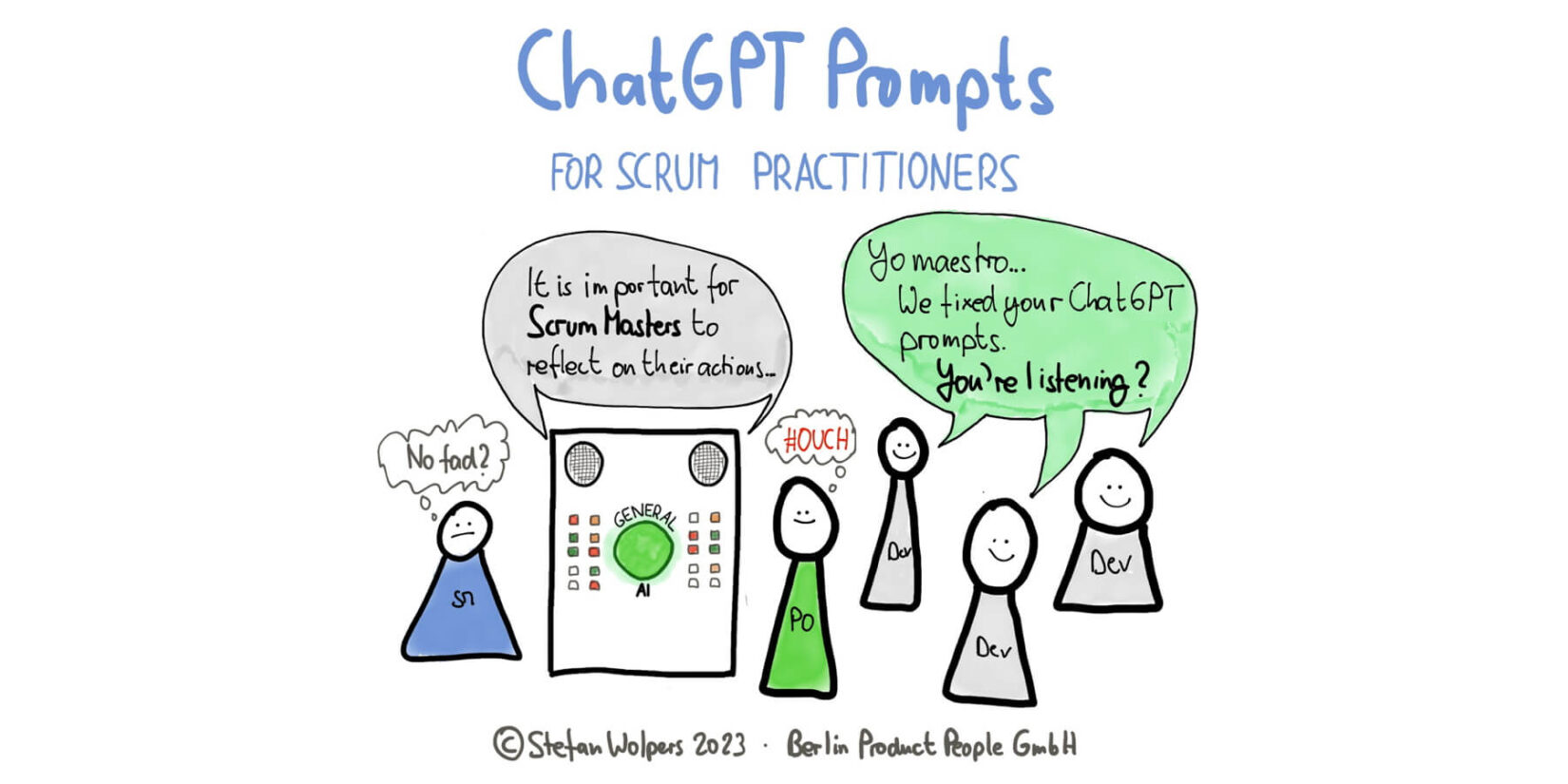
Agility and Scrum According to OpenAI’s ChatGPT — Be Surprised!

TL; DR: Business Agility, Scrum and Generative AI’s Take on Getting There

There has been a lot of talking about generative AI recently, mainly fueled by excellent work results in the text and graphics area. A few days ago, OpenAI made a new model available that “interacts in a conversational way. The dialogue format makes it possible for ChatGPT to answer follow-up questions, admit its mistakes, challenge incorrect premises, and reject inappropriate requests.” (Source.)

I thought it might be fun to ask ChatGPT a few questions about business agility in general and Scrum in particular.

Generative AI: OpenAI’s ChatGPT on Business Agility and Scrum — Age-of-Product.com
Continue reading Agility and Scrum According to OpenAI’s ChatGPT — Be Surprised!

Food for Agile Thought #371: User Story Guide, Not all Planning Is Helpful, ROI of Product Management, Free Facilitation Resources

TL; DR: User Story Guide, Free Facilitation Resources — Food for Agile Thought #371

Welcome to the 371st edition of the Food for Agile Thought newsletter, shared with 36,352 peers. This week, we share an extensive user story guide to create successful products, covering a lot of ground from 3Cs to INVEST to 3Ws. Also, we delve into the benefits of applying principles and patterns from the team topologies concept to remote and hybrid work environments. Moreover, John Cutler busts the myth that all planning is in some way helpful when he points to nine situations where planning might not be beneficial, from planning before the last responsible moment to planning to maximize output.

Also, we appreciate a Forrester Consulting study on the benefits of taking product management seriously, including “key recommendations on making product bets with greater impact.” (Download the study for free.) Then, we analyze different scenarios you may encounter when elevating a team from feature factory workers to problem solvers and dive into the advantages of a product design philosophy popularized by Amazon: Working backward. And Petra Wille shares how to best support your team as a product coach.

Finally, we share lessons learned on how ThoughtWorks helped Etsy create a new product culture, scaling discovery and delivery. The Institute of Cultural Affairs curated an extensive repository of free learning resources for facilitators, from group facilitation methods to virtual facilitation. Lastly, Russ Roberts interviews Annie Duke on the benefits of letting go and how to avoid confusing grit with character.

Food for Agile Thought #371: User Story Guide, Not all Planning Is Helpful, ROI of Product Management, Free Facilitation Resources — Age-of-Product.com
Continue reading Food for Agile Thought #371: User Story Guide, Not all Planning Is Helpful, ROI of Product Management, Free Facilitation Resources

Engage the Agile Fluency® Model with Diana Larsen — Hands-on Agile #46

TL; DR: Hands-on Agile #46: Engage the Agile Fluency® Model with Diana Larsen

On October 12, 2022, agile innovator Diana Larsen delved into the Agile Fluency® Model. After a short introduction to the model, we shifted to an ask-me-anything-style discussion of the groundbreaking view of agile and teams.

Engage the Agile Fluency® Model with Diana Larsen — Hands-on Agile #46 — Age-of-Product.com

📺 Watch the video now: Engage the Agile Fluency® Model with Diana Larsen — Hands-on Agile #46.

Continue reading Engage the Agile Fluency® Model with Diana Larsen — Hands-on Agile #46