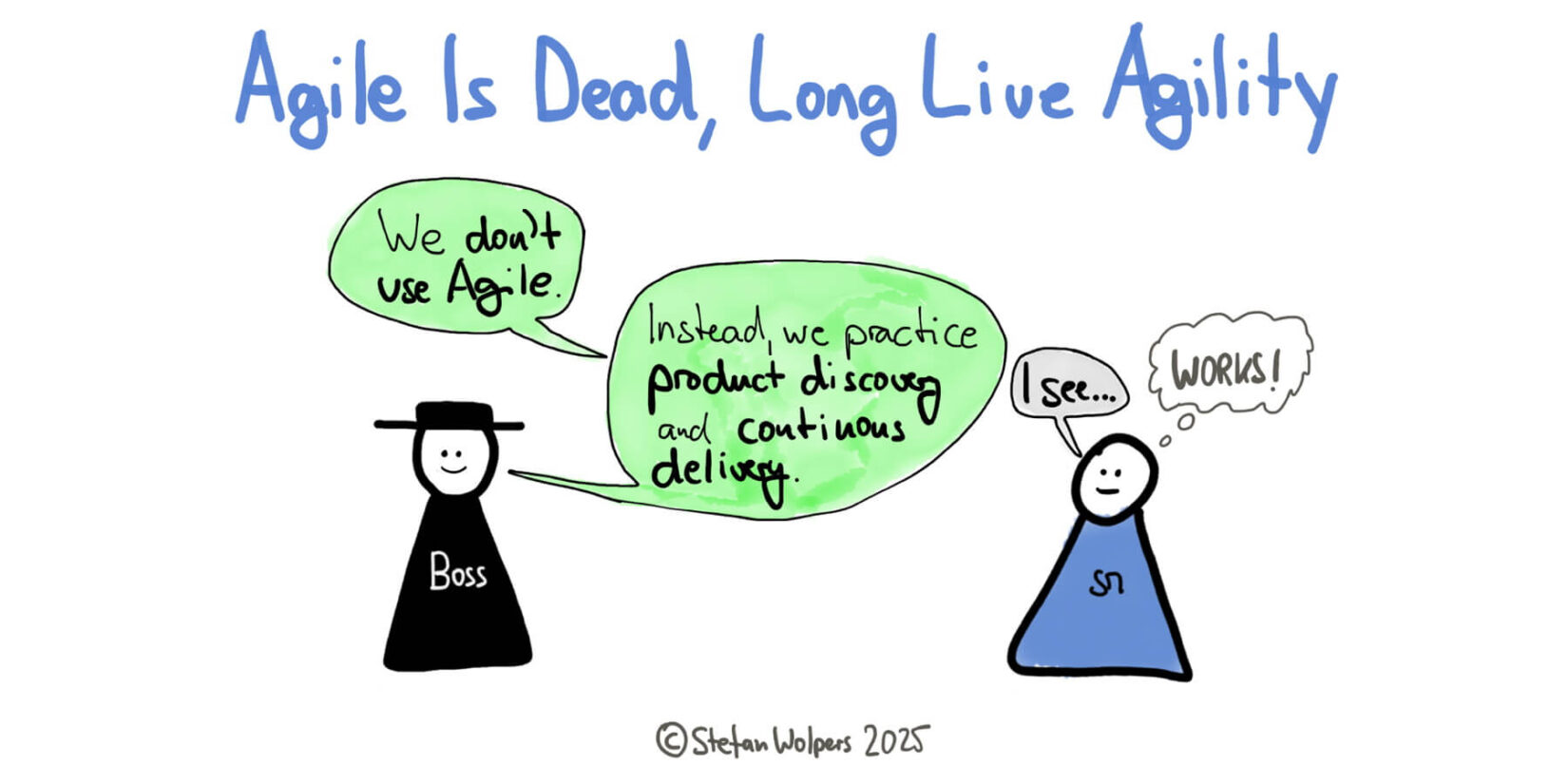
Agile Is Dead, Long Live Agility

TL; DR: Why the Brand Failed While the Ideas Won

Your LinkedIn feed is full of it: Agile is dead. They’re right. And, at the same time, they’re entirely wrong.

The word is dead. The brand is almost toxic in many circles; check the usual subreddits. But the principles? They’re spreading faster than ever. They just dropped the name that became synonymous with consultants, certifications, transformation failures, and the enforcement of rituals.

You all know organizations that loudly rejected “Agile” and now quietly practice its core ideas more effectively than any companies running certified transformation programs. The brand failed. The ideas won.

So why are we still fighting about the label?

Agile Is Dead, Long Live Agility: Why the Brand Failed While the Ideas Won — by Stefan Wolpers of Age-of-Product.com.
Continue reading Agile Is Dead, Long Live Agility

Food for Agile Thought #522: Quo Vadis, AI? POM & Stakeholders, Why Transformations Die, Tech Debt Elephant

TL; DR: Quo Vadis, AI? — Food for Agile Thought #522

Welcome to the 522nd edition of the Food for Agile Thought newsletter, shared with 35,812 peers. This week, Gary Marcus questions the viability of large language models, citing unresolved flaws such as hallucinations and weak reasoning — Quo Vadis AI? Teresa Torres and Petra Wille reflect on AI’s role in user interviews, warning that tech cannot replace skilled human insight, while Peter Yang sees the PM role in AI-native firms shifting toward builders who align quickly. Also, OpenRouter’s massive token data analysis reveals rising agentic use and open models, and Willem-Jan Ageling dissects why many corporate transformations still stall.

Next, Dave Baines urges product managers to stop hiding technical work and instead align it through transparency and joint prioritization. Chris Jones and Marty Cagan remind stakeholders that their job is not to demand features but to enable outcome-driven problem solving. Saffron Huang’s team finds Claude changes engineering workflows at Anthropic and raises career questions. Also, Teresa Torres shares 50 AI use cases from her own process, and Eric Barker recommends strategy over emotion when dealing with difficult coworkers.

Then, Jing Hu questions the true ROI of AI investments, citing McKinsey data showing limited gains and weak agent adoption. Mike Brock calls AGI from LLMs a flawed idea dressed as progress. Mike Fisher warns that chasing velocity without slack leads to chaos, Martin Eriksson urges teams to simplify decisions through focus and consent, and Andi Roberts challenges Tuckman’s model. Finally, John Cutler explains why tools fail when they don’t tackle underlying behavioral constraints.

Food for Agile Thought #522: Quo Vadis, AI? POM & Stakeholders, Why Transformations Die, Tech Debt Elephant - Age-of-Product.com
Continue reading Food for Agile Thought #522: Quo Vadis, AI? POM & Stakeholders, Why Transformations Die, Tech Debt Elephant

From Mechanical Ceremonies to Agile Conversations

TL; DR: Mechanical Ceremonies to Meaningful Events

Your Agile events aren’t failing because people lack training. They’re failing because your organization adopted the rituals while rejecting the transparency, trust, and adaptation that make them work. And often, the dysfunction of mechanical ceremonies isn’t a bug. It’s a feature.

From Mechanical Ceremonies to Agile Conversations: Why Failure Is Not Always a Bug, But a Feature — Age-of-Product.com
Continue reading From Mechanical Ceremonies to Agile Conversations

Food for Agile Thought #521: Critical Thinking & AI, Future of Product Managers, Product Discovery Map, 18. State of Agile Report

TL; DR: Critical Thinking & AI — Food for Agile Thought #521

Welcome to the 521st edition of the Food for Agile Thought newsletter, shared with 35,803 peers. This week, Addy Osmani challenges engineers to sharpen critical thinking using a structured questioning approach to stay focused in AI-enhanced workflows. David Pereira cautions product managers against chasing AI tools at the expense of core skills like decision-making and alignment, and Martin Casado shares hard lessons from building new markets, from pricing mistakes to scaling traps. Grant Harvey recaps Ilya Sutskever’s view that scaling has peaked. Meanwhile, the 18th State of Agile Report signals a return to outcome-driven agility.

Next, Itamar Gilad outlines four product discovery models that balance control, creativity, and evidence, while Teresa Torres and Petra Wille explore how emotional recovery supports resilience in product teams. Simon Willison evaluates Claude Opus 4.5, noting its strength but also the blurring lines between top models. Johanna Rothman links flow metrics to culture change through storytelling, and Andi Roberts presents a hands-on framework to help teams align mindset, mechanics, and routines for better performance.

Then, Stuart Williams explains how AI shifts critical thinking toward context and judgment. Zvi Mowshowitz critiques Gemini 3 Pro’s confident errors. Allan Kelly says Agile evolves beyond hype, John Cutler explores cognitive style clashes in teams, and William Hudson warns against mixing up personas. Finally, Laura Tacho rejects activity metrics and proposes an outcome-focused framework for evaluating developer performance.

Food for Agile Thought #521: Critical Thinking & AI, Product Manager Future, Product Discovery Map, State of Agile Report—Age-of-Product.com
Continue reading Food for Agile Thought #521: Critical Thinking & AI, Future of Product Managers, Product Discovery Map, 18. State of Agile Report

Food for Agile Thought #520: Psychology of Bad Decisions, Building Lovable Products, Shadow Structures, AI Eats the World

TL; DR: Psychology of Bad Decisions — Food for Agile Thought #520

Welcome to the 520th edition of the Food for Agile Thought newsletter, shared with 40,332 peers. This week, Shane Parrish explores Charlie Munger’s take on the psychology of bad decisions, revealing mental pitfalls that sabotage judgment. Teresa Torres distills how AI product teams earn trust and learn faster by narrowing focus and embracing uncertainty. Lenny Rachitsky talks with Stewart Butterfield about building useful products without falling for the founder’s ego, and Jim Highsmith warns that alignment fails without accountability. Also, Christina draws a clear line between tracking performance and setting meaningful, time-bound goals.

Next, Dean Peters presents AI workflows that help PMs stress-test ideas faster and reveal shallow thinking, while Ethan Mollick explains how Gemini 3 behaves like a junior teammate, not just a chatbot. Benedict Evans positions AI as a platform shift, still searching for business models. Maik Seyfert shows how informal shadow systems drive real decisions, and Laura Klein breaks down the costly myths behind skipping user research and the cultural blocks that enable them.

Last, Jenn Spykerman shares tactics for surviving AI chaos when leadership checks out, including spotting failure early and scoping for safety. Gergely Orosz talks with Martin Fowler about how AI reshapes coding while core engineering still holds firm, and Brian Balfour shows how AI prototyping slashes costs and accelerates product alignment. Then, Maarten Dalmijn warns against premature complexity in architecture. Finally, Max Woolf explores Nano Banana’s edge in precise image generation despite style transfer issues and IP risks.

Food for Agile Thought #520: Psychology of Bad Decisions; Building Lovable Products, Shadow Structures — Age-of-Product.com
Continue reading Food for Agile Thought #520: Psychology of Bad Decisions, Building Lovable Products, Shadow Structures, AI Eats the World