Food for Agile Thought’s issue #167—shared with 20,039 peers—focuses on twelve agile transformation phases, why agility is nowadays more important than ever—ScrumAlliance just published a new report based on a survey among enterprise organizations—, and what managers need to embrace to become servant-leaders.
We also learn that growth is good from a product perspective but not at all costs, and what you can do to mitigate risk. We listen to the VP of Product of Medium confirming the importance of getting out of the office, and we reflect on the implications of the sales folks running the product strategy.
Lastly, we visit a Dutch company that proves the obsolescence of the industrial paradigm in the service sector: when the lack of managers is not just improving operations but also the pay-cheques.
Food for Agile Thought’s issue #166—shared with 19,896 peers—focuses on agile transformation challenges: from the agile industrial complex and imposed agile to figuring what problem you are trying to solve to the conditions under which agile teams can flourish.
We also learn what differentiates the Googles and Netflixes of this world from the weak product organizations, what a senior product manager should be capable of handling, and how to avoid common product development pitfalls.
Lastly, we ask: is Holacracy the cure to the malaise that stems from the widespread application of the industrial paradigm or is it just a cult?
by Stefan Wolpers|Agile and ScrumAgile TransitionWebinars
TL;DR: Webinar #7: Scrum Sprint Anti-Patterns
The seventh Hands-on Agile webinar Scrum Sprint Anti-Patterns analyzed 12 ways a Scrum team can improve its effectiveness by avoiding typical sprint anti-patterns. Learn more about gold-plating, delivering Y instead of X, absenteeism, side-gigs, and organizing people instead of the flow of work.
Food for Agile Thought’s issue #165—shared with 19,786 peers—focuses on agile collaboration: from new ways of working in the digital era to classic failure patterns at an enterprise level while transforming to an agile organization. We also learn first hand from a skeptical manager introducing ‘agile’ at mBank.
We dive deep into useful agile metrics, discover how to escape the feature factory mindset, and reconfirm our belief that experimentation is crucial to excelling as a team and organization.
Lastly, we embrace a suggestion on how to incorporate UX and Scrum.
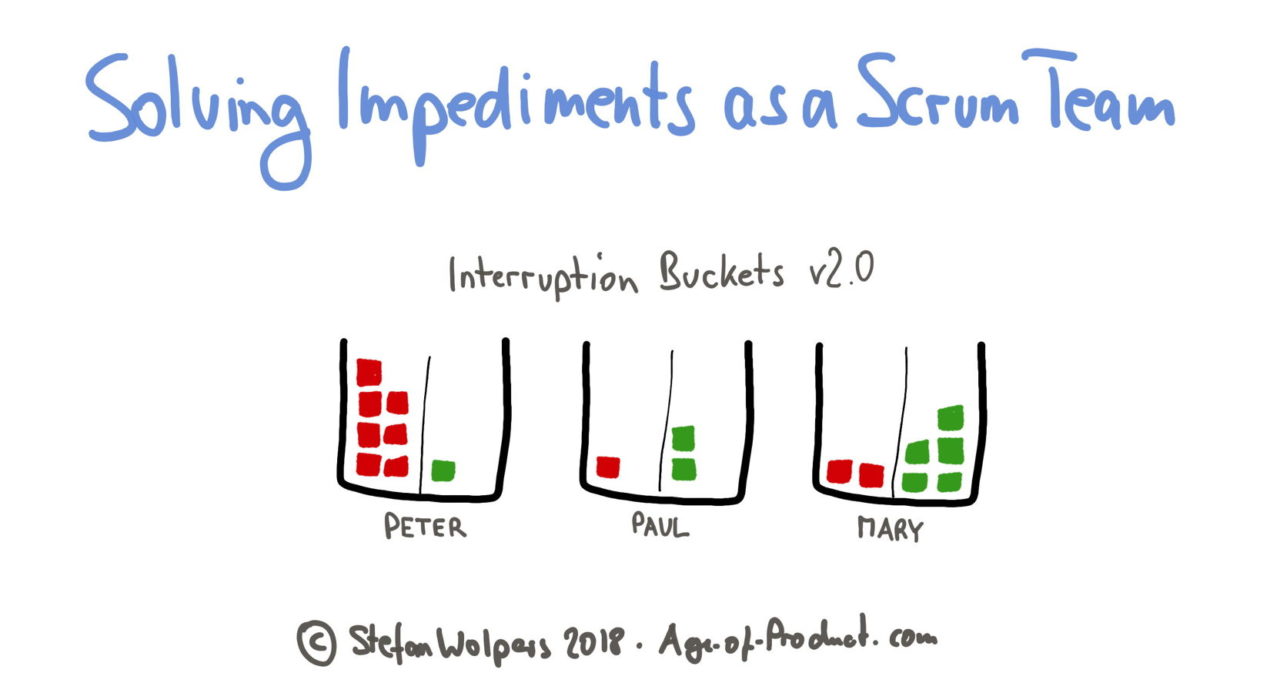
The main message of the retrospective was clear: there are too many interruptions by stakeholders and senior management. The interruptions impeded the flow of work through the team. Consequently, achieving the sprint goal had been at risk several times in the past. Moreover, the team missed the sprint goal twice recently. Solving impediments as a team has become a necessity.
Learn more on how to tackle impediments as a team by running experiments and iterating on the solution.
Food for Agile Thought’s issue #164—shared with 19,635 peers—focuses on successful behavioral patterns of servant leaders, the reasons why change at an organizational level is so hard, and how to cherry-pick existing agile scaling frameworks from SAFe® to Nexus and LeSS.
We also learn from Trello’s example how to scale a product organization, what path Buffer chose to create their new minimum lovable analytics tool, and that distributed teams do not stand in the way of building excellent products.
Lastly, we follow Dave West when he outlines the five most pressing challenges of agile transformations and how to deal with them.