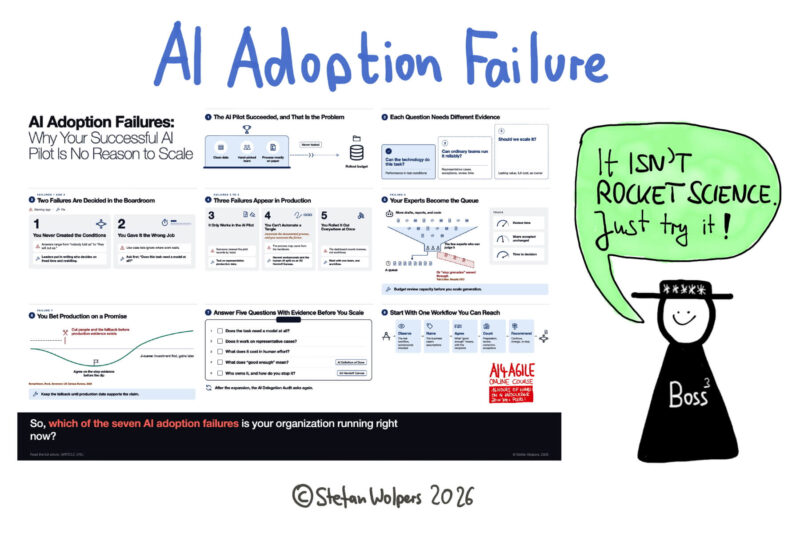
TL;DR: A Successful AI Pilot Proves Nothing
Thesis: This article explains seven AI adoption failures that follow a successful AI pilot, from unready data to overloaded reviewers and premature cuts, and how practitioners set the standard, collect the evidence, and inspect the results before scaling anything.
Your AI pilot worked: the demo impressed the steering committee, the time savings on the slide looked fantastic, and the sponsor is already drafting the rollout budget. However, the AI pilot answered a narrower question than the budget. It showed that the technology can do the task under test conditions, with clean data, a hand-picked team, and a process that mainly exists in the standard operating procedures. Two questions remain open, and nobody has collected evidence for them: whether ordinary teams can run the workflow reliably, and whether expanding beyond the pilot pays off.
Here are seven AI adoption failures that keep recurring in legacy organizations in 2026, each with a warning sign you can check this week, a countermeasure, plus five questions for the scaling decision itself. You do not need to own the budget to use them, because the evidence a scaling decision needs comes from the people closest to the work: they agree on the quality standard, for example, using the AI Definition of Done before the trial, collect the evidence while the workflow runs, and inspect the delegation over time in an AI Delegation Audit. Spoiler alert for the seasoned agile practitioner: If you lived through an Agile transformation, most of the failures will look familiar. History rhymes, and AI, as Agile, is no exception.
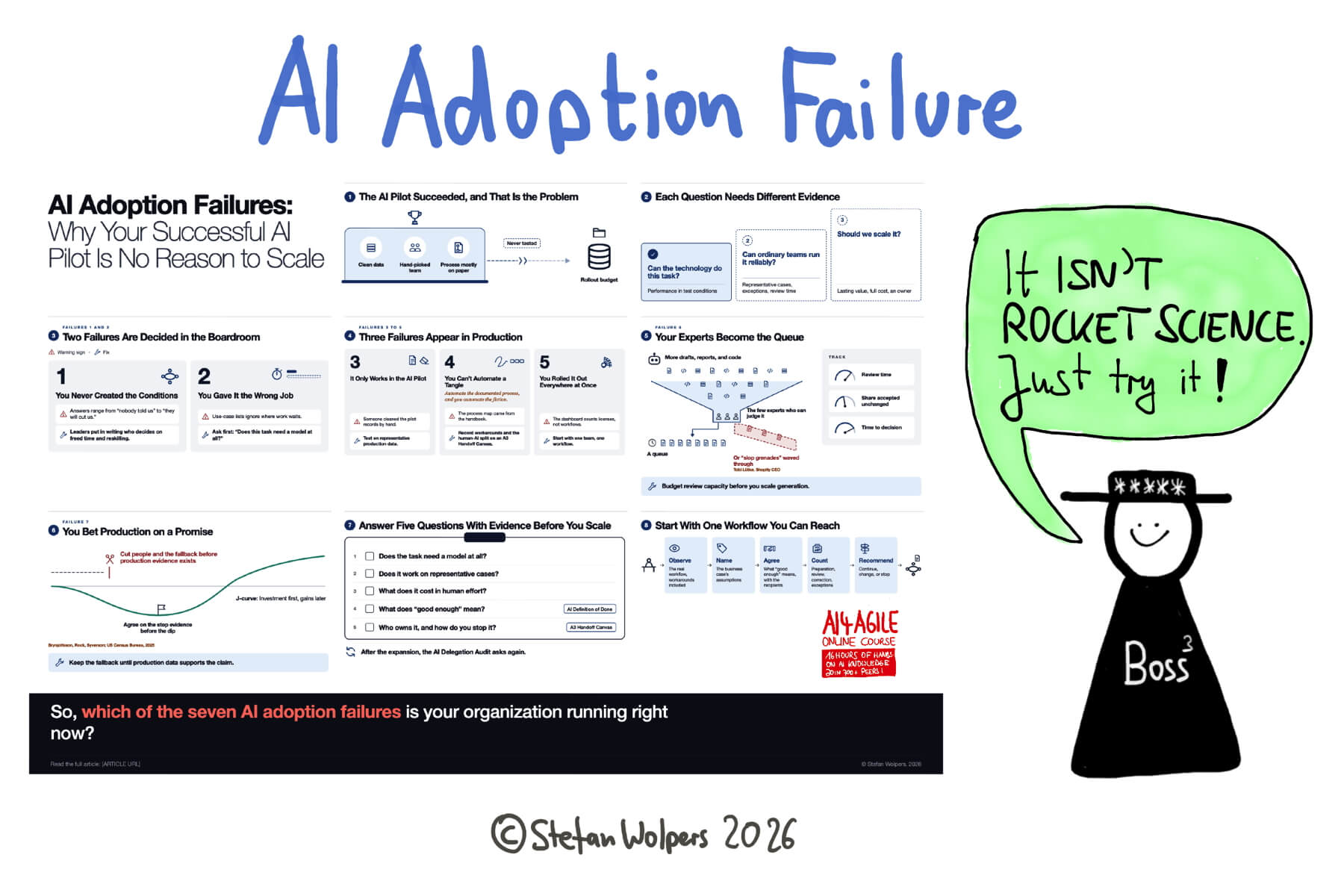
Disclaimer: I read Charniak/McDermott’s book on "Artificial Intelligence" decades ago; of course, I use AI for research, translations, proofreading, challenging story arcs and article structures, creating artifacts such as graphics, and summarization. It is a production tool, not a substitute for thinking.
🎓 🇬🇧 The AI4Agile Online Course v4 — November 27, 2026, at $149 — Join the Waitlist
Sooner or later, a CFO will ask what your AI use actually returns. "It saves me time" will not survive that meeting.
The first wave of AI adoption rewarded practitioners who learned to prompt. That skill still matters, and this course still teaches it. The second wave rewards something rarer: people who can turn individual AI use into knowledge that survives departures, spend that can be explained and steered, and output that organizations can trust. That work is process design and change management. You have been doing both for years, on harder problems than this.
EXCLUSIVE: The new A3 Delegation Lifecycle System with seven ready-to-use templates, from the AI Workflow Inventory to the AI Definition of Done to the AI Working Agreement, to make sense of delegating work to AI models.
BRAND-NEW: Hands-on exercises to build AI Agents, with your tactical work, covering, for example, Jira-based stakeholder reports, product discovery, AI Impact on metrics, or preparation for backlog refinement. All exercises use realistic data and context to simulate reality as closely as possible in a fail-safe environment.
The AI 4 Agile Online Course v4 is in English. 🇬🇧
What You Will Get:
✅ New agent-based exercises: Jira report, product discovery, refinement prep, measuring AI impact ✅ 4 Live onboarding sessions ✅ A cohort-hardened, proven course design ✅ Learn to 10x your effectiveness with AI; your stakeholders will be grateful ✅ Apply AI to classic use cases of “Agile” ✅ The A3 Delegation System comprising seven ready-to-use templates ✅ All texts, slides, prompts, and graphics ✅ Guaranteed: Lifetime access to v4 ✅ AI4Agile Foundation Certificate: 40 questions in 45 minutes.

👉 Please note: The course will be available for $149 from November 27-30, 2026! (After that, $249.) 👈
🎓 Join the Waitlist now and be the first to know: The AI4Agile Online Course v4 — November 27, 2026, at $149 — No Coding Required!
🇩🇪 Zur deutschsprachigen Version des Artikels: KI-Einführungsfehler: Warum Ihr erfolgreiches KI-Pilotprojekt kein Grund zum Skalieren ist.
🗞 Shall I notify you about articles like this one? Awesome! You can sign up here for the ‘Food for Agile Thought’ newsletter and join 35,000-plus subscribers.
🎓 Join Stefan in one of his upcoming training classes!
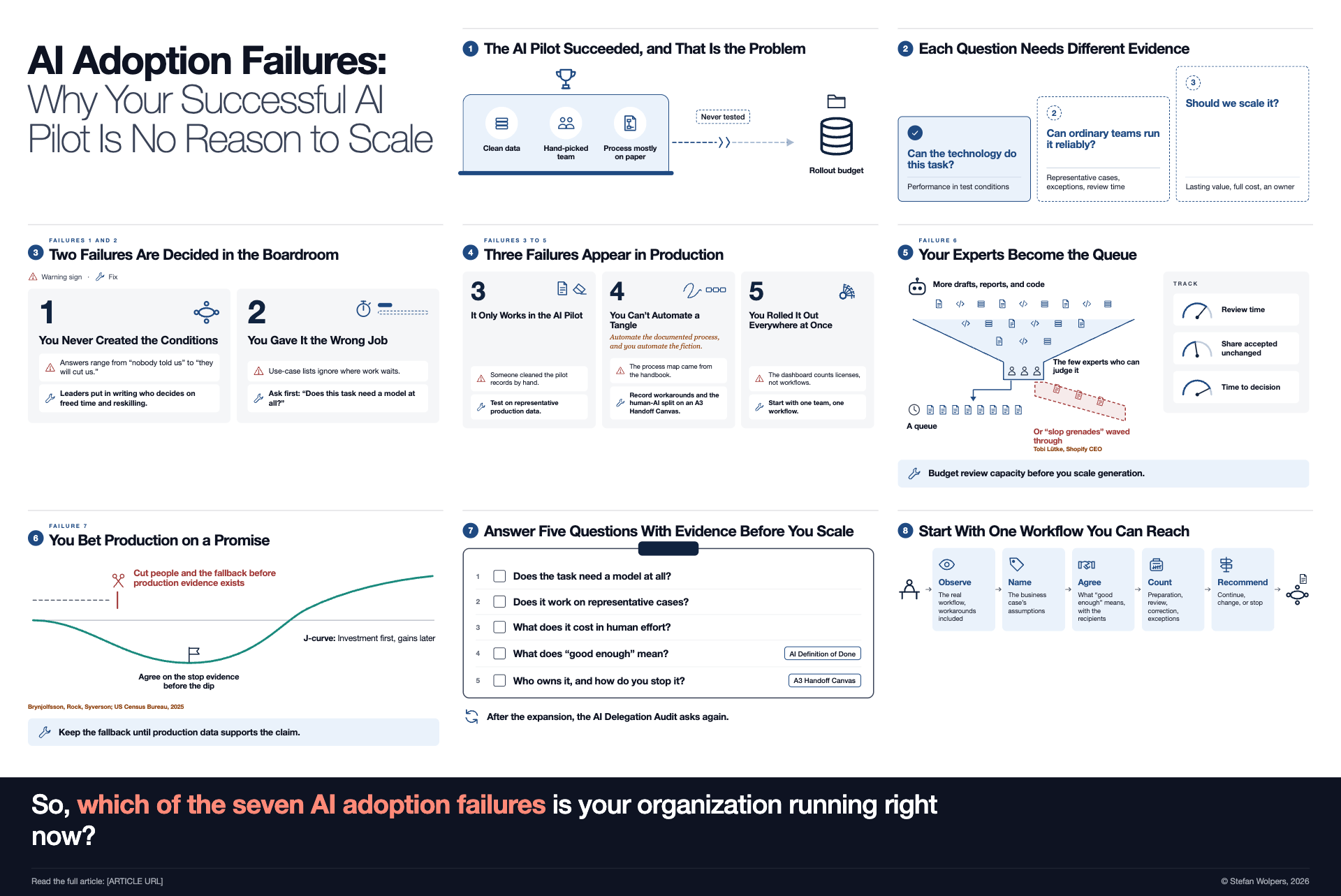
The AI Pilot Succeeded, and That Is the Problem
A small, well-designed AI experiment that fails is cheap: it costs a few weeks, a small budget, and some pride, and it usually teaches the organization something about its data and its processes. A successful pilot, however, can become expensive because it gives the sponsor what looks like evidence for a rollout the pilot never tested. Then, once the rollout begins, the AI meets the organization as it actually runs, and the expected outcome turns into escalations, workarounds, and change requests that nobody put on the original slide.
None of this makes the AI pilot worthless. Testing a narrow technical hypothesis under controlled conditions is legitimate, and curated data and motivated volunteers may be exactly the right setup. The failure happens one step later, when the organization uses the result to answer a question the pilot never asked. There are three questions hidden behind "the AI pilot worked," and each of them needs different evidence:
- Can the technology do this task? Evidence: performance under specified test conditions, which is what a pilot usually delivers.
- Can ordinary teams run this workflow reliably? Evidence: results on representative cases, the exceptions, the support requests, and the time people spend preparing the input and reviewing the output.
- Should we scale the AI pilot? Evidence: value that holds over months, quality the recipients accept, the full operating cost including review, and an accountable owner who can stop the workflow when it fails.
Too many rollout budgets get approved on the answer to the first question alone, resulting in preventable AI Adoption failures. To keep this concrete, I will follow one hypothetical AI pilot through the article (the organization and its numbers are invented): an AI drafts the weekly stakeholder status report from Jira for one product team, the team's product manager reviews each draft, the report goes out in 20 minutes instead of 3 hours, and the sponsor now wants the same for all 40 product teams by next quarter.
In an earlier article on why AI transformations rhyme with Agile transformations, I described the greenfield showcase as one of five patterns the two share. The seven failures below follow once the applause fades, grouped by when they occur.
Your Part When You Do Not Own the Budget
If you are a Scrum Master, Project Manager, Product Owner, Product Manager, or Agile Coach, you probably do not decide about reskilling budgets or the rollout plan. Nevertheless, you sit closer to the evidence than anyone on the steering committee, and you can do five things for one expansion decision:
- Observe how the workflow actually runs, workarounds included.
- Name the assumptions the business case takes for granted.
- Agree with the recipients of the output on what "good enough" means.
- Count the preparation, review, correction, and exception handling the output requires.
- Recommend continuing, changing, or stopping, with the evidence behind it.
None of this gives you authority over employment policy. However, it puts something better than the pilot slide in front of the people who have that authority and will help to avoid AI Adoption failures.
Cannot see the form? Please click here.
Before You Start: Two AI Adoption Failures Decided in the Boardroom
1. You Never Created the Conditions
Classic change management applies to AI adoption as much as it applied to every reorganization before it: people need to understand what is in it for them personally, and they need to believe the answer. Too often, the official message about AI is a license announcement on the intranet, while the unofficial message, the one people hear at the coffee machine, is that AI exists to reduce headcount. People act on the second message, and it is hard to blame them for it.
If you want subject matter experts to share how the work really gets done (see failure 4), they need to hear, explicitly and from someone with authority, that the organization values their knowledge and expects AI to multiply what they can do with it. Nobody becomes AI-native by licensing Copilot, and creating the environment for lasting change is, as so often, primarily a people and culture effort.
The counter-example everyone seems to cite these days comes from Ingka Group, the franchisee that runs most IKEA stores. According to Fortune's July 2026 report, Ingka introduced its customer service bot Billie in 2021 and retrained the roughly 8,500 call center employees whose routine work the bot took over, instead of laying them off. Their remote sales channel generated €1.25 billion in the last fiscal year. Investing in the people did not rule out early savings, either: Ingka's own 2023 account puts Billie's savings at nearly €13 million. (The hundreds of corporate roles Ingka and Inter IKEA cut in spring 2026 were, according to Fortune, neither in the remote sales centers nor attributed to AI.) My reading of the case is that the visible decision to keep the call center employees is what made the rest work.
The warning sign: Ask five people outside the AI steering committee what the AI initiative means for their job. If the answers range from "nobody told us" to "they will cut us," the trust problem is unresolved, whatever the license report says.
What to do instead: This countermeasure has two parts with different owners. Leadership must commit, in writing, to what happens to the time AI frees up, who decides about it, and how much reskilling the organization will fund before the first workflow changes. From inside the team, you can ask those five people yourself, take their answers to the sponsor unedited, and give your subject matter experts a role worth wanting: they decide whether the AI's output is good enough, which is exactly what an AI Definition of Done writes down.
2. You Gave It the Wrong Job
The second failure begins with a list of use cases compiled by asking "Where can we use AI?" instead of "Where does our work wait, break, or get redone?" The answers then point AI at the wrong job in two ways.
The first kind of wrong job needs no model at all: a weekly report that a spreadsheet formula could assemble, or a routing decision that a simple rule could make. A language model does such tasks less reliably and at a recurring cost. The question I now ask before the A3 Framework's three categories, Assist, Automate, and Avoid, is: "Does this task need a model at all?" If a rule, a script, or a feature of a deterministic system you already use can do it reliably, it is not an AI task. In the status report example, counting tickets per status and listing what moved since last week are jobs for a Jira filter or dashboard; the model earns its place only in the part that needs interpretation, such as explaining what the numbers mean for the stakeholder's next decision.
The second kind of wrong job is a step that is not the bottleneck. If drafting a proposal takes 2 hours and its approval takes 3 weeks, an AI that drafts in 10 minutes saves time you can measure, yet it barely changes the lead time the customer experiences. Agile practitioners know this from flow metrics: accelerating a step that is not the constraint does little for the whole system.
The warning sign: Your list of AI use cases has no column for where work waits, and nobody asked whether a simpler, deterministic solution exists.
What to do instead: Map one value stream from request to delivery, find where the work waits longest, and ask of each candidate step whether it needs an AI model at all, before anyone discusses which model.
From Pilot to Production: Three AI Adoption Failures in the Trenches
3. It Only Works in the AI Pilot
The pilot's data was usually prepared for the AI pilot: someone picked a clean extract, removed duplicates, filled in missing fields, and decided which of three customer records was the real one. Production data comes without that service, often from several "sources of truth" that may contradict each other. The hypothetical pilot team closed its stale tickets and added the missing estimates before the first run, while the boards of the other 39 teams still carry tickets nobody has touched for a year and statuses that contradict the comments.
In February 2025, Gartner put the condition plainly: according to analyst Roxane Edjlali, AI-ready data must be "representative of the use case," including its errors and outliers. A carefully built evaluation set can be representative by design, so curation, as such, is not the problem. The problem is a data set someone cleaned so that the pilot would succeed, combined with a business case that assumes nobody will ever have to do that cleaning again.
The warning sign: Ask who prepared the pilot's data and how long it took. If the answer involves a person cleaning records by hand, find out which part was a one-time cleanup and which part recurs every week. The recurring part needs a person in production, too, and the business case probably does not include them.
What to do instead: Test the workflow on a representative sample from the production system, messy cases and important exceptions included, in an environment your data protection and security people have approved. (Pushing a raw production extract full of customer records into an AI pilot tool can create a compliance problem of its own.) Then count how many cases need a human to repair the input first, because that number belongs in the business case.
4. You Can't Automate a Tangle
Behind the process documentation of every legacy organization sits a second organization that actually keeps the work alive. Its members know whom to call when a shipment is stuck, how to work around a standard operating procedure that no longer describes reality and stands between the customer and the value, and when to simply ignore a rule to get things done. None of this is written down, which is one reason why it works, and also why nobody outside the team sees it.
When you automate the documented process, you automate the fiction. The AI works from the standard operating procedure, and it may misread that procedure or depart from it in ways nobody anticipated. Meanwhile, the human workarounds drop out of the loop, and exceptions that used to be resolved with a phone call turn into escalations. Back in the status report pilot, the team's experienced product person knew that "In Review" on her board means "waiting for the vendor," and she corrected every draft accordingly before sending it. Nobody counted those corrections, and none of the other 39 teams has her. To make matters worse, the people who know the workarounds are often the same people who fear for their jobs (see failure 1), so they have little reason to volunteer what they know.
The warning sign: Nobody on the AI project has spent a day with the people who do the work, and the process map came from the quality management handbook.
What to do instead: Sit with the people who do the work and ask, "What do you do when this step fails?" For the workflow you want to delegate, and only for that one, write down the workarounds and handoffs, then decide which exceptions to keep, which to remove, and which to leave with people. That takes a few hours with the team instead of a process redesign program, and the result is the task split between human and AI that an A3 Handoff Canvas records before an agent takes over any work.
5. You Rolled It Out Everywhere at Once
Giving everyone a license so that people can try things can be a reasonable decision. It turns into a failure when the organization treats that access as the rollout of a workflow it now depends on: it licenses Copilot for everyone, publishes a prompt guide on the intranet, and calls it a day. The Agile version of this pattern was the mandate from above combined with training treated as optional. The AI version adds a twist, however: the tool works well enough on individual tasks that the license report looks like success. For the status report, the big-bang version is 40 teams switching on the same Monday, with a prompt guide and no AI Definition of Done, so each team decides for itself what "checked" means.
I have to include myself here. When I ran the founding workshop for my A3 Delegation System with practitioners in September 2026, their feedback was that the complete system overwhelmed them, and everyone took a rather cavalier approach to the preparation material. If motivated volunteers in a workshop feel that way, an organization-wide rollout with a license and an intranet page faces worse odds. I drew my own conclusions: the next workshop runs as three sessions instead of two long days, and in short formats, I now start with 2+2 templates instead of the whole system.
The warning sign: Your rollout dashboard reports licenses activated and prompts sent, and it has no line for a workflow that changed.
What to do instead: Start with one team and one workflow, support it with real training and someone to call when things break, and add the next team when the first one can explain what changed in its work, what it stopped doing, and what the change costs in review time.
Once It Runs: Two AI Adoption Failures That Show Up in the Numbers
6. Your Experts Become the Queue
AI on top of a dysfunctional operation accelerates the dysfunction, as I argued for Product Backlog management in AI on Top of a Dysfunctional System, and in most organizations, the acceleration shows up first in review capacity.
The visible symptom is a sharp rise in the volume of artifacts: more drafts, reports, specifications, code, and slide decks than ever before. However, decisions do not happen any faster, because the bottleneck has moved to judgment, meaning the few people who understand the business well enough to check the AI's output for quality and compliance. They now review far more than before, on top of their regular work, and they either become a queue, which cancels the speed gain, or start waving things through, which hands the risk to your customers and your compliance function. (Remember Tobi Lütke's "slop grenades"?) For the status report AI pilot, this means that 40 AI-drafted reports a week land with the same three people in the PMO who know which numbers the board will question. At the same time, the stakeholders receive more reports than ever without deciding anything sooner.
Three numbers tell you which way it goes: the review time per output, the share of outputs accepted without changes, and the time from output to decision. The break-even test I described in Measuring AI Impact uses the first two, and its simple form rests on two assumptions: a failed output means doing the task by hand, and every minute people spend on the workflow counts, including prompting and preparation. In short, compare the total human effort with and without AI at the quality the recipients accept. A high acceptance rate is good news, though, only as long as someone still spends real time on the review, which is what the creep check of the AI Delegation Audit watches.
The warning sign: The volume of AI-generated artifacts rises, decisions do not get faster, and the same handful of experts appear as reviewers on everything.
What to do instead: Budget review capacity before you scale generation, and protect your experts' time accordingly. Track the review time per output and the time to decision next to the volume, and treat every hiccup as a diagnosis of the underlying process before you speed it up any further.
7. You Bet Production on a Promise
The last failure is probably the hardest to undo. The organization treats the AI pilot's result as a promise about production and then cuts headcount, retires the old process, or stops maintaining the fallback before production evidence exists. It often starts with the job description the sponsor gave the AI in the first place: delivering a cost saving by a budget deadline, before the workflow has shown that saving under production conditions and at its full cost.
Erik Brynjolfsson, Daniel Rock, and Chad Syverson described the productivity J-curve at the level of national statistics: general purpose technologies require large, mostly intangible investments in new processes, skills, and business models, so measured productivity can look worse at first and better only later. A 2025 Census Bureau working paper by Kristina McElheran, Brynjolfsson, and colleagues found a similar shape inside firms: American manufacturers that adopted industrial AI saw short-term losses, concentrated among older businesses, while earlier adopters that survived grew faster over time. Among older plants, abandoning structured production-management practices accounted for roughly a third of the losses. Although the data covers industrial AI from 2017 to 2021, and dropping management practices is not the same as retiring a manual fallback, the analogy to a legacy organization that retires its old process too early is so close that you cannot ignore it.
The dip, however, does not permit keeping a failing initiative alive indefinitely, which is why the evidence that would end it has to be agreed on before the dip starts. And in the status report pilot, the analyst who used to compile the reports by hand moves to another team, and three months later, when the AI's figures start to drift, nobody remembers how the reports were built, or who checks them when the responsible product person is on vacation.
The warning sign: The business case shows payback within the budget year, and the old process, or the people who ran it, are already gone.
What to do instead: Keep the fallback alive until production data, not AI pilot data, supports the claim. Name who checks the output when the usual reviewer is absent, and agree in advance what evidence at month six would tell you that you are in the dip and not at a dead end, including the result that makes you stop.
Before You Expand or How to Avoid AI Adoption Failures: Five Questions for One Workflow
The seven countermeasures come together in one decision: whether to scale a single workflow. Before you take that decision to the steering committee, check whether you can answer the following five questions with evidence, each of which already has a place in the A3 Delegation System:
- Does the task need a model at all, and what should improve? Name the baseline and the improvement you expect, so that "more output" cannot quietly become the success criterion; this is the question I now ask before the A3 Framework's three categories.
- Does it work on representative cases? Show results on a sample that includes the messy cases and the important exceptions.
- What does it cost in human effort? Count preparation, prompting, review, correction, and support, and compare the total with the effort without AI.
- What does "good enough" mean? An AI Definition of Done, agreed with the recipients, makes the quality standard inspectable: which claims get checked, by whom, and against which source.
- Who owns it, and how do you stop it? The "Validation" and "Failure response" fields of the A3 Handoff Canvas name who checks the output, what the fallback is, what the stop rule says, and who owns escalation.
After the expansion, the AI Delegation Audit asks the same questions again, monthly or every other Sprint, because a workflow that passed once can drift: the inputs change, the model changes, and review time falls toward zero without anyone deciding so.
What This Looks Like in Practice: An Extract From the Course
The AI4Agile Online Course v4 includes a Jira Status Report Exercise that turns this article's running example into practice, set at MegaBrain.io, the fictional startup the course uses as its teaching case: a Jira export with 296 tickets across 58 columns, six findings planted in the data, and a CTO who needs a report he can defend in front of the founders. Before touching the AI, the student writes an AI Definition of Done for the task class "Status report for the CTO from a Jira export." Here is a condensed extract from my solution:
- Verification level: I trace every figure and every claim that would change the CTO's decision back to the export, record the assumption behind each one, and label what the export cannot support.
- Provenance disclosure: AI-assisted, with a closing line that names the assistant, the export, who checked the figures, and when.
- Sufficiency tier: A model that runs code on the uploaded file, because counting 296 rows is calculation. A mid-tier model is my starting tier for this exercise, and it stays only as long as its reports pass this standard.
When I tested the exercise in October 2026, three runs on ChatGPT and Claude all produced correct figures, and yet the drafts disagreed on the capacity assumption that decided the answer and on what to recommend. Correct arithmetic, therefore, settles only part of the check: the student still has to examine the assumption that connects the figures to the recommendation, which is why the AI Definition of Done asks for the assumption behind every figure, and why the student writes it before the first run.
AI Adoption Failures – Conclusion: Start With One Workflow You Can Reach
The seven failures feed each other: missing trust keeps the workarounds hidden, hidden workarounds and prepared data make the pilot unrepresentative, and an unrepresentative pilot justifies the big-bang rollout and the bet on a promise. Fixing the trust problem of a whole organization is rarely in your hands. However, you can start with one workflow you use or support, sit with the people who run it, write the AI Definition of Done together with the recipients of its output, and count the review time. When an expansion decision comes up, with or without a steering committee asking you, your answers to the five questions are ready.
If you want to practice this work on a realistic case before you try it in your own organization, join the waitlist for the AI4Agile Online Course v4, which launches on November 27, 2026. Its new chapter of practical applications lets you check an AI-drafted status report against the Jira export with an AI Definition of Done, test whether delegated workflows break even, and run the AI Delegation Audit's four checks, all on the MegaBrain.io case. The launch price is $149 from November 27 to 30, 2026. Outside that window, the regular price is $249.
So, which of the seven AI adoption failures is your organization running right now?
Key Questions This Article on AI Adoption Failures Answers
Why Do Successful AI Pilots Fail in Production?
A successful AI pilot usually shows that the technology can do a task under test conditions: prepared data, a motivated team, and a documented process. Production raises two further questions, whether ordinary teams can run the workflow reliably and whether expanding it pays off. Those require different evidence: representative cases, including exceptions; the human effort for preparation and review; an agreed quality standard; and an accountable owner with a fallback.
How Can an Organization Tell Whether Its Data Is Ready for AI?
Data is ready for AI when it represents the actual use case, including its errors, outliers, and exceptions, as Gartner analyst Roxane Edjlali puts it. A practical test is to run the AI on a representative sample from the production system, in an approved environment, and count how many cases need a human to repair the input first, separating one-time cleanup from preparation work that recurs every week.
Why Does Scaling AI Output Overload the Experts Who Review It?
When AI multiplies the volume of drafts, reports, specifications, and code, the capacity to judge that output stays flat. The bottleneck moves to the few experts who understand the business well enough to check quality and compliance, and they either become a queue or start waving work through. Teams should budget review capacity before they scale generation and track review time per output and the time to decision to avoid classic AI Adoption failures.
What Is the Productivity J-Curve, and What Does It Mean for AI Adoption?
The productivity J-curve, described by Erik Brynjolfsson, Daniel Rock, and Chad Syverson, explains why general purpose technologies such as AI can first depress measured productivity: organizations must invest in new processes, skills, and business models before the gains appear. A 2025 Census Bureau study found a similar pattern among manufacturers adopting industrial AI, concentrated in older businesses. Cutting staff or retiring the fallback before production evidence arrives can turn a temporary dip into a lasting failure.
What Evidence Should a Team Have Before Expanding an AI Workflow?
Before expanding, a team should be able to show the baseline and the intended improvement, results on representative cases and important exceptions, the total human effort including preparation, prompting, review, and correction, an agreed quality standard such as an AI Definition of Done, and an owner with a fallback and a stop rule, as recorded on an A3 Handoff Canvas. After the expansion, an AI Delegation Audit re-checks the workflow monthly or every other period.
AI Adoption Failures — Related Posts
We're Not Paid to Practice Scrum, but Answer 5 Product Questions
Measuring AI Impact: What Your Velocity Chart Cannot Tell the CFO
AI-Assisted Refinement Preparation
AI-Assisted Product Discovery: When Code Is Cheap, Judgment Is the Job
AI Transformations And Agile Transformations Rhyme
The A3 Handoff Canvas: Six Questions That Turn AI Delegation Into a Repeatable Workflow
The A3 Framework: Assist, Automate, Avoid — A Decision System for AI Delegation

👆 Stefan Wolpers: The Scrum Anti-Patterns Guide (Amazon advertisement.)
📅 Training Classes, Workshops, and Events
Learn more about AI Adoption failures with our AI and Scrum training classes, workshops, and events. You can secure your seat directly by following the corresponding link in the table below:
| Date | Class and Language | City | Price |
|---|---|---|---|
| 🖥 🇬🇧 November 27, 2026 | GUARANTEED: Join 700 Peers for the AI4Agile Online Course v4 at $149 on November 27, 2026 (Ai4Agile Certificate; English; Online Course) | Online Course | $149 incl. 19% VAT (If applicable.) |
| 🖥 🇬🇧 Dec 3-17, 2026 | A3 Delegation System Pilot Workshop 2 (English; Live Virtual Class) | Live Virtual Class | $149 incl. 19% VAT (If applicable.) |
| 🖥 🇩🇪 Dec 8-9, 2026 | Professional Scrum Product Owner Training (PSPO I; German; Live Virtual Class) | Live Virtual Class | €1189 incl. 19% VAT (If applicable.) |
| 🖥 🇬🇧 Dec 15-16, 2026 | Professional Scrum Master – Advanced Training (PSM II; English; Live Virtual Class) | Live Virtual Class | €1189 incl. 19% VAT (If applicable.) |
| 🖥 🇩🇪 Feb 16-17, 2027 | Professional Scrum Product Owner Training (PSPO I; German; Live Virtual Class) | Live Virtual Class | €1189 incl. 19% VAT (If applicable.) |
See all upcoming classes here.

You can book your seat for the training directly by following the corresponding links to the ticket shop. If your organization's procurement process requires a different purchasing approach, please contact Berlin Product People GmbH directly.
✋ Do Not Miss Out and Learn More about AI Adoption Failures — Join the 20,000-plus Strong ‘Hands-on Agile’ Slack Community
I invite you to join the “Hands-on Agile” Slack Community and enjoy the benefits of a fast-growing, vibrant community of agile practitioners from around the world.

If you would like to join, all you have to do now is provide your credentials via this Google form, and I will sign you up. By the way, it’s free.
