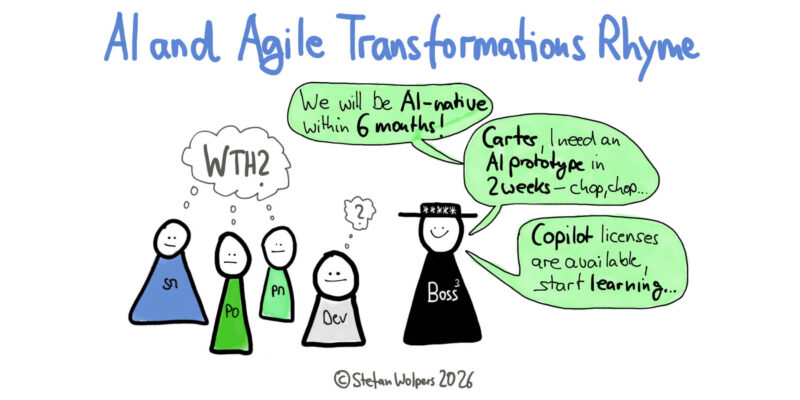
TL;DR: AI Transformations and Agile Transformations Rhyme
AI adoption seems to be scaling: 37% of respondents in McKinsey’s 2026 survey report an EBIT effect from AI, and Gartner finds that 22% of organizations have scaled it across business units. Now, Agile practitioners have seen this combination before, as AI transformations and Agile transformations rhyme. There are five classic failure patterns from the Agile transformation adventures that are back under new names: from mandates from above to licenses mistaken for training to greenfield showcases to parachuted consultants to promised payroll savings dressed up as strategy. They share one condition: organizations make AI decisions at organizational scale without leaving inspectable evidence at the workflow level in the trenches. And for good measure, let us throw in ignoring culture and excluding most of the organization’s people in the process.
The A3 Delegation System is not an AI-transformation method. It is a deliberately low-tech, paper-level discipline that lets a team produce that evidence in hours, and this article spends as much time on where the system stops as on what it does. If you are a Scrum Master, Product Owner or Manager, an Agile Coach, or a Project Manager who has to argue upward about AI, the last section gives you one thing to do this week.
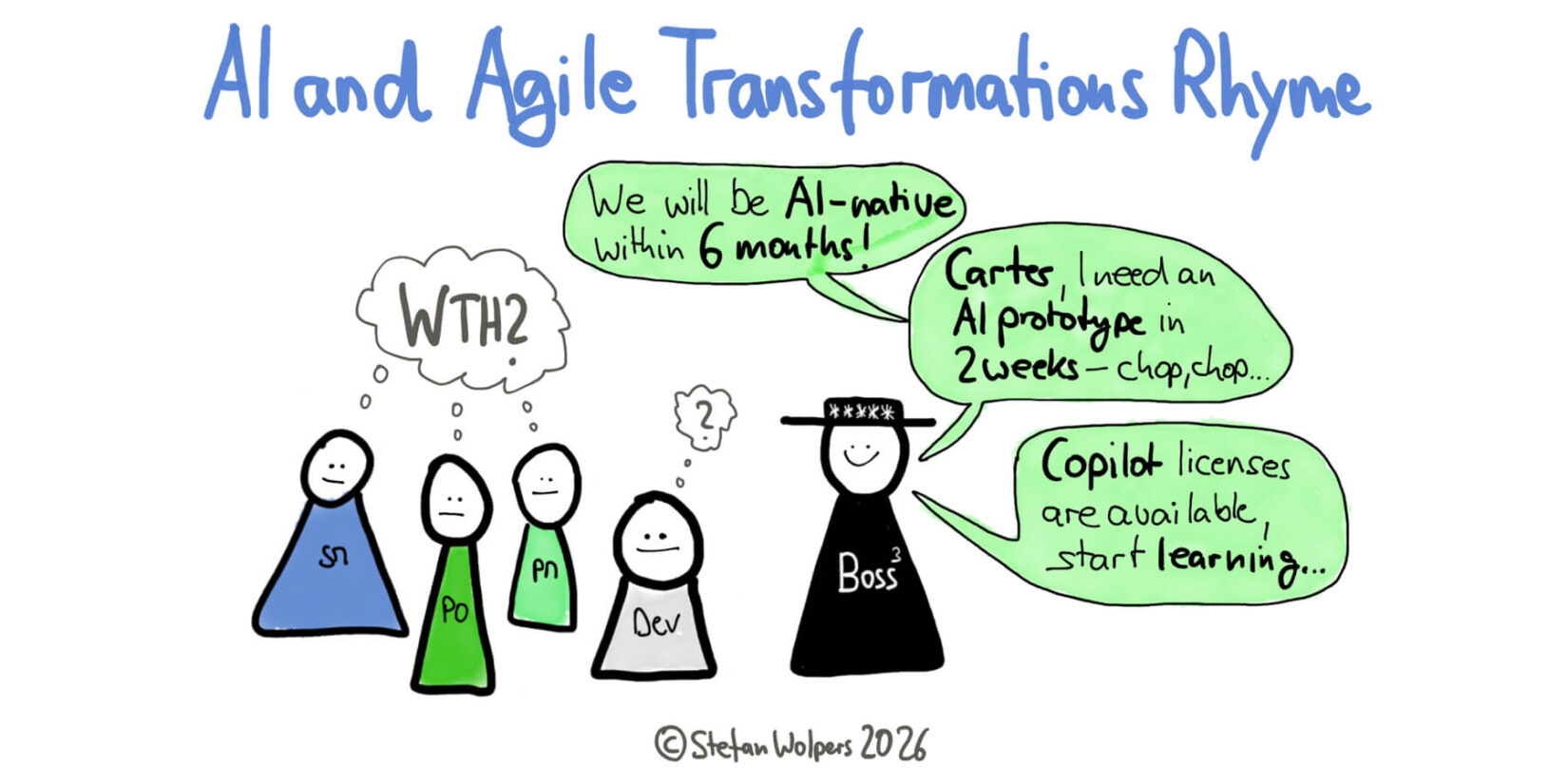
Disclaimer: I am among those who read Charniak/McDermott’s book on “Artificial Intelligence” decades ago; of course, I use AI for research, translations, proofreading, challenging story arcs and article structures, and summarization. It is a production tool, not a substitute for thinking.
🎓 🇬🇧 The A3 Delegation System Founding Workshop to Make Your AI Transformations Work — September 28-29, 2026
Your team already delegates work to AI: reports, research, customer feedback analysis, stakeholder communication, or parts of operational workflows.
But can you answer these questions without improvising?
- What may AI decide, and what must remain a human decision?
- What does “good enough” mean for this particular work?
- Who verifies the result before somebody acts on it?
- Who checks whether the delegation still works after the model or workflow changes?
If those answers live in one person’s head, or nowhere, your problem is no longer prompting. You have a delegation problem.
The A3 Delegation System gives you a practical way to decide what AI may do, hand over the work clearly, define acceptable results, and inspect the delegation over time.
During two hands-on sessions, you will apply the system to a workflow. You will leave with a clear understanding of how to apply the A3 Delegation System to your workflows so that team members or stakeholders can understand, challenge, and continue your AI delegation work. Everything you learn is directly applicable to your situation the next day. The class is in English.

👉 Join the Workshop Now — $199: The A3 Delegation System Founding Workshop — September 28-29, 2026
🗞 Shall I notify you about articles like this one? Awesome! You can sign up here for the ‘Food for Agile Thought’ newsletter and join 35,000-plus subscribers.
🎓 Join Stefan in one of his upcoming training classes!
History Does Not Repeat Itself, but AI Transformations and Agile Transformations Do Rhyme
AI transformations in large organizations are scaling, individual productivity is up, leaders still plan to increase spending, and yet enterprise financial impact remains limited:
- McKinsey's 2026 State of AI survey (1,719 respondents, fieldwork May 4 to June 8, 2026) puts numbers on three of the four: 44 percent of respondents say AI is scaling across their enterprise, up from 38 percent a year earlier; 80 percent of those who use AI report improved individual productivity; and 37 percent attribute any EBIT impact to AI at all, with the "AI high performer" group flat at about 6 percent.
- Gartner's September 2026 survey of 1,303 respondents from organizations with at least $50 million in annual revenue supplies the spending picture: 85 percent of functional leaders plan to increase AI spending in 2026, 22 percent of organizations have scaled AI across multiple business units or adopted an AI-first approach, and 11 percent do not know what their function spent on AI in 2025.
Something is happening, and something is also not translating. Agile practitioners have seen that combination before. "History does not repeat itself, but it rhymes," a line widely attributed to Mark Twain despite no evidence that he said it; the attribution to Twain dates back to 1970. The attribution is shaky; nevertheless, the observation holds.
I wrote the Scrum Anti-Patterns Guide about what organizations do to Agile when they adopt it from the top down. The same organizations are now doing the same things to AI, with a new generation of leaders who consider the Agile years ancient history, and five rhymes stand out.
The Five Rhymes of AI Transformations
Rhyme 1: The Mandate From Above
IBM's June 2026 study of 2,000 C-level technology executives found that 80% reported CEO-driven AI transformation mandates, and 77% said adoption is already outpacing their governance capabilities. The most public example is Shopify. In a late-March 2025 memo that he later posted on X, CEO Tobi Lütke told the company that "reflexive AI usage is now a baseline expectation at Shopify" and that, before asking for more headcount, teams "must demonstrate why they cannot get what they want done using AI," as Tom's Hardware and TechCrunch reported. Whether that works at Shopify I cannot judge from the outside. What I can judge is the predictable risk when that kind of memo lands in an organization where governance is already falling behind: visible compliance and invisible workarounds. Agile practitioners remember the memo announcing "we are now an agile organization" and the Sprint Reviews that followed, which were ignored by everyone who could change a decision.
Cannot see the form? Please click here.
Rhyme 2: The Belief That This Time Training Is Optional
The Agile version bought a two-day certification class and called it a transformation. Often, AI transformations skip even that: buy Copilot or ChatGPT Enterprise licenses, send an email, done. The tool is "intuitive," so the reasoning goes; it is sold as the classic example of learning by applying. Lütke's own memo contradicts this, noting that "using AI well is a skill that needs to be carefully learned." The McKinsey gap between 80% reporting individual productivity gains and 37% reporting any EBIT impact shows why individual productivity is a poor proxy for organizational change. Individuals may get more productive, whatever that means in this context, which does not imply that the organization has changed at the same time. The same survey shows where the difference lies: nearly three-quarters of high performers report fundamentally redesigning workflows because of AI, against one-quarter of everyone else. Deloitte's June 2026 pulse check of nearly 3,700 professionals found that 48% were adding AI without redesigning workflows or roles, and only 12% were redesigning workflows or roles at scale. The divide runs between organizations that change the nature of work and those that bolt AI onto whatever structure they have.
Rhyme 3: The Greenfield Showcase
Every transformation needs a success story for the board, so a team with no dependencies on the legacy systems, no regulatory exposure, and no operational duty builds something impressive. The Agile version was the "pilot team" in the innovation lab with the fancy toys. The AI version is the internal chatbot that answers HR policy questions and was presented at the town hall as evidence of AI's great potential. Exploration detached from production constraints is useful. The anti-pattern is mistaking evidence that something can be built for evidence that the organization has created value. BCG's 2025 survey of 1,250 senior executives found that 70% of AI's potential value sits in core business functions such as sales and marketing, manufacturing, supply chain, and pricing, which is where the showcase usually never goes, due to the "unsexiness" of the use cases.
Rhyme 4: The Consultancy That Sets It Up for You
In come the slide decks, the "AI transformation office," and the currently fashionable forward-deployed engineers. The role name dates back to Palantir in the early 2010s; the practice is far older. Thomas Otter, who spent years at SAP, notes that "early chunks of SAP R/1 was built at ICI and John Deere," decades before anyone called the practice forward deployment. I do not consider the practice an anti-pattern. Engineers who join the organization, learn its culture, and stay long enough to hand over applications built on understanding are legitimate. The anti-pattern is the parachute version: the engineers arrive, do the tactical technical work, and leave, and the organization is now running systems it cannot explain. Agile had the consultancy-staffed transformation office that left when the budget line ended.
Rhyme 5: The Cost Story
Ask most leadership teams why the organization adopts AI, and you get a story about new business, better products, and faster learning. Ask what the business case they signed off actually contains, and you find payroll. Consultancies, in my observation, sell AI as they sold offshoring: a way to remove people who do repetitive work. Cost reduction, as such, is not the anti-pattern; however, turning it into the transformation objective is. About 80% of McKinsey's high performers, and everyone else, pursue efficiency, but most high performers also pursue growth or innovation, thereby distinguishing the two approaches. Klarna ran the other experiment in public. After claiming its AI assistant did the work of 700 customer service agents, CEO Sebastian Siemiatkowski told Bloomberg in May 2025, as CX Dive reported, that "cost unfortunately seems to have been a too predominant evaluation factor when organizing this; what you end up having is lower quality," and started hiring humans again. McKinsey's respondents have noticed which story their leadership actually believes: 39% now expect AI-related job cuts, up from 32% a year earlier. Agile had the same split. The board heard "faster and cheaper"; the teams heard "better products"; and when the two stories collided, the teams lost.
What the Five Rhymes of AI Transformations Share
Each of the AI transformation rhymes has a visibility problem. The leadership can see the headcount numbers perfectly well and still optimize them, and a consultancy dependency is a capability-transfer problem, while a mandate is an authority and incentive problem.
What the five have in common sits one level down. In each case, the organization makes its AI decisions at organizational scale (a mandate, a license contract, a showcase budget, a vendor engagement, a business case) without leaving inspectable evidence at the workflow scale. Too often, nobody can show, for a specific workflow, who decided that AI would do this work, on what terms, under what cost constraints, who checked it, and with what result. Visibility is the symptom, and missing evidence is the condition.
Scrum already had low-tech answers to similar problems: an ordered Product Backlog, an explicit Definition of Done, and a recurring Retrospective. None of them needed a platform, and none of them made leadership act. What they did was let a team generate evidence about the system it worked inside. The A3 Delegation System borrows that design principle: make consequential decisions visible before buying another layer of tooling to manage them. Six stages (Decide, Route, Hand Over, Define Done, Inspect, Roll Up), seven artifacts, and no software beyond the AI the team already uses. It is an operating discipline for AI delegation, one workflow at a time, and the evidence is a byproduct of doing the work.
Where Each Rhyme Meets a Countermeasure
Let us come back to the five "rhymes" and how the A3 Delegation System can mitigate these AI transformation issues:
The AI Workflow Inventory makes the license fallacy and the showcase inspectable: Before anything else, the team lists the workflows it already hands to AI, each with an owner. It takes an hour, and the assumption that "people will figure it out" collapses once the list shows what they figured out. You may discover personal AI habits that were never treated as organizational workflows at all, including some touching sensitive data. The inventory also refuses the greenfield showcase by construction. Only existing workflows with a named owner enter it.
The A3 Framework decision and the Routing Policy put a countermeasure against the mandate: For each inventory entry, the team decides Assist (AI drafts, you decide), Automate (delegate execution, not responsibility), or Avoid (the cost of failure is trust). Then it routes the work to a model tier by stakes and cost. Leadership can set the boundaries: approved tools, prohibited data, risk limits, or spending constraints. It cannot make the workflow-specific delegation decision from a company-wide memo; the people who know the work can do so in minutes per entry, and the decision is then on paper for leadership to read. Routing is also where the token bill becomes a decision, and precision matters here: while the price per token keeps falling, the cost of operating AI keeps rising, because cheaper tokens invite longer, more autonomous workflows that consume far more of them. Gartner predicted in August 2026 that inference costs per agentic workflow will rise more than fivefold through 2028; its analyst, Will Sommer, said, "Product leaders cannot rely on more efficient token economics to rationalize AI costs." That is the economic problem the Routing Policy addresses at the workflow level: expensive intelligence is a deliberate choice, never a default.
The A3 Handoff Canvas and the AI Definition of Done make the parachute inspectable: Six fields (task split, inputs, outputs, validation, failure response, records) and a one-page quality standard per task class. Here is the ownership test for anything a consultancy or a forward-deployed engineer built: can the team fill in these two documents for the system without calling the vendor? If yes, the team owns the delegation, whoever set it up. If no, the organization is renting understanding, and the rent comes due when the engineers leave.
The Delegation Audit asks one question, and it is not the cost question: Monthly or every other Sprint, 45 to 60 minutes, four checks: output and source drift, model fit, reversibility, and category creep (Assist work that quietly became unreviewed Automate). Each finding gets an owner and a decision: change the A3 category, change the tier, update the AI Definition of Done, fix the stop rule, or retire the delegation. The Audit asks whether this delegation is still sound. It does not ask what the freed capacity produced. Roll Up, the last stage, compiles what the audits show for those who ask. Whether what they show is worth paying for is a leadership decision, and it sits outside the A3 Delegation System. The system produces evidence for the value conversation, but it does not own the value decision.
The AI Working Agreement wraps the other six: It records the team's rules on data, disclosure, responsibility, and review, and it is the document the team hands upward when leadership asks what "AI adoption" looks like here. It is a page that beats a slide on every occasion.
Where the A3 Delegation System Stops
A skeptical reader, and my readers have watched frameworks overclaim for twenty years, will ask the obvious question: am I criticizing consultancies for selling transformation frameworks and then selling my own?
A3 is not an AI-transformation methodology. It is an evidence-generating delegation discipline. It cannot make leadership respond to the evidence. It can make ignoring the evidence harder. It does not determine why your organization adopts AI, nor does it replace a strategy, a portfolio decision, or the conversation about what happens to the people whose repetitive work disappears. What it does is make the absence of those decisions visible within weeks, team by team, in writing, for the price of a few hours.
There is a second limit: A3 can tell you whether AI should do a piece of work, which model, what it needs, what acceptable output means, whether the delegation has drifted, who owns it, and what it is allowed to cost. It does not tell you whether the workflow should exist. Suppose the system reduces a weekly reporting workflow from 4 hours to 40 minutes, with excellent output and impeccable governance. The question that remains is why the organization produces that report at all. The A3 Delegation system can prevent undisciplined delegation. It cannot prevent an organization from competently automating work that should have disappeared. The likely next development step of the A3 system is a single field on the AI Workflow Inventory, not another canvas: what changes if this workflow works? I have not added it yet.
The team should expect the visibility A3 produces to be unwelcome. A team that runs the inventory, the decisions, and the Audit inside a mandate-driven transformation produces evidence the organization may refuse to absorb. I have watched organizations refuse the evidence their Retrospectives produced for years, and the refusal told the teams more about the transformation than any all-hands did. If your leadership will not read a one-page working agreement and a monthly audit log, you have learned what the AI transformation is for.
Conclusion
AI transformations may repeat many of the mistakes of Agile transformations. The A3 Delegation System does not prevent organizations from making them.
However, it gives teams a simple way to make some of them visible before they become expensive: Count how many of the five rhymes are playing in your organization right now. Respect yourself and be honest while aggregating those. Then put a document against one of them.
Note: If you want to walk one real workflow through all six stages, I run the two-day A3 Delegation System founding workshop on September 28 and 29, 2026, and a Scrum.org webinar on the AI Delegation Audit on October 6, 2026.
AI Transformations and Agile Transformations Rhyme — Related Posts
Webinar: The AI Delegation Audit, Scrum.org, October 6, 2026
You Already Have an AI Working Agreement. Write It Down.
If You Can Facilitate a Retrospective, You Can Audit Your AI
The AI Definition of Done: Human in the Loop Is Not a Quality Standard
The AI Delegation Lifecycle: Your Team Has AI Outputs. Where Are the Decisions?
Assist, Automate, Avoid: How Agile Practitioners Stay Irreplaceable with the A3 Framework
The A3 Handoff Canvas: Six Questions That Turn AI Delegation Into a Repeatable Workflow
The A3 Framework: Assist, Automate, Avoid — A Decision System for AI Delegation
👆 Stefan Wolpers: The Scrum Anti-Patterns Guide (Amazon advertisement.)
📅 Training Classes, Workshops, and Events
Learn more about why AI transformations and Agile transformations rhyme with our AI and Scrum training classes, workshops, and events. You can secure your seat directly by following the corresponding link in the table below:
| Date | Class and Language | City | Price |
|---|---|---|---|
| 🖥 💯 🇬🇧 Sep 28-29, 2026 | GUARANTEED: A3 Delegation System Founding Workshop (English; Live Virtual Class) | Live Virtual Class | $199 incl. 19% VAT (If applicable.) |
| 🖥 🇩🇪 Sep 30 to Oct 1, 2026 | Professional Scrum Product Owner Training (PSPO I; German; Live Virtual Class) | Live Virtual Class | €999 incl. 19% VAT (If applicable.) |
| 🖥 🇬🇧 October 15 to November 5, 2026 | AI4Agile BootCamp #9 (English; Live Virtual Cohort) | Live Virtual Cohort | €499 incl. 19% VAT (If applicable.) |
See all upcoming classes here.

You can book your seat for the training directly by following the corresponding links to the ticket shop. If your organization's procurement process requires a different purchasing approach, please contact Berlin Product People GmbH directly.
✋ Do Not Miss Out and Learn More about Why AI Transformations and Agile Transformations Rhyme — Join the 20,000-plus Strong ‘Hands-on Agile’ Slack Community
I invite you to join the “Hands-on Agile” Slack Community and enjoy the benefits of a fast-growing, vibrant community of agile practitioners from around the world.

If you would like to join, all you have to do now is provide your credentials via this Google form, and I will sign you up. By the way, it’s free.