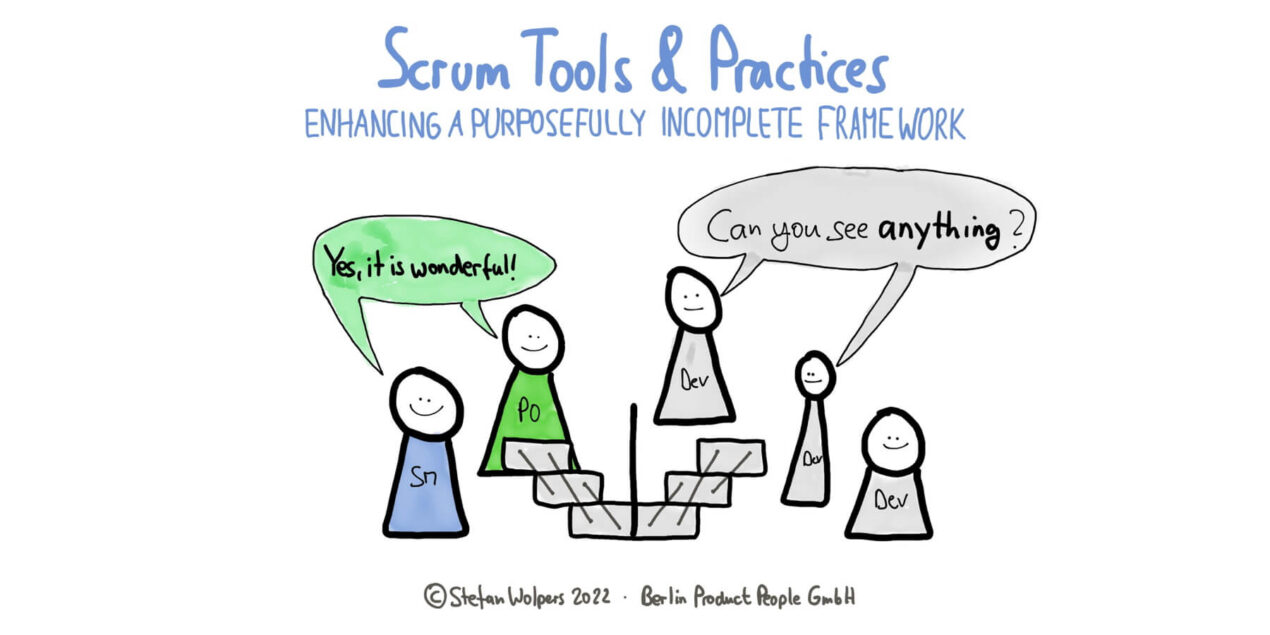
When is the time to look beyond Scrum? After all, many things—ideas, practices, mantras, etc.—outlive their utility sooner or later; why would Scrum be an exception? Moreover, we are not getting paid to practice Scrum but solve our customers’ problems within the given constraints while contributing to the sustainability of our organization. Scrum is a tool, a helpful practice but neither a religion nor a philosophy. Which brings us back to the original question: Is there a moment when a Scrum team should stop using Scrum?
TL; DR: Taming Complexity — Food for Agile Thought #366
Welcome to the 366th edition of the Food for Agile Thought newsletter, shared with 36,188 peers. This week, we identify five practical ways of taming complexity to avoid feature creep and pushing away users and share “examples of organizations that operate beyond the traditional set of agile practices and have been able to break down the bureaucratic hierarchy by adopting radical forms of consent, participation, and self-management.” Also, we have a look at building high-trust teams at Shopify in a remote working world, and suggest shifting “from leading with goals to leading with questions,” referring to Nobel laureate Richard Feynman.
Then, we point out that many companies may run experiments to test product ideas with users and customers; however, they fail to follow up with meaningful action. Following this example of failing innovation, we share lessons learned from a 100-plus-year-old company that is still a market leader, trying to innovate itself out of decline. Moreover, we appreciate a global benchmarking survey on activation rates with participants from Expedia, Grammarly, Canva, Duolingo, and others and examine the Lean UX Canvas in detail, pointing to shortcomings such as the need for a root cause analysis or mapping dependencies.
Finally, we share a primer on why “interviewing stakeholders provides helpful information about their context, [allowing] us to identify business goals they are concerned with, and increases their support.” And we close this edition of the newsletter with a video that explains what it takes to successfully use OKRs and points to common anti-patterns in their application, from tying them to compensation to excessive use.
TL; DR: Hands-on Agile #45: FAST Scaling: An Innovative Way to Scale Agile with James Shore
In this energizing 45th Hands-on Agile session, James Shore shared his experiences with scaling “agile:” first with traditional approaches and, more recently, with FAST scaling. Learn in this deep-dive what works, what doesn’t, and how you can try FAST in your organization.
TL; DR: Fixing Toxic Cultures — Food for Agile Thought #365
Welcome to the 365th edition of the Food for Agile Thought newsletter, shared with 36,117 peers. This week, we dive into the research on toxicity in the workplace and point to three means of fixing toxic cultures, from leadership to social norms to work design. Also, we detail how to collaborate with challenging people you need to include in your work and argue that principally ruling out discussions on productivity leads in the wrong direction. Additionally, we reflect on critical techniques for any transformation: learning, unlearning, and changing the habits of participants and stakeholders.
Then, we appreciate Lenny Rachitsky’s visualization of the hierarchy of goals in product management, and we share tips & tricks to start or grow your Product CoP, from starting at a minimum viable level to formalizing the CoP to expanding the community management team. Moreover, Janna Bastow shares how the unsuitedness of timeline roadmaps—based on deadlines—helped her design her approach to outcome-based planning.
Finally, we check out a new tool to “help facilitate your thinking when taking new products or ideas to market.” Also, we share a free ebook on identifying what is worth building, from involving your team members to communicating your research results with stakeholders, and we point to six critical elements of successful user journey mapping, from the business goal to mapping a specific user’s experience.
TL; DR: Scrum Master Interview (6): Demand Creates Supply and the Job Market for Agile Practitioners is No Exception
Scrum has proven time and again to be the most popular framework for software development. Given that software is eating the world, a seasoned Scrum Master is nowadays in high demand. And that demand causes the market entry of new professionals from other project management branches, probably believing that reading one or two Scrum books will be sufficient. Which makes any Scrum Master interview a challenging task.
Suppose you are looking to fill a position for a Scrum Master (or agile coach) in your organization. In that case, you may find the following 73 interview questions helpful in identifying the right candidate. They are derived from my sixteen years of practical experience with Scrum and XP, serving as Product Owner and Scrum Master. So far, I have interviewed dozens of Scrum Master candidates on behalf of my clients. This article covers a new set of questions on Sprint Planning.
So far, this Scrum Master interview guide has been downloaded more than 25,000 times.
TL; DR: Empowered Product Teams? — Food for Agile Thought #364
Welcome to the 364th edition of the Food for Agile Thought newsletter, shared with 36,083 peers. This week, we share the real-life case of an organization embracing Marty Cagan’s ‘empowered product teams (EPT)’ model entirely—with underwhelming results. Moreover, we ask why the concept of “Done” seems to be constantly misunderstood in organizations while we explore why engineering speed drops over time and what you can do about it. Additionally, we delve into an “understanding of management (managing), self-managing, and the manager role.”
Then, we consider that many transformations fail because they lack a focus on product leadership and cover the challenges of managing a product in its mature state, from figuring out whether your product has achieved that stage to the four top-handling strategies. Also, Doc Norton analyzes the path from complexity to our need for certainty to experimentation based on observations, questions, hypotheses, methods, and results, and we illuminate the importance of Sprint Goals for a Scrum team’s success.
Finally, we listen to Allan Kelly proposing a seven-step, lightweight process to develop products, building on his previous work, and appreciate a new exercise from John Cutler to help teams to move from focusing on how they measure to what they measure. Lastly, Kellan Elliott-McCrea reflects on the annual planning ritual in engineering, from the futility of a bottom-up approach to constraints and dependencies.