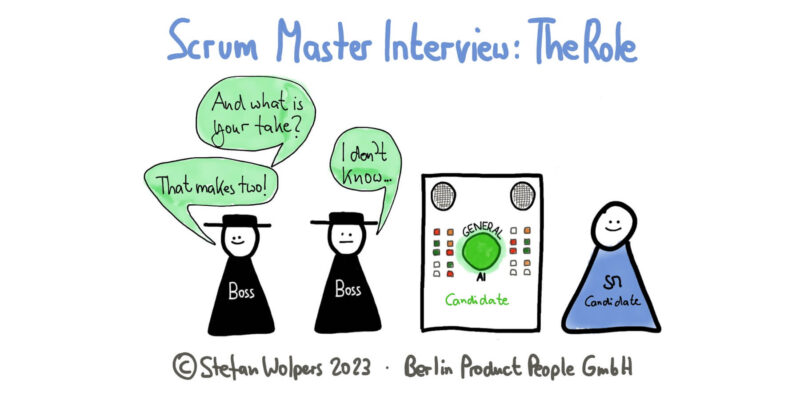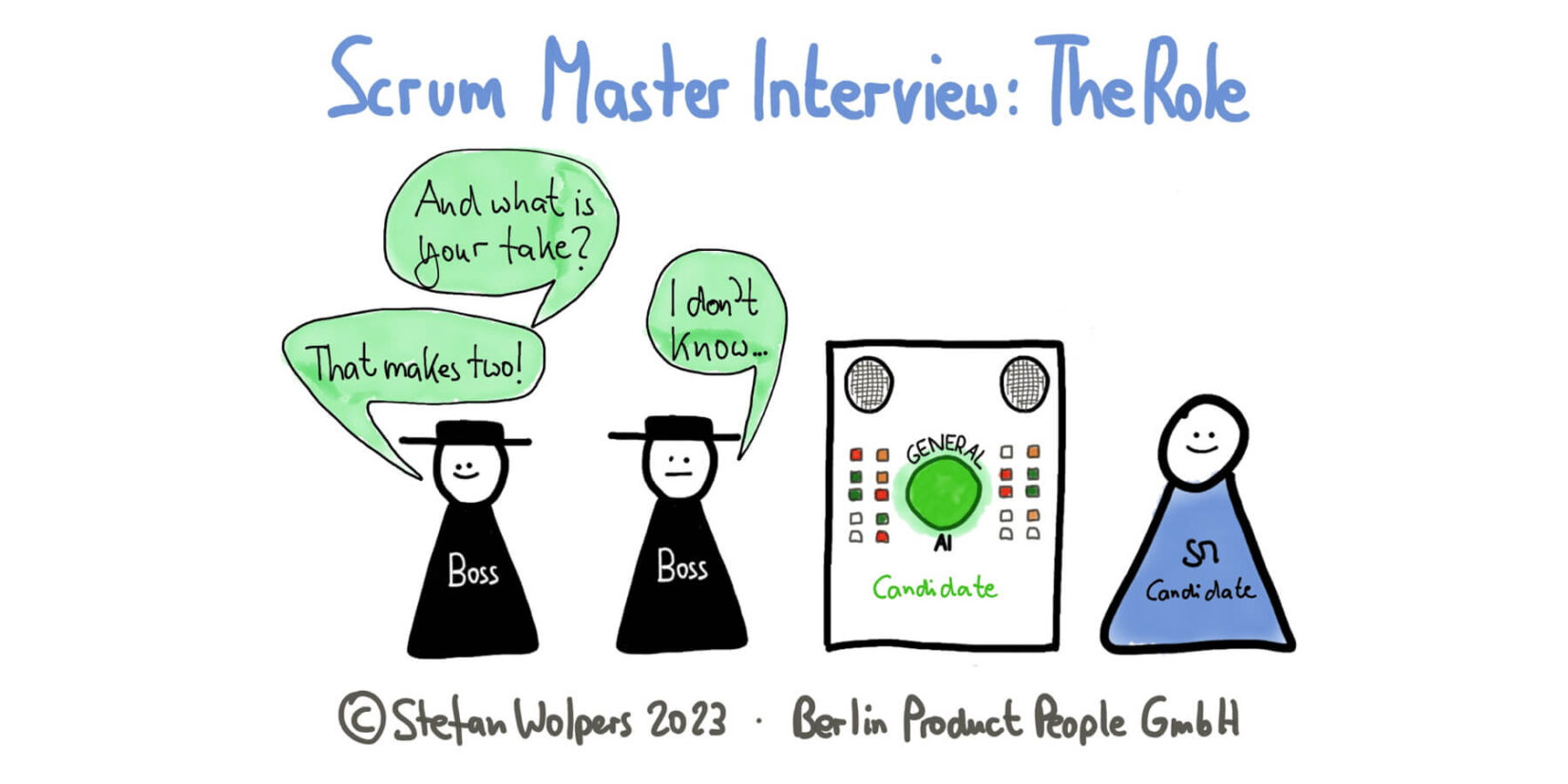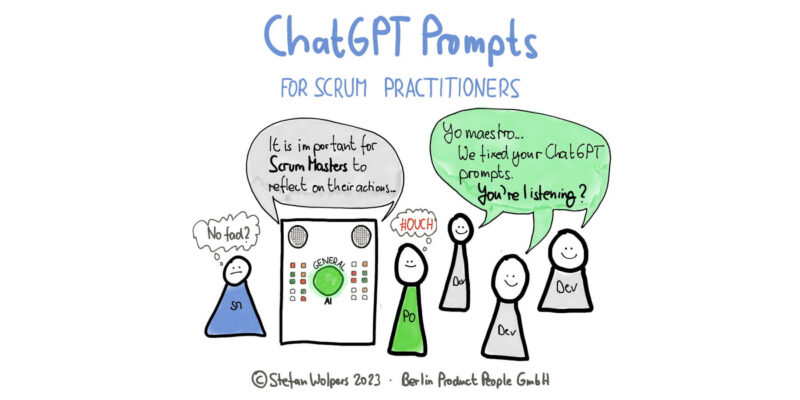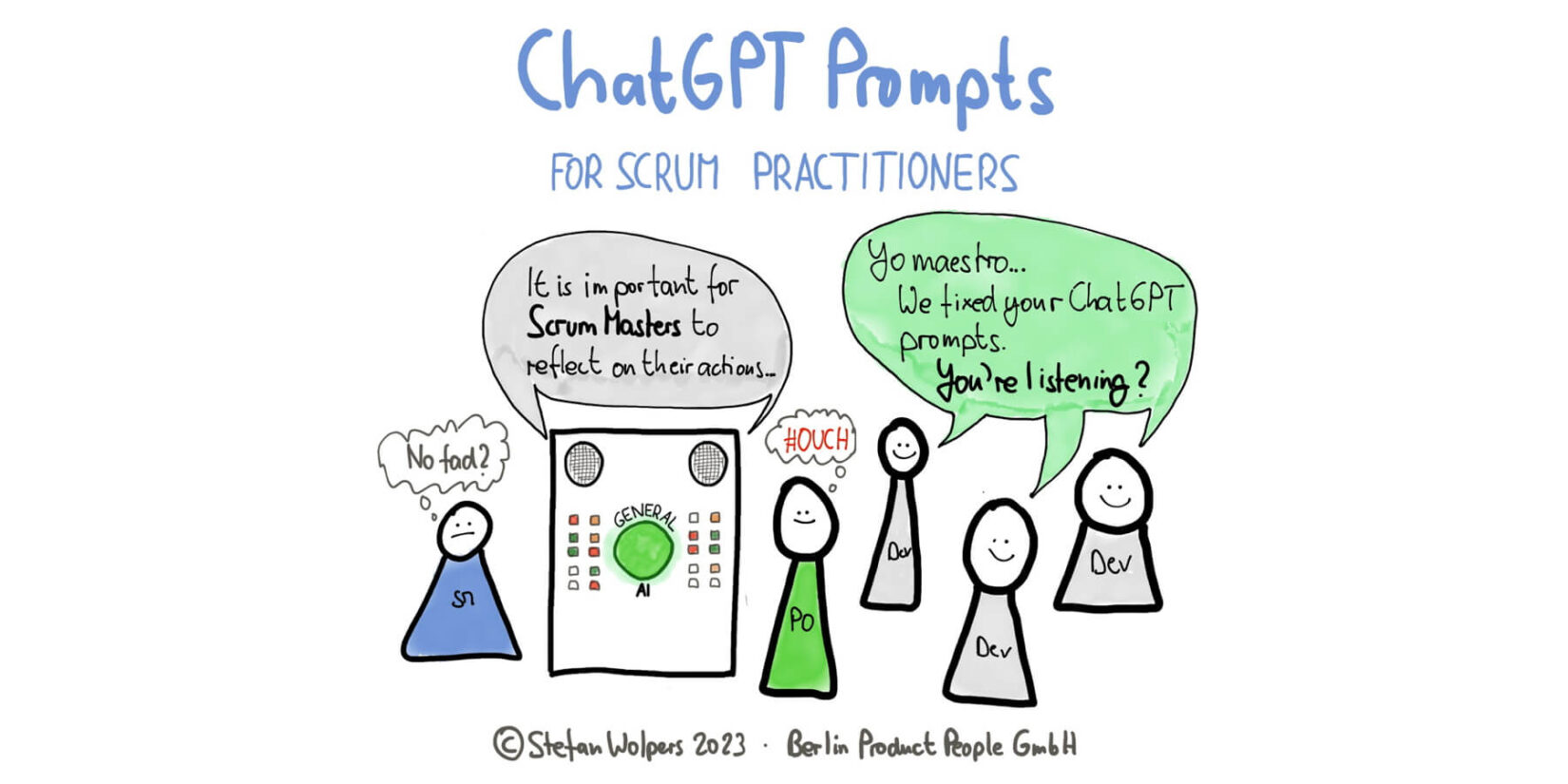
TL; DR: A ChatGPT Job Interview for a Scrum Master Position
Can a large language model, not specializing in anything “agile,” pass a screening interview for a Scrum Master position? In this ChatGPT job interview, I put OpenAI’s latest generative AI to the test. I took several questions from the 73 Scrum Master Interview Questions guide, see below, covering the whole spectrum from the broad picture to more specific questions, only answerable with hands-on experience on the interviewee’s side.
So, read on and learn whether Scrum Masters will soon be replaced with a chatbot.
TL; DR: The Hidden Micromanager, Defining Product Outcomes — Food for Agile Thought #374
Happy 2023 and welcome to the 374th edition of the Food for Agile Thought newsletter, shared with 36,453 peers. This week, we share a short assessment of whether you fall into the category of the “hidden micromanager.” Speaking of which, we delve into nurturing a blame-free learning organization, from accepting the inevitability of failure, embracing the resulting learning opportunity, reflecting, and moving on. Moreover, we listen to Jason Knight and Douglas Squirrel diving deep into how tech teams can get closer to the business side, improve decision processes, and have effective conversations across the whole organization whiling pointing to five habits of high-performing teams, from using pre-mortems to a disagree-but-commit attitude to making learning a priority.
Then, we follow Teresa Torres and Hope Gurion, delving into the intricate details of getting outcomes right, from avoiding masquerading outputs as outcomes to not choosing outcomes outside your team’s control to not measuring action instead of value, and we reflect on the inherent risks of continuing to work with your prototypes beyond product-market fit, which is all too common. Additionally, we point out that failures are inevitable, and product managers learn in public. Consequently, it would help if you improved dealing with failure in public, too.
Finally, we provide a comprehensive guide on the OKR framework and its application to product management. Moreover, we reframe the investigative and often intrusive ‘why’ question so you “indirectly but effectively get the answers you need.” Amazingly, John Cutler created a live diagram of his modeling process. As an example, he aims to identify the drivers of a healthy community. Lastly, Jason Yip advocates using Blink Estimation, User Story Mapping, and swimlane sizing to improve project-level forecasting.
What topics are you interested in learning about in 2023? Please share your ideas with me, and I’ll do my best to bring you the content you want. Let me know what you think!
I need your support, dear community. For months, I have been working on turning the popular Scrum Anti-Patterns Guide PDF into a new book from Scrum-org’s Professional Scrum Series, published by Pearson. We will soon start the editing process, and I am hopeful we may see a release date in Q2/2023.
Creating the graphics has been challenging at times; there will be more than 50 cartoons and sketches in the book. However, it has also been gratifying to rethink some of the old cartoons and, generally, improve their quality.
There is one challenge, though, I like to ask for your support: which cover shall it be — red or blue?
TL; DR: ChatGPT and Disruption, The Value of Agile Coaching — Food for Agile Thought #373
Welcome to the 373rd edition of the Food for Agile Thought newsletter, shared with 36,412 peers. This week, we suggest how AI, in general, and ChatGPT and its successors, in particular, may disrupt our current world. Additionally, we delve into how agile coaches can communicate the benefits of their work to organizations, suggesting the NABC value proposition scheme. Plus, we point to the many benefits of cognitive diversity to avoid blind spots and adapt to changing environments. Also, Adam Grant interviews John and Julie Gottman, renowned researchers of marital relationships, on how to play the infinite game. We can apply many of their findings to creating trust and rapport professionally.
Then, we share a comprehensive guide to a critical artifact, the product strategy document, covering the dos & don’ts, what it needs to cover, and its subsequent inspection and adaptation. Moreover, we share “how to use the product discovery loop to build high-growth products” while discussing all things stakeholder management, from its general benefits to the nitty-gritty details of creating alignment. By the way, an excellent tool to create alignment is the Product Goal Canvas; see below.
Finally, we detail how to apply a hugely valuable flow metric to your work and point to the all-so-human flaw of falling for vanity metrics to measure “success” when it is all about solving problems and building relationships. Lastly, we try to answer a compelling question: Is ChatGPT a game-changer? And if so, from whom?
I hope you have a fantastic season filled with joy and happiness. Whether you’re celebrating Christmas, Hanukkah, Kwanzaa, or something else, I hope the season brings you good cheer and lots of time to spend with the people you love.
This edition will be the last for 2022; Food for Agile Thought will be back on January 8, 2023.
TL; DR: Your Unfit Product Goal and the Product Goal Canvas
We plan a lot in Scrum: There is a daily plan when the Developers think about progressing toward the Sprint Goal during the Daily Scrum. Of course, the Sprint Goal reflects an intermediate target the Scrum team considers valuable to solve their customers’ problems. Moreover, there is the Product Goal, a mid- or long-term objective of the Scrum team.
The problem is that when Scrum teams already struggle with embracing the concept of the Sprint Goal—first, you agree on the objective of the Sprint, then you pick the work you consider necessary to accomplish it—they most likely also struggle with proper Product Goals.
Let’s check three critical issues Scrum teams have with Product Goals and a practical tool that helps you avoid the mess.