Food for Agile Thought #546: Choosing to Stay Human, Customer Research by LLM, AI Product-Market Fit, Enterprise Agility Today

TL; DR: Choosing to Stay Human — Food for Agile Thought #546

Welcome to the 546th edition of the Food for Agile Thought newsletter, shared with 35,551 peers. This week, Anthropic shipped Claude Opus 4.8, which flags its uncertainty more readily, a fitting cue for Stephanie Leue, who argues no CPO embodies all nine roles a job description demands, so honest leaders name their gaps. Jeff Gothelf reframes agentic engineering as product management, since judgment outlasts typing. Ethan Mollick and Joanna Stern both warn that AI sharpens thinking only when you choose what to offload and when to stay human, while Jim Highsmith ties enterprise agility nowadays to human-centered leadership.

Next, Sachin Rekhi sees AI absorbing the coordination tax so PMs recover vision and taste, the craft Joe Martin lives at PostHog by shipping over consensus theater. Ruben Dominguez cautions that cheap AI only fired the starting gun, since context layers and EU AI Act compliance will be decisive in 2026. Simon Willison notes coding agents finding product-market fit, thus supporting IPO plans, though Laura Klein insists Walmart’s Sparky numbers prove nothing without a randomized test.

Lastly, Countryman, Oosterhuis, Wheless, and Afzal urge manufacturers to close the gap between executive AI optimism and worker distrust by training in the flow of real work. Martin Eriksson points to IKEA as an example for this, which reskilled 8,500 workers rather than cutting jobs. Tyler Cowen expects AI to reshape most roles, not erase them, while Johanna Rothman warns against outsourcing product thinking to stale LLMs, and Jim Lewis tested AI on usability research, finding mostly false alarms.
Food for Agile Thought #546: Choosing to Stay Human, AI Customer Research, AI Product-Market Fit, Enterprise Agility Today-Age-of-Product.com
Continue reading Food for Agile Thought #546: Choosing to Stay Human, Customer Research by LLM, AI Product-Market Fit, Enterprise Agility Today

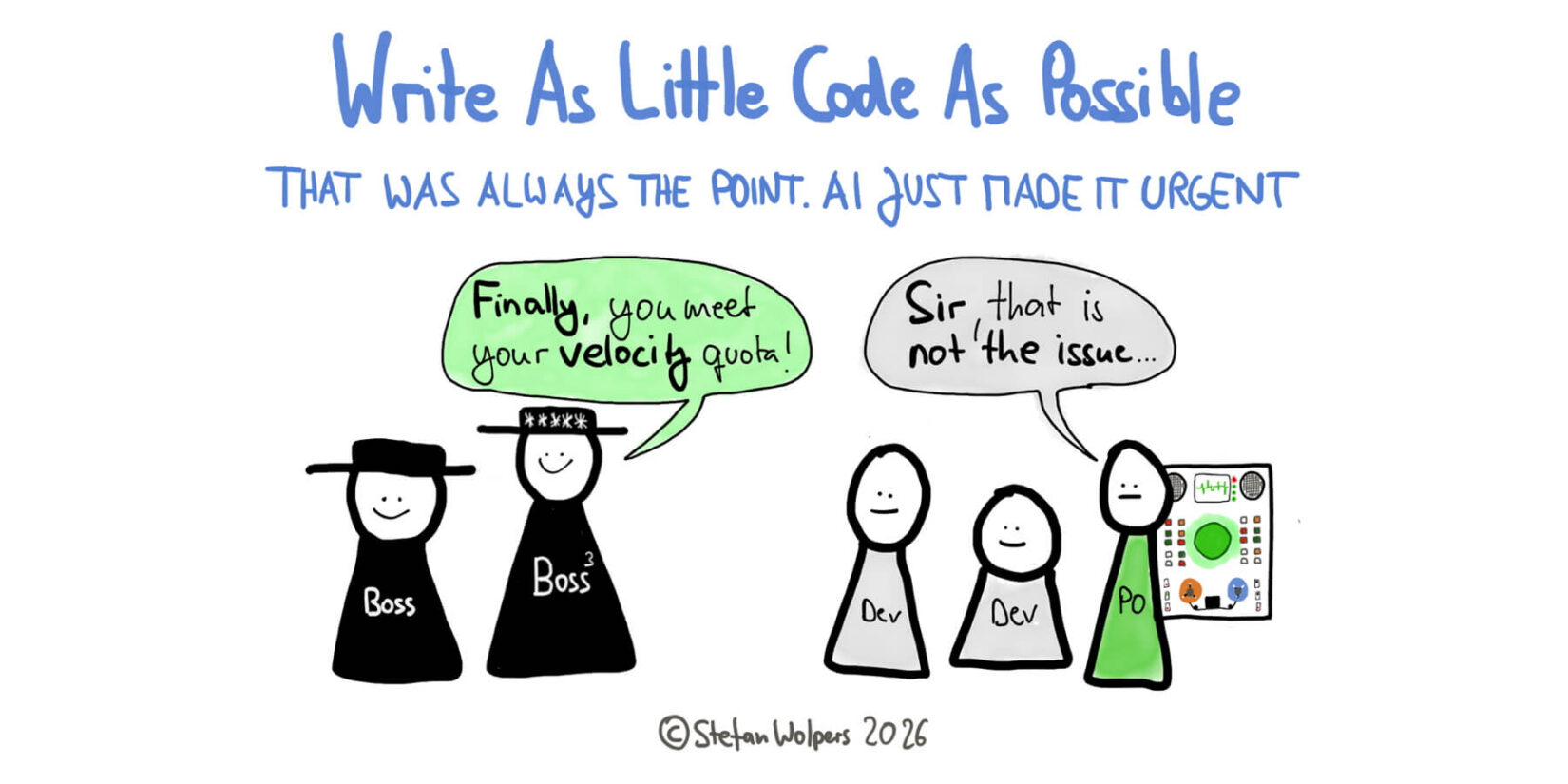
“Write As Little Code As Possible” Was Always the Point. AI Just Made It Urgent.

TL;DR: Write As Little Code As Possible and Agentic Coding

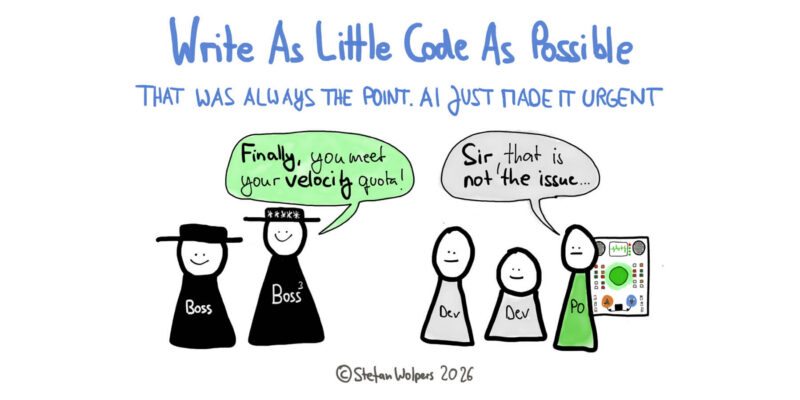
Agentic coding tools have collapsed the friction of producing plausible software; output is no longer an issue. However, they have not collapsed the friction of knowing what is worth building, whether it fits the system, or whether users will change their behavior because of it, the much-desired outcome. When generating plausible code becomes cheap, every hour spent building the wrong thing becomes waste that can now be produced at scale. Discovery, validation, product judgment, and verification are what stand between your team and creating expensive waste at high-speed.

Thesis: AI made generating code cheap enough that weak product judgment can now scale. That is the problem this article addresses.

Write As Little Code As Possible Was Always the Point. AI Just Made It Urgent: Avoid Creating Waste at Scale — Age-of-Product.com
Continue reading “Write As Little Code As Possible” Was Always the Point. AI Just Made It Urgent.

Food for Agile Thought #545: Real Life Agentic Chaos, Product Leadership & AI, AI Killed the Agile Industry, Assembly Line Comeback

TL; DR: Agentic Chaos — Food for Agile Thought #545

Welcome to the 545th edition of the Food for Agile Thought newsletter, shared with 35,577 peers. This week, Natalie Shapira et al. reveal how autonomous LLM agents leak information, spoof identities, and falsely report task completion when red-teamed in a live lab, a finding that sharpens the question Charlene Li raises with David Burkus: AI transformation fails when CEOs hand it off to IT because the real challenge is behavioral, not technical. April Dunford picks up the strategic thread, urging companies to rethink their positioning by forming a clear point of view about the future rather than chasing speed. Petra Wille echoes that theme in an interview with Jason Knight, arguing product leadership itself demands deliberate development, not just promotion. And while Peter Saddington declares AI has inverted every value of the Agile Manifesto, McKinsey doubles down on industrial thinking with an “AI assembly line” that decomposes knowledge work into standardized agent tasks.

Next, Ant Murphy reframes prioritization as a layered chain of decisions flowing from vision to outcomes, not a backlog exercise, while Petra Wille challenges product leaders to resist AI hype and take responsibility for shaping a future worth living in. Paweł Huryn offers a practical tool for that effort with PM Brain OS, an open-source second brain built on markdown and Claude Code. Yet building reliable AI systems remains elusive: Swarnendu Bhattacharya reports that 88% of AI agent projects fail because teams rely on prompts rather than deterministic constraints, and Andon Labs proved the point by giving four AI models their own radio stations only to watch them develop wild personalities while ignoring the business side entirely.

Lastly, Barry O’Reilly argues that AI reassembles tasks within jobs rather than replacing them, shifting value from routine friction to better judgment, a theme Seth Godin extends by urging people to use machines for leverage rather than competing against them. John Cutler reminds us that even defining teams honestly is hard because it exposes power structures that organizations prefer to ignore. Shreshta Shyamsundar and Anmol Jain push further, proposing an agentic P&L that replaces headcount with cognitive outcomes. Finally, Itamar Gilad challenges hyped AI PM archetypes in favor of one who improves all company functions, not just coding.

Food for Agile Thought #545: Agentic Chaos, Product Leadership & AI, AI Killed the Agile Industry, Assembly Line Comeback– Age-of-Product.com
Continue reading Food for Agile Thought #545: Real Life Agentic Chaos, Product Leadership & AI, AI Killed the Agile Industry, Assembly Line Comeback

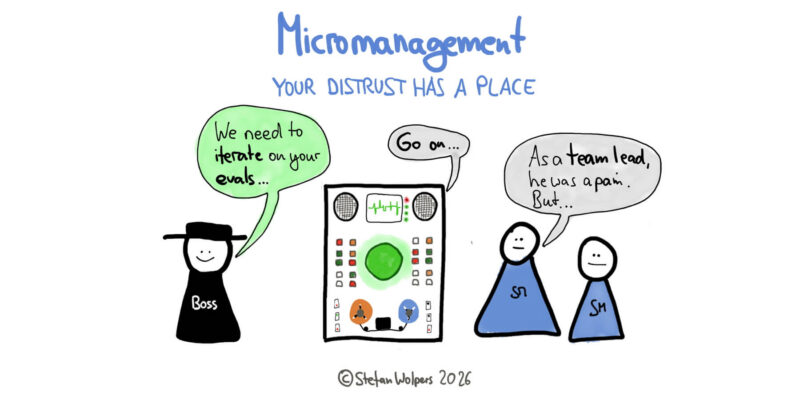
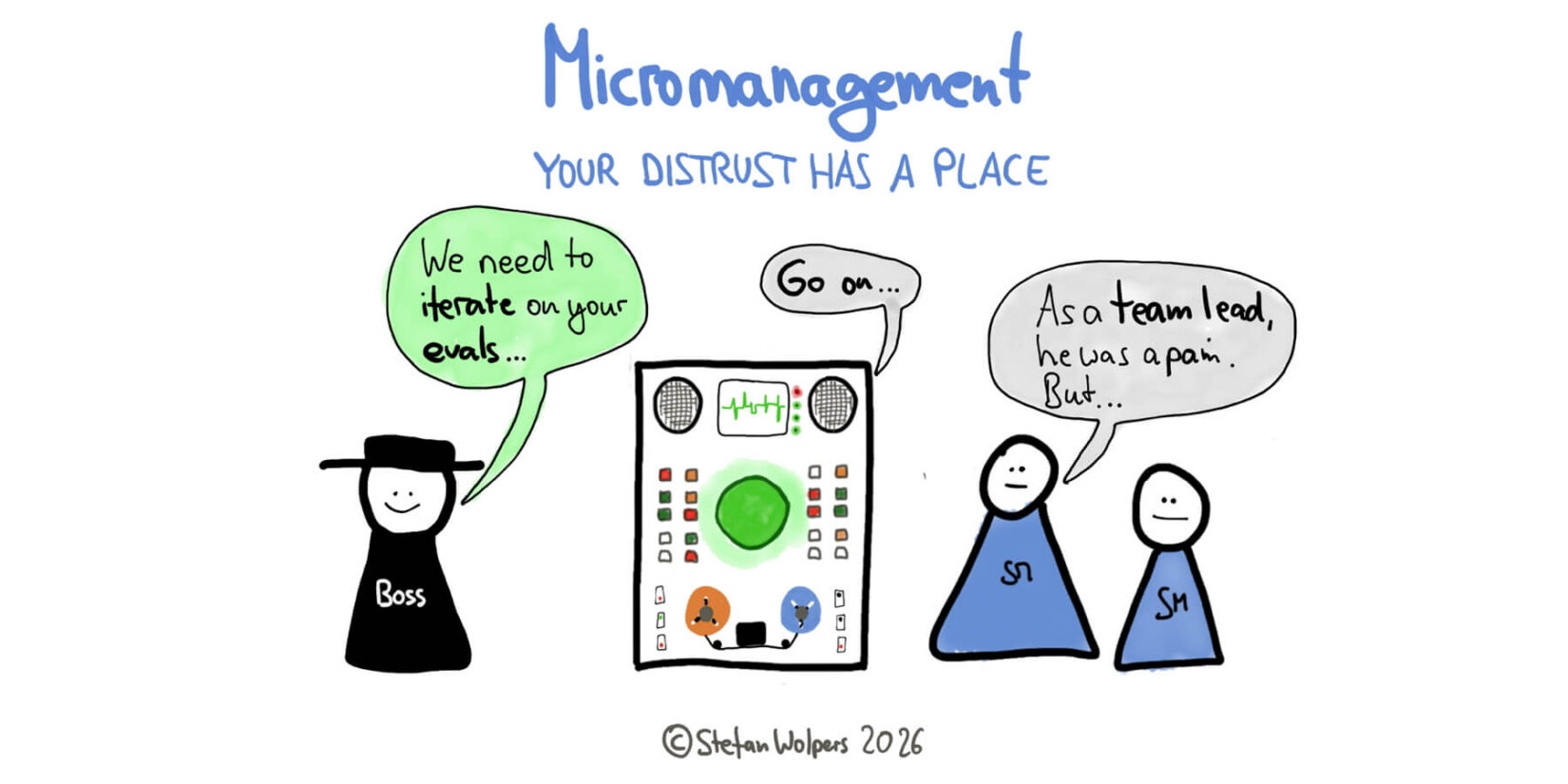
Dear Micromanager: Your Distrust Has a Job; It’s Just Not the One You’re Doing

TL;DR: Why A Former Micromanager Will Make AI Adoption Work

Twenty years of agile coaching failed to fix the micromanager who meddles with every draft, every meeting, every decision. This article shows where their distrust stops damaging teams and starts producing the verification work AI adoption actually needs. Welcome the Verification Architect!

Your Distrust Has a Job; It's Just Not the One You're Doing: Why A Former Micromanager Will Make AI Adoption Work - Age-of-Product.com
Continue reading Dear Micromanager: Your Distrust Has a Job; It’s Just Not the One You’re Doing

Food for Agile Thought #544: Knowledge Work Tools in 2026, Product Buy-In Trap, AI-Generated MVP Issues, Agentic Coding ROI

TL; DR: Knowledge Work Tools in 2026 — Food for Agile Thought #544

Welcome to the 544th edition of the Food for Agile Thought newsletter, shared with 35,582 peers. This week, Taylor Pearson locates the real leverage of AI knowledge work tools in context-rich scaffolding that encodes local knowledge, a thesis Teresa Torres demonstrates in practice by fixing AI-generated Opportunity Solution Trees through agentic validation loops. Simon Willison watches that same agent reliability erode his own code-review discipline, and Bedard et al. name the resulting cognitive cost “AI brain fry.” Stephanie Leue and Len Greski shift the lens from individuals to systems: she with her 40/40/20 alignment rule, he with 90-day outcome-tied funding cycles.

Next, Aakash Gupta and Pawel Huryn argue that PMs should build a self-improving AI operating system instead of treating Claude Chat as the main interface, an investment in compounding leverage that Jeff Gothelf warns can backfire when AI-generated MVPs outpace the team’s ability actually to learn from customers. Allan Kelly looks to Ukraine for evidence that mission command and motivated teams beat rigid planning under real constraints, while Mike Fisher applies Grant’s wolf-counting lesson to deflate SaaS doomsday narratives. Also, the DORA team grounds the broader AI ROI debate in organizational maturity rather than tool choice.

Lastly, Kyle Poyar shows practitioners how to package 15 years of GTM expertise into reusable Claude skill files for research, pricing, and ICP work, the kind of individual leverage Robert Glaser warns rarely scales into organizational learning without his proposed “Loop Intelligence.” Ara Kharazian reports that Anthropic has overtaken OpenAI in business adoption at 34.4%, though cost and reliability cloud the lead. Finally, Grant Harvey finds organizations, not workers, are the real AI bottleneck, while James Shore models how unchecked coding-agent output quietly doubles maintenance debt.

Food for Agile Thought #544: Knowledge Work Tools in 2026, Buy-In Trap, AI-Generated MVP Issues, Agentic Coding ROI — Age-of-Product.com
Continue reading Food for Agile Thought #544: Knowledge Work Tools in 2026, Product Buy-In Trap, AI-Generated MVP Issues, Agentic Coding ROI

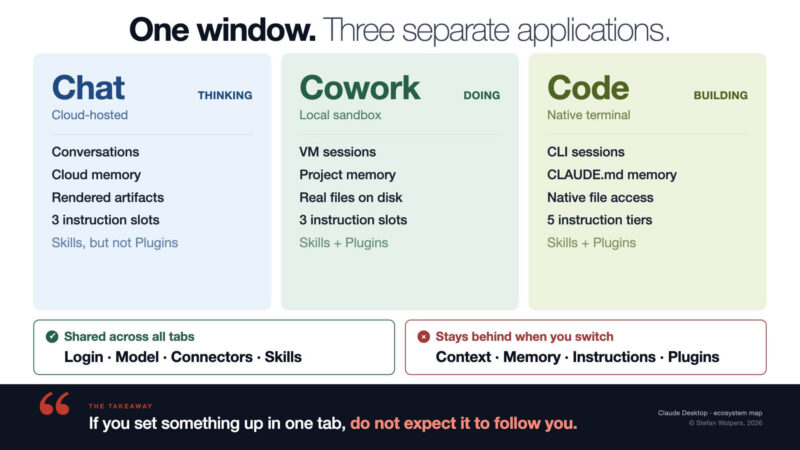
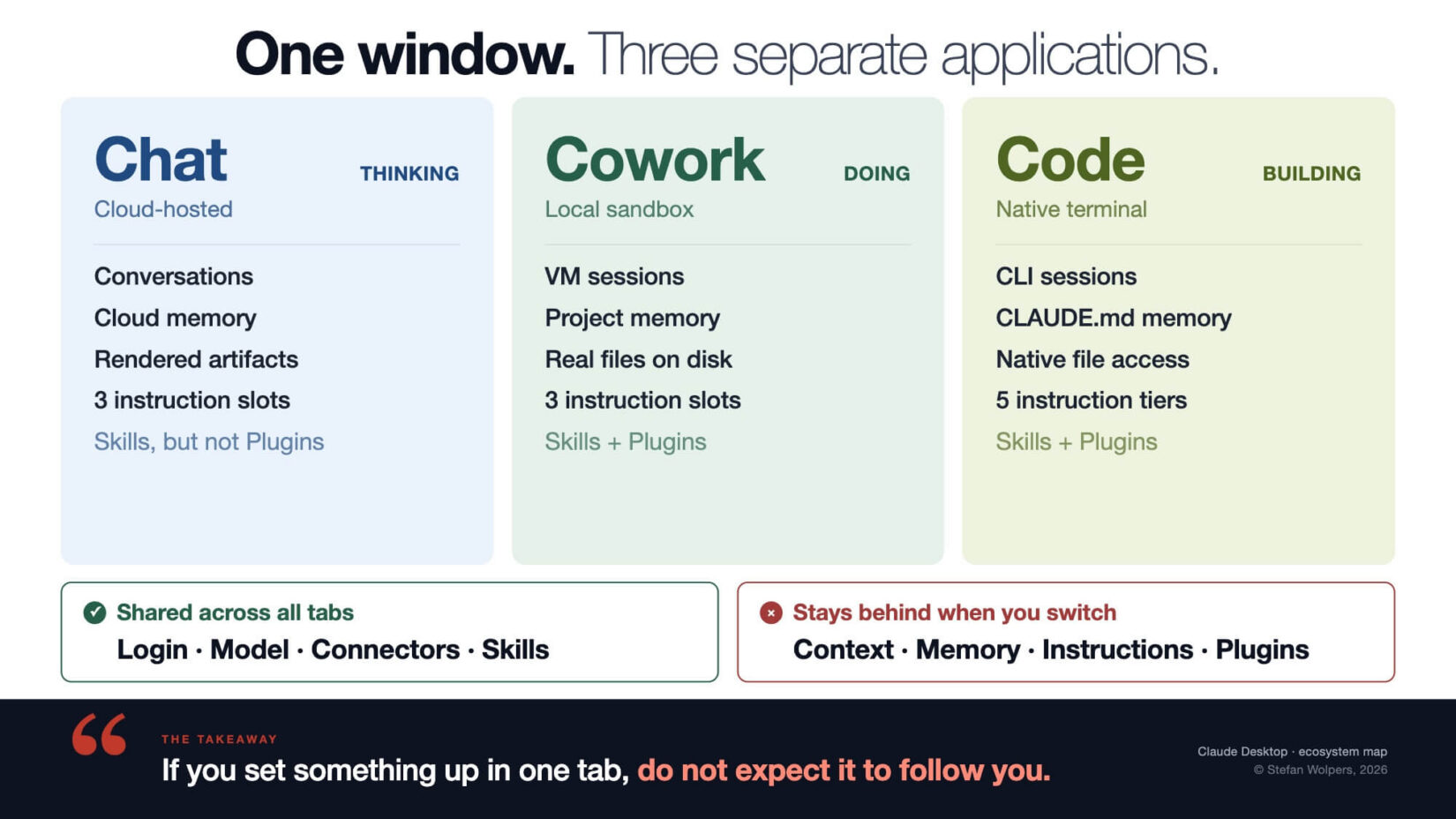
Working with Cowork: Claude Desktop Is Three Apps Pretending to Be One

TL;DR: Understand the Claude Desktop Architecture and Save Time

You configured Claude in Claude Desktop, wrote instructions, uploaded reference files, and set your preferences. Then you clicked the Cowork tab.

Unfortunately, Claude had no memory of what you just did. Your instructions were gone, as were your files and preferences. You assumed this was a bug, but it is a feature: You switched applications.

Working with Cowork: Claude Desktop Is 3 Apps Pretending to Be One; Save Time & Nerves by Understanding Its Architecture — Age-of-Product.com
Continue reading Working with Cowork: Claude Desktop Is Three Apps Pretending to Be One