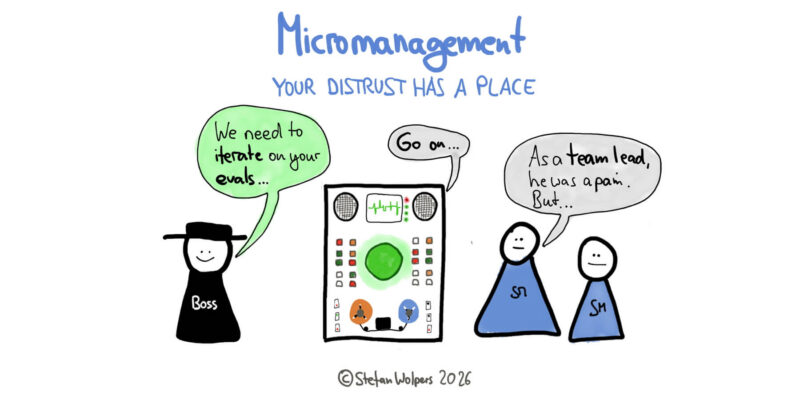
TL;DR: Why A Former Micromanager Will Make AI Adoption Work
Twenty years of agile coaching failed to fix the micromanager who meddles with every draft, every meeting, every decision. This article shows where their distrust stops damaging teams and starts producing the verification work AI adoption actually needs. Welcome the Verification Architect!
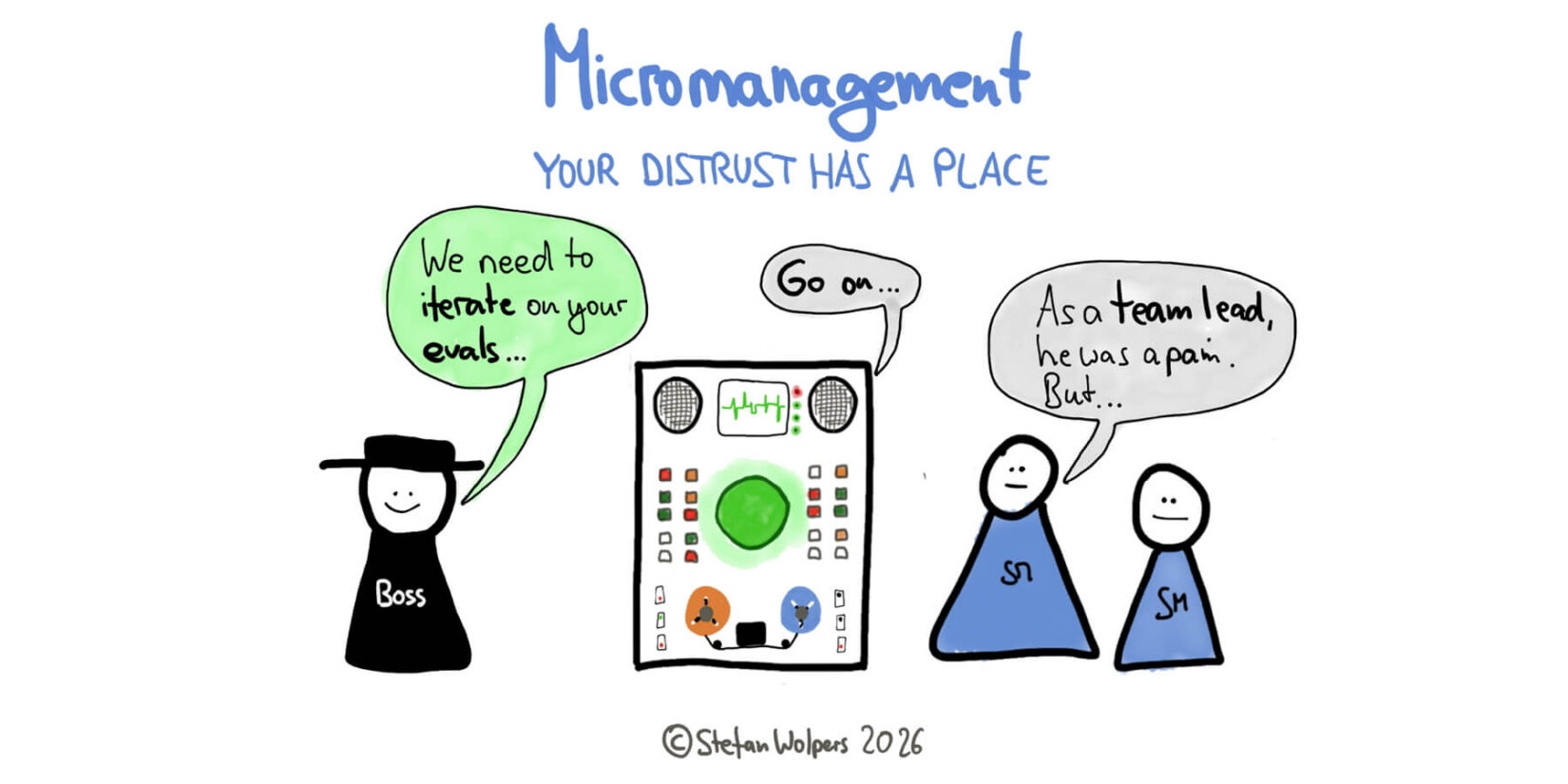
What is a Verification Architect? A Verification Architect is the person responsible for deciding which AI tasks belong in Assist mode, which belong in Automate mode, and which belong in Avoid mode of the A3 framework; defining what review means in each mode; and running the verification loop that converts each AI failure into a sharper prompt, eval, or acceptance criterion. The role is not a compliance auditor: compliance asks whether rules were followed, while verification asks whether the system produces the claimed outcome under the conditions in which it operates. In smaller organizations, the work is often a responsibility carried by a Product Manager, Scrum Master, QA lead, or technical lead, rather than by someone holding the title. Learn more about why a micromanager might be an excellent fit for this role below.
🎓 🇬🇧 The Claude Cowork Online Course — Available June 8-15 for $129
You have been prompting AI for months. The results are inconsistent, every conversation starts from zero, and the model forgets who you are. That is the ceiling of prompting.
The Claude Cowork Online Course teaches you to break through it: build Skills that encode your expertise, connect them to your tools, and assemble Agents who handle recurring work the way you would handle it yourself. No coding required.
What You Will Get:
✅ 8+ hours of self-paced video modules: Skills, Agents, delegation frameworks — ✅ Tested with a live BootCamp cohort (April 2026) — ✅ The A3 Framework: decide what to delegate and what to keep — ✅ Starter kit with folder structure, CLAUDE.md, and Skill templates — ✅ All texts, slides, prompts, graphics; you name it — ✅ Designed for the $20/month Pro plan — ✅ Lifetime access to the version you purchase — ✅ Claude Cowork Foundational Certificate.

👉 Please note: The course will be available for $129 from June 8 to 15, 2026! (After that, $199.) 👈
🎓 Join the Waitlist of the Course Now: Claude Cowork: Stop Prompting. Start Delegating. No Coding Required!
🇩🇪 Zur deutschsprachigen Version des Artikels: Mikromanager: Ihr Misstrauen hat eine Aufgabe, nur nicht den Job, den Sie gerade machen.
🗞 Shall I notify you about articles like this one? Awesome! You can sign up here for the ‘Food for Agile Thought’ newsletter and join 35,000-plus subscribers.
🎓 Join Stefan in one of his upcoming Professional Scrum training classes!
The Micromanager
You know the type of manager: The micromanagers ask to see the draft before the team talks to the customer. They rewrite the acceptance criteria after refinement. They join the Slack thread “just to clarify” and leave with the decision back in their hands. They are not malicious. They genuinely believe the work needs their eyes before it ships.
For 20-plus years, agile coaches have tried to convince these people to trust the team, the people they hired themselves. The psychological safety workshops did not work. The servant-leadership reading lists did not work. Much of the coaching industry learned to work around this population and focus on the trainable middle. The micromanagers stayed.
Now the same manager is being asked to delegate work to AI. They will not delegate without asking. But this time, their skepticism deserves a hearing.
The Micromanagement Disposition Is Not the Defect
There is a reason the AI industry uses the phrase human in the loop. Probabilistic systems running autonomously should not be trusted by default with consequential decisions in their current form. They hallucinate citations. They produce confident wrong code. They will follow an under-specified instruction into a wall and report success. The instinct to verify before accepting consequential output is not a defect in this domain. It is reliability engineering.
This context exposes the problem with the standard Agile framing. Telling a chronic skeptic that they need to trust more works against the evidence. The skeptic micromanager looking at agentic AI sees what the engineers building it see: a powerful tool with known failure modes that has to be wrapped in observability, harnesses, evals, and verification before it produces reliable value. The skeptic’s posture toward AI is closer to reliability engineering than to the optimism that much AI adoption theater demands.
Where the same instinct fails is with human colleagues, not because humans are reliably better than generative AI systems. Humans fail differently. The reason inspection often damages human work but can improve AI work is that inspection changes the system being inspected. People learn, adapt, withdraw, hide information, and protect themselves in response to how they are treated. Surveillance degrades the very capability the manager claims to protect. With AI, verification does not demotivate the model. The model produces what it produces, and the verification loop sharpens over time, as we feed back findings to improve prompts, skills, evals, constraints, and operating rules.
From that perspective, the problem was never the micromanager’s distrust. The problem was where it was pointed: at humans.
Two Patterns Wearing the Same Costume
Two very different micromanager motives can produce the same behavior. The distinction matters because they respond to different interventions, and one of them is genuinely useful in an AI context while the other is not:
- The first pattern shows up as authority maintenance: The distrust is about keeping the decision in the manager’s hands, not about improving the output. Ask this manager what would count as evidence that a teammate’s work is trustworthy, and the answer is often operational nonsense: “I need to see it first.” The verification, when it happens, is performative. What gets inspected is compliance, not risk. AI tooling does not help this person because they do not actually want better evidence. They want to be the one who decides.
- The second pattern shows up as accumulated experience: The distrust is grounded in specific past failures. This manager can describe in detail what they have seen go wrong, what was promised and not delivered, and which verification step was skipped before the failure. With human teammates, this manifests as micromanagement because verifying human judgment is socially costly. You cannot run a unit test on a colleague’s reasoning. So they over-supervise, the team feels controlled, and the relationship degrades. With AI, verification is structured and cheap. The same disposition that damages a team produces useful work when pointed at a probabilistic system that actually benefits from repeated checks.
A small diagnostic helps distinguish them:
| Question | Authority maintenance | Accumulated experience |
|---|---|---|
| What would make this output trustworthy? | “I need to see it first.” | “It has to pass these three checks.” |
| What failure are you trying to prevent? | Vague loss of control. | A specific failure mode they can name. |
| When would you stop reviewing every step? | Never. | When the system demonstrates reliability under defined conditions. |
| What do you inspect? | The person’s compliance. | The work product’s risk. |
| What changes after your review? | The decision returns to me. | The system gets a sharper check, rule, prompt, or acceptance criterion. |
The difference is not whether the person distrusts. The difference is whether their distrust leaves behind better evidence, better criteria, and a sharper system, or merely a returned decision right.
This is not permission to allow the micromanager to “direct” humans. Human work still needs verification, but the verification must be designed as a social contract: clear intent, explicit constraints, agreed-upon review points, and decision rights that do not silently migrate upward whenever the manager feels anxious. The same person who becomes useful in AI verification may still be destructive in a team context if they cannot make that shift. The disposition is not the license. The redirected target, however, provides a new perspective for the micromanager.
Cannot see the form? Please click here.
A3 Is the Sorting Mechanism
The A3 Framework (Assist, Automate, Avoid) is one way to test which pattern you are looking at. Authority maintenance can fill in the A3 boxes. It cannot use A3 honestly. The answers stay vague, reversible, and dependent on the micromanager’s comfort rather than on named risks. The accumulated-experience pattern can categorize a task in seconds, because the suspicion is grounded in specific past failures that map to specific risk profiles.
In Assist, where AI drafts and a human decides, the contribution is defining what a genuine review looks like. Most teams using AI in Assist mode are rubber-stamping. The experienced skeptic refuses to. They will read the draft and tell you which two of the five suggestions contradict a constraint the model could not have known about.
In Automate, where AI executes under explicit rules and audit cadences, the same person designs the audit. They will write the acceptance criteria with teeth, the failure modes worth alerting on, the rollback conditions, and the sample size for the weekly check. The team may look slower for two weeks because the work is finally visible. Six months later, that visibility is what prevents the incident everyone else would have called “unexpected.”
In Avoid, where AI should not be used at all, the skeptic is the person qualified to make the call. Most organizations lack this authority. Optimistic adopters struggle to say no. Blanket skeptics say no too cheaply. The experienced skeptic can distinguish a stakeholder relationship in which one wrong AI-drafted phrase costs six months of trust from a low-stakes draft in which Assist is fine.
The categorization is not the value in this case, but the decision authority is. Many AI adoption initiatives lack a qualified person with the authority to say we should not use this here, and they produce predictable failure modes as a result.
Summary: AI task types and the verification mode each require
Bounded drafts a human reviews:
- A3 mode: Assist.
- What the Verification Architect does: Defines the specific criteria the draft must pass before acceptance.
Repeated execution under explicit rules:
- A3 mode: Automate.
- What the Verification Architect does: Designs audit cadences, rollback conditions, and drift detection.
High-trust or irreversible work:
- A3 mode: Avoid.
- What the Verification Architect does: Protects the boundary against convenience-driven AI adoption.
Name the New Role for the Micromanager: the Verification Architect
The piece this article has been circling is that AI creates a role the Agile movement never learned to name. Call it the Verification Architect.
A Verification Architect does not ask: “Can AI do this?” They ask: “What would have to be true for AI to do this safely, repeatedly, and measurably in our context?” Their unit of work is not the prompt. It is the loop, the day-to-day work that compounds over months:
- Turn vague AI use cases into Assist, Automate, or Avoid decisions before anyone opens a prompt window.
- Define what review means in Assist mode, not as a vibe check but as specific criteria the draft has to pass.
- Design audit cadences in Automate, including sample sizes, drift detection, and rollback conditions.
- Protect Avoid zones from convenience-driven erosion, which is the failure mode of every governance regime that lacks an enforcer.
- Convert each failure into a sharper prompt, a new eval, a tightened acceptance criterion, or an updated Definition of Done.
- Track drift over time, because models, data, and use cases all move.
In smaller organizations, this may not be a job title. It may be a responsibility carried by a Product Manager or Owner, a Scrum Master/Agile Coach, a QA lead, a product operations person, or a technical lead. The title matters less than the loop.
The Verification Architect is not a compliance role. Compliance asks whether the rules were followed. Verification asks whether the system produces the claimed outcome under the conditions in which it operates, with the named failure modes. The first is bureaucracy. The second is engineering judgment.
The role is not new in the strict sense. Reliability engineers, design verification architects, and rigorous product operations leaders have been performing this work on traditional software for years. What is new is the application to AI-enabled work systems in non-technical organizational settings, where agentic workflows with non-deterministic outputs and rapid deployment cycles make verification load-bearing rather than nice-to-have. The organizations that ship AI without this capability produce demos. The organizations that build it produce systems that compound.
The Work Inside the Dip
The AI Spending Trap argued that organizations are often stuck in the J-curve dip because they buy tools and skip the intangible-capital investment that drives the eventual rise. The argument has a missing piece. The intangibles do not invest themselves. They need process redesign, retraining, restructuring, data plumbing and governance, and change management. Every category gets paid for by specific humans doing specific work.
The part of the dip organizations most consistently underprice is verification work, eval design, output review, prompt or skill refinement, acceptance-criteria sharpening, and failure-mode cataloging. This is the place where the Verification Architect earns their salary.
Done well, the loop becomes a compounding system. Each verification cycle encodes a little more organizational judgment about what good looks like in this specific context, the evals get sharper, and the acceptance criteria get more specific. The agent’s effective competence in this organization increases over time, not because the underlying model improves, but because the surrounding system encodes accumulated knowledge of where it fails. The trusting person ships v1 and moves on. The Verification Architect ships v1, watches it, catches the failures, refines the prompts, tightens the evals, updates the Definition of Done, and runs the loop again.
Without this person, the deployment stays at v1 and degrades as conditions shift. With them, the system gets better while the headcount stays flat. That is the curve “The AI Spending Trap” described, and this is who pulls it upward.
The work is currently underpriced. Eval design does not ship on Monday. Output review does not produce a launch announcement. Refining prompts in month four produces nothing that the quarterly board deck can show. That is exactly why the disposition is a competitive advantage for organizations that recognize it before the rest of the market does.
A Warning About the Label
The label “Verification Architect” will be hollowed out, as every useful role title in this industry eventually is. (Remember: Agile Coach, Product Owner, and Scrum Master?)
Ask what the person last sent back for revision and why. Ask what they last protected from AI involvement and what would have to change for that decision to flip. Ask what their longest-running audit loop has caught. The genuine Verification Architect answers with names, dates, and specific failures. The fake one answers with frameworks and vocabulary.
Conclusion on the Micromanager: Move the Work, Not the Person
If you have spent your career being told your skepticism was a problem, consider that the people telling you were trying to fit you as a micromanager into a role that does not need you. The agentic AI stack needs people who refuse to trust output they did not verify. It needs people who design the evals, who run the audit loop, who notice the failure that everyone else celebrated as a launch. The work is currently underpriced. That is the opportunity.
The micromanager disposition was never the problem; shoehorning it into an unfitting role was.
Pick a teammate you struggled to delegate to in the last six months. Pick an AI task that frustrated you in the same window. Compare the instructions you gave each. If the pattern is the same, you have found the problem. One system is being damaged by your inspection. The other may finally be receiving the discipline it needs.
Does your distrust produce evidence, or does it merely preserve authority? My suggestion: Move the work, not the person.
Key Questions This Article on Micromanagers Answers
What is a Verification Architect in AI adoption?
A Verification Architect is the person who decides which AI tasks belong in Assist, Automate, or Avoid mode, defines what review means in each mode, and runs the verification loop that converts each AI failure into a sharper prompt, eval, or acceptance criterion. Their unit of work is not the prompt; it is the loop. In smaller organizations, the responsibility may be carried by a Product Manager, Scrum Master, QA lead, or technical lead rather than someone holding the title.
Why Do Micromanagers Struggle to Delegate to AI?
Most do not, because their underlying distrust of probabilistic systems is engineering common sense, not a character defect. The reason inspection damages human teams but improves AI systems is that inspection changes the system being inspected: people adapt and withdraw under surveillance, models do not. The skeptic’s posture toward AI is closer to reliability engineering than to the optimism that much AI adoption theater demands.
How Can I Tell If my Distrust Is Useful Verification or Authority Maintenance?
Apply a five-question diagnostic. Useful verification can name a specific failure mode it prevents, define operational criteria for when to stop reviewing, assess the work product’s risk rather than the person’s compliance, and leave behind a sharper rule, prompt, or acceptance criterion after each review. Authority maintenance cannot answer those questions in operational terms; its only output is returning the decision to the reviewer.
Who Does the Verification Work that Makes AI Adoption Compound over Time?
The Verification Architect. The work includes eval design, output review, prompt and skill refinement, acceptance criteria sharpening, and failure-mode cataloging. Each cycle encodes more organizational judgment about what “good” looks like in a specific context, so the system’s effectiveness improves over time even when the underlying model does not. Without this person, deployments stay at v1 and degrade as conditions shift.
The Micromanager and AI: Related Work
The decision system underneath the Assist/Automate/Avoid distinction is documented in The A3 Framework: Assist, Automate, Avoid. The J-curve argument and the intangible-capital investment categories that Verification Architects pay down inside the dip are in The AI Spending Trap: Why Adoption Outpaces Outcomes.
Building the A3 loop into practical workflows is what the AI4Agile and Claude Cowork courses teach.
The Micromanager: Related Articles
The AI Spending Trap: Why Adoption Outpaces Outcomes
Assist, Automate, Avoid: How Agile Practitioners Stay Irreplaceable with the A3 Framework
Stop Telling Professionals How to Do Their Job — Commander’s Intent at Work
Three AI Skills to Sharpen Judgment
No More Cheap Claude: Four First Principles of Token Economics in 2026
👆 Stefan Wolpers: The Scrum Anti-Patterns Guide (Amazon advertisement.)
📅 Training Classes, Workshops, and Events
Learn more about the micromanager with our AI and Scrum training classes, workshops, and events. You can secure your seat directly by following the corresponding link in the table below:
| Date | Class and Language | City | Price |
|---|---|---|---|
| 🖥 💯 🇬🇧 July 20,2026 | GUARANTEED: AI 4 Agile Course v3 — Master AI for Agile Practitioners (English; Self-paced Online Course) | Self-paced Online Course | $149 incl. 19% VAT (If applicable.) (Before and after: $249) |
| 🖥 💯 🇬🇧 July 23,2026 | GUARANTEED: HoA 76: Where Are Your Decisions to Avoid AI Debt? (English) | Meetup | FREE |
| 🖥 🇩🇪 August 25-26, 2026 | Professional Scrum Product Owner Training (PSPO I; German; Live Virtual Class) | Live Virtual Class | €999 incl. 19% VAT (If applicable.) |
| 🖥 💯 🇬🇧 August 27 to September 17,2026 | GUARANTEED: AI4Agile BootCamp #8 (English; Live Virtual Cohort) | Live Virtual Cohort | €499 incl. 19% VAT (If applicable.) |
| 🖥 💯 🇬🇧 Sep 28-29,2026 | GUARANTEED: A3 Delegation System Founding Workshop (English; Live Virtual Class) | Live Virtual Class | $199 incl. 19% VAT (If applicable.) |
| 🖥 🇩🇪 Sep 30 to Oct 1, 2026 | Professional Scrum Product Owner Training (PSPO I; German; Live Virtual Class) | Live Virtual Class | €999 incl. 19% VAT (If applicable.) |
See all upcoming classes here.

You can book your seat for the training directly by following the corresponding links to the ticket shop. If your organization’s procurement process requires a different purchasing approach, please contact Berlin Product People GmbH directly.
✋ Do Not Miss Out and Learn More about the Micromanager — Join the 20,000-plus Strong ‘Hands-on Agile’ Slack Community
I invite you to join the “Hands-on Agile” Slack Community and enjoy the benefits of a fast-growing, vibrant community of agile practitioners from around the world.

If you would like to join all you have to do now is provide your credentials via this Google form, and I will sign you up. By the way, it’s free.
