The Agile Camp Berlin Workshop Day — An Exciting Opportunity for Professionals
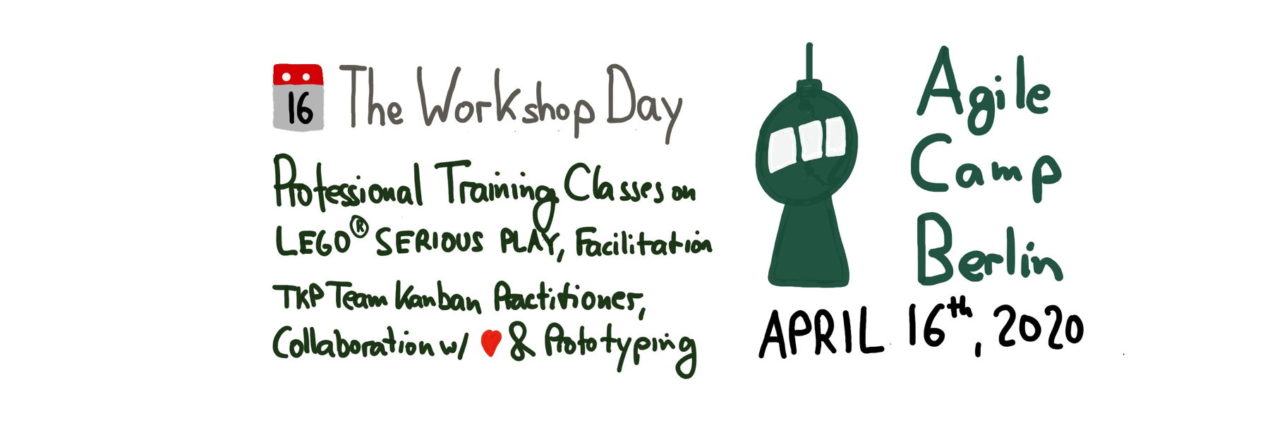
Extend your learning experience at the ACB20 by attending one of five high-class one-day workshops, well-known trainers and coaches will offer at the Agile Camp Berlin Workshop Day on October 22, 2020.
Choose between the following five training classes:
The following terms and conditions apply to the ACB Workshop Day:
🇬🇧 Please note, that the class language in all cases is English unless otherwise stated.
All classes offered at the Agile Camp Berlin can be booked separately from the attendance of the Agile Camp Berlin 2020 with the respective trainer. Please note that this also implies that the attendance of a workshop does not include a ticket for the Agile Camp Berlin 2020.
However, we have an additional 20 ACB20 tickets reserved for workshop attendees who do not have a ticket for the conference yet. (There are no more public tickets available for the ACB20 at this moment.)
The respective trainers provide all workshops. The Berlin Product People GmbH as the organizer of the Agile Camp Berlin 2020, is not involved in the organization of any workshops; any contract is between the workshop attendee and the respective trainer.
Lastly, please also note that the Professional Scrum Master Training PSM I is a 2-day class and hence will take place on April 7-8, 2020; that is a week earlier than the one-day classes.
TL; DR: Kent Beck, Psychological Safety—Food for Agile Thought #230
Welcome to the 230th edition of the Food for Agile Thought newsletter, shared with 25,326 peers. This week, we listen to Kent Beck, the XP creator; we get into the details of how agile leadership manifests itself, and we follow Dave Snowden analyzing a three-part-question popularized by Liberating Structures.
We also delve into the top ten deliverables of product managers; we embrace new ways of organizing our Product Backlogs, and we enjoy the deep-dive into the benefits of the north star framework.
Lastly, we ask what ‘psychological safety’ actually means in practice.
We used two Liberating Structures microstructures — Appreciative Interviews and Superpower Cakewalk — to delve into what lets us grow as professionals as well as individuals.
TL; DR: Traumatic Agile, Absurd Design Sprints—Food for Agile Thought #229
Welcome to the 229th edition of the Food for Agile Thought newsletter, shared with 25,103 peers. This week, we ask whether ‘Agile’ is a reactionary movement; we delve into suitable metrics for experiments, and we learn from a bank how to become agile with 20-plus teams.
We also learn how Pinterest keeps ideas for experiments coming. Speaking of which, we gain insight into suitable experiments at Slack, and we reconsider the usefulness of Design Sprints.
Lastly, we finally have a reference to answer the obvious question: Does Google use Scrum?
TL; DR: The Agile Movers & Shakers Interview with Dave West of Scrum.org
Welcome to the Agile Movers & Shakers interview series. Today’s guest is Dave West.
Dave West is the Product Owner and CEO at Scrum.org. He is a frequent keynote speaker and is a widely published author of articles, along with his acclaimed book: Head First Object-Oriented Analysis and Design. He led the development of the Rational Unified Process (RUP) and then worked with Ivar Jacobson running the North American business for IJI. Then Dave managed the software delivery practice at Forrester research where he was VP and research director. Prior to joining Scrum.org, Dave West was Chief Product Officer at Tasktop where he was responsible for product management, engineering, and architecture.
TL; DR: Asking Good Questions, Trade-offs & Debts—Food for Agile Thought #228
Welcome to the 228th edition of the Food for Agile Thought newsletter, shared with 25,103 peers. This week, we delve into asking good questions, thus overcoming assumptions; we learn more about the cognitive science behind ‘Agile,’ and we cautiously check SAFe again.
We gain insight into how to handle product failures catastrophes; we reflect whether trade-offs are worth the costs. Also, we come back to defining what a product is, focusing on its two critical elements.
Lastly, we appreciate an excursion into psychological safety—from its origins to pioneering its application.