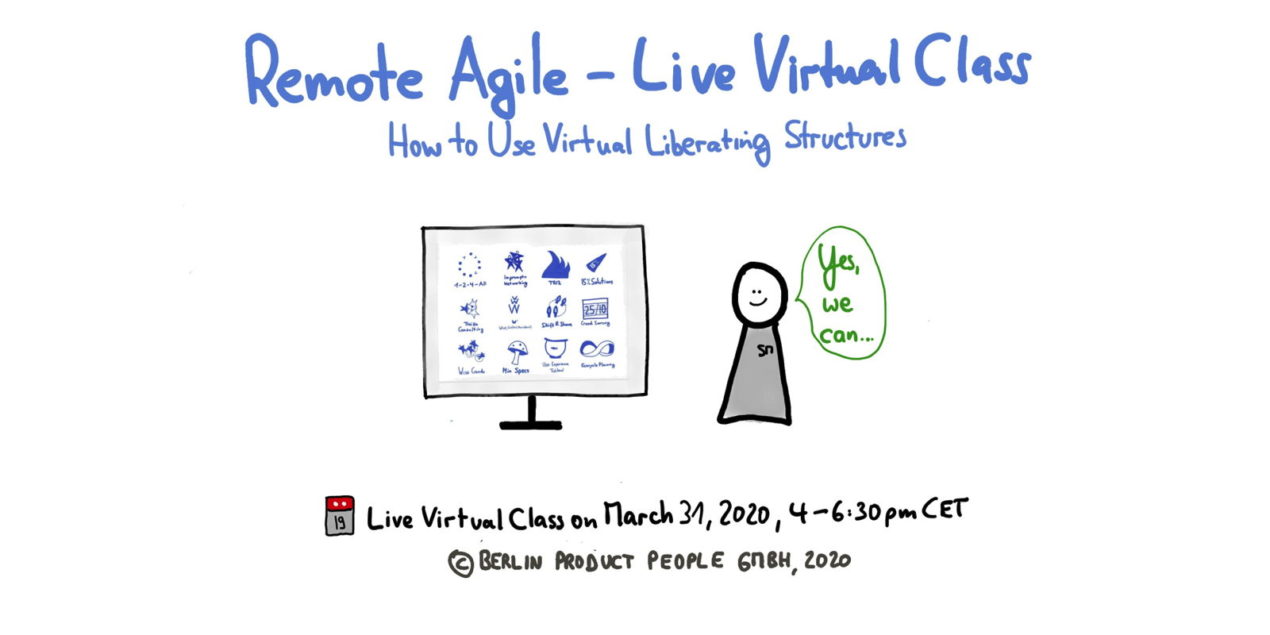
Last week, we addressed basic practices and tools of remote agile with distributed teams. Based on that article, I also ran a live virtual class, the recording of which will be made available soon on the Age-of-Product’s Youtube channel. This follow-up post now delves into virtual Liberating Structures, answering the question of how we can make use of the powerful toolbox of inclusive and collaborative practices in a remote setting.
TL; DR: The Distributed Agile Team, Remote Agile—Food for Agile Thought #234
Welcome to the 234th edition of the Food for Agile Thought newsletter, shared with 25,852 peers. This week, we gain insight into what drives the performance of a distributed agile team; we address disagreement in the time of remote work, and we identify seven ways to improve the level of psychological safety.
We also dare to see an advantage in a downturn; we embrace the magic of conflict for the benefit of the customers, and we download a free, 100-page preview of Mr. Business Model Canvas’ latest book.
Lastly, we explore three key leadership disciplines for distributed agile organizations.
TL; DR: Remote Agile, Part 1: Practices & Tools for Scrum Masters, Agile Coaches, and Product Owners
Agile has always been about colocation, about direct communication, physical boards, and all the other haptic and analog moments to create value in the digital realm. As a Professional Scrum Trainer, I strive to provide training classes without using PowerPoint or digital devices. Moreover, admittedly, I love index cards. However, times are changing. So, let’s dive into the particularities of practicing remote Agile with distributed teams.
We start with basic techniques and tools and follow up with how to apply Liberating Structures in the remote realm. If you like to get a hands-on introduction, consider joining my webinar/live virtual class next Thursday.
TL; DR: Organizational Silos, Staying Calm—Food for Agile Thought #233
Welcome to the 233rd edition of the Food for Agile Thought newsletter, shared with 25,738 peers. This week, we delve into mental models that support decision making in heated situations; we examine how organizational silos emerge and how to take a shot at them, and we embrace a comprehensive analysis of the ‘right’ size of a Scrum team.
We then applaud an epic book-club facilitation guide covering Melissa Perri’s ‘Escaping The Build Trap’ book; we get a better understanding of how we can turn WFH time into quality time from a product management perspective, and we tackle six common product leadership challenges.
Lastly, we take another step towards organizational agility by understanding the importance of multi-functional learning for your team members.
TL; DR: Agile’s Demise, Big Scale Digital Transformations—Food for Agile Thought #232
Welcome to the 232nd edition of the Food for Agile Thought newsletter, shared with 25,623 peers. This week, we look back at ‘Agile’ and ask yourselves: Are the rumors of its demise exaggerated? We also get the inside view of a large scale digital transition of a traditional engineering corporation.
We then explore the perils of being probably too data-driven; we learn how to drive innovation from Mr. Business Model Canvas, and we take ten essential rules of team objectives to heart.
Lastly, we sharpen our tools to overcome any disengagement of team members and continue our Scrum anti-patterns series, focusing on stakeholders.
TL; DR: Liberating Structures, Beautiful Mess—Food for Agile Thought #231
Welcome to the 231st edition of the Food for Agile Thought newsletter, shared with 25,467 peers. This week, we learn about Liberating Structures and change for everyone; we point at the perils of measuring a complex reality, and we get a better understanding of where business agility is heading.
We also enjoy John Cutler’s excursion into embracing change successfully; we gain insight into three ways of making decisions in complex situations, and we listen to why OKRs may not provide the right objectives for a product team.
Lastly, we look back at the evolution of Haier’s organizational model and how self-organization and refrigerators go hand-in-hand.