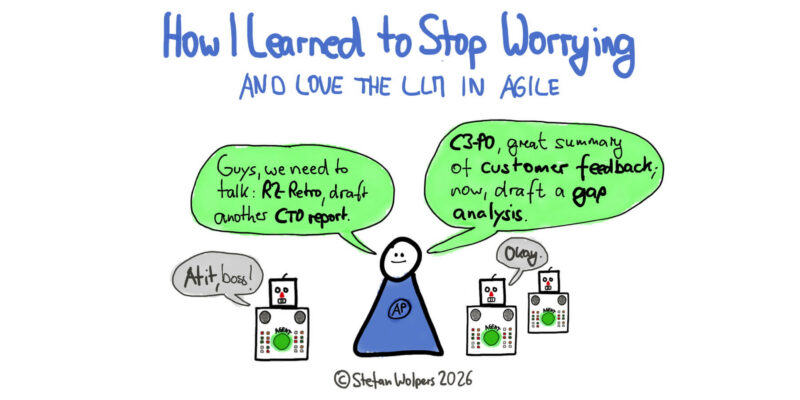
TL;DR: The LLM in Agile
Most agile practitioners are still debating whether AI matters. I stopped debating and started using it. Over two-plus years, AI went from proofreading my book manuscript to designing Retrospectives based on team data, to running an entire product development process for a new course, to working with autonomous AI agents. Each phase revealed what the previous one could not teach. Finally, I went Kubrick and started loving the LLM in Agile.
The window of opportunity to build this competence is open now, but it will not remain open indefinitely. Start acting.
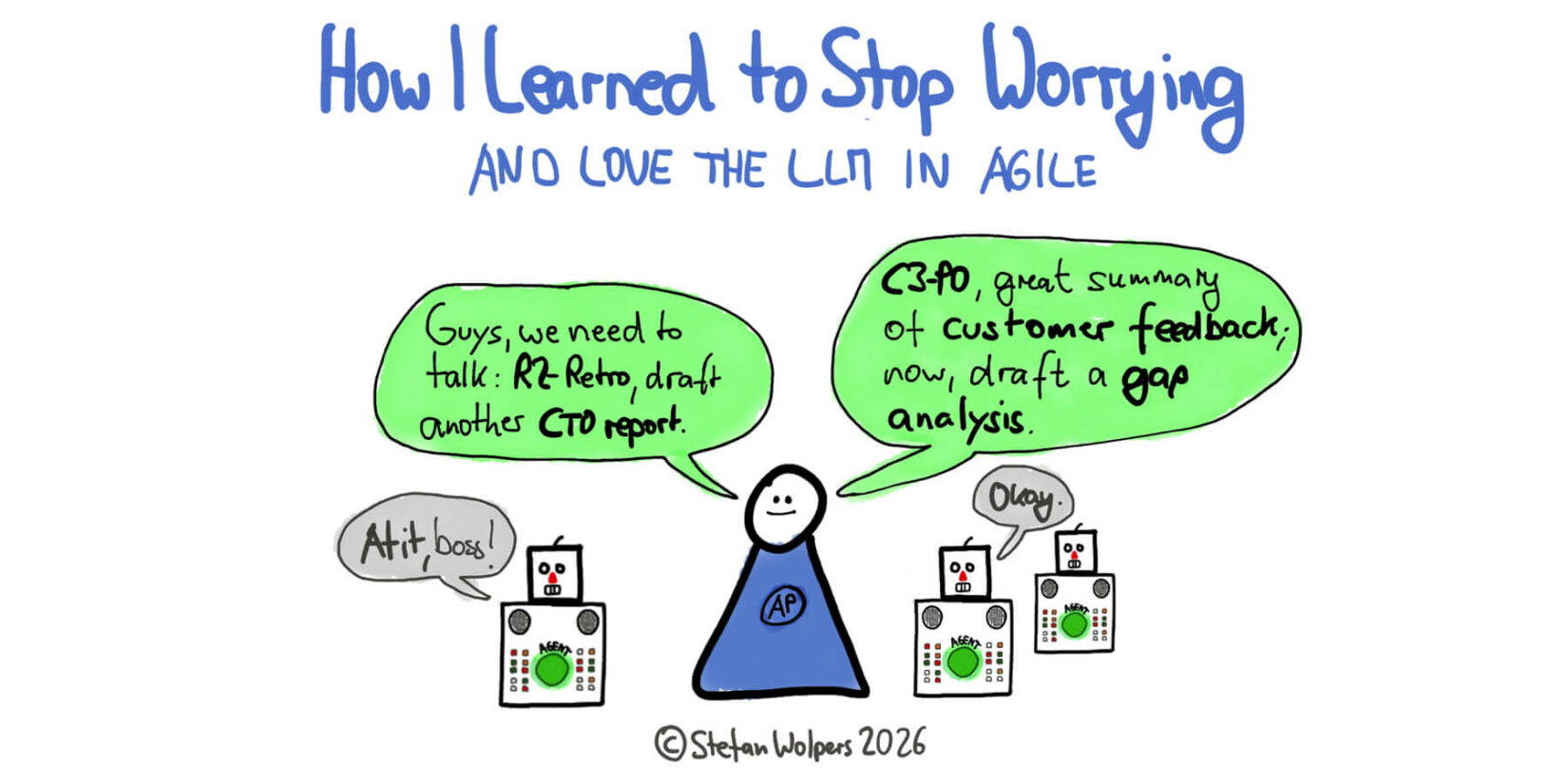
🎓 🇬🇧 🤖 OUT NOW — The AI 4 Agile Online Course v2 at $149
The AI4Agile Online Course v2 teaches you to use AI in your daily agile work. Every lesson uses MegaBrain.io, a fictional startup where you apply AI to Sprint Retrospectives, stakeholder reports, product discovery, and backlog analysis.
72 video lessons. 13+ hours. 9 hands-on exercises. 155+ downloadable resources. 11 modules covering prompt engineering, Claude Skills, Claude Cowork, data analysis, and a framework for deciding where AI helps and where it does not.
No coding required. You leave knowing which tools to use and where to draw the line. This course shows you how to do that precisely .
The latest Version 2 is now available and comes with an introductory price of $149 instead of $249—don’t miss this opportunity to save $100!
👉 Join 400+ Peers and Save $100—But Only Until March 9: AI4Agile Online Course v2 at $149.
🗞 Shall I notify you about articles like this one? Awesome! You can sign up here for the ‘Food for Agile Thought’ newsletter and join 35,000-plus subscribers.
A Personal Journey to the LLM in Agile
You have heard it all by now: AI will take your job, AI is overhyped, get another certification, or wait it out. The advice contradicts itself weekly, and none of it tells you what to do on Monday morning.
Meanwhile, you have not opened an LLM this week for anything related to your actual work. Or you opened one, got a generic Sprint Retrospective agenda, and closed the tab. Neither reaction is wrong, yet both are incomplete.
I want to share something different: what happened when I stopped debating AI and started using it. Not as a party trick or a thought experiment, but as a working tool, applied to real problems I face as an agile practitioner and trainer. The progression surprised me, and it will surprise you, too.
Phase One: A Proofreading Buddy Who Talked Back
My first serious use of AI had nothing to do with Scrum events or team facilitation. It was my book.
I was in the middle of the editing process for the Scrum Anti-Patterns Guide, and anyone who has written a book knows the problem: after the tenth pass through your own manuscript, you stop seeing your own mistakes. Your brain auto-corrects what is on the page to match what you intended to write. Editors help, but the back-and-forth takes weeks per round.
Then, ChatGPT 3.5 appeared. For the first time, I had a collaborator who could check my writing before I passed it to the human editor. Not a spell checker. A thinking partner who could flag where an argument was unclear, where a paragraph lost its thread, where a sentence tried to do too much.
That was the moment AI stopped being a curiosity and became a tool I actively integrated into my work. Proofreading is not exciting. But having a collaborator who catches what your exhausted brain no longer sees changes how you approach a 400-page manuscript.
Phase Two: Pattern Recognition I Could Not Do Alone
The next step happened when I started experimenting with Retrospective design. I had years of facilitation experience and a mental library of formats and exercises. What I did not have was the ability to cross-reference team performance data, identify emerging patterns, and match those patterns against known formats at speed.
AI is good at this, though not for the reason people assume. AI is not creative. It matches: it analyzes data, identifies a pattern, and connects it to something in its training data that fits. That is not original thinking. But it is exactly what a practitioner needs when deciding which Retrospective format will surface the conversation that the team needs most.
The insight was not "AI can design Retrospectives." The insight was that AI is an analytical partner for problems I already knew how to solve, but solved more slowly and with more blind spots on my own.
Phase Three: The LLM in Agile as a Process Collaborator
The real shift came when I was building the Advanced Product Backlog Management Course from scratch. For the first time, I used AI across an entire product development process, not just for a single task.
I started by feeding it student feedback from in-person workshops, interviews, and surveys. Then I added the curriculum's "product strategy and the roadmap." I asked it to find patterns in the feedback: what themes kept appearing? How did those themes align with the idea of where the curriculum should move? How did the short-term priorities, which lessons or artefacts to build next, support or contradict those patterns?
From there, I used AI to generate hypotheses about what practitioners might need, and then to turn those hypotheses into test cards I could validate with experiments before committing to building anything.
This learning was not AI replacing my judgment. I still decided which hypotheses to test and designed the experiments. But AI compressed what would have taken 2 weeks of synthesis into 1-2 hours. And it surfaced connections I had missed because I was too close to my own assumptions about what the market wanted.
Cannot see the form? Please click here.
Where the LLM in Agile Is Heading
The fourth phase arrived while I was building version two of the AI 4 Agile Online Course. I created a lesson on Claude Cowork, Anthropic's tool for non-coders to work with autonomous AI agents. Preparing that lesson forced me to understand something I had been circling around: the difference between using AI as a tool you direct and briefing an AI agent who plans and executes work on your behalf.
That distinction matters for agile practitioners. An agent who handles your operational layer (drafting, formatting, data gathering, report generation) while you focus on judgment, relationships, and strategy is not a party trick. It is a different way of working, which only works if you have a shared understanding of what the agent does, when it does it, and who remains accountable for the result. (That is what the A3 Framework addresses: Assist, Automate, or Avoid.)
The next step in my own practice follows from this: building a personal operating system where AI agents connected to a knowledge store like Obsidian handle routine workflows, while I focus on the work that requires human judgment. I am not there yet. But the direction is clear, and it follows the same pattern: each phase teaches you something the previous phase could not.
That progression, from proofreading buddy to analytical partner to process collaborator to agent operator, took roughly two years. It changed how I work and how I think about what agile practitioners should learn next.
The Window of Opportunity Is Real, and It Is Not Permanent
I wrote last week about why agile practitioners are better positioned for the AI era than the doom narrative suggests. The argument stands: organizations adopting AI are failing for the same structural reasons they failed at Agile transformations. You have the skills to help them succeed.
But skills without tools are incomplete. And the window of opportunity for building AI competence while the competition is still figuring it out is finite. Daily rates for freelance Scrum Masters are in free fall. The old model of defining yourself by the framework you practice is a dead end. You already know this. The question is what you are doing about it.
The investment is small. A $20 monthly subscription to an LLM. A few hours per week of deliberate practice. You do not need a data science degree. You do not need to spend thousands on certifications. You need to do the work: pick a real problem, apply AI to it, evaluate the result, and iterate. The same empirical approach you teach your teams.
I formalized what I learned into the AI 4 Agile Online Course, which launches version two today at an introductory price of $149. It covers prompt engineering, AI-assisted Retrospectives, Product Backlog analysis, the A3 Framework for AI delegation decisions, Claude Skills, and autonomous AI agents, all designed for how agile practitioners think and work. Over 400 practitioners have taken version one. If you want to go further, the AI4Agile Group Coaching adds eight weekly Lean Coffee sessions starting March 16, where you and your peers set the agenda. (The coaching is available as an add-on.)
Conclusions
The gap between practitioners who use AI and those who don't is widening every week. A $20 subscription and a few hours of deliberate practice is all it takes to start. The cost of waiting is not standing still; it is falling behind while the market moves on without you.
The practitioners who will thrive in 2026 are the ones who stopped debating and started experimenting. Pick one task from your week. Run it through an LLM, and see what happens. Then decide what to try next based on evidence, not anxiety.
A year from now, you will wish you had started this week. So, start this week.
📖 LLM in Agile — Related Posts
Why Agile Practitioners Should Be Optimistic for 2026 (Part 1): You Have Already Survived This
The AI4Agile Practitioners Report 2026
Assist, Automate, Avoid: How Agile Practitioners Stay Irreplaceable with the A3 Framework
Agile Is Dead, Long Live Agility
The Reformation That Became the Church
The Immunity Response: How Organizations Neutralize Change

👆 Stefan Wolpers: The Scrum Anti-Patterns Guide (Amazon advertisement.)
📅 Scrum Training Classes, Workshops, and Events
Learn more about the Survival of Agile Practitioners with our AI and Scrum training classes, workshops, and events. You can secure your seat directly by following the corresponding link in the table below:
| Date | Class and Language | City | Price |
|---|---|---|---|
| 🖥 💯 🇬🇧 March 19-April 16,2026 | GUARANTEED: AI4Agile BootCamp #6 — March 19-April 16,2026 (English; Live Virtual Cohort) | Live Virtual Cohort | €499 incl. 19% VAT |
| 🖥 🇩🇪 March 24-25, 2026 | Professional Scrum Product Owner Training (PSPO I; German; Live Virtual Class) | Live Virtual Class | €1.299 incl. 19% VAT |
| 🖥 🇩🇪 April 22-23, 2026 | Professional Scrum Product Owner – AI Essentials Training (PSPO AIE; German; Live Virtual Class) | Live Virtual Class | €799 incl. 19% VAT |
| 🖥 🇩🇪 May 19-20, 2026 | Professional Scrum Product Owner Training (PSPO I; German; Live Virtual Class) | Live Virtual Class | €1.299 incl. 19% VAT |
See all upcoming classes here.

You can book your seat for the training directly by following the corresponding links to the ticket shop. If your organization's procurement process requires a different purchasing approach, please contact Berlin Product People GmbH directly.
✋ Do Not Miss Out and Learn More about the LLM in Agile — Join the 20,000-plus Strong ‘Hands-on Agile’ Slack Community
I invite you to join the “Hands-on Agile” Slack Community and enjoy the benefits of a fast-growing, vibrant community of agile practitioners from around the world.

If you would like to join all you have to do now is provide your credentials via this Google form, and I will sign you up. By the way, it’s free.