
TL; DR: AI Bubble — Food for Agile Thought #511
Welcome to the 511th edition of the Food for Agile Thought newsletter, shared with 40,483 peers. This week, Cedric Chin outlines the Vaughn Tan Rule: keep human judgment central while using AI for synthesis, retrieval, transformation, and speed across grading, feedback, research, coding, scheduling, and discovery. Janna Bastow reframes roadmaps as living prototypes tied to strategy and impact. Itamar Gilad urges AI-enabled, evidence-guided discovery over artifact output. Azeem Azhar, with Nathan Warren, proposes five gauges for assessing the AI bubble risk, while Alex Heath interviews Bret Taylor on agentic apps, voice, and outcome-based models.
Next, Teresa Torres and Petra Wille show how real AI products emerge from prompt decomposition, orchestration, observability, and rigorous evals with cross-functional tradeoffs. Jing Hu highlights MIT’s AI Risk Repository and urges post-deployment focus and concrete failure modes. Mike Fisher explains scaling culture through codified values and rituals, and Kent Beck frames programming deflation and the scarcity of judgment. Also, Gergely Orosz and Laura Tacho share how 18 firms measure AI’s engineering impact.
Lastly, Maarten Dalmijn urges context over dogma by adapting or breaking Scrum rules when outcomes suffer. Paul Boag promotes functional, task-driven personas via lightweight AI workflows, and Emma Webster argues AI accelerates speed but not craft, calling for curiosity, intuition, taste, and intention. Also, Shane Hastie interviews Thanos Diacakis on attacking one bottleneck, limiting WIP, and investing 20 to 30 percent in improvement. Finally, Aaron Chatterji and coauthors chart ChatGPT’s global, rising nonwork adoption and decision-support value.

🎓 🇬🇧 🤖 The AI 4 Agile Online Course at $129 — October 13, 2025
I developed the self-paced AI 4 Agile Online Course for agile practitioners, including Product Owners, Product Managers, Scrum Masters, Agile Coaches, and delivery professionals who want to integrate artificial intelligence into their workflows with clarity, ethics, and purpose.
You don’t need to become an AI expert. However, you do need to understand how LLMs like ChatGPT, Claude, or Gemini can support real agile work and where their limitations lie. Like Jim Highsmith said, AI isn’t just a tool, but a new context for agility.
This course shows you how to do precisely that.
What’s Included:
- 10+ hours of self-paced video modules
- A cohort-hardened, proven course design
- Learn to 10x your effectiveness with AI; your stakeholders will be grateful
- Delve into classic agile use cases of AI
- Help your team create more customer value
- All texts, slides, prompts, graphics; you name it
- Access custom GPTs, including the “Scrum Anti-Patterns Guide GTP”
- Enjoy community access for peer learning
- Guaranteed: Lifetime access to all course updates and materials; there is a lot more to come
- Certificate of completion.

👉 Please note: The course will only be available for sign-up at $129 until October 20, 2025! 👈
🎓 Join the Waitlist of the AI 4 Agile Online Course Now: Master AI Integration for Agile Practitioners—No AI Expertise Required!
Did you miss the previous Food for Agile Thought issue 510?
🗞 Shall I notify you about articles like this one? Awesome! You can sign up here for the ‘Food for Agile Thought’ newsletter and join 40,000-plus subscribers.
🎓 Join Stefan in one of his upcoming Professional Scrum training classes!
🏆 The Tip of the Week
(via Commonplace): How to Use AI Without Becoming Stupid
Cedric Chin introduces the Vaughn Tan Rule: Do not outsource subjective value judgments to AI unless you clearly state and accept the tradeoff. Preserve human meaning-making while using AI for synthesis, retrieval, transformation, and speed. Practical examples span grading, feedback workflows, research comparisons, coding, scheduling, and product discovery.
🎯 Product
(via ProdPad): The Problem with the Perfect Roadmap
Janna Bastow says polished roadmaps waste time, hide uncertainty, and block adaptation. She suggests treating them as living prototypes that show bets, gaps, and desired outcomes, invite debate, and tie initiatives to strategy and measurable impact.
and : 🎙 Building AI Products
Teresa Torres and Petra Wille explain how product teams build real AI products, emphasizing prompt decomposition, orchestration, observability, rigorous evals, and cross-functional collaboration while weighing risk, maintenance costs, and when AI truly solves customer problems rather than casual ChatGPT use.
: AI and Product Management: Becoming More Evidence-Guided
Itamar Gilad argues AI’s real value for PMs is enabling evidence-guided discovery, augmenting analysis, modeling, and goal setting. At the same time, humans lead communication and context, so culture shifts from output and artifacts to outcomes and validated learning.
(via Smashing Magazine): Functional Personas With AI: A Lean, Practical Workflow
Paul Boag advocates functional, task-driven personas over demographics, using lightweight AI workflows to synthesize messy inputs, segment by needs, validate lightly, and keep personas living tools that guide design, content, and conversion decisions.
🧠 Artificial Intelligence
: Is AI a bubble? A Practical Framework to Answer the Biggest Question in Tech
Azeem Azhar and Nathan Warren argue that AI is a boom, not a bubble yet. They offer five gauges to monitor economic strain, industry strain, revenue growth, valuation heat, and funding quality, which can help identify the AI bubble risk.
(via The Verge): Sierra CEO Bret Taylor on why the AI bubble feels like the dotcom boom
Alex Heath captures Bret Taylor’s view that today’s AI surge mirrors the dotcom era: exuberant investment, inevitable failures, yet durable winners as agentic applications mature, voice grows, and outcome-based business models align real value.
: All You Need For AI Risks
Jing Hu spotlights MIT’s living AI Risk Repository cataloging 1,600 failures, urging teams to ignore hype, focus on post-deployment risks, pick one killer domain, shortlist concrete failure modes, and tell actionable stories to drive accountability.
(via Figma): How to Harness Skills That AI Can’t Automate
Emma Webster argues AI boosts speed but not craft, urging teams to cultivate curiosity, intuition, taste, and intention, use design systems as guardrails, and steer AI toward emotionally resonant, high-quality outcomes instead of merely functional prototypes.
🖥 💯 🇬🇧 AI for Agile BootCamp Cohort #3: October 1 – November 12, 2025
The job market’s shifting. Agile roles are under pressure. AI tools are everywhere. But here’s the truth: the Agile pros who learn how to work with AI, not against it, will be the ones leading the next wave of high-impact teams.
So, become the one who professional recruiters call first for “AI‑powered Agile.” Be among the first to master practical AI applications for Scrum Masters, Agile Coaches, Product Owners, Product Managers, and Project Managers.
Tickets also include lifetime access to the corresponding online course, once it is published. The class is in English. 🇬🇧
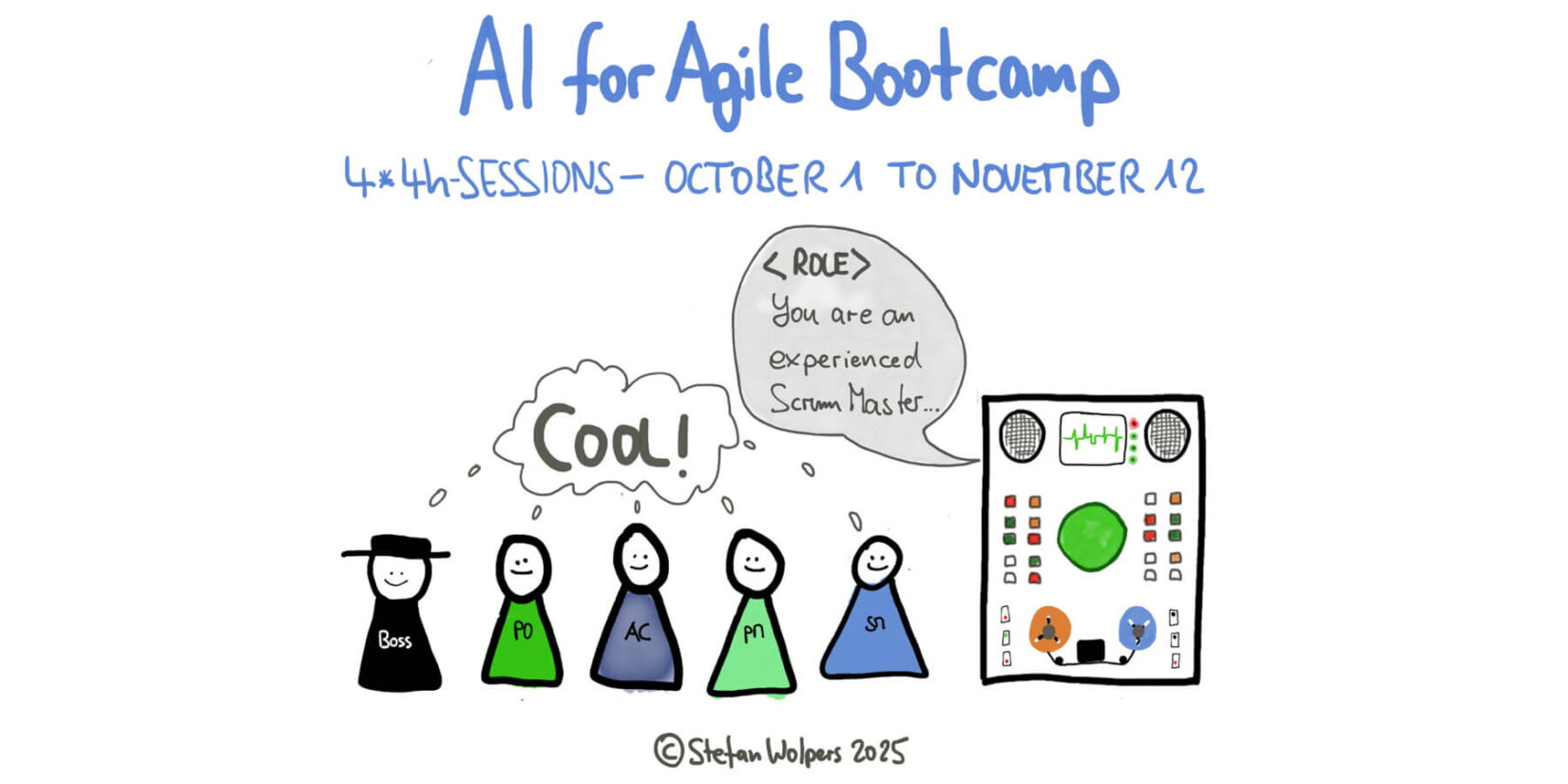
Learn more: 🖥 💯 🇬🇧 AI for Agile BootCamp Cohort #3 — October 1 – November 12.
Customer Voice: “The AI for Agilists course is an absolute essential for anyone working in the field! If you want to keep up with the organizations and teams you support, this course will equip you with not only knowledge of how to leverage AI for your work as an Agilist but will also give you endless tips & tricks to get better results and outcomes. I thoroughly enjoyed the course content, structure, and activities. Working in teams to apply what we learned was the best part, as it led to great insights for how I could apply what I was learning. After the first day on the course, I already walked away with many things I could apply at work. I highly recommend this course to anyone looking to better understand AI in general, but more specifically, how to leverage AI for Agility.” (Lauren Tuffs, Change Leader | Business Agility.)
➿ Agile & Leadership
: On Inversion, Rules and Purpose
Maarten Dalmijn argues rules serve a purpose, not obedience. Challenge dogma, apply inversion, and adapt Scrum pragmatically. When a rule hinders outcomes, consider amending or breaking it to favor context, experimentation, and understanding instead.
: How Culture Scales (or Doesn’t)
Mike Fisher argues that growth stresses culture and proximity-based norms break as teams scale. Leaders must codify values, design durable rituals, use stories, and build decision frameworks so culture strengthens with size and remains adaptive.
: Programming Deflation: When Code Gets Cheaper Every Day
Kent Beck argues programming is in deflation: AI makes code cheap, amplifying both substitution and Jevons effects. Use commodity tools, but invest in judgment, taste, systems thinking, and integration—the new scarcity that wins regardless of headcount outcomes.
📯 Join the AI for Agile Practitioners Survey — Why We Need Your Insights
After analyzing dozens of “AI will transform agile” articles, I’ve found a troubling pattern: They’re written by AI enthusiasts who’ve never run a Sprint, not by practitioners dealing with the messy reality of AI integration.
The result? A dangerous gap between AI hype and Agile’s reality on the ground, leading to misguided implementations across our industry.
As someone who has documented Agile anti-patterns for years, I recognize this pattern. When we let others define our practices without practitioner input, we get cargo cult implementations that miss the essence of what makes Agile work.
👉 The AI for Agile Practitioners Survey is our opportunity to establish the definitive, practitioner-driven understanding of AI’s actual impact on our field—before the consultants and tool vendors do it for us.
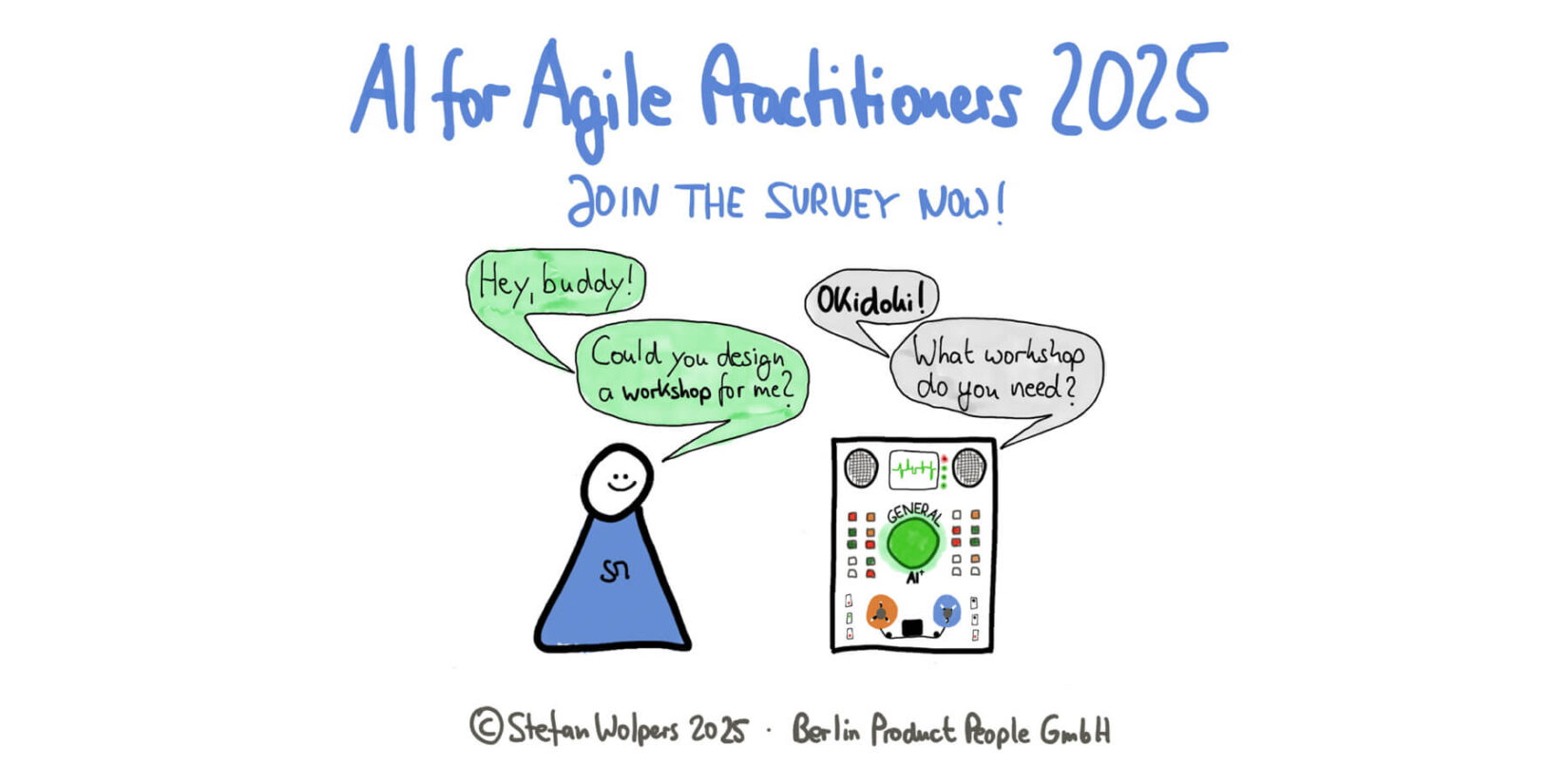
🎓 Learn more: Join the AI for Agile Practitioners Survey — Why We Need Your Insights.
🛠 Concepts, Practices, Tools & Measuring
(via InfoQ): 🎙 Why Software Development Sucks And 7 Mental Models To Help Fix It
Shane Hastie interviews Thanos Diacakis, who argues teams should tackle one bottleneck at a time, limit work in process, balance features with quality and debt, automate feedback to ship faster, and invest 20 to 30 percent in improvement.
and : How tech companies measure the impact of AI on software development
Gergely Orosz and Laura Tacho detail how 18 companies measure AI’s impact on engineering using core delivery, quality, and DevEx metrics plus AI usage, costs, and cohorts to balance speed, reliability, maintainability, and real outcomes.
(via NBER): 📈 How People Use ChatGPT
Aaron Chatterji et al. analyze ChatGPT adoption through July 2025, finding usage by about 10 percent of the world’s adult population, with nonwork use rising, work led by writing, and decision support driving value.
📅 Scrum Training & Event Schedule
You can secure your seat for Scrum training classes, workshops, and meetups directly by following the corresponding link in the table below:
| Date | Class and Language | City | Price |
|---|---|---|---|
| 🖥 💯 🇬🇧 March 19 to April 16, 2026 | Guaranteed: AI4Agile BootCamp #6 (English; Live Virtual Cohort) | Live Virtual Cohort | €499 incl. 19% VAT (If applicable.) |
| 🖥 💯 🇬🇧 April 15-29, 2026 | Guaranteed: Claude Cowork BootCamp (English; Live Virtual Cohort) | Live Virtual Cohort | $149 incl. 19% VAT (If applicable.) |
| 🖥 🇩🇪 April 22-23, 2026 | Professional Scrum Product Owner – AI Essentials Training (PSPO AIE; German; Live Virtual Class) | Live Virtual Class | €799 incl. 19% VAT (If applicable.) |
| 🖥 🇩🇪 May 19-20, 2026 | Professional Scrum Product Owner Training (PSPO I; German; Live Virtual Class) | Live Virtual Class | €1,299 incl. 19% VAT (If applicable.) |
| 🖥 💯 🇬🇧 May 28 to June 25, 2026 | Guaranteed: AI4Agile BootCamp #7 (English; Live Virtual Cohort) | Live Virtual Cohort | €499 incl. 19% VAT (If applicable.) |
See all upcoming classes here.

You can book your seat for the training directly by following the corresponding links to the ticket shop. If the procurement process of your organization requires a different purchasing process, please contact Berlin Product People GmbH directly.
📺 Join 6,000-plus Agile Peers on Youtube
Now available on the Age-of-Product YouTube channel to improve learning, for example, about the AI Bubble:
- Hands-on Agile #68: How to Analyze Unstructured Team Interview Data with AI.
- Fabrice Bernhard: The Lean Tech Manifesto.
- Maarten Dalmijn: The 5 Obstacles to Empowered Teams.
- Roman Pichler: The Top Reasons Why a Product Strategy Fails.
- Johanna Rothman: How to Instill Agility, not Agile Practices.
- Hands-on Agile EXTRA: How Elon Musk Would Run YOUR Business with Joe Justice.

✋ Do Not Miss Out: Learn more about the AI Bubble — Join the 20,000-plus Strong ‘Hands-on Agile’ Slack Community
I invite you to join the “Hands-on Agile” Slack Community and enjoy the benefits of a fast-growing, vibrant community of agile practitioners from around the world.

If you would like to join, all you have to do now is provide your credentials via this Google form, and I will sign you up. By the way, it’s free.
Help your team to learn about Personal AI Productivity by pointing them to the free Scrum Anti-Patterns Guide:

🗞️ Last Week’s Food for Agile Thought Edition
Read more: Food for Agile Thought #510: AI Riches, The Shipping Illusion, Middle-Aged PMs, Enterprise Change Pattern?