
TL; DR: First AI Product — Food for Agile Thought #507
Welcome to the 507th edition of the Food for Agile Thought newsletter, shared with 40,503 peers. This week, Teresa Torres reflects on six lessons from building her first AI product, stressing problem focus, prototyping, architecture, evaluation, and ethical data use. Martin Eriksson argues that execution speed depends more on team organization than strategy, showing how autonomy and reduced dependencies accelerate outcomes. Also, John Cutler contrasts the transformation struggles of chaotic scale-ups with sluggish enterprises. Grant Harvey examines whether AI is a bubble or a breakthrough, hinging on efficiency gains, while Paweł Huryn and Mike Goitein highlight reverse-engineering real choices to uncover actual product strategy.
Next, Richard Mironov urges product leaders to frame trade-offs in financial terms to influence executives. Mike Fisher recommends replacing big bets with many small experiments to accelerate learning, and Sheryl Estrada reports on MIT’s claim that most AI pilots fail. Pawel Brodzinski critiques Radical Candor, emphasizing context over rigid models. Additionally, Janna Bastow challenges teams to stop waiting for structured data and embrace scrappy, ongoing feedback gathering.
Lastly, Mark Greville argues enterprise AI fails when leaders neglect human factors, calling for trust and adaptability over rigid choices. Gary Marcus and Nathan Hamiel highlight significant security risks as LLMs combine with coding agents, and Cris Beswick defends middle managers as critical for innovation and execution. Tanner Wortham warns against wasting energy on unwilling teams, and James Newhook offers practical fixes for flawed personas. Finally, Jason Cohen insists proper validation requires paying customers.
🎓 🇬🇧 🤖 The AI 4 Agile Online Course at $129 — September 15, 2025
I developed the self-paced AI 4 Agile Boot Course for agile practitioners, including Product Owners, Product Managers, Scrum Masters, Agile Coaches, and delivery professionals who want to integrate artificial intelligence into their workflows with clarity, ethics, and purpose.
You don’t need to become an AI expert. However, you do need to understand how LLMs like ChatGPT, Claude, or Gemini can support real agile work and where their limitations lie. Like Jim Highsmith said, AI isn’t just a tool, but a new context for agility.
This course shows you how to do precisely that.
What’s Included:
- 10+ hours of self-paced video modules
- A cohort-hardened, proven course design
- Learn to 10x your effectiveness with AI; your stakeholders will be grateful
- Delve into classic agile use cases of AI
- Help your team create more customer value
- All texts, slides, prompts, graphics; you name it
- Access custom GPTs, including the “Scrum Anti-Patterns Guide GTP”
- Enjoy community access for peer learning
- Guaranteed: Lifetime access to all course updates and materials; there is a lot more to come
- Certificate of completion.

👉 Please note: The course will only be available for sign-up at $129 until September 22, 2025! 👈
🎓 Join the Waitlist of the AI 4 Agile Online Course Now: Master AI Integration for Agile Practitioners—No AI Expertise Required!
Did you miss the previous Food for Agile Thought issue 506?
🗞 Shall I notify you about articles like this one? Awesome! You can sign up here for the ‘Food for Agile Thought’ newsletter and join 40,000-plus subscribers.
🎓 Join Stefan in one of his upcoming Professional Scrum training classes!
🏆 The Tip of the Week: Your First AI Product
: Building My First AI Product: 6 Lessons from My 90-Day Deep Dive
Teresa Torres shares six lessons from building her first AI product, highlighting the need to frame AI around real problems, prototype with care, refine architecture, run continuous evals, and uphold strong ethical data practices.
🎯 Product
: Strategy into Action: Organising Teams to Execute at Pace
Martin Eriksson explains that slow execution often stems from poor team organisation, not flawed strategy, and shows how separating structure from topology, minimising dependencies, and empowering teams enables real ownership and faster strategic impact.
: Two POM Transformation Flavors
John Cutler contrasts two product operating model transformations: rapid scale-ups wrestling with speedboat chaos and large enterprises burdened by Titanic-like inertia, each requiring different tactics to align strategy, structure, and funding.
: Small Bets: Why Volume Beats Conviction in Product Development
Mike Fisher argues most big product bets fail, urging teams to embrace many small, low-risk experiments instead, compounding insights over time and building faster learning systems that outperform high-conviction, resource-heavy launches.
: Finishing Our (Money) Sentences
Richard Mironov argues that product leaders weaken their case by avoiding financial framing, urging them to translate technical trade-offs into money sentences with rough revenue impact estimates to influence executive decisions effectively.
🧠 Artificial Intelligence
(via The Neuron): Are we about to enter ‘AI winter?’
Grant Harvey explores the debate over whether AI is a bubble or a transformative engine, contrasting soaring infrastructure investment with weak enterprise ROI, and showing how unresolved efficiency problems could decide AI’s economic future.
(via Fortune): MIT report: 95% of generative AI pilots at companies are failing
Sheryl Estrada highlights MIT’s claim that 95% of generative AI pilots fail to deliver impact, yet the methodology looks unbalanced, comprising convenience sampling and vague coding. Pilot failure rates are surely high, but readers should review the report themselves before treating its findings as broadly generalizable or market-moving.
and : LLMs + Coding Agents = Security Nightmare
Gary Marcus and Nathan Hamiel warn that combining LLMs with coding agents massively expands the attack surface, enabling prompt injections, watering hole attacks, and remote code execution risks that threaten developer tools and software supply chains.
: Designing for humans: Why most enterprise adoptions of AI fail
Mark Greville argues most enterprise AI adoptions fail not due to technology but because leaders ignore human factors, urging focus on trust, federated innovation, concrete use cases, proper implementation, and adaptability over rigid choices.
🖥 💯 🇬🇧 AI for Agile BootCamp Cohort #2 — September 15 – October 6, 2025
The job market’s shifting. Agile roles are under pressure. AI tools are everywhere. But here’s the truth: the Agile pros who learn how to work with AI, not against it, will be the ones leading the next wave of high-impact teams.
So, become the one who professional recruiters call first for “AI‑powered Agile.” Be among the first to master practical AI applications for Scrum Masters, Agile Coaches, Product Owners, Product Managers, and Project Managers.
Tickets also include lifetime access to the corresponding online course, once it is published. The class is in English. 🇬🇧

Learn more: 🖥 🇬🇧 AI for Agile BootCamp Cohort #2 — September 15 – October 6, 2025.
Customer Voice: “The AI for Agilists course is an absolute essential for anyone working in the field! If you want to keep up with the organizations and teams you support, this course will equip you with not only knowledge of how to leverage AI for your work as an Agilist but will also give you endless tips & tricks to get better results and outcomes. I thoroughly enjoyed the course content, structure, and activities. Working in teams to apply what we learned was the best part, as it led to great insights for how I could apply what I was learning. After the first day on the course, I already walked away with many things I could apply at work. I highly recommend this course to anyone looking to better understand AI in general, but more specifically, how to leverage AI for Agility.” (Lauren Tuffs, Change Leader | Business Agility.)
➿ Agile & Leadership
: The Innovation Crisis: Why Eliminating Middle Managers is Corporate Self-Sabotage -
Cris Beswick warns that eliminating middle managers undermines innovation, as they provide psychological safety, translate strategy into execution, and scale customer-focused solutions, making their removal corporate self-sabotage disguised as efficiency.
: Radical Candor Is an Unreliable Feedback Model
Pawel Brodzinski argues that Radical Candor is unreliable because the lines between care and aggression shift constantly, making context and relationships more important than rigid models for giving and receiving feedback effectively.
: Let the Dead Teams Die
Tanner Wortham argues that some teams are like dead plants: no effort revives them. Leaders waste energy on the unwilling instead of investing in teams ready to grow, eroding morale and culture.
📯 The Statistical AI Parrot in Your Sprint
Your LLM tool doesn't think. It's a statistical AI parrot: sophisticated and trained on millions of conversations—but still a parrot. Teams that fail with AI either don't understand this or act as if it doesn't matter. Both mistakes are costly.
The uncomfortable truth in Agile product development isn't that AI will replace your team (it won't) or that it's useless hype (it isn't). Most teams use these tools on problems that need contextual judgment, then accept outputs without the critical thinking Agile demands.
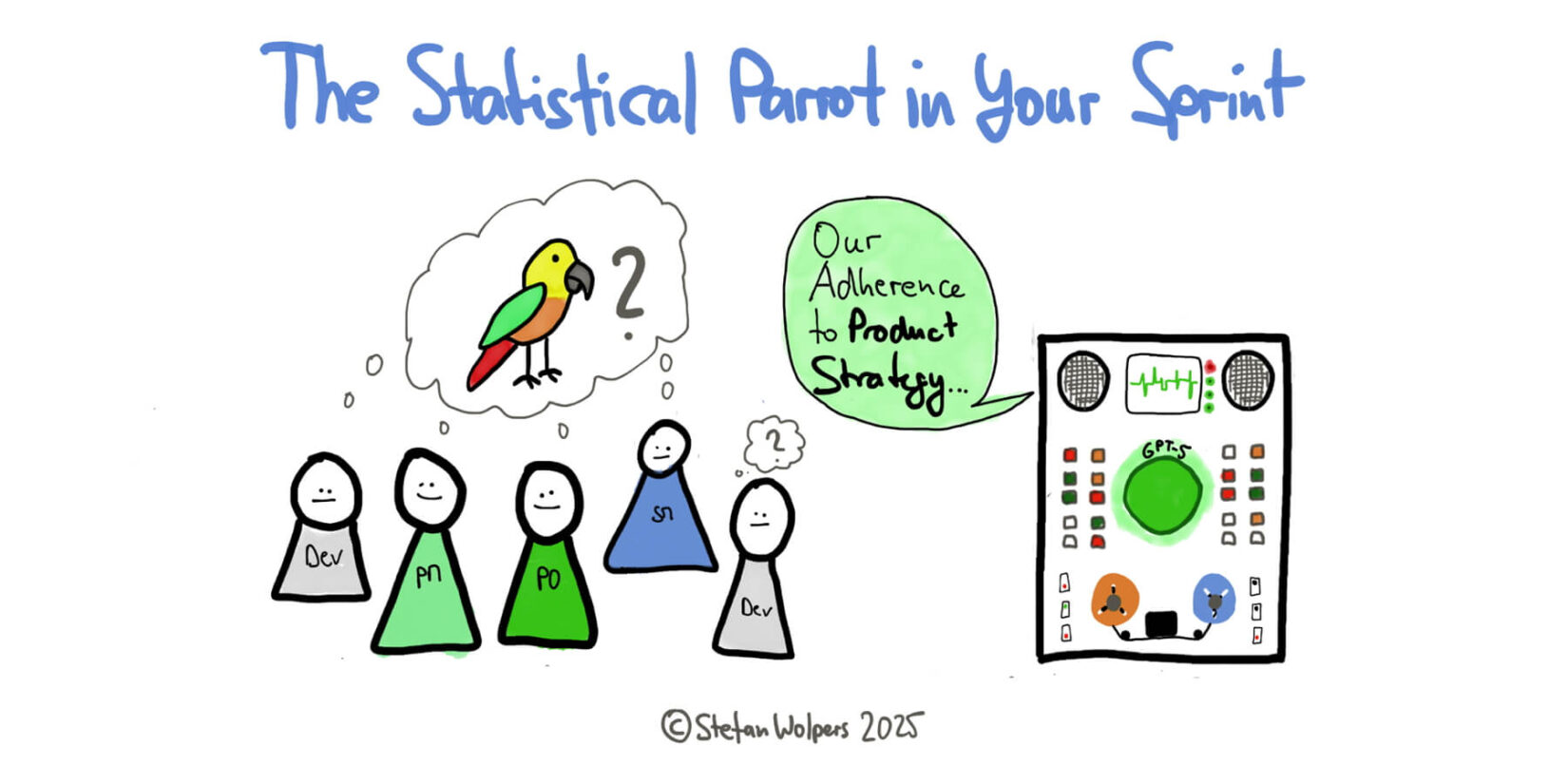
🎓 Learn more: The Statistical AI Parrot in Your Sprint: Why AI Won't Replace Your Agile Team (and Why Ignoring It Is a Mistake).
🛠 Concepts, Practices, Tools & Measuring
(via ProdPad): Early-Stage Feedback: Fast, Scrappy Ways to Get Ahead
Janna Bastow argues that waiting for structured data is procrastination, stressing that scrappy, hands-on feedback gathering uncovers real insights and should be a lasting discipline for both startups and large organisations.
and : A Complete Guide To Reverse-Engineering Strategy
Paweł Huryn and Mike Goitein explain that every product already has a strategy, but most teams confuse goals or plans with it. Reverse-engineering real choices and user behavior reveals the true strategy.
(via IxDF - Interaction Design Foundation): Persona Health Check: What’s Wrong with Yours—and How to Treat It
James Newhook explains how personas often fail when treated as static documents and offers practical fixes like focusing on one primary persona, grounding them in research, involving teams in their creation, and keeping them continuously updated.
(via Jason Cohen): Yes, but who said they'd actually BUY the damn thing?
Jason Cohen argues that startups often skip real validation, fooling themselves with ideas and excuses, when the only evidence that matters is finding at least ten customers ready to pay.
📅 Scrum Training & Event Schedule
You can secure your seat for Scrum training classes, workshops, and meetups directly by following the corresponding link in the table below:
| Date | Class and Language | City | Price |
|---|---|---|---|
| 🖥 💯 🇬🇧 February 19, 2026 | Guaranteed: Hands-on Agile #72: Become Your Organization's AI Champion: A Crowdsourced Playbook (English; Live Virtual Meetup) | Meetup | FREE |
| 🖥 💯 🇬🇧 March 10-11, 2026 | Guaranteed: Professional Scrum Master—Advanced Training (PSM II; English; Live Virtual Class) | Live Virtual Class | €1,299 incl. 19% VAT |
| 🖥 💯 🇬🇧 March 19 to April 16, 2026 | Guaranteed: AI4Agile BootCamp #6 (English; Live Virtual Cohort) | Live Virtual Cohort | €499 incl. 19% VAT |
| 🖥 🇩🇪 March 24-25, 2026 | Professional Scrum Product Owner Training (PSPO I; German; Live Virtual Class) | Live Virtual Class | €1,299 incl. 19% VAT |
| 🖥 🇩🇪 April 22-23, 2026 | Professional Scrum Product Owner – AI Essentials Training (PSPO AIE; German; Live Virtual Class) | Live Virtual Class | €799 incl. 19% VAT |
| 🖥 🇩🇪 May 19-20, 2026 | Professional Scrum Product Owner Training (PSPO I; German; Live Virtual Class) | Live Virtual Class | €1,299 incl. 19% VAT |
See all upcoming classes here.

You can book your seat for the training directly by following the corresponding links to the ticket shop. If the procurement process of your organization requires a different purchasing process, please contact Berlin Product People GmbH directly.
📺 Join 6,000-plus Agile Peers on Youtube
Now available on the Age-of-Product YouTube channel to improve learning, for example, about your First AI Product:
- Hands-on Agile #68: How to Analyze Unstructured Team Interview Data with AI.
- Fabrice Bernhard: The Lean Tech Manifesto.
- Maarten Dalmijn: The 5 Obstacles to Empowered Teams.
- Roman Pichler: The Top Reasons Why a Product Strategy Fails.
- Johanna Rothman: How to Instill Agility, not Agile Practices.
- Hands-on Agile EXTRA: How Elon Musk Would Run YOUR Business with Joe Justice.

✋ Do Not Miss Out: Learn more about Your First AI Product — Join the 20,000-plus Strong ‘Hands-on Agile’ Slack Community
I invite you to join the “Hands-on Agile” Slack Community and enjoy the benefits of a fast-growing, vibrant community of agile practitioners from around the world.

If you would like to join all you have to do now is provide your credentials via this Google form, and I will sign you up. By the way, it’s free.
Help your team to learn about Personal AI Productivity by pointing them to the free Scrum Anti-Patterns Guide: