by Stefan Wolpers|Agile and ScrumAgile TransitionLean and Product
TL; DR: Ethical AI or Risk?
Without ethical AI, Product Owners and Product Managers (PO/PMs) face a dilemma: balancing AI’s potential with its product discovery and delivery risks. Unchecked AI can introduce bias, compromise data, and erode empathy.
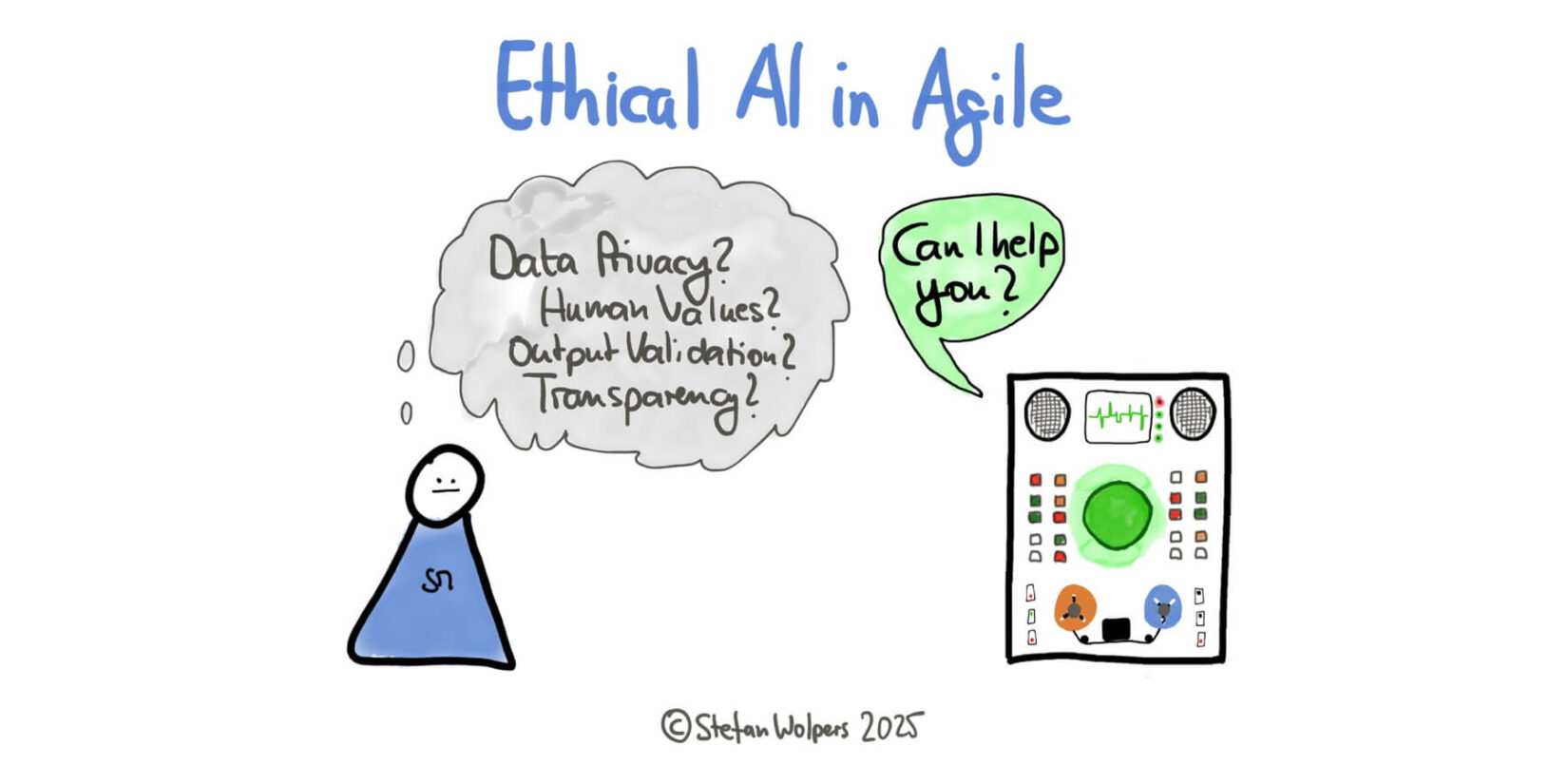
To navigate this, implement four guardrails: ensuring data privacy, preserving human value, validating AI outputs, and transparently attributing AI’s role. This approach transforms PO/PMs into ethical AI leaders, blending AI’s power with indispensable human judgment and empathy.
TL; DR: Is There a Need for the Scrum Guide Expansion Pack?
The Scrum Guide Expansion Pack represents a fascinating contradiction in the agile world. While attempting to cure Scrum’s reputation crisis, it may actually amplify the very problems it seeks to solve. Let me explain what this means for practitioners dealing with the aftermath of failed Scrum implementations.
“Good Enough Agile” is ending as AI automates mere ceremonial tasks and Product Operating Models demand outcome-focused teams. Agile professionals must evolve from process facilitators to strategic product thinkers or risk obsolescence as organizations adopt AI-native approaches that embody Agile values without ritual overhead.
The data couldn’t be more supportive: Despite 25 years of the Agile Manifesto, countless books, a certification industry, conferences, and armies of consultants, we’re collectively struggling to make Agile work. My recent survey, although not targeting Agile failure, still reveals systemic dysfunctions that persist across organizations attempting to implement Agile practices:
Agile teams face ethical challenges. However, there is a path to ethical AI in Agile by establishing four pragmatic guardrails: Data Privacy (information classification), Human Value Preservation (defining AI vs. human roles), Output Validation (verification protocols), and Transparent Attribution (contribution tracking).
This lightweight framework integrates with existing practices, protecting sensitive data and human expertise while enabling teams to confidently realize AI benefits without creating separate bureaucratic processes.
Stop treating AI as a team member to “onboard.” Instead, give it just enough context for specific tasks, connect it to your existing artifacts, and create clear boundaries through team agreements. This lightweight, modular approach of contextual AI integration delivers immediate value without unrealistic expectations, letting AI enhance your team’s capabilities without pretending it’s human.