Daily Scrum Anti-Patterns: 24+2 Ways to Improve as a Scrum Team

TL; DR: 24+2 Daily Scrum Anti-Patterns

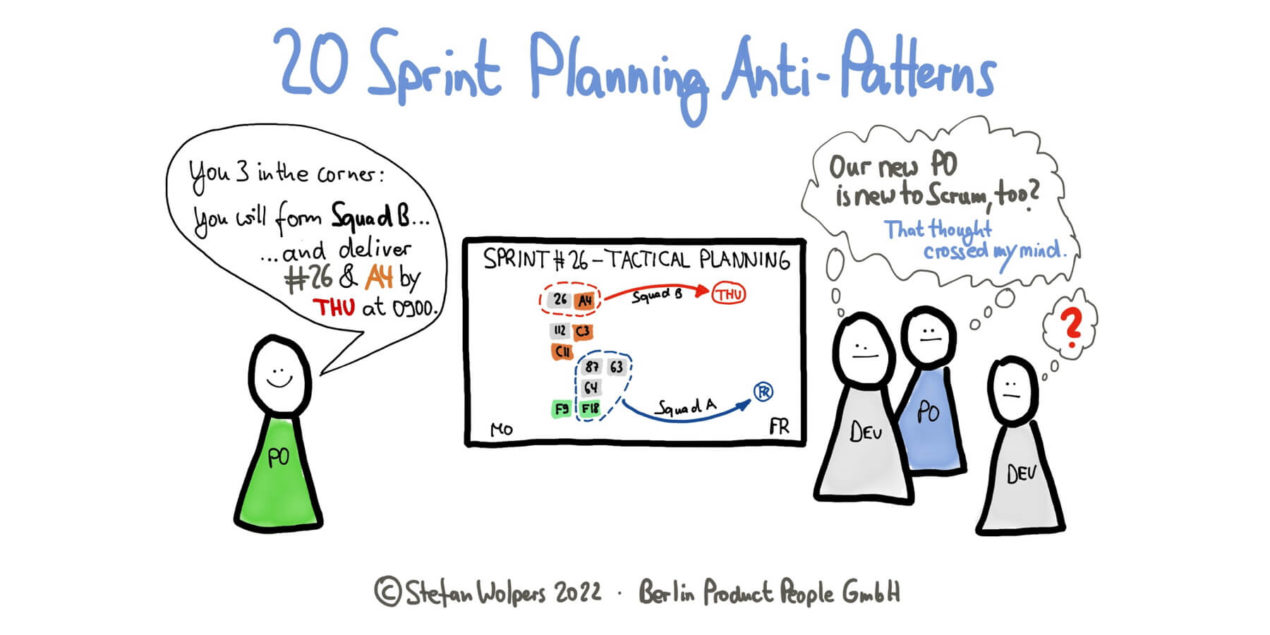
In my experience, the Daily Scrum is the Scrum event with the highest anti-pattern density among all events. Learn more about Daily Scrum anti-patterns that threaten your Scrum team’s success, from becoming a reporting session to assignments to answering these three questions.

Daily Scrum Anti-Patterns: 24+2 Ways to Improve as a Scrum Team — Age-of-Product.com
Continue reading Daily Scrum Anti-Patterns: 24+2 Ways to Improve as a Scrum Team

Food for Agile Thought #334: Shape Up, Product Sense, Adaptive Self-Organization, User Onboarding at Shopify

TL; DR: Shape Up, Product Sense — Food for Agile Thought #334

Welcome to the 334th edition of the Food for Agile Thought newsletter, shared with 34,804 peers. This week, we share lessons learned on what it takes to succeed with Shape Up, Basecamp’s framework for running product development teams by collaboration and productivity. Also, we explore “the impact of hybrid work environments on Agile work,” and we delve into anything Spike-related, from purpose to common misunderstandings.

We then follow Jules Walter as he explains what ‘product sense’ is all about and shares actionable and practical advice on how to develop your product sense. At the same time, John Cutler summarizes the must-haves to get a product team started, from having some process to artifacts to tools. Moreover, we analyze why the collaboration between Product and Marketing may unravel, how to fix this issue, or—better—prevent it from happening in the first place.

Lastly, we reflect on the eleventh principle of the Agile Manifesto: “The best architectures, requirements, and designs emerge from self-organizing teams,” and we point at five estimation failures, from settling for the average to skipping the Definition of Done to fixing time to story points.

Food for Agile Thought #334: Shape Up, Product Sense, Adaptive Self-Organization, User Onboarding at Shopify — Age-of-Product.com
Continue reading Food for Agile Thought #334: Shape Up, Product Sense, Adaptive Self-Organization, User Onboarding at Shopify

How to Pass the Scrum Master Certification — PSM I, PSM II, and PSM III

TL; DR: How to Pass the Scrum Master Certification

The first article of this mini-series established that you do not need a certificate to become good at what you do, for example, working as a Scrum Master. However, getting certified may be a piece of sound investment advice, as documented by the Scrum Master Salary Report 2022: There is a statistical correlation between your remuneration and the certificates you hold. If you want to take advantage of this signaling power that Scrum certificates seem to have, the question is how to pass the Scrum Master certification?

How to Pass the Scrum Master Certification — PSM I, PSM II, and PSM III — Age-of-Product.com
Continue reading How to Pass the Scrum Master Certification — PSM I, PSM II, and PSM III

Food for Agile Thought #333: Identifying New Ways of Working, Burnout in Product Teams, Management Fads such as Agile, Saying No as a PM

TL; DR: Identifying New Ways of Working, Burnout in Product Teams — Food for Agile Thought #333

Welcome to the 333rd edition of the Food for Agile Thought newsletter, shared with 34,749 peers. This week, we reflect on signs of failed self-management and explore how to improve the identification of new ways of working instead. Also, we share a comprehensive take on tech debt, from the term’s coining to cost to inherited debt to, finally, keep it under control. Moreover, we follow Joost Minnaar when he delves into his favorite management fads, turning into religions attracting missionaries and apostles, and we follow Ben Thompson’s analysis on the long-term impact of Putin’s war on Ukraine on the tech industry.

We then explore product management practices that can lead to burnout, and we dive into product strategy, the “connective tissue between what a product team is doing day-to-day and the company’s ambition.” Additionally, we share Joni Hoadley’s recipe for managing stakeholders and how to ‘say no’ without losing their support or trust, and we learn more about user stories as a concept from Bill Wake.

Lastly, we list seven common reasons why stakeholders ignore your team’s Sprint Review, from a lack of progress to ignored feedback to conflicting obligations. On top of that, we answer ten popular questions regarding the Monte Carlo method to help you better forecast your team’s throughput for a future period.

Food for Agile Thought #333: Identifying New Ways of Working, Burnout in Product Teams, Management Fads such as Agile, Saying No as a PM — Age-of-Product.com
Continue reading Food for Agile Thought #333: Identifying New Ways of Working, Burnout in Product Teams, Management Fads such as Agile, Saying No as a PM

Scrum Master Success: How Do You Identify a Successful Scrum Master?

TL; DR: Scrum Master Success — My Top-Nine Indicators

How would you know that your Scrum Master is competent? What are indicators for Scrum Master success? Is the regular use of the Confluence retrospective template one of the desired signals? Or is the quest to understand contributing factors futile, as success reasons are so diverse? Probably, there is no direct connection between a Scrum Master, not having authority anyway, and the overall Scrum team’s performance.

Read on and learn more about how Scrum Masters can contribute to the success of a self-managing team in nine simple lessons.

<Scrum Master Success: How Do You Identify a Successful Scrum Master? Age-of-Product.com

Continue reading Scrum Master Success: How Do You Identify a Successful Scrum Master?

Food for Agile Thought #332: Talking to Customers, The Learning Repository, Team Dependencies, Resources for Product Owners

TL; DR: Talking to Customers, Learning Repository — Food for Agile Thought #332

Welcome to the 332nd edition of the Food for Agile Thought newsletter, shared with 34,681 peers. This week, we regret that most product managers seem to have stopped talking to customers nowadays. Also, we list nine reasons to become agile, from a bad ‘it’s the trendy thing to do’ to a good ‘we believe in the Agile values and principles.’ Moreover, we deal with fixing unnecessary dependencies, and we suggest utilizing seven classic team building models to ‘inspire, troubleshoot, and build alignment,’ from Tuckman to Katzenbach to Hackman.

We then argue that it is essential to create a learning repository to run experience-informed experiments, and we share an epic list of binge-worthy material on product ownership. In addition to that, Teresa Torres provides her approach to identifying candidates for both “beginner” and experienced product teams for user interviews.

Lastly, we share a simple visualization tool to foster rapid idea generation—quantity may have its own quality, and we follow Jeff Gothelf, who vigorously opposes the notion that goals do not need continuous review and adjustment. And there is one more thing: The Guardian reports on a damning new Netflix documentary, detailing the consequences when a once engineering- and quality-driven culture is forced by the new management to bow to Wall Street.

Food for Agile Thought #332: Talking to Customers, The Learning Repository, Team Dependencies, Resources for Product Owners — Age-of-Product.com
Continue reading Food for Agile Thought #332: Talking to Customers, The Learning Repository, Team Dependencies, Resources for Product Owners