Food for Agile Thought #338: The Taste of Salt & Agile Coaching, Visual Planning w/ Jeff & Gojko, Dunbar’s Number, Escaping the Planning Illusion

TL; DR: The Taste of Salt & Agile Coaching, Visual Planning w/ Jeff & Gojko — Food for Agile Thought #338

Welcome to the 338th edition of the Food for Agile Thought newsletter, shared with 35,072 peers. This week, we listen to Jeff Patton, Gojko Adzic, and James Shore delving into the benefits of visual planning. We also reflect on an often referred-to but rarely understood critical concept required to solve complex adaptive problems. Speaking of teamwork, we dive into the importance of group sizes in creating social cohesion and collaboration, referring to the ‘Dunbar number’—often used, simplified, and rarely understood as a concept. Moreover, Shai Yallin describes a process often causing technical debt and how to create systems to prevent this from happening.

We then analyze three significant problems with long-term planning, from premature decision making to the inevitable time consumption to promoting rigidity. Also, we criticize distinguishing between problem-solving and problem definition; this is probably less helpful than you think. Moreover, we suggest a simple approach to getting started with a critical element of product analytics and product-led growth to prevent you from slipping into feature factory mode.

Lastly, we follow Yves Hanoulle and Jason Yip using a compelling metaphor to explore the idea of ‘agile coaching.’ Then, borrowing from the human-centered systems thinking school, Deirdre Cerminaro suggests a visualization technique to help you ‘spot opportunities for growth and change.’ And we ask: How does Le Corbusier’s ‘Cité Frugès de Pessac’ masterpiece relate to going back to the office? Or shall we rather say: being forced back into the office?

Food for Agile Thought #338: The Taste of Salt & Agile Coaching, Visual Planning w/ Jeff & Gojko, Dunbar’s Number, Escaping the Planning Illusion — Age-of-Product.com
Continue reading Food for Agile Thought #338: The Taste of Salt & Agile Coaching, Visual Planning w/ Jeff & Gojko, Dunbar’s Number, Escaping the Planning Illusion

27 Product Backlog and Refinement Anti-Patterns

TL; DR: 27 Product Backlog and Refinement Anti-Patterns

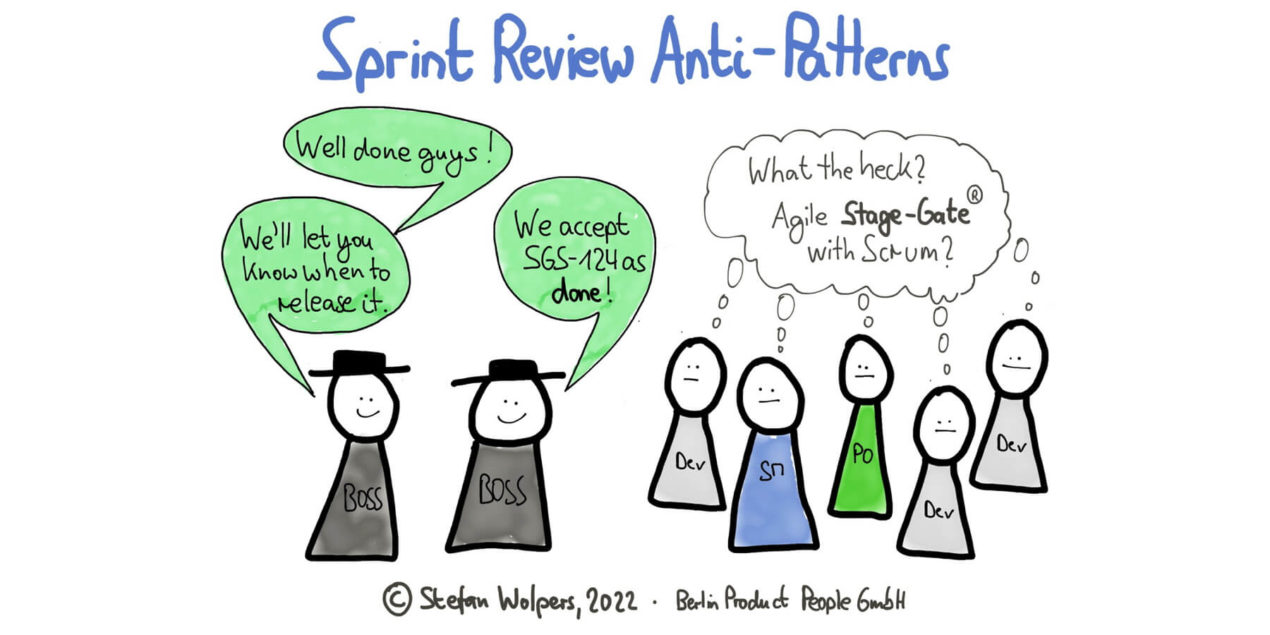
Scrum is a tactical framework to build products, provided you identify what is worth making in advance. But even after a successful product discovery phase, you may struggle to create the right thing in the right way if your Product Backlog is not up to the job—garbage in, garbage out. The following article points to 27 common Product Backlog anti-patterns – including the Product Backlog refinement process – limiting your Scrum team’s success.

Scrum Product Backlog Anti-Patterns from the Scrum Anti-Patterns-Guide — Age-of-Product.com
Continue reading 27 Product Backlog and Refinement Anti-Patterns

Food for Agile Thought #337: Story Points Made Simple, The Art Part of Product Management, Agility Patterns, Useful Team Metrics

TL; DR: Story Points Made Simple, The Art Part of Product Management — Food for Agile Thought #337

Welcome to the 337th edition of the Food for Agile Thought newsletter, shared with 35,011 peers. This week, we join Tim Ottinger, exploring the truth about story points and inviting the rest of the community to join. We also delve into patterns of agile transformations, from psychological safety to the “illusion of control,” and we cover engineering team success tactics from making all work visible to WiP limits to utilizing velocity right.

We then share an engaging canvas on the opportunities and realities of picking work by product teams. Moreover, we explore the criticality of human skills for product management—the Six Cs from communication to consciousness, while pointing out that successful products are typically not the work of a single genius with a magic touch but teamwork. Also, Roman Pichler delved into your questions on the role of the Product Owner, ranging from product manager vs. Product Owner vs. business analyst to the right size of a Product Backlog to linking product vision to Product Goal and Sprint Goal.

Then, based on Annie Duke’s work from “Thinking in Bets,” First Round Capital provides a guide on helpful mental models to support decision-making in teams and organizations, not just startups. On top of that, Lean Agile Intelligence aggregated a valuable list of resources on beneficial team metrics. Finally, we listen to Hà Phan, who advocates that “machine learning (ML) can be a key tool to gain the most effective data about your users.”

Food for Agile Thought #337: Story Points Made Simple, The Art Part of Product Management, Agility Patterns, Useful Team Metrics — Age-of-Product.com
Continue reading Food for Agile Thought #337: Story Points Made Simple, The Art Part of Product Management, Agility Patterns, Useful Team Metrics

📺 Roman Pichler: The Product Owner — Hands-on-Agile #38

TL; DR: HoA #38: Ask-Me-Anything w/ Roman Pichler: The Product Owner

In this energizing 38th Hands-on Agile session, Roman Pichler delved into your questions on the role of the Product Owner. The topics range from product manager vs. Product Owner vs. business analyst to the right size of a Product Backlog to linking product vision to Product Goal and Sprint Goal.

📺 Watch the video now: Roman Pichler: The Product Owner — Hands-on-Agile #38.

Hands-on-Agile #38: AMA with Roman Pichler: The Product Owner — Age-of-Product.com
Continue reading 📺 Roman Pichler: The Product Owner — Hands-on-Agile #38

Food for Agile Thought #336: Prioritization Politics, Experiments w/ POPCORN, Frederick Winslow Taylor, ProductOps Bootcamp

TL; DR: Prioritization Politics, Experiments w/ POPCORN — Food for Agile Thought #336

Welcome to the 336th edition of the Food for Agile Thought newsletter, shared with 34,938 peers. This week, we share a deep dive into the challenges of prioritization politics — as we product folks consider ourselves analytical and algorithmic — and the friction this causes with other stakeholders, namely “the business.” Hesitantly, we also point to a eulogy on #Taylorism, and we learn from Catherine Louis how her experience as a K9 handler and a search-and-rescue technician helped her coach teams live up to their potential.

We then introduce John Cutler’s POPCORN Flow, a ”framework for thinking about improvement experiments.” Moreover, Marty Cagan explains the essence of being in “product” by pointing at a long-thought lost Steve Jobs interview, and Janna Bastow interviews Melissa Perri on the secrets that create successful Product Ops teams.

Lastly, we analyze “21 lessons on the uses, abuses, and half-truths of the measuring innovation” and point to the pitfalls of a typical “transformation” that often starts with killing psychological safety in the opening phase. Finally, we close this week’s edition with a collection of PM memes starring Spiderman, Dilbert, Samuel L. Jackson, and Leonardo DiCaprio.

Food for Agile Thought #336: Prioritization Politics, Experiments w/ POPCORN, Frederick Winslow Taylor, ProductOps Bootcamp — Age-of-Product.com
Continue reading Food for Agile Thought #336: Prioritization Politics, Experiments w/ POPCORN, Frederick Winslow Taylor, ProductOps Bootcamp

Food for Agile Thought #335: Idea Repositories, Team Building w/ Conway’s Law, Measuring Added Value, Estimation Is a Waste

TL; DR: Idea Repositories, Team Building w/ Conway’s Law — Food for Agile Thought #335

Welcome to the 335th edition of the Food for Agile Thought newsletter, shared with 34,866 peers. This week, we analyze the benefits of organizing transparent systems that handle the influx of suggestions, requirements, epiphanies, and learning: ideas repositories. Also, we describe the benefits of applying lessons learned from “Team Topologies” by Manuel Pais and Matthew Skelton regarding team building, and we explain the difference between coaching and mentoring, two critical stances of a servant leader.

We then listen to John Cutler exploring how “teams slip into the trap of using a single ‘mono-process’ (one way) for all types of work.” Moreover, we suggest building products with—not for—your community, delve into six essentials factors determining whether your product team will be successful, and figure out a way to measure the added value of your product.

Lastly, we share Luís Soares’s refreshingly contrarian thinking on estimations, Sprints, and other practices he considers futile. Finally, we close with Shane Parrish, who reflects on the effects of “mapping” the world and then taking this map as an accurate representation of the world.

Food for Agile Thought #335: Idea Repositories, Team Building w/ Conway‘s Law, Measuring Added Value, Estimation Is a Waste — Age-of-Product.com
Continue reading Food for Agile Thought #335: Idea Repositories, Team Building w/ Conway’s Law, Measuring Added Value, Estimation Is a Waste