On many occasions, working with agile teams has amplified existing organizational, technical, and cultural challenges in many organizations. Starting to change always requires the acceptance that there is a problem that needs attention. The following article addresses some of the most prevailing impediments to achieving agility by revisiting several agile laws that are particularly relevant to any team’s effectiveness in solving customer problems.
TL; DR: Continuous Product Improvement — Food for Agile Thought #427
Welcome to the 427th edition of the Food for Agile Thought newsletter, shared with 47,634 peers. This week, Jeff Patton outlines a continuous product improvement cycle, highlighting its critical stages, and Brian Link delves into the evolving landscape of agile practices, reflecting on the recent dynamics. Heidi Helfand shares valuable strategies from her book “Dynamic Reteaming,” while Joost Minnaar advocates personal transformation as a critical element in successful organizational change. Also, we ask whether Scrum GPTs pose a challenge to Scrum Masters.
Then, Roman Pichler shares essential tips on product portfolio strategy, while Alistair Cockburn advocates using simple use cases and user stories in Agile teams. Jason Evanish guides Product Managers on helping engineers improve feature delivery estimates, and Thiago Brant explores the importance of Business Agility across all areas of your organization, pointing to useful practices and helpful frameworks.
Lastly, Alex Ewerlöf discusses the concept of ‘tech gamble’ and the importance of informed decision-making in technology development. The Consortium for Information & Software Quality™ highlights the high cost of poor software quality in the US, and Dave Snowden reflects on his early work with matrices and their alignment with complexity science. Shane Hastie’s interview with psychologist John Fisher explores the Fisher Change Curve and its applications in change management. Finally, Economist Tyler Cowen delves into the evolving role of AI, from its potential for leveling the playing field to its broader societal implications in various domains.
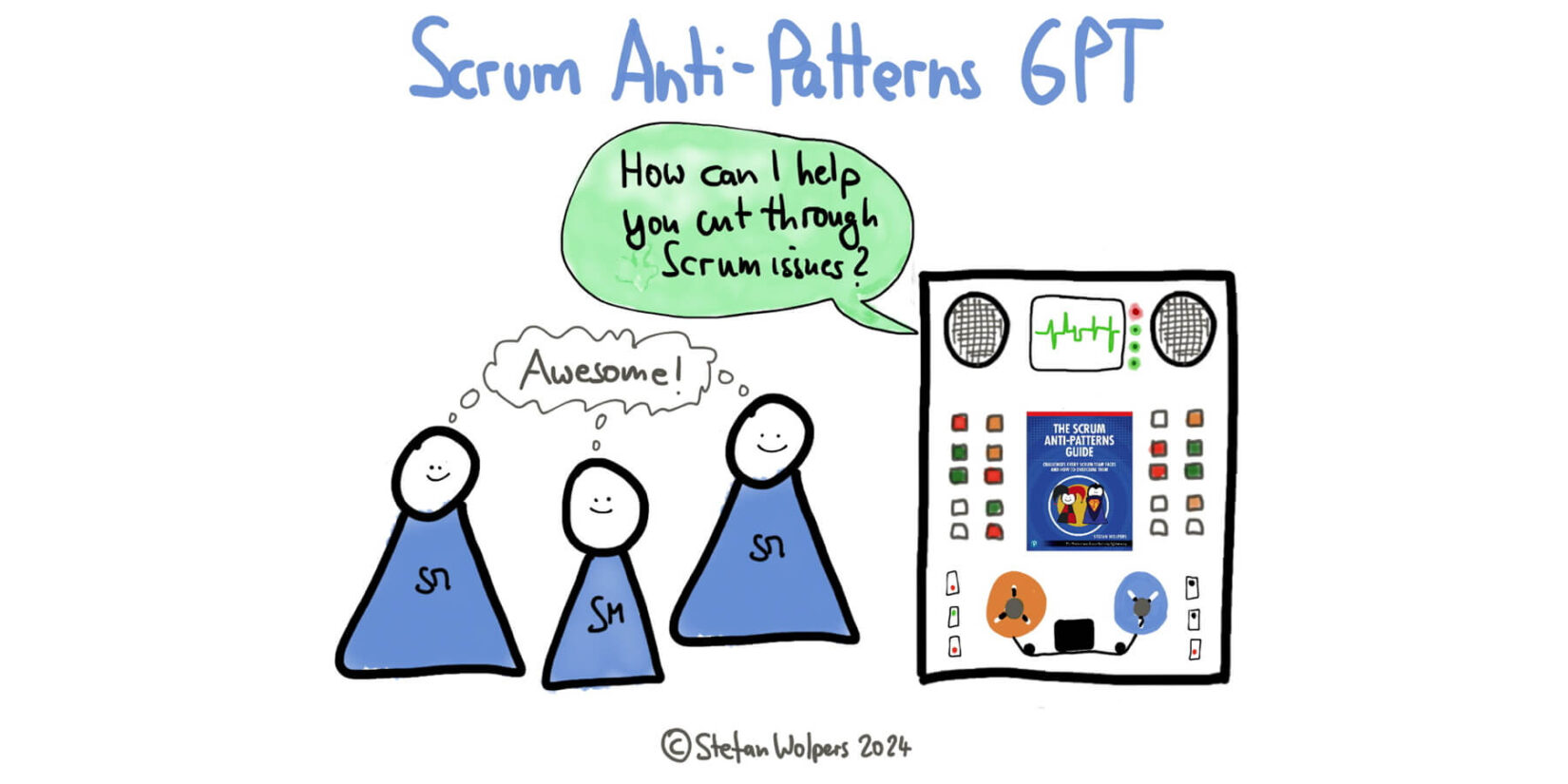
Fewer Jobs for Scrum Masters, and now we see the universal Scrum GPT entering the competition: Will Scrum Masters change from essential practitioners to a niche role?
The job market is currently challenging for many agile practitioners, particularly Scrum Masters. Many are looking for new opportunities, while an increasing number of organizations consider the benefits they contribute to a team’s overall success. This is not just reflected in fewer job offerings for Scrum Masters; we also observe the demand for training significantly reduced.
To make the situation worse, AI has improved significantly over the last 12 months, too. Back in November 2023, OpenAI released GPTs, a hyper-customizable version of their GPT-4-based chatbot. (Please note that you need to have access to OpenAI’s paid version of ChatGPT to use GPTs.)
Besides the exciting market opportunity for many people with specific knowledge, data, or content, the question is what implication this new technology will have on the job market for agile practitioners when their roles are partly based on “knowledge” now available from a machine?
TL; DR: Continuous Integration — Food for Agile Thought #426
Welcome to the 426th edition of the Food for Agile Thought newsletter, shared with 49,156 peers. This week, we explore Martin Fowler’s essay, advocating for Continuous Integration for team efficiency, while Martijn Oost critiques quick Agile transformations, emphasizing a tailored approach. John Cutler discusses rebuilding trust in leadership, and Chris Corrigan explores organizational life cycles with the ‘two loops model.’ Lastly, we identify the signs of a Scrum Master’s journey nearing its end, reflecting on evolving organizational dynamics.
Then, Maarten Dalmijn delves into feature development, highlighting the actual value not in the features themselves but in the opportunities they create for users. Janna Bastow contrasts the complexities of overseeing multiple products in large enterprises with the more focused task of managing a single product. Additionally, Lenny Rachitsky and Dan Hockenmaier emphasize the significance of deciphering your business’s core dynamics using a fundamental equation that encapsulates inputs, desired outputs, and their interconnections.
Finally, Jason Cohen highlights the complexities of forecast evaluation using weather prediction examples, focusing on accuracy beyond just surface-level results. Benjamin Huser-Berta explains Monte Carlo Simulations’ role in forecasting and effective planning. Mads Soegaard and another article discuss the significance of user story mapping and Job Stories in product development, enhancing UX design and aligning with user perspectives. Lastly, Howard Tiersky advocates for agile adaptation in digital transformations to meet evolving technological and customer demands.
In this article, I uncover indicators that a Scrum Master’s or Agile Coach’s journey is coming to a close; they are sunsetting Scrum Masters.
These indicators include, for example, management’s deviation from first principles, reduced support for your change initiatives, an emerging preference for short-term fixes over long-term agile strategies, a shift back to top-down control, decreased communication involvement, exclusion from management discussions, neglected input, waning reliance from the team, being left out of new communication channels, and lessened requests for meeting facilitation.
Consequently, recognizing and addressing these signs is critical to maintaining integrity and effectiveness.
Finally, please do not fool yourself; sometimes, it is also time to move on.
TL; DR: Change Agent Tips — Food for Agile Thought #425
Welcome to the 425th edition of the Food for Agile Thought newsletter, shared with 49,156 peers. This week, John Cutler presents 20 change agent tips. Additionally, in two academic studies, Kristin Geffers, Karen Eilers, Sarah Oeste-Reiß, and Ulrich Bretschneider explore Agile Leadership’s key roles, while Christiaan Verwijs and Daniel Russo examine diversity’s impact on software teams. Moreover, Charity Majors discusses the necessity of engineering managers in startups.
Then, Jason Cohen shares WP Engine’s eight-step journey to success, emphasizing fit and strategic, retention-focused development, and Lenny Rachitsky interviews Will Larson on systems thinking and productivity in product and engineering. Also, Petra Wille explores impactful product culture and leadership, and Maarten Dalmijn introduces ‘humble planning’ as essential in Agile practices for creating valuable products, discussing friction and intent-based leadership.
Lastly, J. Meadows critiques the belief in maximum staff utilization in software organizations, showing its negative impact on productivity and innovation. Adam Thornhill explains Brooks’ Law, where adding staff to delayed projects increases delays, and Kent Beck discusses the complexities of measuring engineering productivity and suggests a balanced approach. Finally, Dave Hora explores the changing role of research in organizations, stressing the importance of understanding current states for effective product integration.