Food for Agile Thought #493: SVPG Product Change Approach, Cheaters Gonna Cheat, Why Startups Fail, Perils of Seeking Approval

TL; DR: SVPG Product Change Approach — Food for Agile Thought #493

Welcome to the 493rd edition of the Food for Agile Thought newsletter, shared with 42,639 peers. This week, John Cutler explores how SVPG product change approach by framing executive challenges as leadership strengths, stressing that change agents must master timing, framing, and credibility. Cedric Chin asserts that authentic demand—not just value propositions—predicts startup success, while Roman Pichler presents the Innovation Ambition Matrix for strategic innovation. Also, Barry O’Reilly urges leaders to see AI as leverage, not a cure-all, and Oliver Schilke and Martin Reimann’s research highlights the paradox of disclosing AI use: transparency erodes trust, but concealment risks harsher backlash.

Next, David Pereira cautions that AI amplifies dysfunction if leaders neglect culture and strategy, while Peter Yang identifies five ways to future-proof your product career. Zvi Mowshowitz contends that AI-enabled student cheating reveals education’s core flaws. An AWS study finds AI prioritized over security, and Andy Cleff shows how nature’s distributed leadership inspires resilient, adaptive organizations.

Lastly, Charles Lambdin examines how narrative “sorcery” shapes power in organizations, while Alex Ewerlöf challenges Staff+ role rigidity, advocating for versatile engineers. Nir Eyal offers strategies to escape approval-seeking, and Gregor Ojstersek shares how AI elevates engineering leadership. Finally, Mike Loukides explores “vibe coding,” urging us to embrace efficiency but remain accountable for code quality and learning.

Food for Agile Thought #493: SVPG Product Change Approach, Cheaters Gonna Cheat, Why Startups Fail, Seeking Approval — Age-of-Product.com
Continue reading Food for Agile Thought #493: SVPG Product Change Approach, Cheaters Gonna Cheat, Why Startups Fail, Perils of Seeking Approval

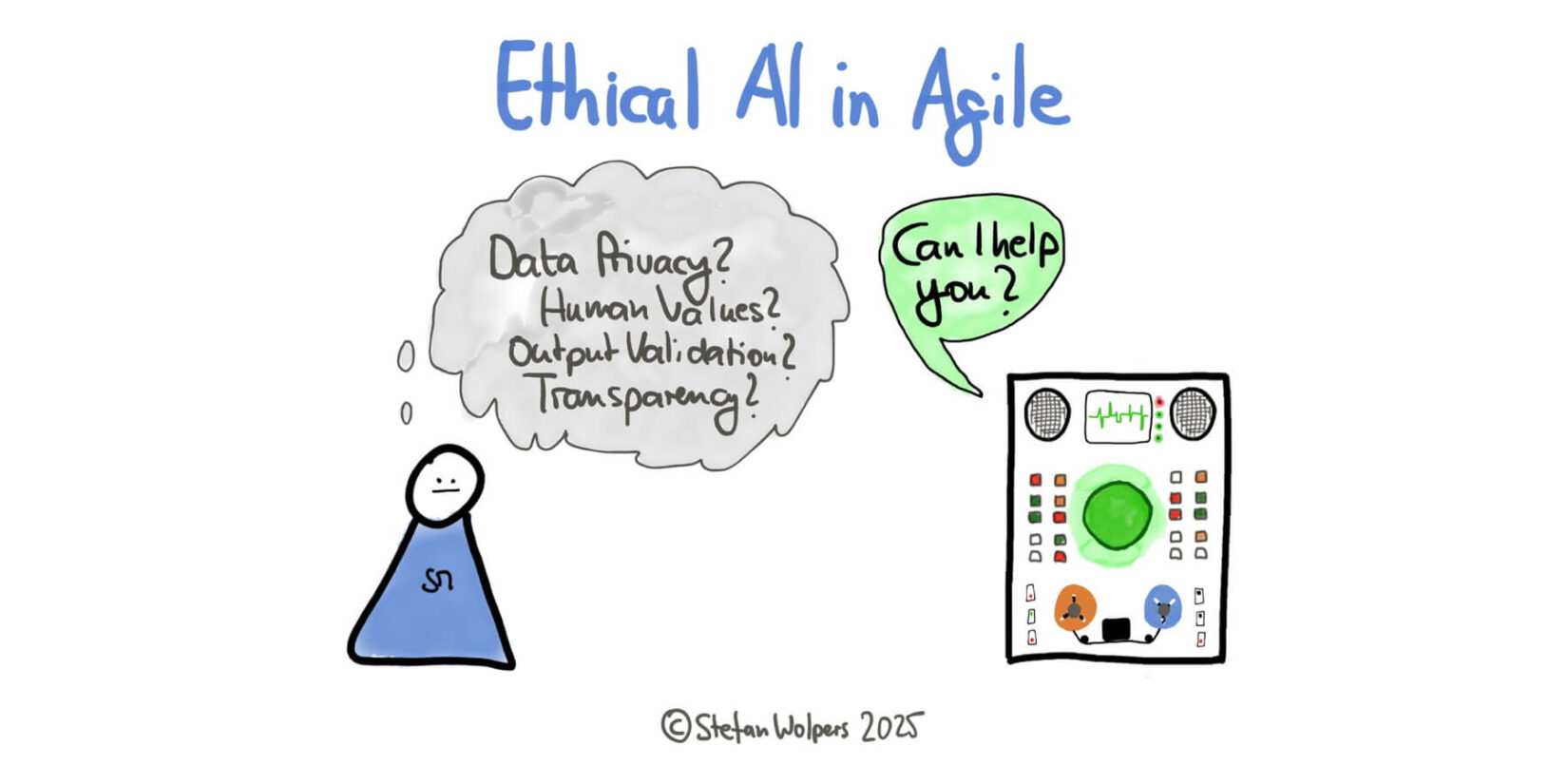
Ethical AI in Agile: Four Guardrails Every Scrum Master Needs to Establish Now

TL; DR: Ethical AI in Agile

Agile teams face ethical challenges. However, there is a path to ethical AI in Agile by establishing four pragmatic guardrails: Data Privacy (information classification), Human Value Preservation (defining AI vs. human roles), Output Validation (verification protocols), and Transparent Attribution (contribution tracking).

This lightweight framework integrates with existing practices, protecting sensitive data and human expertise while enabling teams to confidently realize AI benefits without creating separate bureaucratic processes.

Ethical AI in Agile: Four Guardrails Every Scrum Master Needs to Establish Now — Age-of-Product.com
Continue reading Ethical AI in Agile: Four Guardrails Every Scrum Master Needs to Establish Now

Food for Agile Thought #492: InfoQ Culture Trends 2025, Product Party Modes, Jerry Colonna on Leadership, Product Requirements

TL; DR: InfoQ Culture Trends 2025 — Food for Agile Thought #492

Welcome to the 492nd edition of the Food for Agile Thought newsletter, shared with 42,631 peers. This week, Shane Hastie and Charity Majors spotlight InfoQ culture trends 2025, including AI’s dual impact on speed and collaboration, while reaffirming the importance of psychological safety and Agile-DevOps maturity. John Cutler introduces team “modes” like Questing and Spellcasting, reframing burnout beyond WIP. David Pereira shares leadership lessons for new product leads, Liam Ottley demystifies AI agents, and Zvi Mowshowitz critiques Zuckerberg’s dystopian AI ambitions.

Next, Melissa Perri tells Leah Tharin why AI fails at product strategy without real problem-solving, while Rich Mironov urges PMs to speak the language of money in a pod with Jason Knight. Gary Marcus warns of GenAI’s corrosive impact on academia, and John Pavlus captures NLP’s identity crisis. Meanwhile, Joost Minnaar explores how Haier’s RenDanHeYi model reinvents corporate structure through radical decentralization and entrepreneurial accountability.

Lastly, Jerry Colonna tells Lenny Rachitsky how self-inquiry fuels resilient leadership, while Maarten Dalmijn calls time on the Scrum Master role. Milan Milanović details how Google tackles tech debt at scale, and Vitaly Friedman reframes UX design as risk management. Finally, Jake Bowen-Bate borrows from military strategy to rethink how we communicate product requirements with clarity and intent.

Food for Agile Thought #492: InfoQ Culture Trends 2025, Product Party Modes, Jerry Colonna on Leadership, Product Requirements Age-of-Product.com
Continue reading Food for Agile Thought #492: InfoQ Culture Trends 2025, Product Party Modes, Jerry Colonna on Leadership, Product Requirements

Product Discovery Mistakes, Agile Leadership, Taylorism to Product Mindset — Hands-on Agile 2025

TL; DR: David Pereira, Cliff Berg, and Jonathan Odo speaking at Hands-on Agile 2025

The second batch of videos of Hands-On Agile 2025 is in, and you don’t want to miss them: David Pereira reveals why product discovery often fails—and how teams can avoid common pitfalls to rapidly validate ideas and deliver real value. Also, Cliff Berg shares surprising insights from Agile 2 Academy’s study of highly agile companies like SpaceX, highlighting leadership behaviors rather than traditional Agile practices as key agility drivers, while Jonathan Odo explores timeless engineering principles shaping the future of high-performing, adaptive organizations.

These industry veterans bring decades of enterprise transformation experience, providing actionable insights you can implement immediately. Watch the session recordings to transform how you approach agility.

Product Discovery Mistakes, Agile Leadership, Taylorism to Product Mindset: David Pereira, Cliff Berg, and Jonathan Odo speaking at Hands-on Agile 2025 — Age-of-Product.com
Continue reading Product Discovery Mistakes, Agile Leadership, Taylorism to Product Mindset — Hands-on Agile 2025

Food for Agile Thought #491: Automated Companies, Product Behaviors, Capacity Planning, How to Abandon Scrum

TL; DR: Automated Companies — Food for Agile Thought #491

Welcome to the 491st edition of the Food for Agile Thought newsletter, shared with 42,669 peers. This week, Dwarkesh Patel envisions AI-powered automated companies that replace hiring, learning, and leadership with computing, radically reshaping how economies function. John Cutler curates 270 behaviors and 180 rituals from product leaders at Canva, Stripe, Notion, and more, revealing what makes strong product cultures tick. Ash Maurya rethinks roadmaps with a traction-first, constraint-driven approach. Ethan Mollick highlights how subtle personality tweaks in AI affect trust and influence, while Simon Willison uncovers ChatGPT o3’s eerily precise photo-location guessing, blending vision and reasoning in ways both brilliant and unsettling.

Next, Aakash Gupta shares how Attio builds AI-native products that disappear into workflows, avoiding flashy bolt-ons. Christina Wodtke warns against outsourcing thinking to AI, urging leaders to engage deeply with data, and Sangeet Paul Choudary dismantles shallow AI memes, redirecting focus to system-level change. Meanwhile, Anthropic’s analysis shows that Claude Code is rapidly reshaping front-end development, especially in startup environments.

Lastly, Willem-Jan Ageling outlines when and how to abandon Scrum; Gregor Ojstersek explores fixing “work about work” with more intelligent systems and AI, while McKinsey links decision quality to strategic speed. Moreover, Petra Wille and Teresa Torres reframe capacity planning conflicts, and Brian Feister debunks AI coding hype, pushing for experience-based, question-led practices over blind automation.

Food for Agile Thought #491: Automated Companies, Product Behaviors, Capacity Planning, How to Abandon Scrum — Age-of-Product.com
Continue reading Food for Agile Thought #491: Automated Companies, Product Behaviors, Capacity Planning, How to Abandon Scrum

Contextual AI Integration for Agile Product Teams

TL; DR: Not Onboarding But Integration

Stop treating AI as a team member to “onboard.” Instead, give it just enough context for specific tasks, connect it to your existing artifacts, and create clear boundaries through team agreements. This lightweight, modular approach of contextual AI integration delivers immediate value without unrealistic expectations, letting AI enhance your team’s capabilities without pretending it’s human.

Contextual AI Integration for Agile Product Teams: Your new AI is not a “team member” but a tool — Age-of-Product.com
Continue reading Contextual AI Integration for Agile Product Teams