The Advanced Product Backlog Management Course v2 with AI: July 15, 2025

TL; DR: The Advanced Product Backlog Management Course v2 w/ AI — Out on July 15, 2025

The Advanced Product Backlog Management Course with AI is available on July 15th, 2025, at $99 with free lifetime access to all updates. It cuts through AI hype to address real product management challenges.

Instead of treating AI as a silver bullet, it examines how Generative AI and LLMs genuinely improve Product Backlog management versus when they’re expensive distractions. It uses the practical HealthXYZ startup scenario to distinguish value-adding AI applications from organizational theater, perfect for teams ready to confront uncomfortable truths about their current backlog dysfunction.

🎓 Join the Launch of the AI-Enhanced Version 2 on July 15: Master AI-augmented Product Leadership and Unlock Capabilities Most Practitioners Don’t Even Know Are Possible Yet!


The Advanced Product Backlog Management Course v2 w/ AI — Out on July 15, 2025 — Age-of-Product.com
Continue reading The Advanced Product Backlog Management Course v2 with AI: July 15, 2025

Food for Agile Thought #501: Damage by Passive AI Use, Resistance to Product Models, Trusted Product Engineers, JTBD Interview

TL; DR: Passive AI Use — Food for Agile Thought #501

Welcome to the 501st edition of the Food for Agile Thought newsletter, shared with 40,598 peers. This week, Ethan Mollick warns that passive AI use can dull creativity and critical thinking, while Johanna Rothman emphasizes that product development’s core lies in collaborative learning and flow, not code typing. David Pereira interviews PostHog’s James Hawkins on scaling through engineer autonomy and minimal control. Seth Godin explores AI’s historical parallels, and Cedric Chin distills practical insights from Jobs to be Done interviews for product strategy.

Next, Teresa Torres and Hope Gurion unpack resistance patterns in product operating model pilots and offer ways to build shared clarity. Aakash Gupta interviews Tanguy Crusson on Atlassian’s AI-powered discovery. Maarten Dalmijn critiques budgeting myths, Louis Columbus details Walmart’s scalable AI platform, and Daniel Lereya shares how Monday.com’s AI Month fostered a culture of bold, decentralized innovation at scale.

Lastly, Grant Harvey dissects Grok 4’s impressive yet troubling launch, and Elvis Saravia reframes prompt engineering as context design for LLMs. Chuck Whitten and team call for AI-led business reinvention beyond tech. Megan Saker maps product documentation’s lifecycle value, and Gregor Ojstersek, with Laura Tacho, offers a framework to measure AI’s real impact on engineering teams.

Food for Agile Thought #501: Damage by Passive AI Use, Resistance to Product Models, Trusted Product Engineers, JTBD Interview — Age-of-Product.com
Continue reading Food for Agile Thought #501: Damage by Passive AI Use, Resistance to Product Models, Trusted Product Engineers, JTBD Interview

Harnessing Generative AI for Agile Coaching

TL; DR: Generative AI for Agile Coaches and Scrum Masters

Discover how generative AI can supercharge Agile coaching in high-pressure environments. This webinar presents a real-world scenario where traditional coaching fails and demonstrates how AI identifies emotional cues, contradictions, and recurring pain points hidden within team dynamics.

Learn from Stefan how to reduce cognitive load, make faster, evidence-based decisions, and ethically amplify your coaching impact. Bonus: The same techniques also accelerate product discovery:

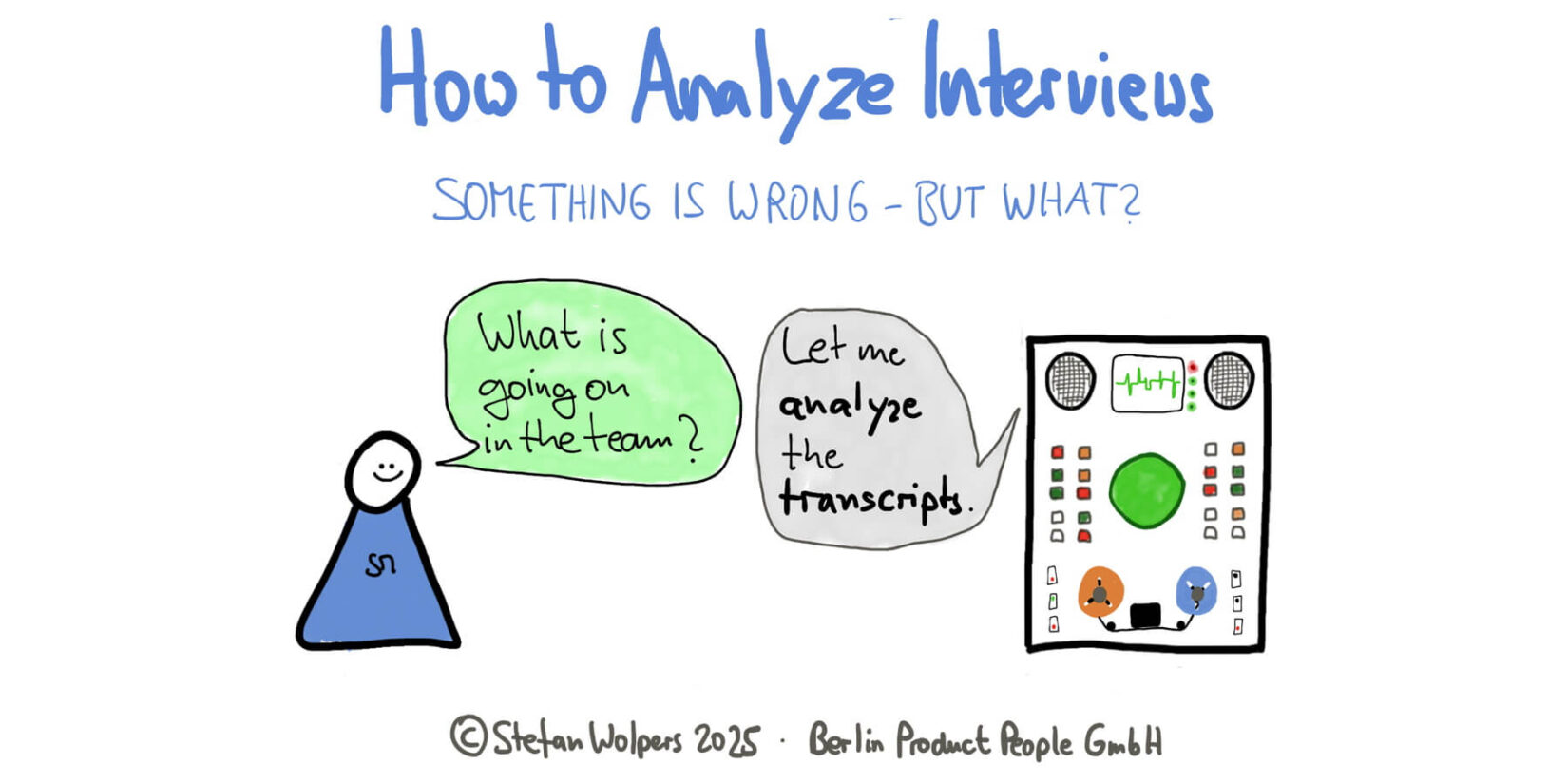
📺 Watch now to rethink your approach: How to Analyze Unstructured Interviews with AI.

How to Harness Generative AI for Agile Coaching: a step-by-step introduction by Stefan Wolpers — Age-of-Product.com
Continue reading Harnessing Generative AI for Agile Coaching

Food for Agile Thought #500: 5C Strategy Framework, Product Enshittification, Fail Fast Culture Failure, How to Unlearn

TL; DR: 5C Strategy Framework — Food for Agile Thought #500

Welcome to the 500th edition of the Food for Agile Thought newsletter, shared with 40,612 peers. This week, Maarten Dalmijn highlights how companies often confuse comfort with strategy and offers the 5C strategy framework to foster genuine strategic thinking. Janna Bastow warns against “enshittification,” the slow death of products driven by misaligned incentives. David Pereira reframes “fail fast” as harmful, advocating for deliberate learning, while McKinsey and Thomas Claburn scrutinize the prerequisites and limits of generative and agentic AI in delivering real business value.

Next, Mike Goitein critiques the obsession with shipping speed, showing how Linear wins by polishing for quality. Richard Mironov reminds product leaders to defend user value and team integrity. Additionally, insights from MIT Sloan’s CIO Symposium reveal that leadership-induced AI failures occur when vision and human factors are ignored. Vaidheeswaran Archana warns of looming LLM cost hikes, and Andy Cleff calls for proactive, trust-based team health strategies.

Lastly, Annie Peshkam and David Dubois stress the importance of shared unlearning for progress. David Burkus urges transparent adaptability, and John Cutler rethinks value hierarchies. Finally, Brian Rain clarifies the true essence of Kanban by pointing to its “theater version,” and Diegovz introduces the RAAEE framework for tracking meaningful product impact beyond vanity metrics.

Food for Agile Thought #500: 5C Strategy Framework, Product Enshittification, Fail Fast Culture Failure, How to Unlearn — Age-of-Product.com
Continue reading Food for Agile Thought #500: 5C Strategy Framework, Product Enshittification, Fail Fast Culture Failure, How to Unlearn

The Agile Paradox: Why Tactical Adoption Rarely Leads to True Transformation

TL; DR: The Agile Paradox

Many companies adopt Agile practices like Scrum but fail to achieve true transformation. This “Agile Paradox” occurs because they implement tactical processes without changing their underlying command-and-control structure, culture, and leadership style.

True agility requires profound systemic changes to organizational design, leadership, and technical practices, not just performing rituals. Without this fundamental shift from “doing” to “being” agile, transformations stall, and the promised benefits remain unrealized.

Continue reading The Agile Paradox: Why Tactical Adoption Rarely Leads to True Transformation

Food for Agile Thought #499: Product Disruption and Denial, Quick AI Guide, Dual Track in Action, 100-Year Leadership Vision

TL; DR: Quick AI Guide— Food for Agile Thought #499

Welcome to the 499th edition of the Food for Agile Thought newsletter, shared with 42,561 peers. This week, Ethan Mollick offers a hands-on, quick AI guide to maximizing the benefits of AI tools like ChatGPT, Gemini, and Claude by exploring their lesser-known features and practical applications. Maarten Dalmijn shares tactics for surviving impossible deadlines by focusing on outcomes and delivering early, while Marty Cagan warns product teams to adapt to AI before it disrupts them. Additionally, Andrej Karpathy reframes LLM success as a “context engineering” challenge, and researchers expose alarming risks of agentic misalignment in top AI models under pressure.

Next, Jason Cohen urges ruthless, transparent prioritization to focus on rare 10x-impact tasks while letting minor issues smolder. Ant Murphy shares how to run discovery and delivery in tandem through iteration and confidence-based decisions. Additionally, Christina Wodtke ranks AI companies by the ethical harm they cause. Stanford researchers expose the misalignment of AI investment with worker needs, and Holly Cummins explores how rest and play fuel creativity in engineering.

Lastly, Gregor Ojstersek reveals why many engineering leaders now view AI with skepticism, citing hype and falling team morale. Andy Cleff examines IKEA’s century-long adaptability and leadership patterns, and Greg Kontos challenges the misuse of user stories. Finally, Maret Kruve presents ADEPT for early-stage discovery, and Philippe Bourgau shows how mob programming drives long-term efficiency through shared learning and better design.

Food for Agile Thought #499: Product Disruption and Denial, Quick AI Guide, Dual Track in Action, 100-Year Leadership Vision – Age-of-Product.com
Continue reading Food for Agile Thought #499: Product Disruption and Denial, Quick AI Guide, Dual Track in Action, 100-Year Leadership Vision