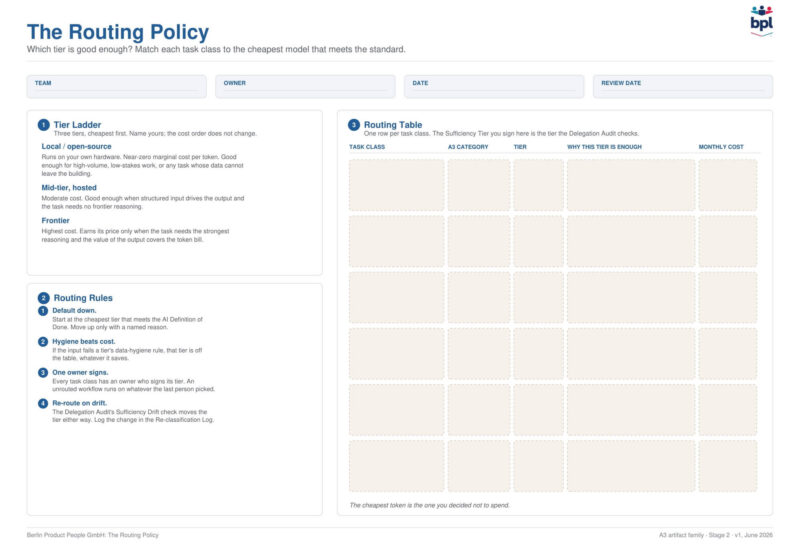
TL;DR: The AI Routing Policy
You moved your routine AI work to a cheaper model, so you think the cost question is handled; however, often, that is not the case. The decision lives in one person’s head and produces nothing that the person accountable for the invoices can read. Worse, it is an architectural choice nobody documented. The AI Routing Policy is the missing artifact of Stage 2 of the Delegation Lifecycle: it records which execution path, from a cheaper model to a frontier model to plain code, handles each class of work, what counts as good enough output to meet the AI Definition of Done, and who owns the call. The skill it needs to work is one you already have: You write acceptance criteria.
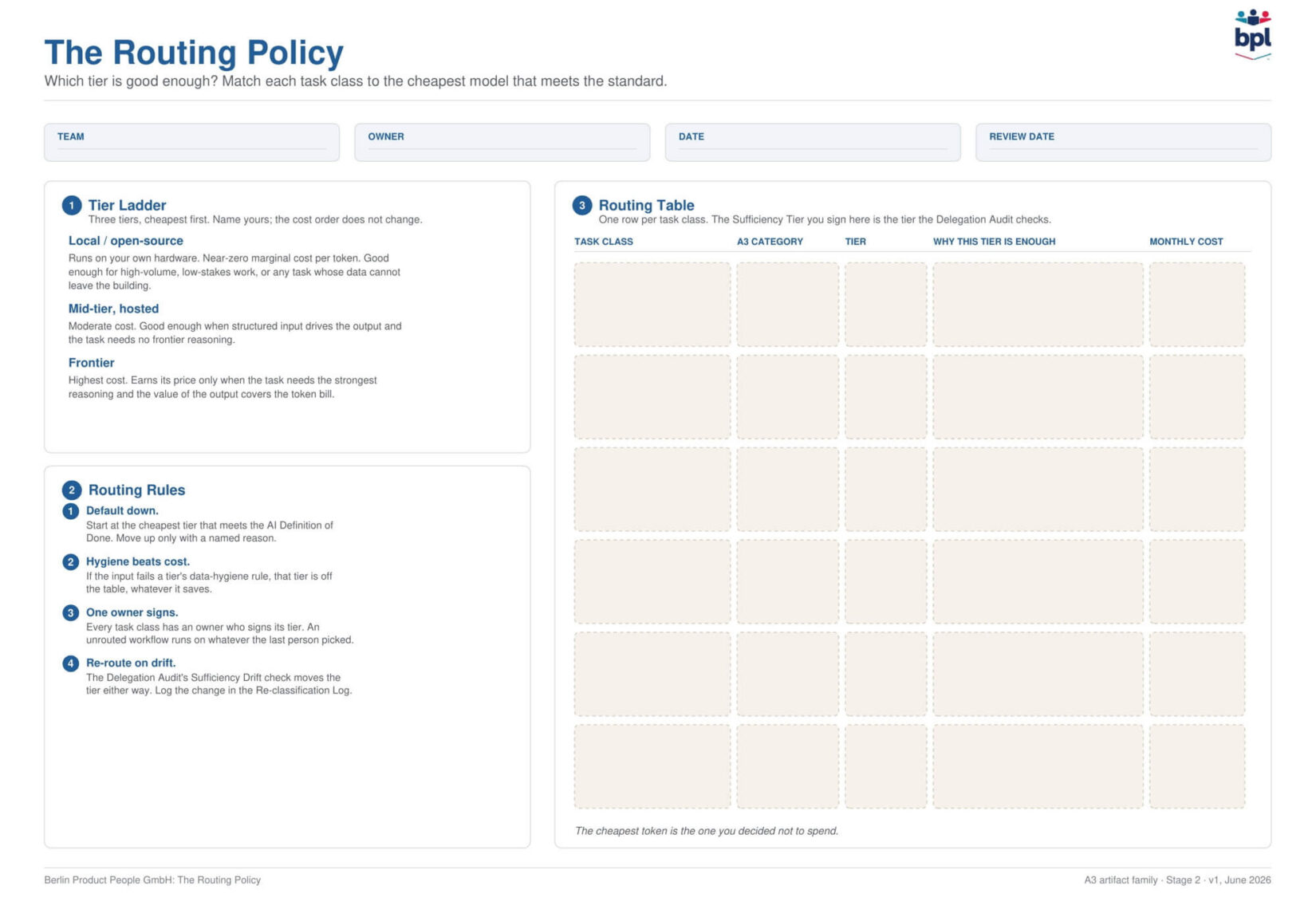
Thesis: An AI routing policy is not about picking a cheaper model at the moment of executing an AI task. It is a written, repeatable team decision that assigns each task class to the cheapest sufficient execution path: a model, human review, deterministic code, or no automation. Paired with a minimal routing log, it creates the spend-by-task-class record that your finance team will eventually request. You can draft the first three lines in twenty minutes.
🎓 🇬🇧 The AI4Agile Online Course v3 — July 20, 2026, at $149 — Join the Waitlist
Sooner or later, a CFO will ask what your AI use actually returns. “It saves me time” will not survive that meeting.
The first wave of AI adoption rewarded practitioners who learned to prompt. That skill still matters, and this course still teaches it. The second wave rewards something rarer: people who can turn individual AI use into knowledge that survives departures, spend that can be explained and steered, and output that organizations can trust. That work is process design and change management. You have been doing both for years, on harder problems than this.
EXCLUSIVE: The new A3 Delegation Lifecycle System with all Templates to make sense of delegating work to AI models.
The AI 4 Agile Online Course v3 is in English. 🇬🇧
What You Will Get:
✅ 16+ hours of self-paced video modules ✅ A cohort-hardened, proven course design ✅ Learn to 10x your effectiveness with AI; your stakeholder will be grateful ✅ Apply AI to classic use cases of “Agile” ✅ The A3 Framework, A3 Handoff Canvas, AI Definition of Done, and Delegation Retrospective as working handouts ✅ The complete MegaBrain.io case package across both acts ✅ All texts, slides, prompts, graphics; you name it ✅ Access custom GPTs, including the “Scrum Anti-Patterns Guide GTP” ✅ Guaranteed: Lifetime access to v3 ✅ AI4Agile Foundation Certificate: 40 questions in 45 minutes.

👉 Please note: The course will be available for $149 from July 20 to 27, 2026! (After that, $249.) 👈
🎓 Join the Waitlist now and be the first to know: The AI4Agile Online Course v3 — July 20, 2026, at $149 — No Coding Required!
🇩🇪 Zur deutschsprachigen Version des Artikels: Wenn Sie Akzeptanzkriterien formulieren können, können Sie auch eine KI-Routing-Richtlinie erstellen.
🗞 Shall I notify you about articles like this one? Awesome! You can sign up here for the ‘Food for Agile Thought’ newsletter and join 35,000-plus subscribers.
🎓 Join Stefan in one of his upcoming training classes!
The Question Nobody Can Answer
Not every company has a board, but every company has a person in the chief financial officer seat: a controller, a chief accountant, or the owner who signs the invoices. At some point, that person looks at the AI line on the budget and asks a simple question: What does this spend buy, and how would we know it creates a return on investment?
In most teams, the answer is a shrug. Someone switched the weekly status draft to a cheaper model last spring. Someone else left the customer-facing summaries on the frontier model because it “felt safer.” Nobody wrote either decision down. While the AI token expenditure is real, the rationale is folklore.
Why a Cheaper Model Is Not a Policy
The fallacy worth naming first is that switching to the cheaper model solves your cost problem. Most likely, it won’t: a model choice that lives only in habit disappears the day the person who made it changes teams. You may have lowered the bill, but you did not create cost control. You made an undocumented architecture decision with financial consequences, and left no one able to explain it.
What Stage 2 of the AI Delegation Lifecycle Is
In the Delegation Lifecycle, Stage 1 (Decide) uses the A3 Framework to answer whether AI should touch a piece of work at all: Assist, Automate, or Avoid. Stage 2 (Route) answers the next question: which execution path runs the work, and what is good enough for that class of work.
AI routing is not the act of selecting a model while you work. That habit matters, and I covered it for the individual practitioner in an earlier piece on token economics (see Related Articles below). This is the level above the habit: the team standard that survives the individual. A written policy says status drafts run on the mid tier, contract review runs on the frontier tier with human review, and recurring calculations run on plain code, each with a one-line reason.
An AI model tier bundle is more than price. It is a capability, risk, data-handling, and accountability class, and the cheapest option that clears the bar is not always a model. A route is wider than a menu of models: a frontier model, a cheaper model, deterministic code, human-only work, a model plus human review, or no automation at all.
It is the difference between a developer who happens to write good code and a team that has a Definition of Done. One depends on the person. The other depends on the agreement.
Cannot see the form? Please click here.
The Sufficiency Criterion Is Acceptance Criteria
The load-bearing idea in an AI routing decision is sufficiency: what does good enough mean for this class of work? Paying for a frontier model on a task that only needs a decent first draft is a waste. A cheap model on a task that goes to a regulator is a different kind of waste, the kind that appears in an incident review.
You write this standard the same way you write acceptance criteria for a Product Backlog item. The standard is not “the best the model can do.” It is whether the output meets the stated conditions that a named person can check:
- For a weekly internal update: traceable to the source board, under 300 words, no invented status.
- For an external compliance summary: every claim sourced, reviewed by a human before it leaves, zero tolerance for a feature that does not exist.
It is the same discipline you apply when you refuse a story without testable acceptance criteria.
The friction appears in three predictable places:
- Teams argue quality in the abstract and never write the criterion, so every task defaults to the most capable model, and the bill climbs.
- Or they name the route but skip the escalation trigger, so nobody knows when a task is allowed to move up to a more expensive one.
- Or they write the whole policy and name no owner, so nobody maintains it, the same way nobody maintains an un-owned automation.
An AI routing policy without an owner is a suggestion.
The Route Most Teams Forget: No Model at All
Routing to a cheaper model is the first lever everyone reaches for. It is also the smallest one. The smarter move is to ask whether the task needs a model every time, or only once.
Packy McCormick and Markie Wagner make the case in their June 2026 essay: “Thinking is expensive but happens rarely. Doing is cheap and happens forever.” Their punchline is shorter: “Because you know what’s cheaper than Chinese models? Code.” (Not Boring, June 10, 2026.) A recurring calculation, a format conversion, or a status roll-up with fixed rules does not need probabilistic judgment on every run. It needs professional judgment once, to design the deterministic path, and then plain code that produces the same output every time.
For a non-coding practitioner, this is still a routing decision you can make, even if you hand the build to a developer or have a model write the script one time. The leadership question is not “which model is cheapest.” It is: does this task need probabilistic judgment every time, or only once to design the path? An AI routing policy that offers only cheap, mid, and frontier models stays trapped in the model vendors’ cost logic. Add two more routes, deterministic code, and no automation at all, and the policy becomes an operating-model decision.
AI Routing Is Where a Team Makes Its Trade-Offs Explicit
Finance is the pressure that makes routing visible, but cost is not the only variable a route balances. Optimize for one alone, and another gives way:
- Cheapest model everywhere: the bill drops, and quality can collapse on the work that mattered.
- Frontier model everywhere: quality holds, and cost discipline collapses.
- Human review everywhere: risk falls, and throughput collapses.
- Agentic workflow everywhere: autonomy rises, and repeatability collapses.
- Deterministic code everywhere: cost falls, and adaptability collapses the moment the rules change.
A route is where a team makes those trade-offs deliberately rather than by accident. That is the difference between using AI and governing it.
Return on Tokens, and Why Task-Class Attribution Matters
Once the routes exist, you need a way to determine whether each route covers its cost. McCormick and Wagner gave that discipline a name: Return on Tokens (ROT), with a plain formula:
Return on Tokens = (Value of Output − Cost of Tokens) / Cost of Tokens × 100.
The formula is the easy part. The operational implication is the hard part: you cannot improve Return on Tokens if you do not know which task class consumed them. The same essay reports the pattern behind the urgency: Fortune 500 leaders admitting they had committed to enormous token spend with no idea what they were getting back.
That is the issue for most readers. On a Claude Pro or Max subscription, you cannot see per-task token cost; the meter moves, and you cannot trace it to a workflow. The discipline still matters because you build it before the subsidy ends, so you are not the one scrambling when flat-rate access narrows further.
If your work runs through the API, you already pay per token, and Return on Tokens is a number you can compute today for each task class against your AI routing policy. The subscriber is rehearsing for metered reality, while the API user already lives in it.
What the Numbers Make Finance Ask
The Ramp Economics Lab publishes U.S. companies’ AI spending per employee, based on aggregated card and bill-pay data from more than 70,000 businesses. In June 2026, the median firm spent $11.38 per employee per month, about one enterprise subscription seat. The top 10% spent $611. The top 1% spent $7,449. (Ramp Economics Lab, June 10, 2026.) That data is spend-side only: it shows what companies pay, not what the spend returns, which is the gap an AI routing policy and a log are meant to close.
Finance rarely worries about one subscription seat. Finance starts asking harder questions when flat-rate experimentation turns into metered API usage, agentic workflows, departmental duplication, and invoices no team can trace back to work. At that point, CFOs want to learn: what runs on frontier models versus cheaper alternatives, by task class, and why. That demand is the AI routing policy, written from the outside in.
A Routing Policy You Can Copy
Here is what three lines look like. Take one task class per row and fill the five columns:
| Task class | Default route | Sufficiency criterion | Escalation trigger | Owner |
|---|---|---|---|---|
| Weekly internal status draft | Mid-tier model | Traceable to the board, under 300 words, no invented status | Missing data, any customer-facing claim, unresolved risk | Workflow owner |
| Customer-facing roadmap summary | Frontier model plus human review | Every claim sourced, no uncommitted feature shown as committed | Enterprise customer, legal or security claim | Product Owner |
| Recurring metrics calculation | Deterministic script, no model | Same input produces same output, test cases pass | Metric definition changes | Product Analyst |
That is the structure of the record finance wants. It is not the record itself yet.
The Record Finance Can Finally Read
An AI routing policy defines the record’s structure; minimal routing logs turn that structure into evidence:
- Without the log, the policy explains intent.
- With the log, it explains expenditures.
The log adds a few fields to each entry: the actual route used, the escalation reason when a task is moved up, a token or cost estimate, the reviewer, and an outcome signal so the policy optimizes for value, not just the lowest bill.
Skip the log, and the policy is governance theater: well written, and accountable to no invoice. Keep the log, and the same meeting that routes the work leaves the trail that finance and procurement ask for later, with no separate report. That is the real economy of the Delegation Lifecycle: the operational artifacts answer the governance questions, once you spend the small effort to record what they decide.
What to Do Before Your Next Planning Session
Do not write a company-wide AI routing policy this week. Take one recurring AI task, the one whose cost or risk you understand least, and fill one row of the table above: the route it runs now, what good enough means in testable terms, the escalation trigger, and the owner. Add one more column, the actual route used last time, and you have started the log. You will probably find the route was never decided, and the standard was never written. That single gap is the case for the policy.
Conclusion
Acceptance criteria keep a team honest about what “done” means before work starts. An AI Routing Policy extends that habit to how the work gets done: which path, against what standard, with what escalation trigger, and where it is recorded. The skill is not new, only the object is.
I have added the AI Routing Policy and a Return on Tokens exercise to version 3 of the AI4Agile Online Course, scheduled for July 20, 2026. The exercise uses June 2026 market data and a worked task portfolio, so participants practice routing real work instead of debating model preferences in the abstract.
When someone in your organization asks what your AI spend buys, will you have a policy and a log to point to, or a shrug?
Key Questions This Article Answers
What Is an AI Routing Policy?
A Routing Policy is a written, repeatable team decision that assigns each class of AI-assisted work to the cheapest sufficient execution path, against a stated sufficiency standard, with a named owner. It is the artifact of Stage 2 (Route) of the AI Delegation Lifecycle. The skill it needs is the one you already use to write acceptance criteria.
What Are the Routing Options?
A route is wider than a menu of models. The options are a frontier model, a cheaper model, deterministic code, human-only work, a model plus human review, or no automation at all. A policy that routes only among model tiers stays trapped in the model vendors’ cost logic. The smarter question is whether the task needs probabilistic judgment every time, or only once to design a deterministic path.
Does an AI Routing Policy Give Finance a Spend Record?
Not on its own. A Routing Policy defines the record structure: task class, route, sufficiency reason, escalation trigger, and owner. A minimal routing log turns that structure into evidence by capturing the actual route used, the escalation reason, a cost estimate, the reviewer, and an outcome signal. Without the log, the policy explains intent. With the log, it explains the spend.
What Is Return on Tokens?
Return on Tokens is a measure proposed by Packy McCormick and Markie Wagner in June 2026: (Value of Output − Cost of Tokens) / Cost of Tokens × 100. The formula is the easy part. The operational implication is more difficult: you cannot improve Return on Tokens without knowing which task class consumed them, which is what an AI routing policy and its log make possible.
AI Routing Policy — Related Articles
AI4Agile Online Course v3 — Release on July 20, 2026
If You Can Facilitate a Retrospective, You Can Audit Your AI
The AI Definition of Done: Human in the Loop Is Not a Quality Standard
The AI Delegation Lifecycle: Your Team Has AI Outputs. Where Are the Decisions?
Assist, Automate, Avoid: How Agile Practitioners Stay Irreplaceable with the A3 Framework
The A3 Handoff Canvas: Six Questions That Turn AI Delegation Into a Repeatable Workflow
The A3 Framework: Assist, Automate, Avoid — A Decision System for AI Delegation
No More Cheap Claude: Four First Principles of Token Economics in 2026
👆 Stefan Wolpers: The Scrum Anti-Patterns Guide (Amazon advertisement.)
📅 Training Classes, Workshops, and Events
Learn more about the AI Routing Policy with our AI and Scrum training classes, workshops, and events. You can secure your seat directly by following the corresponding link in the table below:
| Date | Class and Language | City | Price |
|---|---|---|---|
| 🖥 💯 🇬🇧 July 20,2026 | GUARANTEED: AI 4 Agile Course v3 — Master AI for Agile Practitioners (English; Self-paced Online Course) | Self-paced Online Course | $149 incl. 19% VAT (If applicable.) (Before and after: $249) |
| 🖥 💯 🇬🇧 July 23,2026 | GUARANTEED: HoA 76: Where Are Your Decisions to Avoid AI Debt? (English) | Meetup | FREE |
| 🖥 🇩🇪 August 25-26, 2026 | Professional Scrum Product Owner Training (PSPO I; German; Live Virtual Class) | Live Virtual Class | €999 incl. 19% VAT (If applicable.) |
| 🖥 💯 🇬🇧 August 27 to September 17,2026 | GUARANTEED: AI4Agile BootCamp #8 (English; Live Virtual Cohort) | Live Virtual Cohort | €499 incl. 19% VAT (If applicable.) |
| 🖥 💯 🇬🇧 Sep 28-29,2026 | GUARANTEED: A3 Delegation System Founding Workshop (English; Live Virtual Class) | Live Virtual Class | $199 incl. 19% VAT (If applicable.) |
| 🖥 🇩🇪 Sep 30 to Oct 1, 2026 | Professional Scrum Product Owner Training (PSPO I; German; Live Virtual Class) | Live Virtual Class | €999 incl. 19% VAT (If applicable.) |
See all upcoming classes here.

You can book your seat for the training directly by following the corresponding links to the ticket shop. If your organization’s procurement process requires a different purchasing approach, please contact Berlin Product People GmbH directly.
✋ Do Not Miss Out and Learn More about the AI Routing Policy — Join the 20,000-plus Strong ‘Hands-on Agile’ Slack Community
I invite you to join the “Hands-on Agile” Slack Community and enjoy the benefits of a fast-growing, vibrant community of agile practitioners from around the world.

If you would like to join all you have to do now is provide your credentials via this Google form, and I will sign you up. By the way, it’s free.
