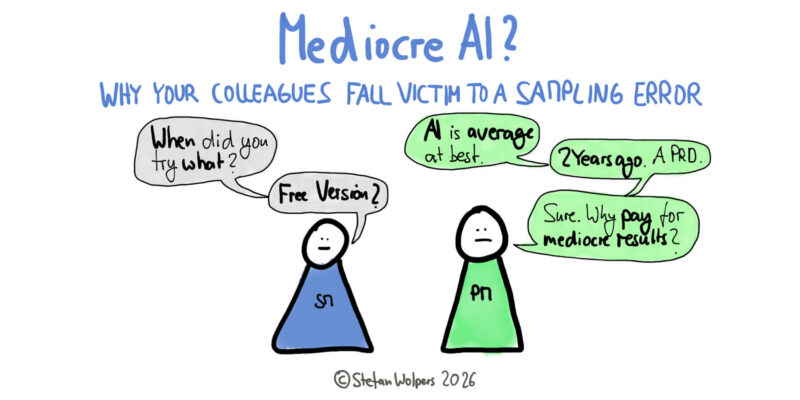
TL;DR: Your Colleague Judge It by the Free Versions
Thesis: The verdict “mediocre AI” usually rests on the free versions of ChatGPT or Claude, which are deliberately limited; this article explains why, which paid plans show the current state, and how agile practitioners test AI on real work.
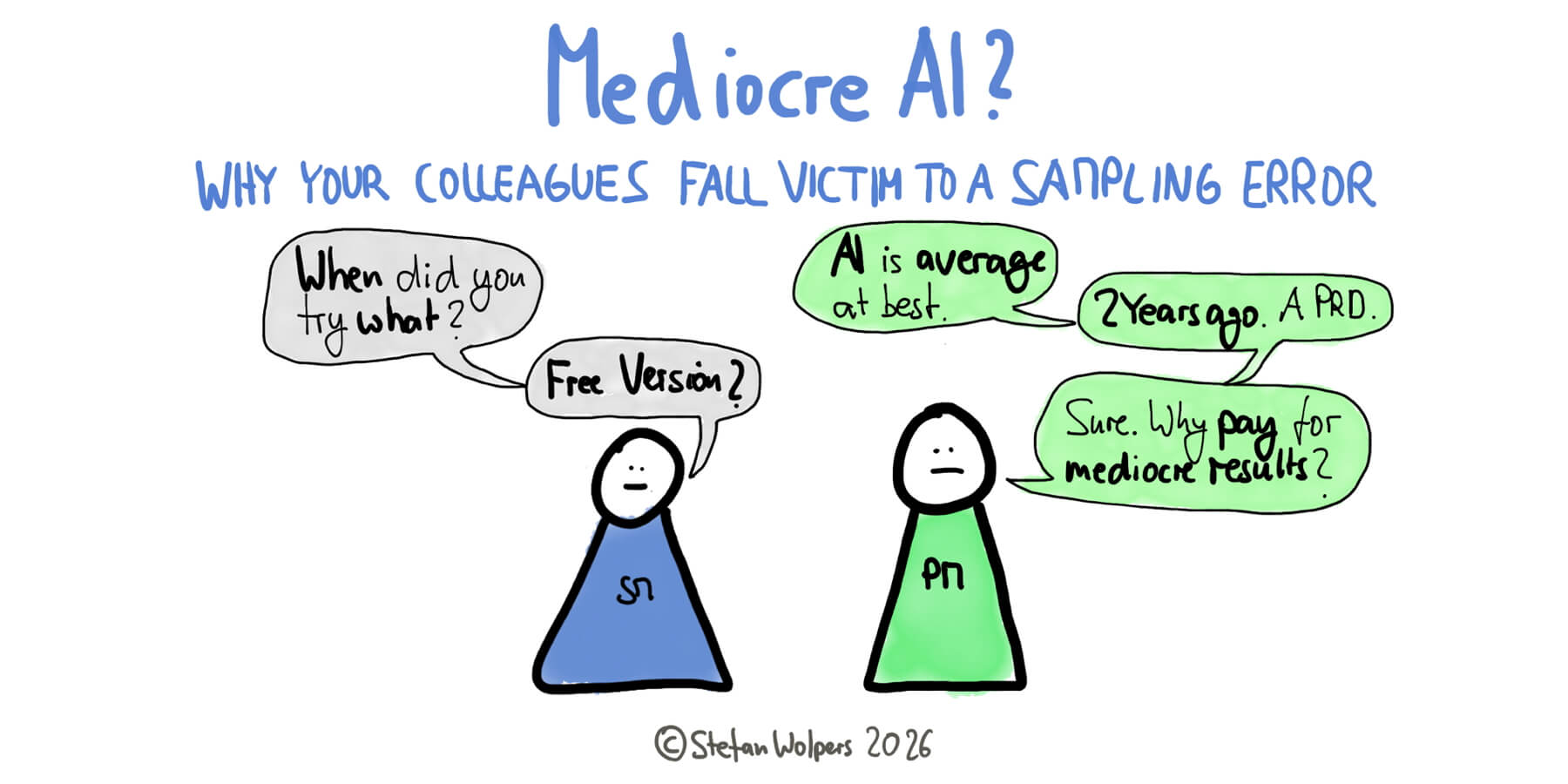
Ask a colleague who dismisses AI as a statistical parrot with glorified autocomplete which version they tested and when; the answer is something along the lines of “the free one” and “last year, I think.” That verdict says more about the sample than about the technology, and as a practitioner with career ambitions, you cannot afford to borrow it. Spend at least $20 a month on ChatGPT or Claude, write down beforehand what a good result looks like (in the A3 Delegation System, that is the job of the AI Definition of Done), and judge AI by what a paid plan does with your own work, including the time it takes you to check the result.
Disclaimer: I read Charniak/McDermott’s book on “Artificial Intelligence” decades ago; of course, I use AI for research, translations, proofreading, challenging story arcs and article structures, creating artifacts such as graphics, and summarization. It is a production tool, not a substitute for thinking.
🎉 The AI4Agile Online Course v4 Is Out!
Code, drafts, and reports now cost almost nothing, so judgment becomes the scarce skill, and helping organizations change has always been your work. That makes this an exciting moment for Scrum Masters, Product Owners, Agile Coaches, and Product Managers.
In v4 of the AI4Agile Online Course, you practice with realistic data, make your own decisions, and check each call against my answer keys. The AI4Agile Online Course v4 is in English. 🇬🇧
What You Will Get:
✅ New agent-based exercises: Jira report, product discovery, refinement prep, measuring AI impact ✅ 4 Live onboarding sessions ✅ A cohort-hardened, proven course design ✅ Learn to 10x your effectiveness with AI; your stakeholders will be grateful ✅ Apply AI to classic use cases of “Agile” ✅ The A3 Delegation System comprising seven ready-to-use templates ✅ All texts, slides, prompts, and graphics ✅ Guaranteed: Lifetime access to v4 ✅ AI4Agile Foundation Certificate: 40 questions in 45 minutes.

🎓 Join Now: The AI4Agile Online Course v4 at $149 — No Coding Required!
👉 Please note: The course will be available for $149 from November 21-30, 2026, including a 14-Day Refund Policy–No Questions Asked! (After that, $249.) 👈
🇩🇪 Zur deutschsprachigen Version des Artikels: Mittelmäßige KI? Warum Ihre Kollegen einem Stichprobenfehler aufsitzen.
🗞 Shall I notify you about articles like this one? Awesome! You can sign up here for the ‘Food for Agile Thought’ newsletter and join 35,000-plus subscribers.
🎓 Join Stefan in one of his upcoming training classes!
The Verdict From the Lunch Table
You have probably heard it in a Retrospective, over lunch, or in a LinkedIn comment: “I tried ChatGPT, and the output was generic,” or “As expected, the mediocre AI made things up, so I stopped using it.” The statement usually comes with the confidence of someone who has seen enough.
Follow up with three questions (which version, when, and what exactly went wrong), and the picture changes. In my experience, the colleague tested the free version, often more than a year ago, on a task like summarizing an article, and has not looked back since. The complaint about invented facts is legitimate, by the way, and paid models make mistakes, too, which is why any serious test needs a standard to check the output against. However, a single trial of a limited version is a poor basis for professional judgment about a technology that is reshaping the market for our jobs.
Nobody Gives Away a Trillion-Dollar Technology
In June 2026, Goldman Sachs Research raised its estimate for the hyperscalers’ combined capital spending from 2025 through 2030 to $5.3 trillion, up from $4.5 trillion before the first-quarter earnings reports. For this calendar year alone, a Business Insider tally, republished by Hargreaves Lansdown, puts the capital expenditure of Amazon, Alphabet, Meta, Microsoft, and SpaceX at $803 billion to $828 billion. That figure covers more than AI, although the companies’ executives name AI infrastructure as the main driver of the surge.
It is ludicrous to expect the best version of such expensive technology for free, and the vendors’ own plan pages confirm you do not get it. Advertising, competition, and the hunt for subscribers all shape what vendors give away. As a result, some models and tools are reserved for paying customers, and usage allowances differ substantially, which makes the free version a deliberately watered-down product. A verdict based on it cannot establish what a current paid plan does with the same work.
Cannot see the form? Please click here.
What the Free Version, the “Mediocre AI” Leaves Out
The gap is anything but subtle. According to OpenAI’s model overview, the Free plan defaults to a Luna model and includes none of the higher thinking levels. In contrast, Plus gets GPT-6 Sol with medium and high thinking in the regular chat, plus GPT-6 Astra in ChatGPT’s Work and Codex tools. Anthropic’s pricing page is even more explicit: Claude Free runs Sonnet and Haiku only, and it includes neither Opus nor Fable, nor Claude Code.
Then there are the limits. Anthropic’s Free plan, for example, resets its usage every five hours and every week. That works for a quick question, but analyzing an export of 300 Product Backlog items takes several rounds of context, drafts, and corrections, and a free allowance may run out before the result has a chance to become any good.
Spend $20, Then $100 When the Work Justifies It
So, if you want a glimpse of what is possible, spend at least $20 a month on ChatGPT Plus or Claude Pro, and give the first month to a deliberate test. I would focus on these two, because, in my assessment, the others currently fall behind for the work agile practitioners do. Google brought Gemini 4 Argon to Google AI Pro and AI Ultra subscribers in the Gemini app on October 13, 9to5Google reports, so Google, too, keeps its flagship behind a paywall. I suspect Google will earn most of its money by building Gemini into Search, which is a different business from the one you need. Grok, whatever its popularity elsewhere, no longer belongs to the frontier in my view, and Meta has taken its Muse models in a different direction with a consumer personal agent. (Note the pricing, though: Muse, too, comes with a free tier and subscriptions at $20 and $100 a month, according to Axios.)
If the usage limits get in your way during that month, for example, because an analysis or a report needs more rounds than the plan allows, go one step further. The $100 tiers, ChatGPT Pro 100 and Claude Max, raise those limits considerably: Claude Max, for example, offers five times the usage of Pro and includes Anthropic’s Fable model for up to half of the weekly limit. Compared with the price of a two-day certification class, $100 a month for a few months of serious practice is a modest investment.
A Year-Old Verdict Rests on Retired Models
The second problem is age. OpenAI retired GPT-4o from ChatGPT on February 13, 2026, and GPT-6 reached the free version in October, according to Tech Insider’s timeline. If your colleague’s verdict dates from late 2025, it rests on models that ChatGPT has since replaced.
Your colleague’s experience is a valid account of what happened back then. Believing that it still describes what AI can do today amounts to living under a rock. (Yes, I spend so much time with these tools that I may be living in a bubble myself.) Still, if you are a professional with career ambitions, or run your own business, you should pay attention to where Wall Street puts its money. Remember the old saying: never listen to what they say; always watch where they invest. On its third-quarter earnings call, Alphabet’s CFO, Anat Ashkenazi, said, “We continue to expect our CapEx to increase significantly in 2027.” That proves nothing about whether AI will serve your particular work. Nevertheless, it tells you that the companies placing these bets expect the capability to keep growing, which makes a 2025 verdict risky to hold.
Mediocre AI – Conclusion: Test AI on Your Own Work With a Standard Set in Advance
Run one test this week. Pick a task you did at work last month, for example, a stakeholder update, and write down what an acceptable result looks like before you open the AI. In the A3 Delegation System, that is the AI Definition of Done: the criteria an AI output has to meet before anyone uses it. For a stakeholder update, these might be accurate figures, claims you can trace to a source, uncertainty stated where it exists, and no commitments the team never made. Then run the task on a paid plan and record two things: whether the result meets your criteria, and how long preparation, checking, and corrections took compared with how you did the update last month.
The result decides your next step: continue, upgrade because a limit got in the way, downgrade because a cheaper model was good enough, or stop because the task does not suit AI. Repeat the test every few months, because the models change faster than opinions do. The AI Delegation Audit asks the same question in its sufficiency check: whether the model tier is still right for the job, in both directions.
If you want to practice this test on a realistic case before you run it on your own work, join the AI4Agile Online Course v4, which launched on November 21, 2026. In its new chapter on practical applications, you check an AI-drafted status report against the Jira export using an AI Definition of Done and run the four checks of the AI Delegation Audit, all on the MegaBrain.io case. You also calculate whether a delegated workflow pays off once you count the time spent checking and reworking the output, which is the same calculation as in the test above. I wrote the exercises for ChatGPT Plus or Claude Pro, so you do not need a $100 plan. The launch price is $149 from November 27 to 30, 2026. Outside this window, the regular price of $249 applies.
🎓 Join Now: The AI4Agile Online Course v4 at $149 — No Coding Required!
So, which task did you last test AI on, when, and against which criteria? I am curious to learn how you avoid the sampling error of others. (After all, we can prove that mediocre AI is fallacy.)
Key Questions This Article on Mediocre AI Answers
Why Does Free AI Seem Mediocre Compared With Paid Plans?
Free versions come with fewer models and tighter usage limits. In November 2026, ChatGPT Free gets a Luna model without the higher thinking levels, while Plus gets GPT-6 Sol in the chat and GPT-6 Astra in the Work and Codex tools. Claude Free excludes Opus, Fable, and Claude Code. A free trial, especially one from 2025, is incomplete evidence about current paid models, although it can reveal problems such as persistent errors or costly checking.
Which AI Subscription Should an Agile Practitioner Pay For?
Start with ChatGPT Plus or Claude Pro at $20 a month and use the first month as a deliberate test on real work. Practitioners whose work keeps hitting usage limits should consider the $100 tiers: ChatGPT Pro 100 or Claude Max. Claude Max offers five times the usage of Pro and includes Anthropic’s Fable model for up to half of the weekly limit. Check the vendors’ pricing pages, because prices change often.
How Should I Test Whether AI Is Useful for My Work?
Pick a real task from last month, such as a stakeholder update, and write down the criteria an acceptable AI result must meet before you start. In the A3 Delegation System, this is the AI Definition of Done. Run the task on a paid plan, then compare both the result and the time spent on preparation, checking, and corrections with your usual way of working. Repeat the test every few months.
Mediocre AI — Related Posts
AI Adoption Failures: Why Your Successful AI Pilot Is No Reason to Scale
We’re Not Paid to Practice Scrum, but Answer 5 Product Questions
Measuring AI Impact: What Your Velocity Chart Cannot Tell the CFO
AI-Assisted Refinement Preparation
AI-Assisted Product Discovery: When Code Is Cheap, Judgment Is the Job
AI Transformations And Agile Transformations Rhyme
The A3 Handoff Canvas: Six Questions That Turn AI Delegation Into a Repeatable Workflow
The A3 Framework: Assist, Automate, Avoid — A Decision System for AI Delegation
👆 Stefan Wolpers: The Scrum Anti-Patterns Guide (Amazon advertisement.)
📅 Training Classes, Workshops, and Events
Learn more about avoiding mediocre AI with our AI and Scrum training classes, workshops, and events. You can secure your seat directly by following the corresponding link in the table below:
| Date | Class and Language | City | Price |
|---|---|---|---|
| 🖥 🇩🇪 Dec 8-9, 2026 | Professional Scrum Product Owner Training (PSPO I; German; Live Virtual Class) | Live Virtual Class | €1189 incl. 19% VAT (If applicable.) |
| 🖥 🇩🇪 Feb 16-17, 2027 | Professional Scrum Product Owner Training (PSPO I; German; Live Virtual Class) | Live Virtual Class | €1189 incl. 19% VAT (If applicable.) |
See all upcoming classes here.

You can book your seat for the training directly by following the corresponding links to the ticket shop. If your organization’s procurement process requires a different purchasing approach, please contact Berlin Product People GmbH directly.
✋ Do Not Miss Out and Learn More about Avoiding Mediocre AI — Join the 20,000-plus Strong ‘Hands-on Agile’ Slack Community
I invite you to join the “Hands-on Agile” Slack Community and enjoy the benefits of a fast-growing, vibrant community of agile practitioners from around the world.

If you would like to join, all you have to do now is provide your credentials via this Google form, and I will sign you up. By the way, it’s free.
