TL; DR: Tech Job Market 2026 — Food for Agile Thought #570
Welcome to the 570th edition of the Food for Agile Thought newsletter, shared with 35,177 peers.
📺 Short on time? Watch the 67-second teaser video now!
This week, Lenny Rachitsky finds PM openings near four-year highs and “LLM” topping job descriptions, yet Henrik (Henok) Lindström et al. see no single AI PM role. With dedicated research possibly vanishing, Teresa Torres and Petra Wille test continuous discovery, Torres wondering whether it must adapt. Rich Mironov doubts 10x coding speed means 10x revenue, while Richard Kasperowski’s panel finds profitability the hard part, and Tugce Erten warns cheaper models strengthen customers’ build-it-yourself option.
Next, Tim Tully et al. find AI spend up 5.4x, and Ara Kharazian shows 1% of businesses driving 80% of OpenAI and Anthropic revenue. Yet Cristina Catania et al. urge CFOs to redesign one finance process, not fund isolated AI pilots. While Tim O’Reilly compared AI to the “Internet of 1997,” Ethan Mollick’s almost-AGI Fable 5.2 experience still needed his judgment. Also, Alan Sharp sees product creation bottlenecks moving to judgment, such as requirements and review, so Agile’s values matter now more than ever.
Lastly, Stacy Gordon and Len Greski show AI token bills getting paid with headcount because spend is visible and value is not, while David Burkus suggests cutting junior roles created employers’ own talent shortage. Mike Fisher documents the opposite reflex: departments preserving problems that justify their headcount. With 43% of incident.io’s PRs merging without human review, as Gergely Orosz reports, Marc Abraham shows an LLM judge can score 90% accuracy and yet catch zero errors.
Disclaimer: I read Charniak/McDermott’s book on “Artificial Intelligence” decades ago; of course, I use AI for research, translations, proofreading, challenging story arcs and article structures, and summarization. It is a production tool, not a substitute for thinking.
🎓 🇬🇧 The AI4Agile Online Course v4 — November 27, 2026, at $149 — Join the Waitlist
Sooner or later, a CFO will ask what your AI use actually returns. “It saves me time” will not survive that meeting.
The first wave of AI adoption rewarded practitioners who learned to prompt. That skill still matters, and this course still teaches it. The second wave rewards something rarer: people who can turn individual AI use into knowledge that survives departures, spend that can be explained and steered, and output that organizations can trust. That work is process design and change management. You have been doing both for years, on harder problems than this.
BRAND-NEW: Hands-on exercises to build AI Agents, with your tactical work, covering, for example, Jira-based stakeholder reports, product discovery, AI Impact on metrics, or preparation for backlog refinement. All exercises use realistic data and context to simulate reality as closely as possible in a fail-safe environment.
EXCLUSIVE: The new A3 Delegation Lifecycle System with seven ready-to-use templates, from the AI Workflow Inventory to the AI Definition of Done to the AI Working Agreement, to make sense of delegating work to AI models.
The AI 4 Agile Online Course v4 is in English. 🇬🇧
What You Will Get:
✅ 20+ hours of self-paced video modules ✅ 4 Live onboarding session ✅ A cohort-hardened, proven course design ✅ New agent-based exercises: Jira report, product discovery, refinement prep, measuring AI impact ✅ Learn to 10x your effectiveness with AI; your stakeholder will be grateful ✅ Apply AI to classic use cases of “Agile” ✅ The A3 Delegation System comprising seven ready-to-use templates ✅ All texts, slides, prompts, and graphics ✅ Guaranteed: Lifetime access to v4 ✅ AI4Agile Foundation Certificate: 40 questions in 45 minutes.

👉 Please note: The course will be available for $149 from November 27-30, 2026! (After that, $249.) 👈
🎓 Join the Waitlist now and be the first to know: The AI4Agile Online Course v4 — November 27, 2026, at $149 — No Coding Required!
Did you miss the previous Food for Agile Thought issue 569?
🗞 Shall I notify you about articles like this one? Awesome! You can sign up here for the ‘Food for Agile Thought’ newsletter and join 35,000-plus subscribers.
🎓 Join Stefan in one of his upcoming training classes!
🏆 The Tip of the Week: Tech Job Market 2026
: State of the Tech Job Market: Late 2026
Lenny Rachitsky finds PM openings at a near four-year high, while open design roles hit record lows and engineering openings have stalled. AI has not replaced product managers, yet "LLM" now tops their job descriptions. Only 14% of tech roles offer remote work, and dedicated user research may be disappearing.
🎯 Product
and : 🎙️ Discovery & The 4 Risks
Teresa Torres & Petra Wille test continuous discovery against the four risks. Torres suggests organizations rarely make the required structural changes, so maybe the method, not the organization, needs adapting.
: The AI Money Pit: Unit Economics, Pricing, and Survival
Richard Kasperowski's panel suggests that building AI products is easy; making them profitable to run is not. Tokens and inference account for only 10-25% of AI's total cost.
: 🎙️ 'If we build the wrong thing, it doesn't matter how fast we build it'
Rich Mironov tells Madalena Costa that 10x faster coding is not 10x revenue: shipping ten times more products mostly multiplies failures. He expects a return to product basics by 2030.
(via Spotify Engineering): AI Product Management at Spotify: A View From Three Angles
Henrik (Henok) Lindström et al. suggest the AI product manager is no single role: Spotify's research, model, and experience PMs share fundamentals but specialize differently, and evaluation becomes product work.
(via Andreessen Horowitz): How AI Applications Earn Their Premium
Tugce Erten suggests that cheaper, better models strengthen your customer’s build-it-yourself option. Applications keep their premium only by outperforming that alternative on execution, context, and proven value, then pricing completed work.
🧠 Artificial Intelligence
: Fable 5.2 and Jagged AGI
Ethan Mollick suggests Fable 5.2 is almost AGI, with failures less about facts than judgment. Its agents grew a 204-section rulebook, yet none asked whether the work was dull. Judging quality still fell to Mollick.
(via Menlo Ventures): 📈 2026: The State of Enterprise AI
Tim Tully, Joff Redfern, Deedy Das, and Derek Xiao found that enterprise AI spend grew 5.4x to $177B, with new budgets funding 55% of the growth. Only 9% shifted from SaaS spend, which suggests AI expands software rather than replacing it.
(via McKinsey & Company): How CFOs can make AI pay off
Cristina Catania et al. suggest CFOs stop funding scattered AI pilots, since only 37 percent report EBIT gains, and instead redesign one finance process end to end with quantified targets.
(via Ramp Builders): Ramp AI Index November 2026 Update: New Fronts in the AI Trade Part 1
Ara Kharazian shows that 1% of businesses drive 80% of OpenAI and Anthropic revenue. Meanwhile, customer support jumped from 0.8% to 13.3% of AI spend since June, eroding engineering's dominance.
(via O’Reilly Media): Where Are the 'Killer Apps' of AI?
Tim O'Reilly suggests ChatGPT, Claude, and coding agents are platforms and plumbing, not AI's killer apps. By his timeline, AI sits around 1997, and agents still lack ways to pay.
🖥 🇬🇧 The A3 Delegation System Pilot Workshop, December 3-17, 2026, Starting at $149
Your team already delegates work to AI: reports, research, customer feedback analysis, stakeholder communication, or parts of operational workflows.
But can you answer these questions without improvising?
- What may AI decide, and what must remain a human decision?
- What does “good enough” mean for this particular work?
- Who verifies the result before somebody acts on it?
- Who checks whether the delegation still works after the model or workflow changes?
If those answers live in one person’s head, or nowhere, your problem is no longer prompting. You have a delegation problem.
The A3 Delegation System gives you a practical way to decide what AI may do, hand over the work clearly, define acceptable results, and inspect the AI delegation over time. The class is in English. 🇬🇧
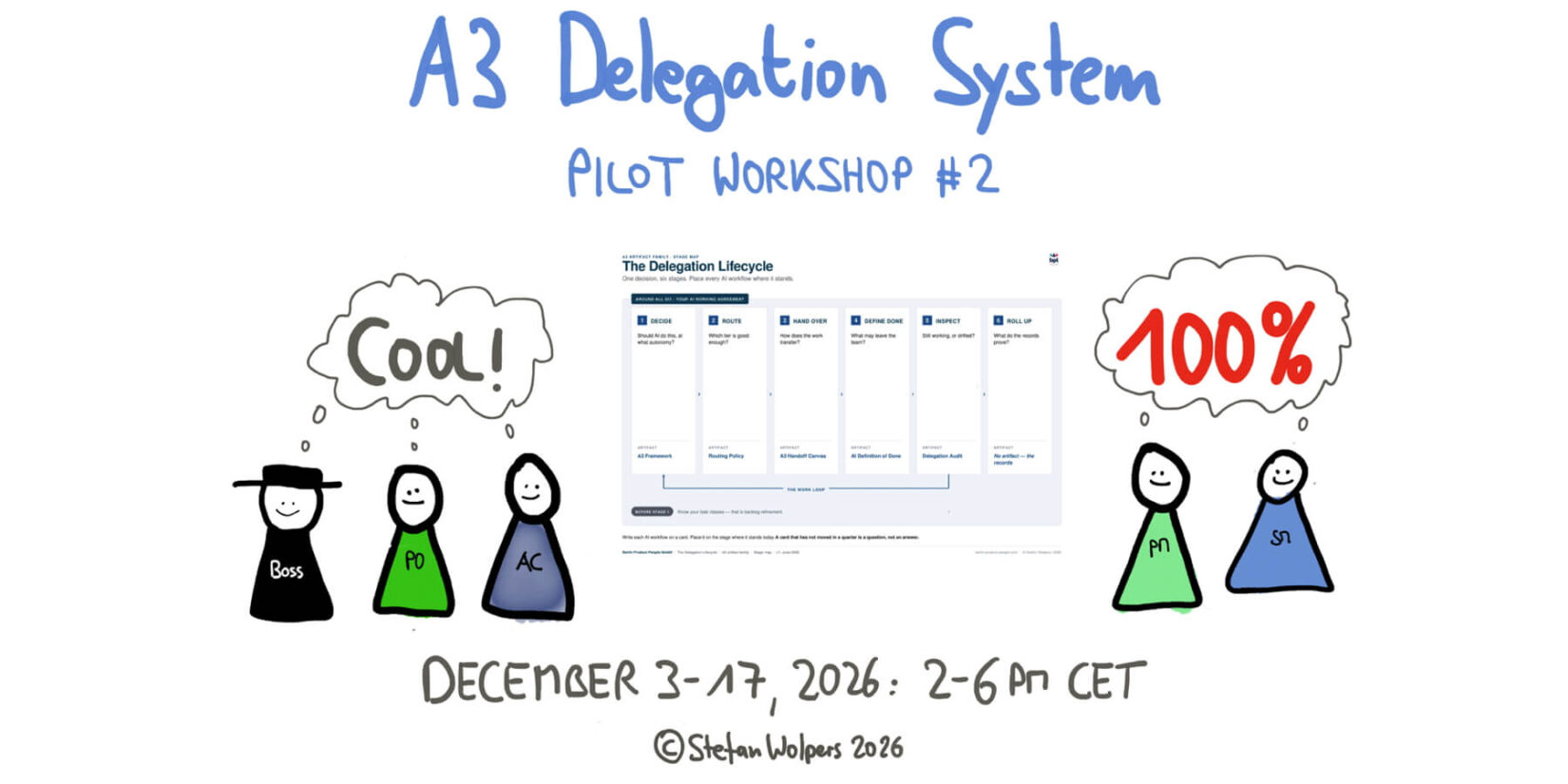
Learn more: 🖥 🇬🇧 The A3 Delegation System Pilot Workshop, December 3-17, 2026, Starting at $149.
➿ Agile, Leadership & Career
(via LeadDev): Agile matters more in the AI era
Alan Sharp suggests that AI has moved the bottleneck from coding to requirements, review, and testing, so Agile's values matter more, even if sprints, standups, and estimation fade. Avoiding Waterfall isn't agility.
(via Leading Agile): 📺 Why Labor Gets Cut First as AI-Spend Rises
Stacy Gordon and Len Greski show why AI token bills, landing in fixed IT budgets, get paid for with headcount. Greski calls it cost myopia: spend is visible; value is not.
: Entry-Level Jobs Are Disappearing, And Your Future Leaders Are Going With Them
David Burkus suggests that employers hunting for cheap yet experienced unicorns created their own talent shortage: cutting junior roles removes the places where people learn the work. He proposes rebuilding them.
: The Tea Tasters: When a department needs its problem to survive
Mike Fisher shows how departments preserve the problems that justify their headcount, like FDA tea tasters who outlasted their purpose. He suggests measuring outcomes and setting sunset dates for charters.
📯 We’re Not Paid to Practice Scrum, but Answer 5 Product Questions
For decades, the cost of building software rationed what an organization could start: nobody could afford to build everything, so somebody had to choose, however crudely. AI has weakened that rationing; the frontier labs need your organization to use more AI with every model generation, and the product operating model promises to fix what Agile supposedly broke. None of this guarantees that anyone asks whether the work solves a customer problem, nor whether solving it was worth the cost. You need to address these product questions yourself.
These product questions become more expensive to skip when starting work gets cheap: which problem is worth solving, whether the work is the best use of the team’s time, whether it is good enough for the people who will see it, whether it solved the problem, and whether the team’s way of working still fits. AI agents can prepare evidence under the A3 Framework’s Assist category, where the agent analyzes and people decide, while explicit standards for AI-assisted work, such as the AI Definition of Done, and recurring inspections, such as the AI Delegation Audit, keep the answers honest. Whether you call any of this Scrum is the least interesting question of all.
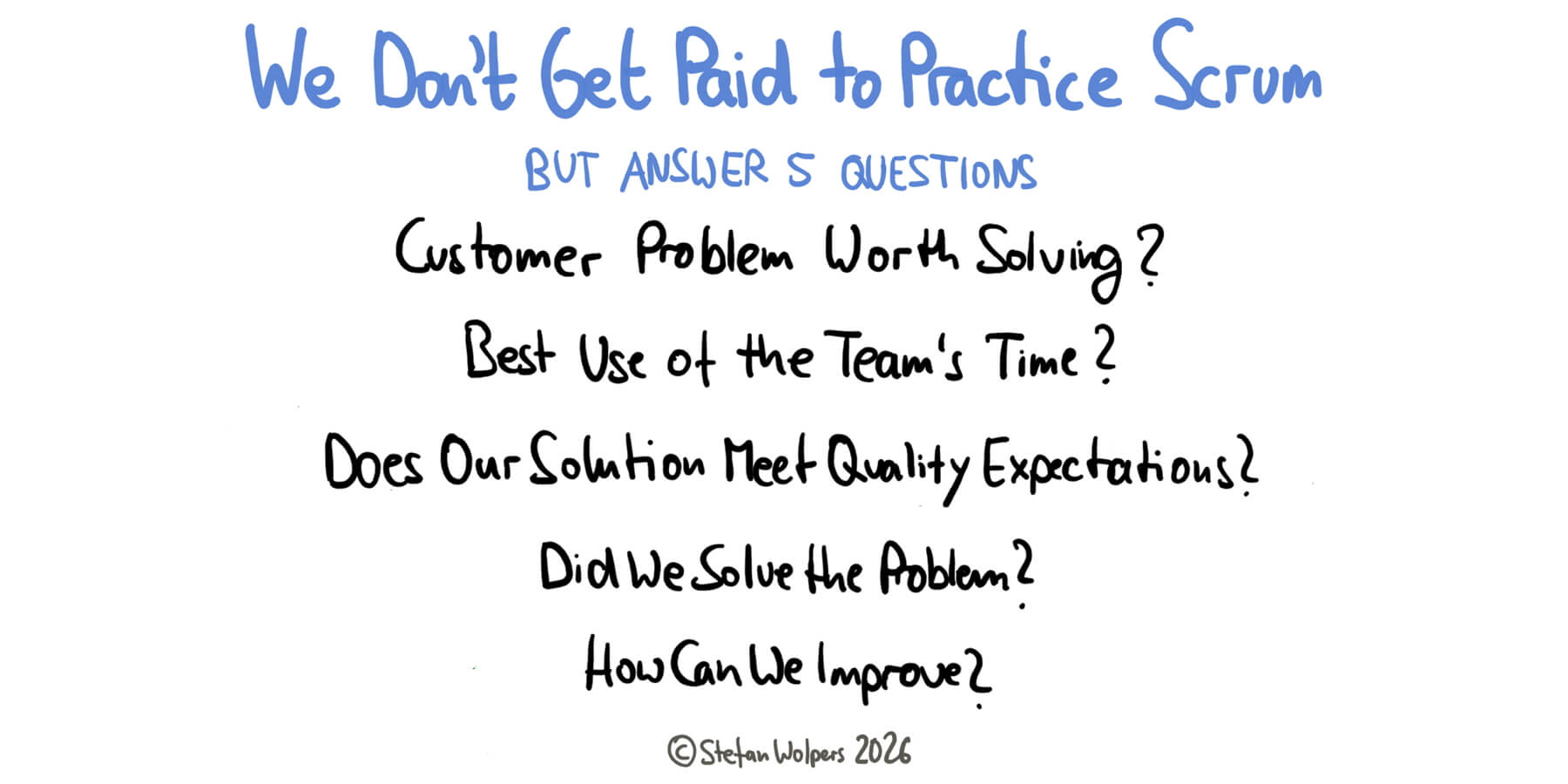
Thesis: This article explains five product questions that become more consequential when AI makes software implementation cheap, why falling AI costs increase the volume of work those questions must filter, and how teams set working principles during early AI adoption.
📺 Watch the article’s video: We’re Not Paid to Practice Scrum — Answer These 5 Product Questions Instead.
👉 Learn more: We’re Not Paid to Practice Scrum, but Answer 5 Product Questions.
🛠 Concepts, Practices, Tools & Measuring
: Details of incident.io’s AI spend
Gergely Orosz details incident.io's AI shift: monthly spend per engineer fell from about $4,500 to $1,600, nearly 80% of production PRs carry agent code, and 43% merge without human review.
: My Product Management Tool (71): Confusion Matrix
Marc Abraham shows how an LLM judge can score 90% accuracy and catch zero errors. He proposes a confusion matrix against human labels, prioritizing the true negative rate, once your labelers agree with each other.
📅 Scrum Training & Event Schedule
You can secure your seat for Scrum training classes, workshops, and meetups directly by following the corresponding link in the table below:
| Date | Class and Language | City | Price |
|---|---|---|---|
| 🖥 🇬🇧 November 27, 2026 | GUARANTEED: AI4Agile Online Course v4 (AI4Agile Certificate; English; Online Course) | Online Course | $149 incl. 19% VAT (If applicable.) |
| 🖥 🇬🇧 December 3-17, 2026 | A3 Delegation System Pilot Workshop 2 (English; Live Virtual Class) | Live Virtual Class | $149 incl. 19% VAT (If applicable.) |
| 🖥 🇩🇪 December 8-9, 2026 | Professional Scrum Product Owner Training (PSPO I; German; Live Virtual Class) | Live Virtual Class | €1099 incl. 19% VAT (If applicable.) |
| 🖥 🇬🇧 December 15-16, 2026 | Professional Scrum Master – Advanced Training (PSM II; English; Live Virtual Class) | Live Virtual Class | €1189 incl. 19% VAT (If applicable.) |
| 🖥 🇩🇪 February 16-17, 2027 | Professional Scrum Product Owner Training (PSPO I; German; Live Virtual Class) | Live Virtual Class | €1099 incl. 19% VAT (If applicable.) |
See all upcoming classes here.

You can book your seat for the training directly by following the corresponding links to the ticket shop. If the procurement process of your organization requires a different purchasing process, please contact Berlin Product People GmbH directly.
📺 Join 6,000-plus Agile Peers on Youtube
Now available on the Age-of-Product YouTube channel to improve learning, for example, about Tech Job Market 2026:
- We’re Not Paid to Practice Scrum — Answer These 5 Product Questions Instead.
- AI Refinement Prep Traps and How to Avoid Them.
- AI-Assisted Product Discovery — Agent Assists, Team Decides.
- Before You Switch the AI Model: The Hidden Cost of "Updating" Models.
- How the A3 Delegation System Helps to Avoid AI Debt.
- OUT NOW: The AI4Agile Course v3 — Master AI for Agile Practitioners.
✋ Do Not Miss Out: Learn more about Tech Job Market 2026 — Join the 20,000-plus Strong ‘Hands-on Agile’ Slack Community
I invite you to join the “Hands-on Agile” Slack Community and enjoy the benefits of a fast-growing, vibrant community of agile practitioners from around the world.

If you would like to join, all you have to do now is provide your credentials via this Google form, and I will sign you up. By the way, it’s free.
Help your team to learn about AI's Götterdämmerung by pointing them to the free Scrum Anti-Patterns Guide: