
TL; DR: AI’s Götterdämmerung — Food for Agile Thought #569
Welcome to the 569th edition of the Food for Agile Thought newsletter, shared with 35,189 peers.
This week, one team of authors questions the AI boom: valuations assume 4 to 5 percent productivity growth, yet data shows about 1 percent. Marty Cagan sees AI moving the bottleneck to discovery, whereas Elena Verna wonders whether agents end feature discovery. Pavel Samsonov doubts AI summaries will rescue overloaded users, while Richard Mironov, because agents grant tickets literally, proposes human review. Also, Chad McAllister’s guests, Jay Nakagawa and Bill Reid, treat many trade-offs as solvable contradictions, pairing Jobs-to-be-Done, TRIZ, and AI to speed analysis.
Next, Casey Newton warns Democrats could squander the AI backlash by repeating the social media decade. Tobi Lütke tells Alex Heath that agent startups should nail value before a business model, while Tugce Erten contends cheaper models strengthen customers’ DIY option, which applications must outperform. As models improve, Sangeet Paul Choudary sees the reviewer role shrinking, and Addy Osmani recommends cutting outdated instructions, whereas Steve Yegge’s cheap models earn autonomy against human baselines.
Lastly, Eric Ries shows IKEA retraining 8,500 workers its chatbot replaced, after which remote sales grew fastest, and Jerry Colonna denies that replacing executives fixes teams replaying inherited roles. John Cutler wonders whether sabotaging ourselves protects our values, while Evgeny Kaganer and Christoph Loch favor evolving learning journeys over fixed transformation programs, and Tom Bennet ends PMs’ clipboard duty between tools. Finally, Paweł Huryn’s 43 skills let product people build with coding agents without reading code.

Disclaimer: I read Charniak/McDermott’s book on "Artificial Intelligence" decades ago; of course, I use AI for research, translations, proofreading, challenging story arcs and article structures, and summarization. It is a production tool, not a substitute for thinking.
🎓 🇬🇧 The AI4Agile Online Course v4 — November 27, 2026, at $149 — Join the Waitlist
Sooner or later, a CFO will ask what your AI use actually returns. "It saves me time" will not survive that meeting.
The first wave of AI adoption rewarded practitioners who learned to prompt. That skill still matters, and this course still teaches it. The second wave rewards something rarer: people who can turn individual AI use into knowledge that survives departures, spend that can be explained and steered, and output that organizations can trust. That work is process design and change management. You have been doing both for years, on harder problems than this.
BRAND-NEW: Hands-on exercises to build AI Agents, with your tactical work, covering, for example, Jira-based stakeholder reports, product discovery, AI Impact on metrics, or preparation for backlog refinement. All exercises use realistic data and context to simulate reality as closely as possible in a fail-safe environment.
EXCLUSIVE: The new A3 Delegation Lifecycle System with seven ready-to-use templates, from the AI Workflow Inventory to the AI Definition of Done to the AI Working Agreement, to make sense of delegating work to AI models.
The AI 4 Agile Online Course v4 is in English. 🇬🇧
What You Will Get:
✅ 20+ hours of self-paced video modules ✅ 4 Live onboarding session ✅ A cohort-hardened, proven course design ✅ New agent-based exercises: Jira report, product discovery, refinement prep, measuring AI impact ✅ Learn to 10x your effectiveness with AI; your stakeholder will be grateful ✅ Apply AI to classic use cases of “Agile” ✅ The A3 Delegation System comprising seven ready-to-use templates ✅ All texts, slides, prompts, and graphics ✅ Guaranteed: Lifetime access to v4 ✅ AI4Agile Foundation Certificate: 40 questions in 45 minutes.

👉 Please note: The course will be available for $149 from November 27-30, 2026! (After that, $249.) 👈
🎓 Join the Waitlist now and be the first to know: The AI4Agile Online Course v4 — November 27, 2026, at $149 — No Coding Required!
Did you miss the previous Food for Agile Thought issue 568?
🗞 Shall I notify you about articles like this one? Awesome! You can sign up here for the ‘Food for Agile Thought’ newsletter and join 35,000-plus subscribers.
🎓 Join Stefan in one of his upcoming training classes!
🏆 The Tip of the Week: AI's Götterdämmerung?
(via CEPR): The AI Bubble Monitor
The authors suggest AI valuations quietly assume 4 to 5 percent yearly productivity growth, while recent data shows about 1 percent, and cheaper Chinese models are gaining users. The AI boom story looks shaky.
🎯 Product
: The end of feature discovery as we know it.
Elena Verna suggests AI may end feature discovery: users state goals, agents invoke capabilities. Tooltips and nudges lose relevance, engagement metrics may mislead, and trust becomes the central design problem.
(via Silicon Valley Product Group): AI and the Future of the Product Role
Marty Cagan suggests AI automates delivery, moving the bottleneck to discovery. Demand for empowered PMs grows, feature team roles shrink, and the product owner role, as he defines it, disappears.
: Thoughtless changes overwhelm our users, and it's our fault
Pavel Samsonov believes we bury users under updates, dashboards, and data nobody asked for, then pretend AI summaries will help them cope. They will not: attention stays scarce, and faster shipping has not benefited customers.
: 🎙️ TRIZ for product managers, without years of training – with Jay Nakagawa and Bill Reid
Chad McAllister interviews Jay Nakagawa and Bill Reid, who suggest your trade-offs are often solvable contradictions: pairing Jobs-to-be-Done with TRIZ and AI speeds analysis, but you still need the fundamentals.
: Quick Wins and Autonomous Backlog Coding
Richard Mironov suggests AI coding turns quick wins into a trap: tickets are wishes, and agents grant them literally. He proposes agent triage plus weekly human review before autonomous shipping.
🧠 Artificial Intelligence
: The AI backlash needs a plan
Casey Newton suggests the election backlash against AI and data centers gives Democrats a mandate they could easily waste, repeating the social media decade: no defined goal, no plan B, and advocates fighting in silos.
and : 📺 Tobi Lütke on the AI agent revolution and future of Shopify
Alex Heath interviews Tobi Lütke, who suggests agent startups should nail the value their agents create before picking a business model, and warns that paid purchase steering can breach trust.
(via Harvard Business Review): The 'Human-in-the-Loop' Fallacy
Sangeet Paul Choudary suggests that making people AI reviewers is a shrinking role: as models improve, validation matters less, while reviewers lose their error-spotting skills. Leaders should redesign around new capabilities.
: You're probably overprompting Claude
Addy Osmani suggests most of us overprompt Claude: state one clear goal and how to verify success, then cut instructions written for older models, restoring only those the model misses.
(via Medium): The Counting House: I think a pattern is starting to emerge in enterprise AI-modernization
Steve Yegge proposes the Counting House: cheap, stateless models on hardened rails, earning autonomy intent by intent, measured against human baselines. Enterprise AI may pay off outside software development first.
🖥 🇬🇧 The A3 Delegation System Pilot Workshop, December 3-17, 2026, Starting at $149
Your team already delegates work to AI: reports, research, customer feedback analysis, stakeholder communication, or parts of operational workflows.
But can you answer these questions without improvising?
- What may AI decide, and what must remain a human decision?
- What does "good enough" mean for this particular work?
- Who verifies the result before somebody acts on it?
- Who checks whether the delegation still works after the model or workflow changes?
If those answers live in one person's head, or nowhere, your problem is no longer prompting. You have a delegation problem.
The A3 Delegation System gives you a practical way to decide what AI may do, hand over the work clearly, define acceptable results, and inspect the AI delegation over time. The class is in English. 🇬🇧
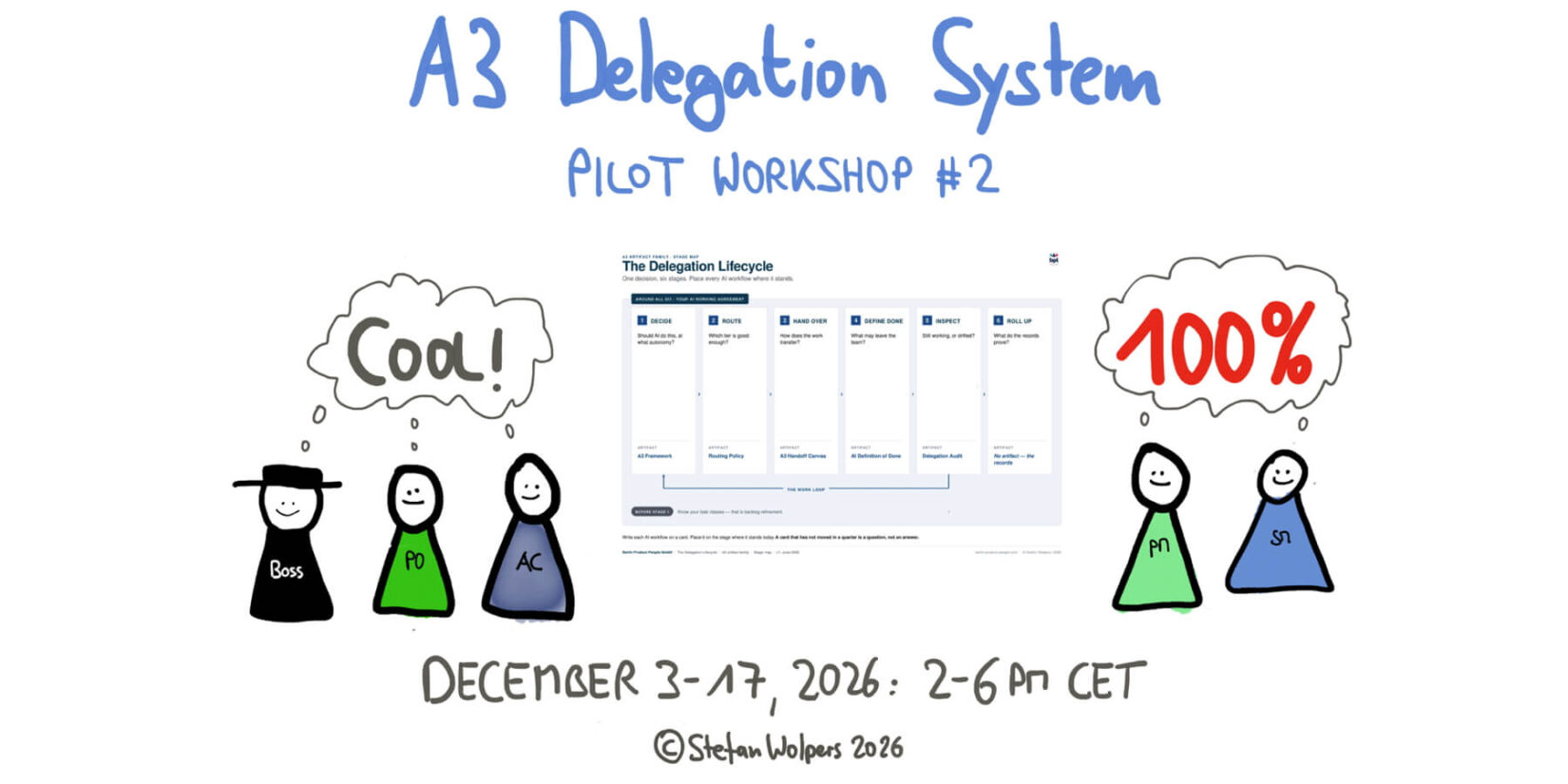
Learn more: 🖥 🇬🇧 The A3 Delegation System Pilot Workshop, December 3-17, 2026, Starting at $149.
➿ Agile, Leadership & Career
: What IKEA did with 8,500 employees replaced by AI
Eric Ries shows how IKEA retrained 8,500 call center workers its chatbot replaced, rather than firing them. The remote sales channel then grew fastest. Cost-cutting AI adoption suddenly looks shortsighted.
: Navigating Executive Team Dysfunction
Jerry Colonna suggests that replacing executives won’t fix a dysfunctional team. Members unconsciously play inherited roles, such as Hero, Cynic, or Ghost, and only surfacing that shared story breaks the cycle.
: Why We Sabotage Our Careers
John Cutler suggests self-sabotage at work may protect what we value, and relentless self-improvement can reinforce the very patterns we fight. Sometimes the answer is to feel disappointment, not to fix ourselves.
📯 Measuring AI Impact: What Your Velocity Chart Cannot Tell the CFO
Sooner or later, someone in your organization shows a slide with a number about what AI did for your team: typically, the team's "velocity" before and after the coding agents arrived, plus a percentage that looks like a return on the token bill. The number may even be "correct"; however, it answers a different question than the one finance is asking: A before-and-after comparison credits every change in that period to the agents, and measuring velocity is controversial for good reason under normal circumstances, which makes measuring AI impact by this means even more challenging.
A claim your team can defend starts elsewhere: with an honest grade of the evidence, a break-even test for every delegated AI workflow, and the creep check of the AI Delegation Audit, which catches the workflows that pass the test only because nobody reviews their output anymore. Each workflow then gets a keep, change, or retire decision in the Re-classification Log, and the result fits on one page that states what the team can claim and what it cannot. Bonus: For your own work, a small trial of eight to ten runs gives you a direction you can act on.
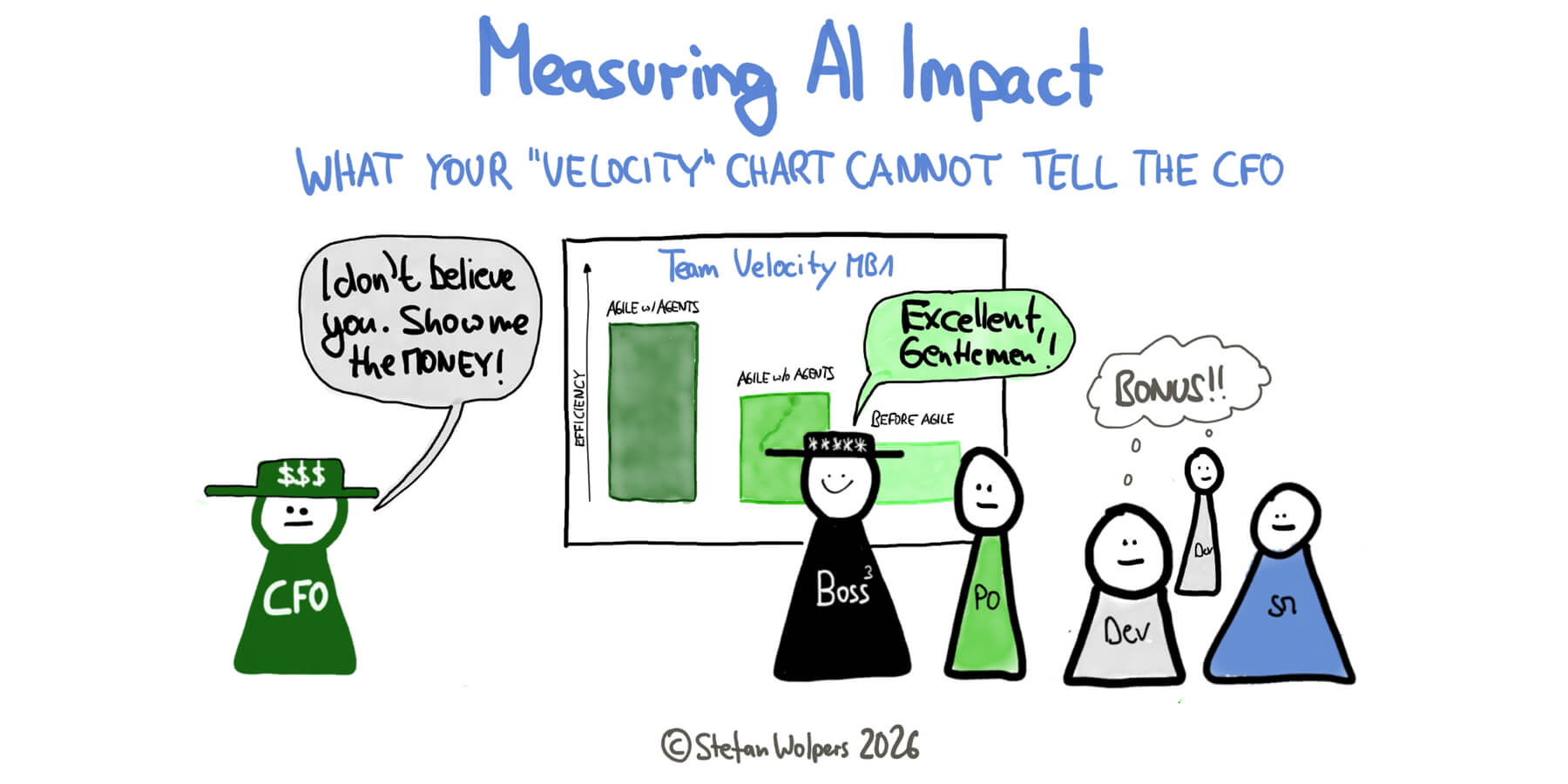
Thesis: This article explains how agile teams can measure AI impact effectively, why before-and-after velocity charts mislead, the three grades of evidence, a break-even test for delegated workflows, a one-page statement for finance, and a personal trial.
📺 Watch the article’s video: Measuring AI Impact: What Your Velocity Chart Cannot Tell the CFO.
👉 Learn more: Measuring AI Impact: What Your Velocity Chart Cannot Tell the CFO.
🛠 Concepts, Practices, Tools & Measuring
(via Harvard Business Review): Transformation Should Be a Learning Journey
Evgeny Kaganer and Christoph Loch suggest transformations often fail as fixed, top-down programs whose assumptions go stale. They propose a learning journey where strategy, priorities, and even the destination evolve.
: An agent harness for PMs
Tom Bennet suggests PMs don’t need more capable agents; they need to stop being the clipboard between tools. His setup shows it’s mostly configuration, with drafts as the approval gate.
: Product Engineering: 43 Free Skills From the First Idea to Paying Users
Paweł Huryn believes popular engineer-oriented skill collections skip discovery, value proposition, and growth. His 43 free skills let product people build with coding agents without reading code, reviewing artifacts instead.
📅 Scrum Training & Event Schedule
You can secure your seat for Scrum training classes, workshops, and meetups directly by following the corresponding link in the table below:
| Date | Class and Language | City | Price |
|---|---|---|---|
| 🖥 🇬🇧 November 27, 2026 | GUARANTEED: AI4Agile Online Course v4 (AI4Agile Certificate; English; Online Course) | Online Course | $149 incl. 19% VAT (If applicable.) |
| 🖥 🇬🇧 December 3-17, 2026 | A3 Delegation System Pilot Workshop 2 (English; Live Virtual Class) | Live Virtual Class | $149 incl. 19% VAT (If applicable.) |
| 🖥 🇩🇪 December 8-9, 2026 | Professional Scrum Product Owner Training (PSPO I; German; Live Virtual Class) | Live Virtual Class | €1099 incl. 19% VAT (If applicable.) |
| 🖥 🇬🇧 December 15-16, 2026 | Professional Scrum Master – Advanced Training (PSM II; English; Live Virtual Class) | Live Virtual Class | €1189 incl. 19% VAT (If applicable.) |
| 🖥 🇩🇪 February 16-17, 2027 | Professional Scrum Product Owner Training (PSPO I; German; Live Virtual Class) | Live Virtual Class | €1099 incl. 19% VAT (If applicable.) |
See all upcoming classes here.

You can book your seat for the training directly by following the corresponding links to the ticket shop. If the procurement process of your organization requires a different purchasing process, please contact Berlin Product People GmbH directly.
📺 Join 6,000-plus Agile Peers on Youtube
Now available on the Age-of-Product YouTube channel to improve learning, for example, about AI's Götterdämmerung:
- AI Refinement Prep Traps and How to Avoid Them.
- AI-Assisted Product Discovery — Agent Assists, Team Decides.
- Before You Switch the AI Model: The Hidden Cost of "Updating" Models.
- How the A3 Delegation System Helps to Avoid AI Debt.
- OUT NOW: The AI4Agile Course v3 — Master AI for Agile Practitioners.
✋ Do Not Miss Out: Learn more about AI's Götterdämmerung — Join the 20,000-plus Strong ‘Hands-on Agile’ Slack Community
I invite you to join the “Hands-on Agile” Slack Community and enjoy the benefits of a fast-growing, vibrant community of agile practitioners from around the world.

If you would like to join, all you have to do now is provide your credentials via this Google form, and I will sign you up. By the way, it’s free.
Help your team to learn about AI's Götterdämmerung by pointing them to the free Scrum Anti-Patterns Guide: